| |
|
|
All great truths begin as blasphemies.
|
|
George Bernard Shaw , Annajanska
|
In this section we will look at how the Church has affected
the development of medical and other related sciences, from
ancient times to the modern day.
Reason is God's crowning gift to man.
Sophocles (c.496-406 BC), Antigone
Already in ancient times medicine had started the transition
from magic to science. Various types of surgery were carried
out, including plastic surgery. Stone Age man had practised
successful brain surgery, a fact witnessed by healed trephined
skulls found in Neolithic deposits all over Europe. Ancient
Egyptian papyri emphasise the importance of cleanliness and
hygiene , a view shared by the Mesopotamians. They built sewers
and water closets over 4,000 years ago. Greeks and Romans were
even keener on public health. They built and used public lavatories,
sewers, aqueducts, water cisterns, and hot and cold baths. For
Greek physicians even conditions like epilepsy had rational
explanations, and were not supernatural in nature1.
As the Greek physician Hippocrates put it in On the Sacred
Disease, a work on this condition, “Men regard its
nature and cause as divine from ignorance and wonder, and this
idea is maintained by their inability to understand it”.
|
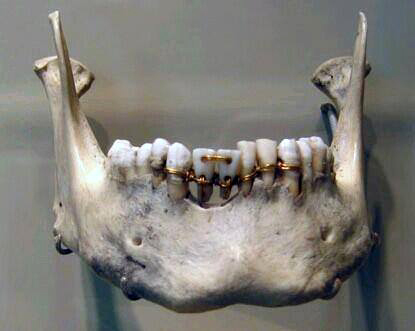
Egyptian dental work ca 2000 BC. Etruscans
and other cultures also pioneered dental work. Such expertise
was lost to Europe during the Christian period, and redeveloped
in the secular age.
For Christians, toothache was caused by tooth-demons.
|
|
|
Around 400 years before Jesus, Hippocrates had founded the
scientific study of medicine on the proposition that every illness
has a natural cause. A Hippocratic text called An Ancient
Medicine asserts that, using Hippocratic methods, causes
and cures would in time be discovered for all illnesses. In
On the Sacred Disease he referred to those who invoked
demonic forces as charlatans guilty of ignorance, deceit and
fraud. After Hippocrates progress was made quickly. Around AD
30 the Epicurean philosopher Celsus knew how to perform cataract
operations and had mastered the use of ligatures. He learned
about muscles and bones by dissecting animals. He understood
the importance of hygiene and taught that prevention was better
than cure. Another great name in ancient medicine was that of
Galen of Pergamum, a Greek who was appointed as personal physician
to Marcus Aurelius in AD 163. His death marked the end of centuries
of medical creativity. After him Christians replaced rational
medicine with their own supernatural medicine. Most of Galen's
writings have been lost — probably destroyed by early Christians.
Those that survived provided by far the best medical treatise
available until the Middle Ages and beyond, but after the introduction
of a formal system of Church censorship, his surviving works
were placed on the Index.
Faith has no merit where human reason supplies the truth.
Pope Gregory I (c.540-604), Homilies
The ascendancy of the Christian Church dates from around the
time of the death of Galen. Having progressed so far, rational
medicine was now abandoned. Medicine in the Bible is entirely
supernatural. The Church developed the view that real practical
medicine savoured of black magic. In any case it was wrong to
try to subvert God's holy will by interfering with the natural
course of events. It was God who caused illness. He was responsible
for cures just as he was responsible for death. Even church
law mentioned, in passing, that diseases were attributable to
God, for example
If, by divine judgment, leprosy happens to a husband or wife,
and the sick one demands the carnal debt from the one who
is healthy, what is demanded must be rendered in accord with
the Apostle's general commandment [1 Cor. 7:3-4], which gives
no exception for this case.
(Decretals of Pope Gregory IX , Book Four, Title VIII C2)
Illness was indisputably caused by sin. The Bible said so,
and so did Church Councils. The only alternative explanations
given credence were diabolical possession, witchcraft and other
satanic machinations. In Christendom, from AD 300 to around
1700 all serious mental conditions were understood as symptoms
of demonic possession. Since illness was thought to be caused
by supernatural agents, cures had to be essentially supernatural
as well. Every cure was literally miraculous, and these miracles
could be effected only by prayer, penance and the assistance
of saints. To claim otherwise was heretical and blasphemous.
The Christian ideal was that women should die rather than allow
themselves to be helped by a physician. Some women won their
sainthood for doing no more than declining medical assistance.
In the fourth century Saint Gorgonia, the daughter of two saints,
was trampled by a team of mules, causing multiple broken bones
and crushed internal organs. She would not see a doctor, as
she thought it indecent. According to Christian sources this
modesty miraculously cured her, and a second such self-healing
miracle assured her sainthood. Today, Gorgonia is a patron saint
for people afflicted by bodily ills. We do not know how many
thousands of other women with identically modest Christian scruples
died following her example and are now forgotten.
|
Illness not caused by sin was necessarily
caused by demons possessing the sick individual. Such
illnesses could be cured only by exorcism. Here St Francis
exorcises a demon from a sick woman.
Bibliothèque nationale de France,
NAF 28640, f, 84r. Bonaventure, Vie et miracles de
saint François d’Assise. c. 1480
[Note, incidentally, the grey friar habits - Fransiscans
originally wore grey, not brown, habits]
|
|
|
  All
manner of illnesses were allocated a patron saint, whose intervention
was required to work the required miraculous cure. Ergotism,
known as sacer ignis or holy fire, was held
to be alleviated by the intervention of the Virgin Mary. Erysipelas,
an infectious disease causing a reddening of the skin, was dealt
with by St Anthony the Great and was thus called St Anthony's
fire. St Vitus took care of chorea, which was thus known
as St Vitus" dance. St Basilissa took care of
chilblains; St Elmo of colic; St Roche of cholera; St Lucy,
eye diseases; St Blaise, throat problems; St Apollonia, toothache;
St Fiacre, haemorrhoids and venereal disease; and so on. Sleepwalking
and insanity were regarded as manifestations of diabolic possession
and both came under the care of St Dympna, the patron saint
of the possessed. There was literally a saint for every disease. All
manner of illnesses were allocated a patron saint, whose intervention
was required to work the required miraculous cure. Ergotism,
known as sacer ignis or holy fire, was held
to be alleviated by the intervention of the Virgin Mary. Erysipelas,
an infectious disease causing a reddening of the skin, was dealt
with by St Anthony the Great and was thus called St Anthony's
fire. St Vitus took care of chorea, which was thus known
as St Vitus" dance. St Basilissa took care of
chilblains; St Elmo of colic; St Roche of cholera; St Lucy,
eye diseases; St Blaise, throat problems; St Apollonia, toothache;
St Fiacre, haemorrhoids and venereal disease; and so on. Sleepwalking
and insanity were regarded as manifestations of diabolic possession
and both came under the care of St Dympna, the patron saint
of the possessed. There was literally a saint for every disease.
 Other
holy people could work miracles too; for example scrofula (a
form of tuberculosis) could be cured by the touch of kings,
by virtue of their divine appointment. It was thus known as
The King's Evil. French and English kings worked miraculous
cures for centuries. Even Protestants accepted it. From 1634
until the mid-eighteenth century, the Book of Common Prayer
included a ritual of royal healing, and the rituals continued
later still. Dr Samuel Johnson, as a child, was touched by Queen
Anne as late as 1712 , and there were still people attributing
the power to Queen Victoria in the nineteenth century. Other
holy people could work miracles too; for example scrofula (a
form of tuberculosis) could be cured by the touch of kings,
by virtue of their divine appointment. It was thus known as
The King's Evil. French and English kings worked miraculous
cures for centuries. Even Protestants accepted it. From 1634
until the mid-eighteenth century, the Book of Common Prayer
included a ritual of royal healing, and the rituals continued
later still. Dr Samuel Johnson, as a child, was touched by Queen
Anne as late as 1712 , and there were still people attributing
the power to Queen Victoria in the nineteenth century.
By the Middle Ages, medicine had regressed on all fronts in
Christian lands. Muslims who came into contact with Christians,
as Usama of Shaizar did during the Crusades, were shocked by
the crudity of their medicine — and it was not only medicine,
but public health too. Whereas Muslims adopted public baths
(hammams) and insisted on washing before meals, Christians adopted
the view that it was wrong to wash. It was flying in the face
of God to presume to clean off his honest Christian filth. Christians
were obliged to accept the will of God and the disease and misery
that went with it. Queen Elizabeth I was famously said to have
bathed twice a year, whether she needed to or not.
|
The Manner of His Majesties Curing
the Disease, Called The Kings-Evil. A broadside on
the people afflicted with scrofula seeking cure from Charles
II; with an engraving by Van Hove showing a hall, in the
centre a throne and Charles II on a raised platform, the
king touching a man kneeling on the steps in front of
him, the throne approached from both sides by grown-ups
and children; with engraved inscription, and with letterpress
title and verses in two columns. (London, Newman: 1679).
British Museum number 1849,0315.31
|
|
|
 The
practice of medicine was monopolised by the Church, so laymen
who practised it became criminals. Then the Church stopped certain
clergymen practising it as well. Monastic medicine was prohibited
by the Synod of Clermont in 1130. Thenceforth the practice of
medicine was reserved to the secular clergy. A generation later,
in 1163, the Council of Tours prohibitted all scientific inquiry
to monastics, and this was interpreted as including surgery,
although the Council did not explicitly use the maxim often
cited, ecclesia abhorret a sanguine (the church abhors
blood). All studies of physical nature, including medicine,
were confirmed as inherently sinful as anyone who pursued such
studies must be in league with the Devil1a. The
practice of medicine was monopolised by the Church, so laymen
who practised it became criminals. Then the Church stopped certain
clergymen practising it as well. Monastic medicine was prohibited
by the Synod of Clermont in 1130. Thenceforth the practice of
medicine was reserved to the secular clergy. A generation later,
in 1163, the Council of Tours prohibitted all scientific inquiry
to monastics, and this was interpreted as including surgery,
although the Council did not explicitly use the maxim often
cited, ecclesia abhorret a sanguine (the church abhors
blood). All studies of physical nature, including medicine,
were confirmed as inherently sinful as anyone who pursued such
studies must be in league with the Devil1a.
To the extent that it survived at all surgery was now the province
of barbers, executioners, bath-keepers and proto-veterinarians.
Monks now went off to the barber-surgeon for the dual purpose
of having their tonsures shaved and their arms bled, but this
was about the limit of surgical health care permitted by the
Church. The much cited maxim ecclesia abhorret a sanguine
seems to have been interpreted as "The Church abhors
bloodshed" because fresh prohibitions were included in
the 18th cannon of the Fourth Lateran Council in 1215:
18. Clerics to dissociate from shedding-blood
No cleric may decree or pronounce a sentence involving the
shedding of blood, or carry out a punishment involving the
same, or be present when such punishment is carried out. If
anyone, however, under cover of this statute, dares to inflict
injury on churches or ecclesiastical persons, let him be restrained
by ecclesiastical censure. A cleric may not write or dictate
letters which require punishments involving the shedding of
blood, in the courts of princes this responsibility should
be entrusted to laymen and not to clerics. Moreover no cleric
may be put in command of mercenaries or crossbowmen or suchlike
men of blood; nor may a subdeacon, deacon or priest practise
the art of surgery, which involves cauterizing and making
incisions; nor may anyone confer a rite of blessing or consecration
on a purgation by ordeal of boiling or cold water or of the
red-hot iron, saving nevertheless the previously promulgated
prohibitions regarding single combats and duels.
Dissections of dead bodies were permitted in selected universities,
but nothing of any value was learned because no research was
carried out. The wisdom of the ancients was repeated to students
parrot fashion — including their errors, such as the liver's
five lobes (which do not exist in human beings). By now Galen,
even though a pagan, was recognised as knowing more than any
Christian, so his word like Aristotle's, was treated as indisputable.
For hundreds of years, everyone saw what he or she was supposed
to see, rather than what was actually there:
During these dissections the learned professor would read
aloud from Galen while a lowly surgeon opened the body. Then
the professor would point toward the organ and describe the
five-lobed liver and other miracles of Galenic anatomy, such
was the blinding weight of tradition and authority2.
Freelance anatomy for original research was illegal. Scientists
like Leonardo da Vinci were obliged to carry on their anatomical
research in secret. Leonardo's famous mirror writing was used
to disguise his findings, in case the Church authorities found
out about them. His notes were not published for more than 200
years after his death.
|
DA Vinci's famous mirror writing
|
|

|
|
|
|
|
Michelangelo was another secret anatomist. He apparently managed
to work some of his anatomical discoveries into his art, including
The Creation of Adam, a section of his fresco in the
Sistine Chapel ceiling (c 1511).
|
Anatomists have pointed out that the
robes around God, Sophia and associates in this famous
depiction of The Creation of Adam are a perfect
representation of the human brain. On examination, details
in the painting match major sulci of the cerebrum in the
inner and outer surface of the brain, the brain stem,
the frontal lobe, the basilar artery, the pituitary gland
and the optic chiasm.
|
|
|
Many Christian ideas about biology were spectacularly wrong.
Leading theologians taught that women had more water in their
bodies than men, so if a humid south wind blew during pregnancy,
or if there were frequent rains, the baby was more likely to
be born female3. The functions
of the organs were also misunderstood. According to the approved
view the liver secreted yellow bile; the spleen, black bile;
the heart, blood; and the brain, phlegm. A Greek thinker, Alcmaeon
of Crotona, had identified the brain as the central organ in
the higher activities of humankind around 500 BC, but 2,000
years later Christian authorities were teaching that the brain
was merely a phlegm-secreting gland.
By identifying the new learning with heresy we make orthodoxy
synonymous with ignorance.
Desiderius Erasmus (c.1469-1536)
The Reformation brought little relief to proto-scientists.
Calvin burned alive scientific pioneers like Michael Servetus.
Luther saw logical argument as dangerous to Christianity. He
said that "To be a Christian, you must pluck out the eye
of Reason" and referred to reason as "The Devil's
whore". He also said
Reason is the greatest enemy that faith has: it never comes
to the aid of spiritual things but, more frequently than not,
struggles against the Divine Word....
and again:
Reason must be deluded, blinded, and destroyed. Faith must
trample underfoot all reason, sense, and understanding, and
whatever it sees must be put out of sight and ... know nothing
but the word of God.
Even with the whole of the schismatic Western Church opposed
to scientific reasoning, the Renaissance had already triggered
the revival of Greek learning, and secular ideas were having
an effect. The supernatural outlook of the Church was challenged
by rationalism, and advances were once more possible. As a medical
historian says, comparing Eastern and Western medicine:
When Europe became static and religious during the Middle
Ages, its medicine resembled Indian medicine tremendously,
except that Indian medicine was much better. When in Europe,
through the Renaissance, the Greek attitude prevailed again,
Europe surpassed India rapidly4.
It is no coincidence that modern medical terminology is largely
derived from Greek, for the ancient Greeks were still the best
medical authorities available after more than 1,000 years of
Christian hegemony. Ancient techniques could now be revived.
For example the ligature, abandoned since the time of Celsus,
was re-introduced by Ambrose Paré (1510-1590). But the
Church did not yield ground easily. Cures were still carried
out using exorcism, consecrated bells, relics, biblical readings,
holy water and torture. The insane were still regarded as possessed
by evil spirits. When Johann Weyer explained that mental illness
was the real cause underlying the symptoms that had been attributed
to witches and evil spirits, the Church denounced him, and his
book was placed on the Index5.
He was himself accused of witchcraft and was obliged to flee
for his life. In time Weyer was vindicated: the Church belatedly
updated its ideas and stopped torturing the insane.
|
A sick monk calls out for the Virgin's
help and is miraculously healed by milk squirted from
her breast.
Book of Hours, Use of Sarum (The 'Neville
of Hornby Hours')
British Library, Egerton 2781, f.24v, c13231-21
|
|
|
Andreas Vesalius in the 16th century carried out the most extensive
anatomical investigations up to his time. His hands-on direct
observation was a huge break with medieval practice, and considered
little short of heresy. He was attacked for his disagreement
with orthodox ideas derived from Galen's studies of human anatomy.
As a young man, around 1536, he had had a dispute with the theologians
of Louvain over the physical location of the soul. About the
same time, while in a dispute over bloodletting, Vesalius rejected
the infallibility of Galen, and was described as the "Luther
of the physicians" i.e. the chief-heretic of the physicians.
Vesalius went on to make a number of discoveries contradicting
truths that had stood for centuries,which Church-trained physicians
considered infallibly true. He could not find holes in the heart
claimed by to exist by all Church anatomists since Galen (but
which do not in fact exist). He discovered that the lower human
jaw was only one bone, not two (as claimed by Galen) and showed
that humans do not have the same network of blood vessels at
the base of the brain found ungulates (again contradicting Galen).
Like several other reformers he owed his survival to powerful
rulers who could shield him from the wrath of the Church. A
letter written a few months after his death related that Vesalius
had been under investigation by the Inquisition, and that he
had survived only because of the intervention of King Philip
II6.
In England, dissection had remained entirely prohibited before
the 16th century. Now a series of royal edicts gave specific
groups of physicians and surgeons limited rights to dissect
cadavers. The permission was still limited for generations to
come. By the mid-18th century, the Royal College of Physicians
and Company of Barber-Surgeons were the only two groups permitted
to carry out dissections, and had an annual quota of ten cadavers
between them.
 Elsewhere
more liberal bishops licensed various medical practice from
surgery to physic and midwifery, which gave them control of
all these disciplines. Bloodletting was still the standard treatment
for all manner of ills in the sixteenth century and would continue
to be for another three centuries. Anyone who suggested that
the ancient Hippocratic medical techniques might be superior
risked charges of heresy. When Pierre Brissot (1478-1522) of
Paris advocated Hippocratic techniques, he was considered a
worse heretic than Martin Luther. Gasparo Tagliacozzi (1546-1599),
Professor of Medicine at Bologna, used skin grafts for plastic
surgery. He was charged with impiety, and his rhinoplasty operations
were prohibited. His technique was not revived until 1822. Sometimes
it is difficult to tell what advances might have been made.
In Christianismi Restitutio, a work for which he was
burned at the stake in 1553, Michael Servetus mentioned pulmonary
circulation — realising the function of the lungs three
generations before William Harvey, who is now generally credited
with discovering the circulation of the blood. Elsewhere
more liberal bishops licensed various medical practice from
surgery to physic and midwifery, which gave them control of
all these disciplines. Bloodletting was still the standard treatment
for all manner of ills in the sixteenth century and would continue
to be for another three centuries. Anyone who suggested that
the ancient Hippocratic medical techniques might be superior
risked charges of heresy. When Pierre Brissot (1478-1522) of
Paris advocated Hippocratic techniques, he was considered a
worse heretic than Martin Luther. Gasparo Tagliacozzi (1546-1599),
Professor of Medicine at Bologna, used skin grafts for plastic
surgery. He was charged with impiety, and his rhinoplasty operations
were prohibited. His technique was not revived until 1822. Sometimes
it is difficult to tell what advances might have been made.
In Christianismi Restitutio, a work for which he was
burned at the stake in 1553, Michael Servetus mentioned pulmonary
circulation — realising the function of the lungs three
generations before William Harvey, who is now generally credited
with discovering the circulation of the blood.
Human beings are perhaps never more frightening than when
they are convinced beyond doubt that they are right.
Laurens van der Post (1906-1996), The Lost World of the
Kalahari
Despite the advances, the Church still held medicine back roughly
to the level of a pre-literate society. Physicians, licensed
by the Church authorities, continued to diagnose cases of witchcraft7.
They appeared in court as prosecution witnesses, confirming
that fits and other symptoms were the product of witchcraft.
They claimed to have discovered devil's marks on the accused.
They even gave evidence confirming that victims had vomited
metal pins and other artifacts without having swallowed them.
In many ways the medical practices of the indigenous people
of South America were still in advance of European Christians.
They carried out trepanation and amputations, excised tumours
and used anaesthetics. They had developed prosthetic techniques
and were using the jaws of decapitated ants as clamps in sutures.
The Church was still clinging to the theory that illness was
caused by sin or demonic agencies. Clergymen were still claiming
to cure illness by magical means. In 1606 the Royal College
of Physicians attempted to prevent the Rev. John Bell from purporting
to cure fevers by writing charms on a piece of paper8.
For the Church, Illness was still caused by sin and so was to
be cured only by means approved by the Church. Other methods
were not to be countenanced, whether magical or rational. The
Anglican Church required its priests and churchwardens to denounce
any parishioners who practised medicine without permission9.
The Church was still responsible for licensing practitioners
of medicine. Genuine researchers were unlikely to be licensed,
although numerous questionable practitioners were, including
a number of leading astrologers10.
|
The four humour theory of medicine had
survived from ancient times as an alternative explanation
for illness. According to this theory illness was caused
by an imbalance of the four humours, not a punishment
for sin.
This illustration shows a human body
along with four elements and humours advocated by Galen
Composition of bodies elements and humors.
Bartholomaeus Anglicus, On the Properties of Things. France,
Le Mans, 15th Century.
|
|
|
At base, illness was caused by sin, and that was all there
was to it. The Flemish scientist J. B. van Helmont (1577-1644)
attacked such theories, regarding miracle cures as natural magic.
The Louvain medical faculty denounced him in 1623. Subsequently
he was called before the Inquisition and imprisoned. To the
extent that there was a genuine scientific theory at all, it
was the ancient one espoused by Galen, that illness was caused
by an imbalance in the four humours in the body. The Church's
enemy Paracelsus developed a much better theory. He rejected
Galen's theory, and speculated about seed-like entities that
invaded the body. Paracelsus thought these seed-like disease-carriers
entered the body through the air, or through food and drink.
Different agents attacked different organs and thus caused different
diseases. In essence he had correctly identified the mechanism
by which many infectious illnesses are communicated. An important
consequence was that Paracelsus realised that it was necessary
to identify specific cures for specific diseases. Physicians
had previously occupied themselves looking for a panacea —
a divinely sanctioned nostrum that would cure all diseases.
|
Two views of "Anatomical Eve"
16-17th Century,
“Anatomie des Vanités” Exhibition, Brussels,
Belgium, 2008.
Medicine in transition: This anatomical
figure was used for medical teaching, but the figure is
the biblical protypical woman - and she still guards her
modesty, even from medical students.
|
|
|
The Church opposed the scientific method and was hostile to
scientific discoveries by Paracelsus or anyone else, preferring
its own pseudo-science. When the rings of Saturn were discovered
by Galileo Galilei in 1610, using his new telescope, the Church
needed an explanation that fitted with Christian theology. The
solution, proposed by Leo Allatius, a Vatican librarian in the
seventeenth century, was that Jesus' foreskin had been resurrected
along with the rest of his body, had ascended to the heavens
as he had, and was now encircling the planet Saturn. His theory
was set out in a treatise entitled De Praeputio Domini Nostri
Jesu Christi Diatriba (A Discussion of the Foreskin of
Our Lord Jesus Christ).
| A recent photograph of Jesus' foreskin,
according to a 17th Roman Catholic theory. |
|
|
Like many embarrassing documents, Leo Allatius's work has
inexplicably disappeared from the Vatican Library. Some
Catholic apologists have claimed that it never existed.
Below is an extract from a Vatican catalogue - proof that
it did exist.
. Fabricius, Johann Albert, Bibliotheca Graeca ,
(Hamburg, 1728). (Vol. 14, Bk 8, p. 17, item 164.
See also Foote, G. W.; Wheeler, J. M. (1887). Crimes
of Christianity. (London: Progressive Publishing Company,
1887) p.94. |
|
|
The Church could not deny the efficacy of medicines indefinitely,
and views gradually changed. Now, instead of banning medical
practices, it sought to reassert its medical monopoly. The Church
now became interested in drugs. New ones from South America
were exploited by churchmen. For example the Jesuits exploited
quinine, introduced from Peru in the 1630s. It was even known
as "the Jesuit powder" because of their lucrative
monopoly. Willem Piso (1611-1675) learned the use of ipecacuanha
for treating amoebic dysentery from indigenous inhabitants of
Brazil. Emetine, an alkaloid of ipecacuanha, is still used for
the same purpose today.
.
I was lost in a great forest at night, with only a small
flickering light to guide me. A stranger came and said to
me "My friend, put out your candle, so that you will
find the way better". That man was a theologian.
Denis Diderot, Pensées sur la Religion
Until the Enlightenment the state of European medical knowledge
was still no better, and arguably rather worse, than that of
the ancient Greeks. Useful research was not possible while the
Church exercised control. In fact the Church's ignorance often
made medical problems all the greater. When plagues and other
epidemics swept through Europe, devout Christians gathered in
churches to pray for deliverance. In doing so they permitted
the infection to spread that much faster and suffered high mortality
rates as a result. Christians in some French towns confined
local prostitutes to leper houses during Holy Week. We can only
guess at the consequences of this particular act of piety.
|
During the whole 1500 years of the Christian
period, caesarian deliveries were assumed to be necessarily
fatal to the mother, and for most of that period they
invariably were. There are a handful of exceptions from
the 1580s, and the mortality rate for mothers was down
to 85% by 1865. The first modern Caesarian section in
Europe was performed in 1881. Elsewhere, outside Christendom,
caesarian operations had long been carried out successfully,
for example in Moslem lands and Africa. Caesarian operations
also seem to have been carried out successful in pre-Christian
times in pagan Rome and in China.
Detail from Birth of Caesar, Royal 16 G VII f.219,
c.1400
|
|
|
Gradually the hold of the Church was relaxed as new ideas filtered
into Europe from the Americas and from the East. Thus for example,
innoculation was learned from the Turks in the eighteenth century,
having already been used to prevent smallpox for 1,000 years
in the East. Priests and pilgrims had been passing through Turkey
for centuries, but it was the wife a British ambassador who
thought to introduce the practice of innoculation to western
Europe, and had to fight both medical and religious establishments
to do so11.
|
Lady Montague (Mary Wortley Montague)
arguably did more for medicine than the whole Christian
Church over 2000 years. She had arrived at the court of
the Ottoman Empire in 1717 with her husband, the British
ambassador. She wrote voluminously of her travels. In
one letter 11. She noted
that the local practice of deliberately stimulating a
mild form of smallpox through innoculation conferred immunity.
She had the procedure performed on both of her own children.
By the end of the eighteenth century, the English physician
Edward Jenner was able to cultivate a serum in cattle,
which, when used in human vaccination, eventually led
to the worldwide eradication of the illness.
Lady Mary Wortley Montague in Ottoman
dress
|
|
|
| |
While freethinkers like Condorcet and Voltaire advocated inoculation
against smallpox, it was condemned in France by university faculties
of theology.
In England, as a result of pressure from anatomists in the
rapidly growing medical schools, the Murder Act 1752 allowed
the bodies of executed murderers to be dissected for anatomical
research and education. Churches made no significant objection
to this as it was consistent with the traditional Christian
practice of posthumously punishing the bodies of those found
guilty of particularly heinous crimes.
|
William Hogarth, Four stages of cruelty
- The reward of cruelty, 1751, last of a series of engravings.
Tom Nero's body is dissected after he has been hanged
|
|
|
Original thought and open minds also helped. Quakers, who rejected
religious dogma, took to medicine in significant numbers, as
it was the only learned profession open to them in England at
the time. They provided many of the outstanding physicians of
the age. Significant advances were made by Quakers such as John
Fothergill (diphtheria and neuralgia) , John Lettsom (alcoholism)
, Robert Willan (dermatology) , Thomas Hodgkin (Hodgkin's disease)
and Joseph Lister (1827-1912) (antiseptic surgery).
|
Christians even imagined toothache
to be caused by demons
The Tooth Worm as Hell’s Demon, southern
France, 18th Century
|
|
|
Infant mortality also became an issue. In France, Jean-Jacques
Rousseau was largely responsible for discarding the practice
of swaddling babies, and of using wet nurses. French medicine
was finally freed from the grip of the Church in 1794 when the
Ecole de Santé was opened under the new secular
government. Paris soon became the European centre of medical
research, attracting men like Franz Joseph Gall, who had been
obliged to leave Austria because of his lack of religious belief.
No people do so much harm as those who go about doing good.
Bishop Mandell Creighton (1843-1901), Life and Letters
of Mandell Creighton
 In
Europe the Galenic practice of bloodletting continued into the
nineteenth century, long after the four humour theory that underlay
it had been abandoned. In
Europe the Galenic practice of bloodletting continued into the
nineteenth century, long after the four humour theory that underlay
it had been abandoned.
Eastern medicine continued to filter into Europe during the
nineteenth century. For example, hypnosis for anaesthetic purposes
had long been known in the East; the technique was introduced
to Britain by James Esdaile on his return from India around
1840. Indian physicians, it would turn out, had known about
the link between rats and plague in the fifth century BC.
Inconvenient discoveries could always be incorporated into
the religious scheme of things in one way or another. When the
existence of bacteria was established, true believers knowing
for a fact that sin was the cause of illness deduced that bacteria
must be the result of illness, rather than the cause of it.
This is what millions of Christian Scientists believe today.
That medical cures could be effected only by supernatural means
was still accepted by the faithful. The correct procedure was
to use holy relics, to undergo penance, to pray or to fast.
As late as 1853 the Presbytery of Edinburgh petitioned Queen
Victoria for a nationwide fast against a cholera epidemic. For
centuries cleanliness had been considered a sin; it had been
a Christian's duty to accept God's natural filth except in exceptional
circumstances12. Ideas
started to change in the wake of medical science. Now, as John
Wesley put it, cleanliness was next to godliness. By Victorian
times baths were acceptable for all.
The battle was far from over. Christian leaders were still
denying medical help to those who needed it. Leo XII (pope 1823-1829)
forbade vaccination during a smallpox epidemic because it was
"against the natural law". This undoubtedly increased
mortality, particularly among the Jews that the Pope had confined
to a cramped ghetto. Another favourite Christian idea was that
all manner of illness was caused by sinful sex. Coitus interruptus
was said to cause nervous disorders and pelvic complaints in
women13. Masturbation
caused all manner of problems. In addition to those mentioned
already (see page 483), it caused gastric disorders, vomiting,
coughing, hoarseness, palsy, lethargy, pallor, emaciation, facial
cysts, amnesia, dementia, paralysis, fever, palpitations, headaches,
dizziness, tremors, cramps, chest pain, abdominal pain and kidney
problems14.
It also caused suicides. In 1758 DR Simon Tissot of Lausanne
had published Onania in which he claimed that masturbation
caused the brain to desiccate so that it could be heard rattling
around in the skull. The book was a best seller through Christian
Europe, the last edition appearing in 1905. One can so easily
imagine generations of Christian schoolmasters, shaking children's
heads for evidence of sin, while taking care not to shake their
own. Such teachings are the most extreme nonsense, with no scientific
foundation at all. They contrast starkly not only with modern
ideas but also with ancient ones. Galen had suggested that both
sexual intercourse and masturbation were healthy practices,
an idea adopted by the Muslim philosopher Avicenna (died 1037).
Johann von Wesel, a priest who studied and advocated these ideas,
was convicted of heresy at Mainz in 1479 by an Inquisitor, and
died two years later under sentence of imprisonment for life.
Gynaecology, practised only by men in the nineteenth century,
suffered especially badly from the ignorance fostered by the
Church. Hysteria was believed to be caused by ambulatory wombs,
and could thus be suffered only by women. The only evidence
for this was the word's etymology. It followed that hysteria
could be cured by preventing the womb from misbehaving, for
example by operating to remove the ovaries. Women's bodies were
still mysterious and presented plenty of scope for original
research. J. Marion Finns perfected techniques of vaginal surgery
on black slave women. Surgeons like Isaac Baker Brown treated
women for unlikely complaints like gyromania. Any woman
displaying "a morbid desire to spin round and round, her
waist encircled by a male arm" stood to be diagnosed as
suffering from gyromania. Such women, who sound to
modern ears to have been no more afflicted than any keen dancer,
were treated surgically by cutting into the muscles of their
calves and buttocks. Baker Brown also practised clitorectomies
— that favourite treatment advocated by Christians opposed
to the sin of female masturbation15.
|
One serendipitous result of Christian
prudery was the invention of the stethoscope. It
was invented in France in 1816 by René Laennec
at the Necker-Enfants Malades Hospital in Paris.
It consisted of a wooden tube similar to the common
ear trumpet, a traditional form of hearing aid.
Laennec invented the stethoscope because he was
uncomfortable placing his ear on women's breasts
to hear their hearts.
|
|
 |
The Church had no problem with surgical techniques to keep
women's sexuality in check, but they were vocal in opposing
real medical advances, for example in anaesthesia. Anaesthesia
was prohibited on the grounds that if God meant us to suffer,
then we must accept the suffering, and not seek to ameliorate
it. In 1847 the Edinburgh obstetrician Sir James Simpson managed
to introduce the use of chloroform in Scotland, despite opposition
from the Churches. A few years later, in 1853, Queen Victoria
and her physician John Snow were much criticised for defying
the Queen's religious advisers by using chloroform during her
confinement for her seventh child, Prince Leopold. As theologians
pointed out, God had expressed His view on the matter to Eve
in no uncertain terms :
Unto the woman he said, I will greatly multiply thy sorrow
and thy conception; in sorrow thou shalt bring forth children
... Genesis 4:16
God wanted women to suffer in childbirth, so it was wrong for
physicians to interfere. The Roman Church countenanced even
more suffering than the Anglican one.
|
Since disease was believed to be caused
by sin, it followed that the worst afflicted were particularly
sinful. Lepers were considered to be guilty of lust -
one of the seven deadly sins. Of course the only cure
was miraculous, so no attempt was made to find a cure
until the Age of Science.
The causative agent of leprosy, Mycobacterium leprae,
was discovered by G. H. Armauer Hansen in Norway in 1873
- the first bacterium to be identified as causing disease
in humans. The first effective treatment became available
in the 1940s.
|
  |
Between 1587 and 1977 the Roman Church taught that a man may
not marry unless he could impregnate his wife. The reason was
that the prime purpose of marriage was reproduction. Thus for
example a eunuch could not contract a valid marriage. Because
of medieval ignorance about the mechanics of reproduction, there
has never been a similar rule about women. Several times during
the nineteenth and twentieth centuries it was ruled that a woman
could marry even though her reproductive organs had been surgically
removed16. Theologians
apparently believed that women could conceive without wombs.
Another strange idea formulated by some Christian physicians
in medieval times was that women produce semen just like men.
There was no evidence for this, but the theory was accepted
in Church circles, even after the discovery of the ovum in 1827.
Roman Catholic theologians were still writing about female semen
well into the twentieth century17.
Anatomy was still restricted by the availability of cadavers,
demand for which had expanded as the the influence of the Church
started to decline and scientific activities became ever more
popular. A black market arose in cadavers and body parts, leading
to the creation of the professions of body-snatcher and in Scotland
professional murderer (In 1828, Burke and Hare murdered 16 people
in order to sell their cadavers to anatomists). The resulting
public outcry led to the passage of the Anatomy Act 1832, which
increased the legal supply of cadavers for dissection.
|
Churches had prohibited the practice
of human anatomy since the Middle Age, so medical research
involving dissection was either confined to animals, or
illegal. Prohibitions lifted gradually from the Enlightenment,
but restrictions remained well into the nineteenth century,
The mortsafe (shown below) is a unique Scottish invention
designed to prevent Resurrection men from digging up dead
bodies
|
|
|
Other absurdities (such as the practice of torturing lunatics
and forcing them to sit in baths of iced water) died out as
the Church lost its control over the care of the insane and
secular physicians took over.
The healing of the sick in His name is as much a part of
the proclamation of the Kingdom as the preaching of the Good
News of Jesus Christ.
Lambeth Conference 1978, Resolution 8
 Christians
were still trying to prove the existence of the human soul into
the twentieth century. Dr. Duncan MacDougall (1866 - October
1920), a Christian physician in Haverhill, Massachusetts, sought
to measure the mass lost when the soul departed the body at
death. He attempted to measure the mass change of six patients
at the moment of death. In 1901, MacDougall weighed six patients
while they were dying from tuberculosis in an old age home.
The death bed was placed on an industrial sized scale which
was reported to be sensitive to "two-tenths of an ounce".
His first subject reportedly lost "three-fourths of an
ounce". He took his results to support his hypothesis that
the 'soul' had mass, and when the 'soul' departed the body,
so did this mass. Christians
were still trying to prove the existence of the human soul into
the twentieth century. Dr. Duncan MacDougall (1866 - October
1920), a Christian physician in Haverhill, Massachusetts, sought
to measure the mass lost when the soul departed the body at
death. He attempted to measure the mass change of six patients
at the moment of death. In 1901, MacDougall weighed six patients
while they were dying from tuberculosis in an old age home.
The death bed was placed on an industrial sized scale which
was reported to be sensitive to "two-tenths of an ounce".
His first subject reportedly lost "three-fourths of an
ounce". He took his results to support his hypothesis that
the 'soul' had mass, and when the 'soul' departed the body,
so did this mass.
MacDougall also measured fifteen dogs in similar circumstances
as a control, because according to Christian theologians, animals
do not possess souls, so no change in weight would be expected.
As anticipated the canine results were "uniformly negative"
with no perceived change in mass. MacDougall took his results
as confirmation that the 'soul' had weight, and that dogs did
not have 'souls'.
 MacDougall's
results were published in April 1907 in the Journal of the
American Society for Psychical Research and the medical
journal American Medicine. Researchers soon noted that
MacDougall's experimental results were flawed in several ways:
limitations of his equipment, lack of sufficient control over
the experimental conditions, the small sample size, and inadequate
allowance for the differences in sweating between dogs and humans
- so that dead humans continue to lose body water while dead
dogs to not. Out of MacDougall's six human patients only one
had apparently lost weight at the moment of death. Two of the
patients were excluded from the results due to "technical
difficulties", one patient lost weight but then put it
on again, and two of the other patients registered a loss of
weight at death but a few minutes later lost even more weight.
MacDougall did not use the six results, just the one that supported
his hypothesis - attracting widespread derision within the scientific
community. No properly conducted scientific experiment has ever
confirmed the weight of the soul, and theologians have now decided
that souls are weightless. MacDougall's
results were published in April 1907 in the Journal of the
American Society for Psychical Research and the medical
journal American Medicine. Researchers soon noted that
MacDougall's experimental results were flawed in several ways:
limitations of his equipment, lack of sufficient control over
the experimental conditions, the small sample size, and inadequate
allowance for the differences in sweating between dogs and humans
- so that dead humans continue to lose body water while dead
dogs to not. Out of MacDougall's six human patients only one
had apparently lost weight at the moment of death. Two of the
patients were excluded from the results due to "technical
difficulties", one patient lost weight but then put it
on again, and two of the other patients registered a loss of
weight at death but a few minutes later lost even more weight.
MacDougall did not use the six results, just the one that supported
his hypothesis - attracting widespread derision within the scientific
community. No properly conducted scientific experiment has ever
confirmed the weight of the soul, and theologians have now decided
that souls are weightless.
While Christian doctors concerned themselves with experiments
like this, non-believers were concerning themselves with children's
health. Children's welfare was a new and most un-Christian concern,
which seemed to many to be contrary to the law of God. In England,
Lettice Fisher, an agnostic, discovered that the death rate
for illegitimate babies was much higher than that for legitimate
ones. She established the National Council for the Unmarried
Mother in 1918, which sought to reduce infant mortality.
Healthcare was still not a Christian issue. Freethinkers had
first proposed a National Health Service in the nineteenth century,
and the idea was implemented by liberals and socialists in the
twentieth century. Many churchmen opposed such ideas, and the
Roman Catholic hierarchy succeeded in having one such scheme
scuppered in the Republic of Ireland. The Archbishop of Dublin
summoned the Teasoc and informed him that the scheme was "contrary
to Catholic morals"18.
Few would doubt today that Hippocrates was correct in his assertion
that every illness has a natural cause, but the Church denied
it for almost 2,000 years. Now only a few minority sects, such
as the incongruously named Christian Scientists, continue to
do so. The Catholic Church is ever more reticent about supposed
exorcisms. Even so, various Churches still oppose medical progress.
Heart transplants have been opposed on the medieval grounds
that the heart is the repository of the soul. When human hearts
were first stopped deliberately during surgical operation it
was still necessary to seek approval from the Churches. In Britain
the Archbishop of Canterbury was consulted in 1957, before an
artificial pump could be used to take over the function of the
heart during surgery.
|
Supposed miracle cures (never scientifically
confirmed) are still occurring in the twenty first century.
This is Pope Francis in St. Peter's Square in May 2013,
"laying hands" on a man identified only as Angel
V, to cure him of his demons. Various sources close to
the Vatican acknowledged this as an exorcism until the
world's media took up the story and Angel claimed that
he was still possessed by demons.
|
|
|
Blood transfusions and organ transplants are still opposed
by a number of Church groups. Techniques such as the implantation
of foetal brain cells to alleviate Parkinson's Disease have
also been attacked. Continuing their traditional antipathy to
medical progress, Christian Churches are also attacking medical
progress in birth control, male and female fertility, stem cell
research, and the genetic elimination of hereditary diseases.
Many Christians have opposed research into the virus that causes
AIDS and even the dissemination of information about it. The
grounds, the same as those previously applied to information
about syphilis and a host of other preventable ills, are that
AIDS is the judgement of God and it is not our place to interfere
with his judgement.
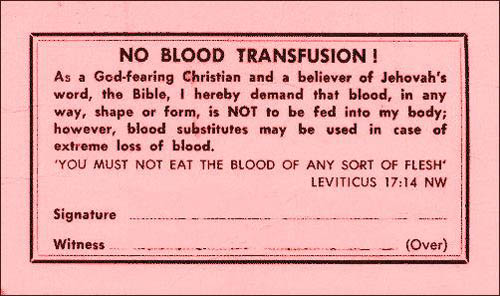
Children of ardent Christian frequently die of treatable diseases
such as diabetes — around 300 over the last 25 years in
the US alone — because their parent's Churches continue
to teach the traditional Christian doctrine that only God can
heal the sick19.
Religion has not civilised man, man has civilised religion.
Robert Ingersoll (1833-1899)
To sum up, the Church has opposed all manner of advance in
medicine. It suppressed the rational medicine of the ancient
world, destroyed medical books, and promoted its own pseudo-medicine
based on supernaturalism. It burned medical researchers and
other proto-scientists as heretics. It opposed anatomical research
and taught that illness was caused by sin. It denied medical
assistance to millions, including surgery, inoculation, anaesthetics
and prophylaxis. It promoted a body of falsehoods about the
medical consequences of various forms of sexual activity, and
has been prepared to see people die rather than contravene the
word of God by permitting medical assistance. Elsewhere (pages
357- 363) we have seen that it has a poor record in respect
to the treatment of the sick, notably the mentally ill, the
deaf, the physically handicapped, lepers, women in labour, indeed
anyone who was unlucky enough to became ill or injured. In classical
Rome life expectancy had been 50-60 years. After a thousand
years of Christian hegemony it had halved to around 25-30 years.
For the 1,500 years that the Church dominated medicine it made
virtually no advance whatsoever. Indeed, almost all major advances
were made despite its efforts. They were made by heretics, by
Muslims, by Jews, or were imported from nonbelievers outside
Christendom. For centuries the only medical advances within
Christendom were made by enemies of the Church like Paracelsus
, or those who ignored its restrictions, like Leonardo DA Vinci.
The Enlightenment brought medicine to many who had been ignored
or maltreated by the Church, notably the insane, the old, the
blind, the deaf and the congenitally deformed. The Enlightenment
also triggered an interest in public health, hygiene and infant
mortality. The Church's traditional position on many medical
matters was challenged by freethinkers: first by humanists,
then by deists, then by atheists. The greatest Christian contributions
came from Quakers and from occasional maverick believers who
were prepared to defy their Churches.
The most curious thing of all is that senior churchmen seem
always to have had at least an inkling about the efficacy of
scientific medicine. During the many centuries that they were
denying medical help to others, many bishops, cardinals and
popes retained their own personal Jewish physicians.
Christian opposition to medical progress is but one example
of Christian hostility to scientific progress, a topic to which
we will return.
|
|
|
|
|
|
|
|
|
|
|
|
|
|
|
|
|
|
|
|
|
|
|
|
|
|
|
|
|
|
|
|
|
|
|
|
|
|
Buy the Book from Amazon.com
|
|
|
|
|
|
Buy the Book from Amazon.co.uk
|
|
|
| |
| |
| More Books |
|
|
|