| |
|
|
The Scourging of penitents might well
have fulfilled a twofold purpose, enabling the priest
to indulge a taste for sadism and the penitent a penchant
for masochism
|
|
George Riley Scott, A History
of Torture
|
  The
Church never seems to have specifically identified sadism or
masochism as sins. The concepts seem to have gone wholly unrecognised,
although the Church has arguably been home to many of the most
notable sadists and most bizarre masochists in history. The
Church never seems to have specifically identified sadism or
masochism as sins. The concepts seem to have gone wholly unrecognised,
although the Church has arguably been home to many of the most
notable sadists and most bizarre masochists in history.
Below are just a few examples of the range of sadomasochistic
Christian ideas and practices.
Jesus and Mary
 One
of the most notable things about Christianity for many non-Christians
is the intense preoccupation with death and suffering. The torture
of Jesus and the sorrow of Mary are favourite themes, often
depicted in graphic detail. As has been noted many times, in
any other context these images would be considered disturbing,
sadomasochistic, deviant and unsuitable for children. They concentrate
heavily on brutality, beating, flogging, piercing, torture,
bleeding, nailing and death. Collecting and drinking blood is
an especially popular theme in Christian art. Some Christians
submit themselves to some of these sufferings - wearing crowns
of thorns, flogging themselves, and even having themselves nailed
to crosses. One
of the most notable things about Christianity for many non-Christians
is the intense preoccupation with death and suffering. The torture
of Jesus and the sorrow of Mary are favourite themes, often
depicted in graphic detail. As has been noted many times, in
any other context these images would be considered disturbing,
sadomasochistic, deviant and unsuitable for children. They concentrate
heavily on brutality, beating, flogging, piercing, torture,
bleeding, nailing and death. Collecting and drinking blood is
an especially popular theme in Christian art. Some Christians
submit themselves to some of these sufferings - wearing crowns
of thorns, flogging themselves, and even having themselves nailed
to crosses.
|
Graphic Images of suffering from a Catholic
Website
|
  |
|
|
|
Andrei Rublyev
|
|

|
|
|
|
|
|

|
|
|
|
|
|
Saint Francis Of Assisi Catches the Blood
Of Christ From The Wounds (1486) by Carlo Crivelli
Christ is reopening his wounds to squirt blood towards
Francis.
Francis is catching the blood in a communion cup, presumably
to drink.
Collecting (and licking or drinking) blood from Jesus'
wounds
has been a popular theme in Christian literature and art
for centuries
|
|

|
|
|
|
“Manus Christi” (detail)
by Mark Ryden, 2003
|
|
 |
 |
|
|
|
|
Kissing Jesus's spear wound on Good Friday,
2011, in Havana, Cuba.
|
|

|
|
|
|
Saint Paul of the Cross:
"When you are alone in your room, take your crucifix,
kiss its five wounds reverently, tell it to preach to
you a little sermon, and then listen to the words of eternal
life that it speaks to your heart; listen to the pleading
of the thorns, the nails, the precious Blood. Oh, what
an eloquent sermon! "
|
|
|
|

|
|
|
|
Saint Francis, complete with his own
stigmata, fondles and kisses the bleeding wounds of Jesus
|
|

|
| |
|
The Innocent by Ezio Marzi
|
|
|
| |
|
|
|
|
|

|
|
|
|
Blood of Christ by Connie Wong
|
|
|
| |
|
For those who enjoy contemplating suffering
|
|
|
| |
|
|
|

|
|
|
|
St. Martin de Porres
|
|

|
|
|
|
|
|
Francisco Ribalta Christ Embracing Saint
Bernard (c. 1626)
|
|

|
|
|
|
Doubting Thomas
|
|
|
|
|
|
Francis Embrace Christ Francisco Ribalta
|
|

|
|
|
|
|
|

|
|
|
|
Much Christian art created before the
lifetime of Sigmund Freud has strong and obvious homoerotic
elements
William-Adolphe Bouguereau (1825-1905), Dante and Virgil
in Hell
Canto VII, lines 112-114 ("They smote each other
not alone with hands ,/ But with the head and with the
breast and feet, / Tearing each other piecemeal with their
teeth"
|
|

|
| |
|
Holy Wound. Psalter and Hours of Bonne
of Luxembourg, Duchess of Normandy Attributed to Jean
Le Noir
Religious Imagery pre-Freud is often blatant by modern
standards
|
|
|
|
|
|
Licking or drinking Jesus' blood is a
common theme in Christianity and Christian art.
2011 English translation of the Roman Missal: "Take
this, all of you, and eat of it: for this is my body
"Take this, all of you, and drink from it: for this
is the chalice of my blood"
|
|

|
|
|
|
Iglesia en la Nueva España, Madrid,
1634
The bloods dribbles into a container and then via two
tubes into a bason for wider distribution.
|
|
|
|
|
| |
|
|
|
|
|
An advert with a clear target audience
|
|

|
|
|
|
Imitating the suffering of Christ - flagellation
- an early stage
|
|
|
| |
|
Jean Bellegambe, Mystic Bath of Souls
(detail), 1505-10 or 1526, Musée des Beaux-Arts,
Lille, France.
It is not easy to see at this resolution, but Jesus is
bleeding into a bath.
Semi-naked Christian men and women are bathing together
in His accumulated blood.
(The Christian prohibition on mixed bathing did not apparently
extend to souls bathing in Jesus' blood)
|
|
|
| |
| |
|
|
| |
| |
|
Voluntary Crucifixion in the Philippines
- A popular Easter Passtime
Note that the victim wants to suffer, but not too much.
The nails are not as big or rough as first century nails,
and are carefully and unrealistically placed not to do
too much permanent damage (Crucifixion victims are known
to have been nailed through the wrist)
|
|
|
| |
|
Agnus dei - The Lamb of God - bleeding
from the heart
|
|
|
| |
| |
|
|
| |
|
Here Jesus is not only bleeding into
the chalice, he is actually standing in it.
|
|
|
| |
| |
|
|
| |
| |
|
|
| |
| |
|
Voluntary Crucifixion in the Philippines
- complete with Roman soldiers
|
|
|
| |
|
Voluntary Crucifixion in the Philippines
Again, the nails are not as big or rough or dirty as first
century nails, and are carefully and unrealistically placed
not to do permanent damage (Crucifixion victims were nailed
through the heel)
|
|
|
|
Jesus' flagellation and wounds have been
a source of fascination to a certain kind of Christian
for many centuries. This is Caravaggio's version of St-Thomas
broggling Jesus' spear wound.
|
|
|
|
Details from the Isenheim Altarpiece
painted by Matthias Grünewald between 1512 and 1516
for the Monastery of St. Anthony in Isenheim. It is now
on display at the Unterlinden Museum at Colmar, Alsace,
in France - A sadomasochist's delight
|
|
|
|
|
|
Public display in Washington CD
|
|
|
|
Statues of Mary often depict her intense
sorrow and suffering.
Here she is holding the nails used to torture and kill
her son.
Note the sword through her heart, representing one of
her seven sorrows.
|
|
|
 St.
Marguerite Marie Alacoque (1647 - 1690), a Burgundian nun, was
frequently visited by Jesus, who exposed to her his heart. Sometimes
the heart was burning; sometimes torn and bleeding. To torment
herself, she sought out rotten fruit and dusty bread to eat.
She allowed herself no drink from Thursday to Sunday, and when
she did drink, drank water in which laundry had been washed.
Like almost all of her fellow "mystics", she frequently
fell to the ground in convulsions. She imagined the devil was
buffeting her. In her diaries she describes how she wished to
clean up the vomit of a sick patient, and could not resist doing
so with her tongue. This caused her so much pleasure that she
wished she could do the same every day. Like so many other female
saints, she loved to suffer and to humiliate herself, her excessive
masochism betraying sever mental problems. Her autobiography
mentions her activities with faeces of a victim of dysentery.
She cut the name of Jesus on her chest with a knife. When the
wounds started to heal, she burnt them in permanently with a
candle flame.8
. Her hallucinations were the basis of the modern cult of the
Sacred Heart of Jesus, which in turn suggested the cult of the
Immaculate Heart of Mary. St.
Marguerite Marie Alacoque (1647 - 1690), a Burgundian nun, was
frequently visited by Jesus, who exposed to her his heart. Sometimes
the heart was burning; sometimes torn and bleeding. To torment
herself, she sought out rotten fruit and dusty bread to eat.
She allowed herself no drink from Thursday to Sunday, and when
she did drink, drank water in which laundry had been washed.
Like almost all of her fellow "mystics", she frequently
fell to the ground in convulsions. She imagined the devil was
buffeting her. In her diaries she describes how she wished to
clean up the vomit of a sick patient, and could not resist doing
so with her tongue. This caused her so much pleasure that she
wished she could do the same every day. Like so many other female
saints, she loved to suffer and to humiliate herself, her excessive
masochism betraying sever mental problems. Her autobiography
mentions her activities with faeces of a victim of dysentery.
She cut the name of Jesus on her chest with a knife. When the
wounds started to heal, she burnt them in permanently with a
candle flame.8
. Her hallucinations were the basis of the modern cult of the
Sacred Heart of Jesus, which in turn suggested the cult of the
Immaculate Heart of Mary.
|
A pierced, bleeding and burning heart
- An extremely common image in Roman Catholicism.
On the right a child Jesus clutches his burning heart
in one hand and his crucifixion nails in the other.
|
|
|
|
Exposed hearts - often cut or burning
or pierced by thorns are still extremely popular
|
|
|
|
Our Lady of Sorrows
|
Our Lady of Sorrows
|
Our Lady of Sorrows
|
|
|
|
|
|
Our Lady of Sorrows
|
Our Lady of Sorrows
|
Our Lady of Sorrows
|
 |
 |
|
|
|
|
|
|
Virgin of Seven Sorrows, Italy, 18thC
|
|

|
|
|
|
Mater Dolorosa, stained glass (circa
1513),
on show in Hamburg. Germany, Corpus Vitrearum Deutschland,
2009
|
|
|
Visionaries sometimes reported strange goings-on with their
hearts, often based on erroneous contemporary theories about
the nature and function of the heart. (Before William Harvey,
the heart was thought of as a sort of miniature furnace). St.
Catherine of Siena asked God to take her own heart her. Jesus
supposedly heard the prayer and appeared to her. He opened her
left side, took out her heart and went away with it. Catherine
afterward told her confessor that she no longer had a heart.
Later, in Siena, Catherine fell into an ecstasy. Afterwards,
a light from Heaven encircled her and Jesus appeared. He held
in his hands a bright red human heart. Approaching Catherine,
He opened her left side once again and placed the heart within
her chest, saying: "Dearest daughter, as I took your heart
away, now, you see, I am giving you mine so that you can go
on living with it forever". He closed the opening he had
made, but as a sign of the miracle, a scar remained. Dominica
a Paradiso also got a new heart from Jesus. She received a vision
in which he extracted her heart from her chest and substituted
one of burning fire. She rose immediately from her sick bed,
renewed in body and mind. Afterwards, a fragrance emanated from
her body. St. Margaret Mary Alacoque was yet another lucky recipient.
In her autobiography she wrote that Jesus "asked me for
my heart, which I begged Him to take. He did so and placed it
in His own adorable heart, where He showed it to me as a little
atom which was being consumed in this great furnace, and withdrawing
it thence as a burning flame in the form of a heart."
|
Traditional and contemporary Christian
attraction to images of Jesus' death and suffering
is increasingly out of step with modern secular society
|
|
|
Tales From the Bible
 The
Old Testament contains many stories, all equally inspired by
God. One might therefore expect them to carry equal weight for
believers, and to be discussed, preached about and represented
in art in equal measure. In practice, their seems to be a very
distinct bias. For example, it is difficult to find much material
on topics like God's failures and ignorance, nor examples of
polygamy, genocide, racism, or divinely sanctioned concubines
or sex-slaves. (It is for example not easy to find material
on King Solomon's 700 wives or 300 concubines). Even ordinary
slaves have disappeared over the last century or so. Almost
all Christian art has been designed to support the Christian
teachings of the day. A notable exception has been divinely
sanctioned killing, especially holy massacres, child killing
and murder. Murders are preferred if they are the murder of
or murder by naked or semi-naked women. Here are just a few
examples of paintings of Judith, who murdered Holofernes by
beheading him as he slept (Judith 13:6) The
Old Testament contains many stories, all equally inspired by
God. One might therefore expect them to carry equal weight for
believers, and to be discussed, preached about and represented
in art in equal measure. In practice, their seems to be a very
distinct bias. For example, it is difficult to find much material
on topics like God's failures and ignorance, nor examples of
polygamy, genocide, racism, or divinely sanctioned concubines
or sex-slaves. (It is for example not easy to find material
on King Solomon's 700 wives or 300 concubines). Even ordinary
slaves have disappeared over the last century or so. Almost
all Christian art has been designed to support the Christian
teachings of the day. A notable exception has been divinely
sanctioned killing, especially holy massacres, child killing
and murder. Murders are preferred if they are the murder of
or murder by naked or semi-naked women. Here are just a few
examples of paintings of Judith, who murdered Holofernes by
beheading him as he slept (Judith 13:6)
|
Judith en Holofernes c1550
by Jan Metsys (1509-1573)
|
Judith with the Head of Holofernes, 1500s
Vincent Sellaer (c 1500 - 1589)
|
|
|
|
| |
|
|
Judith with the Head of Holofernes,
1543
Jan Metsys (1509-1573)
|
Judith met het hoofd van Holofernes
Jan Metsys (1509-1573)
|
|
|
|
| |
|
|
Judith, Illuminated Manuscript
c 1505 Anonymous
|
Judith with the Head of Holofernes(
1525)
Hans Baldung Grien (c 1484-1545)
|
|
|
|
| |
|
|
|
|
Judith Beheading Holofernes (1598) by
Michelangelo Caravaggio 1571-1610
|
|
|
|
|
|
Judith Victorious, 1530, by Lucas Cranach
the Elder
|
|
|
These are just a few of the hundreds of renderings of this
particular murder. There are as many again of Jael murdering
Sisera by hammering a tent peg into his head (Judges 4:21),
and of countless other bloody scenes.
|
The frisson of a blood sacrifice required
of Abraham has always been particularly popular
- until modern secular times in the West .
( Orthodox Jews and Moslems continue to find it a heartwarming
tale).
|
|
|
|
Another representation of Abraham preparing
to sacrifice his son
|
|
|
|
Charles Le Brun Jephthah's Daughter
The devout Jephtha is just about to sacrifice his daughter
to God
|
|
|
The New Testament also held potential. Another especial favourite
was the massacre of the Innocents (Matthew 2:16-18). The story
is related only by the Matthew author, and is not supported
by any historical evidence. Because of its macabre subject matter
it was once a favourite Christian story. This subject has become
less popular since nonbelievers pointed out that the massacre
came about because of God's failure to anticipate the consequences
of the inadequate information He provided to the magi - that
they would tell Herod about the forthcoming birth, and that
Herod would commission a massacre (as supposedly fortold in
the Old Testament) as a result. Modern representations of the
story tend to lay much less emphasis on the killing, and more
on the Holy Innocents' reception into heaven (despite them not
being baptised Christians). God has actually done them a great
favour in facilitating their massacre, allowing them into heaven,
as some Catholics believe. Somehow these infants have become
martyrs for Christianity rather than victims of God's inadequate
planning and imprecise instructions. As well as the maternal
terror, note the amount of unnecessary nudity in these Christian
images below - not just among the children, but also their frantic
mothers, and even the men charged with murdering them.
|
Massacre of the Innocents fom the Egbert
Codex, created AD 980-993 for Archbishop Egbert of Trier,
|
|
|
|
|
| |
|
|
Massacre of the Innocents (1590)
Cornelis Van Haarlem, 1562-1638
|
Massacre des Innocents (1824)
François Joseph Navez, 1787-1869
|
|
|
|
|
|
| |
|
|
Massacre of the Innocents, Picture Bible from the
Monastery of St Bertin, France. Created c 1200.
|
Giacomo Paracca, 'The Slaughter
of the Innocents', Polychrome clay sculptures, c.
1587, Italy, Sacro Monte di Varallo.
|
|
|
|
|
|
| |
|
|
Massacre of the Innocents, Luca Giordano,
1634-1705 (detail)
|
|
|
|
|
| |
|
|
The Massacre of the Innocents c1500-25
Gerolamo Mocetto, 1458-1532, detail
|
Massacre of the Innocents (1590)
Cornelis Van Haarlem, 1562-1638, detail
|
|
|
|
|
|
| |
|
|
Massacre of the Innocents, c 1611–12
Peter Paul Rubens, 1577-1640, detail
|
Slaughter of the Innocents c1308-11
Duccio di Buoninsegna, c1255-1319, detail
|
|
|
|
|
|
| |
|
|
Massacre of the Innocents, 1611, by Guido
Reni, 1572-1642, detail
|
|
|
|
|
| |
|
|
Massacre of the Innocents (1590)
Cornelis Van Haarlem, 1562-1638, detail
|
Holy Innocents Icon
|
|
|
|
|
|
| |
|
|
Murder of the Innocents in Bethlehem
c. 1180 Fresco,
Panteón de los Reyes, Colegiata de San Isidoro,
Léon_01
|
|
|
|
|
|
Holy Innocents - in Heaven
|
|
|
|
Herod killing innocent babies echoed
another incident where God himself was responsible for
killing innocent babies, in Exodus 12 29-30.
This illustration comes from a Bible illustrated by Gustave
Dore and is entitled The Firstborn Slain
|
|
|
|
|
|
Holy Innocents, Church of Saint Cecilia,
Aguilar de Campo
|
|
|
|
|
|
Holy Innocents, Getty Museum
|
|
|
|
|
|
|
| |
Legends of Martyrdom
The vast majority of Christian martydoms have no independent
historical confirmation. From a number of different clues it
is clear that stories of martyrdom were fabricated - some in
the first millennium, the vast majority in the High Middle Ages.
These fabricated stories were custom made for their audience,
and what went down best were stories of steadfast martyrs, entirely
innocent and virginal, dreadfully abused by monstrous and vindictive
pagans. These martyrs suffered a vast range of tortures. They
survived long after any normal person would have died, suffering
unspeakable agonies. Often God miraculously turned the tortures
against the evil perpetrator, who usually died in front of his
victim. A massively disproportionate number of these victims
were nubile young women whose suffering included being stripped
and humiliated. With the benefit of modern knowledge it is easy
to identify sadomasochistic tendencies in these stories and
associated art. As Marina Warner has pointed out:
In Christian hagiography, the sadomasochistic content of
the paeans to male and female martyrs is startling, from the
early documents like the Passion of saints Perpetua and Felicity
into the high Middle Ages. But the particular focus on women's
torn and broken flesh reveals the psychological obsession
of the religion with sexual sin, and the tortures that pile
up one upon the other with pornographic repetitiousness underline
the identification of the female with the perils of sexual
contact1
 Many
stories of tortured women martyrs were pure sadistic invention
- many of them have no better authority than prurience and the
Golden Legend. A good example is Saint Agatha. She was like
so many others supposedly tortured for being a Christian in
the third century. Among the imaginary tortures she underwent
on the orders of Quintianus was the cutting off of her breasts.
Fortunately an apparition of Saint Peter "cured" her.
Quintianus, undeterred by this spectacular miracle, now sentenced
her to death by being rolled naked on a bed of live coals -
but she somehow survived. In Christian art her imaginary mutilation
is far more popular than her imaginary roasting, for reasons
that we can only guess at. Many
stories of tortured women martyrs were pure sadistic invention
- many of them have no better authority than prurience and the
Golden Legend. A good example is Saint Agatha. She was like
so many others supposedly tortured for being a Christian in
the third century. Among the imaginary tortures she underwent
on the orders of Quintianus was the cutting off of her breasts.
Fortunately an apparition of Saint Peter "cured" her.
Quintianus, undeterred by this spectacular miracle, now sentenced
her to death by being rolled naked on a bed of live coals -
but she somehow survived. In Christian art her imaginary mutilation
is far more popular than her imaginary roasting, for reasons
that we can only guess at.
|
Saint Agatha by Felice Ficherelli,
17th Century
|
|
Portrait of a Young Woman as Saint Agatha
by Cariani (Giovanni Busi) 1516 - 1517
|
 |
|
 |
 Saint
Agatha is often depicted carrying her excised breasts, sweetly
contemplating them on a salver held in her own hand. Saint
Agatha is often depicted carrying her excised breasts, sweetly
contemplating them on a salver held in her own hand.
The shape of her amputated breasts, as depicted in artistic
renderings, gave rise to her attribution as the patron saint
of bell-founders and as the patron saint of bakers, whose loaves
were blessed at her feast day. More recently, she has been venerated
as patron saint of breast cancer patients. She is also the patron
saint of wet nurses.
|
The Martyrdom of Saint Agatha (1519)
by Sebastiano del Piombo
|
A more recent but equally disturbing
Saint Agatha
|
 |
 |
|
“The Holy Breasts of Saint Agatha”
by Orazio Riminaldi, 1625
Agatha's pudding-like holy breasts look particularly edible
in this rendering.
|
|
|
|
|
|
|
|
St Agatha by Caitlin Karolczak, 2011.
Oil, gold pigment on panel in antique frame
|
|
|
 According
to a legend with no corroboration, and set in various locations
in different accounts, Saint Apollonia had all of her teeth
violently pulled out for no very good reason. She tried to kill
herself by jumping into a fire and again by jumping into a river,
but failed and was then decapitated (the method of Christian
martyrdom almost always given in invented stories). Because
of the incident of her teeth being pulled out, she is popularly
regarded as the patroness of dentistry and those suffering from
dental problems. According
to a legend with no corroboration, and set in various locations
in different accounts, Saint Apollonia had all of her teeth
violently pulled out for no very good reason. She tried to kill
herself by jumping into a fire and again by jumping into a river,
but failed and was then decapitated (the method of Christian
martyrdom almost always given in invented stories). Because
of the incident of her teeth being pulled out, she is popularly
regarded as the patroness of dentistry and those suffering from
dental problems.
|
Saint Apollonia - two statues and a holy
relic, one of her teeth
|
|
|
|
Saint Irene of Mytilene is an invented
twelve-year old saint who supposedly lived on the Isle
of Lesbos. As in many other cases her story was unknown
until some bones were discovered (in 1959), at which point
the bones started communicating telepathically with especially
devout locals, who related contradictory stories about
their previous owner's life, torture and martyrdom.
|
|
|
 Martyrdom
and torture was the most popular theme in Christian legends
and Christian art for many centuries. Since the legends were
made up, they could be purpose-made to appeal to Christian tastes.
Made-up torture victims were generally female, generally young,
generally attractive, and generally naked. Often, like Agatha,
they underwent a long series of tortures, depicted in graphic
detail. Martyrdom
and torture was the most popular theme in Christian legends
and Christian art for many centuries. Since the legends were
made up, they could be purpose-made to appeal to Christian tastes.
Made-up torture victims were generally female, generally young,
generally attractive, and generally naked. Often, like Agatha,
they underwent a long series of tortures, depicted in graphic
detail.
These martyrs suffered every torture imaginable - not because
of the proclivities of persecutors (who did not exist), but
because of the preferences of the readership and audience of
the works in which they appeared. Imaginary victims were tied
up, often in BDSM poses. They were exposed to the public gaze.
They were abased and humiliated. Their flesh was cut or torn.
Their bones were broken. Their skin was stripped off. They were
pierced by nails or stakes.
Stories and pictures were precisely as titillating as contemporary
mores would allow - except that for reasons of religious fantasy
they had to remain virgins, so it never occurred to the vicious
persecutors to rape them. Legends and paintings in which they
appeared were the nearest their Christian audience ever came
to seeing a snuff movie. Animals were involved more often than
seems decent to modern tastes.
 Lucy
whose name comes from, Lux, the Latin word for light, was a
conventional female Roman Christian martyr. Like almost all
of these martyrs, she was supposedly promised in marriage but
refused the match because she preferred to remain a virgin and
follow God. As a consequence she was tortured and then martyred.
As in other cases the tradition is unreliable - though it was
invented at a much earlier stage than most. Lucy
whose name comes from, Lux, the Latin word for light, was a
conventional female Roman Christian martyr. Like almost all
of these martyrs, she was supposedly promised in marriage but
refused the match because she preferred to remain a virgin and
follow God. As a consequence she was tortured and then martyred.
As in other cases the tradition is unreliable - though it was
invented at a much earlier stage than most.
In the first stories God made her so heavy that her persecutors
could not move her, even with a team of 50 oxen. Her persecutors
tried to burn her alive, but that did not work, so they stabbed
her through the throat, yet she continued to berate them. She
is sometimes depicted holding a sword, or specifically with
a sword through her neck.
 In
the fourteenth century this story was elaborated and improved.
Her name probably suggested stories connected with her sight,
and new legends were fabricated in which her eyes had been removed.
According to some, her persecutors has used forks to remove
her eyes, according to others she had torn out her own eyes
to make her unsuitable as a marriage partner. In
the fourteenth century this story was elaborated and improved.
Her name probably suggested stories connected with her sight,
and new legends were fabricated in which her eyes had been removed.
According to some, her persecutors has used forks to remove
her eyes, according to others she had torn out her own eyes
to make her unsuitable as a marriage partner.  This
tale seems to have been a great marketing success. Audiences
loved stories of blinding, so she quickly became a favourite
in church art, holding her removed eyes on a dish (though she
always has a new pair in her head - sometimes of a different
colour). Bizarrely, the eyes on a dish suggested dainty morsels
so a tradition arose of making eye-like cakes and eating them
on her saint's day - much like the breast-cakes of her equally
imaginary friend, Agatha.. Particularly devout followers still
make special eye-like St Lacy cakes for their children in Catholic
countries. In Italy, large grains of soft wheat representing
her eyes and are an annual treat. Lucy is the patron saint of
sweet-makers as well as the blind. This
tale seems to have been a great marketing success. Audiences
loved stories of blinding, so she quickly became a favourite
in church art, holding her removed eyes on a dish (though she
always has a new pair in her head - sometimes of a different
colour). Bizarrely, the eyes on a dish suggested dainty morsels
so a tradition arose of making eye-like cakes and eating them
on her saint's day - much like the breast-cakes of her equally
imaginary friend, Agatha.. Particularly devout followers still
make special eye-like St Lacy cakes for their children in Catholic
countries. In Italy, large grains of soft wheat representing
her eyes and are an annual treat. Lucy is the patron saint of
sweet-makers as well as the blind.
|
Santa Lucia (Saint Lucy) by Adolfo Wildt,
1927, Forlì Museo del Risorgimento
|
 |
|
St Lucy
|
St Lucy
|
St Lucy
|
St Lucy
|
 |
 |
 |
|
|
St Lucy
|
St Lucy's Cakes
|
A devotee of St Lucy
|
 |
|
|
|
Detail from The Martyrdom and Last
Communion of Saint Lucy, c. 1582, by Paolo Veronese
Lucy's eyes have been miraculously restored. In the full
picture flames in the background allude to an earlier
attempt to kill her by burning which she miraculously
survived, and oxen refer to the team that miraculously
failed to drag her to a brothel.
|
|
|
|
|
|
Saint Agnes or Saint Lucy?
|
|
|
 Christian
women's cruelty towards their own children was another popular
theme. Two Saints names Felicity after the Roman goddess of
happiness illustrate the range of imaginary horror that Christian
minds invented. According to the Catholic Church one Saint Felicity
was the Christian slave of a Christian noblewoman. Both were
supposedly condemned to death for their beliefs (something that
did not happen in the Roman world). But Felicity was pregnant
and writers knew that pagan Roman practice did not allow the
execution of pregnant women. According to the story she was
"fortunate" enough to give birth just in time for
her scheduled martyrdom, and was delighted to able to leave
her newborn child and go to God, her breasts still wet with
milk for her newborn infant. Another Felicity (equally fictitious)
was the mother of seven sons who encouraged all of them to be
martyred, and asked for her own martyrdom to be delayed so that
she could watch. Killing children was was not a normal pagan
practice, but it seemed so natural to later Christians that
the sons were often depicted as boys. Christian
women's cruelty towards their own children was another popular
theme. Two Saints names Felicity after the Roman goddess of
happiness illustrate the range of imaginary horror that Christian
minds invented. According to the Catholic Church one Saint Felicity
was the Christian slave of a Christian noblewoman. Both were
supposedly condemned to death for their beliefs (something that
did not happen in the Roman world). But Felicity was pregnant
and writers knew that pagan Roman practice did not allow the
execution of pregnant women. According to the story she was
"fortunate" enough to give birth just in time for
her scheduled martyrdom, and was delighted to able to leave
her newborn child and go to God, her breasts still wet with
milk for her newborn infant. Another Felicity (equally fictitious)
was the mother of seven sons who encouraged all of them to be
martyred, and asked for her own martyrdom to be delayed so that
she could watch. Killing children was was not a normal pagan
practice, but it seemed so natural to later Christians that
the sons were often depicted as boys.
|
The Seven Brothers - Felicity (or Felicitas)
from the Nuremberg Chronicles, with the heads of her seven
martyred sons held on the same sword: the perfect Christian
mother.
|
Felicity is depicted in Christian art,
but even more striking are amateur efforts, such as the
one below by the devout Christian mother of a large modern
American Roman Catholic family, who presumably has not
read any Sigmund Freud
.(http://joyfilledfamily.blogspot.com/2011/11/ )
|
|
|
|
 The
martyrdom of seven sons seems to have been a popular theme,
and other unlikely stories of similar martyrdoms were popular.
Symphorosa was the widow of Getulius, who had supposedly been
martyred by Emperor Hadrian. When the emperor's attempts to
induce his widow, Symphorosa, and their seven sons to sacrifice
to the Roman gods were unsuccessful, he ordered Symphorosa to
be brought to the Temple of Hercules. There, after various tortures,
she was thrown into the river, with a heavy rock fastened to
her neck, and drowned. The next day the emperor summoned her
seven sons, and ordered them to be tied to seven stakes which
had been erected for the purpose round the temple. They too
were tortured, then each of them suffered a different kind of
martyrdom. Crescens was pierced through the throat, Julian through
the breast, Nemesius through the heart, Primitivus through the
navel, Justinus through the back, Stracteus through the side,
and Eugenius was cleft in two from top to bottom. There is of
course not a scintilla of evidence that any of this really happened,
and every reason to think that it represents Christian fantasy.
(Stories of the martyrdom of seven Christian brothers are invariably
modelled on 2 Maccabees chapter 7). The
martyrdom of seven sons seems to have been a popular theme,
and other unlikely stories of similar martyrdoms were popular.
Symphorosa was the widow of Getulius, who had supposedly been
martyred by Emperor Hadrian. When the emperor's attempts to
induce his widow, Symphorosa, and their seven sons to sacrifice
to the Roman gods were unsuccessful, he ordered Symphorosa to
be brought to the Temple of Hercules. There, after various tortures,
she was thrown into the river, with a heavy rock fastened to
her neck, and drowned. The next day the emperor summoned her
seven sons, and ordered them to be tied to seven stakes which
had been erected for the purpose round the temple. They too
were tortured, then each of them suffered a different kind of
martyrdom. Crescens was pierced through the throat, Julian through
the breast, Nemesius through the heart, Primitivus through the
navel, Justinus through the back, Stracteus through the side,
and Eugenius was cleft in two from top to bottom. There is of
course not a scintilla of evidence that any of this really happened,
and every reason to think that it represents Christian fantasy.
(Stories of the martyrdom of seven Christian brothers are invariably
modelled on 2 Maccabees chapter 7).
 The
(imaginary) torture and martyrdom of Saint Philomena, a thirteen
year old girl shown on the right, has a obvious appeal for a
certain category of religiously inclined sexual deviant. There
is no reason to suppose she ever existed, except a story that
her otherwise unidentified bones communed with people, starting
with a Catholic priest in 1805. By an astonishing coincidence
he had visited Rome in the hope of exactly such a thing happening. The
(imaginary) torture and martyrdom of Saint Philomena, a thirteen
year old girl shown on the right, has a obvious appeal for a
certain category of religiously inclined sexual deviant. There
is no reason to suppose she ever existed, except a story that
her otherwise unidentified bones communed with people, starting
with a Catholic priest in 1805. By an astonishing coincidence
he had visited Rome in the hope of exactly such a thing happening.
She told supernatural communicants all about herself. She had
declined to marry the Emperor Diocletian and had been stripped,
tied to a pillar, and lashed until bathed in blood. "My
whole body felt like one open wound, but I did not faint".
She was cast into open water with an anchor around her neck,
but rescued by angels. She was shot with a shower of arrows.
"My blood flowed, but I did not faint.". Further attempts
to shoot her resulted in the arrows boomeranging and killing
six archers. She was finally beheaded. (A fact not often mentioned
to today's faithful, is that numerous saints are known only
because their supposed bones in the catacombs communed supernaturally
with priests, monks, popes, and visionaries and told them standardised
stories of martyrdom - all fuelling a trade in newly discovered
martyrs' relics. A miracle accepted as proved in 1835 was the
multiplication of Saint Philomena's bone dust, which provided
for hundreds of reliquaries without the original amount of bone
dust decreasing in quantity). In 1961 her name was removed from
the Catholic liturgical calendar - as near as the Church ever
comes to admitting that a saint never really existed.
Acisclus and Victoria are fairly typical saints in that their
alleged martyrdom has them surviving all sorts of murderous
tortures. One 10th century passio relates that the Roman prefect
of Córdoba, Dion, had Acisclus and Victoria cast into
a fiery furnace. When he heard Acisclus and Victoria sing songs
of joy from within the furnace, Dion had them bound to stones
and cast into the Guadalquivir. They were soon seen floating
unharmed on the river's surface. He retrieved them and had them
roasted over a fire. The fire raged out of control and killed
hundreds of pagans. The two saints then submitted to martyrdom,
having demonstrated their faith in the standard manner.
 One
of the give-aways that these sadistic stories were invented
is the fact that they are essentially identical. Only the details
of the sadistic tortures vary. In the standard trope for female
virgins they always try to put off their suitors by saintly
trick - St Lucy plucks out her own eyes. Saint Uncumber grows
a beard. Another give-away is that martyr's names often make
reference to their life or martyrdom - a very easy linkage to
invent when referring to imaginary events in an indistinct past.
Thus the main even in the story of Saint Christopher is that
he carries Christ on his shoulders (The name Christopher means
"Christ bearer"). St Lucy's name, derived from the
word for light, makes reference to her sight. Saint Hippolytus
is killed by horses being unleashed, as his name suggests -
Hippolytus means "unleasher of horses". Even less
imagination than usual went into this one as it is a direct
lift from Euripides' play of the same name, where the eponymous
hero is killed by being dragged along by horses. The picture
above is from The Death of Hippolytus, by Sir Lawrence
Alma-Tadema (1836–1912), but you can find it reproduced
on numerous Catholic websites and blogs described as The
Death of Saint Hippolytus - without a single reader betraying
any knowledge of Greek plays or Victorian art. One
of the give-aways that these sadistic stories were invented
is the fact that they are essentially identical. Only the details
of the sadistic tortures vary. In the standard trope for female
virgins they always try to put off their suitors by saintly
trick - St Lucy plucks out her own eyes. Saint Uncumber grows
a beard. Another give-away is that martyr's names often make
reference to their life or martyrdom - a very easy linkage to
invent when referring to imaginary events in an indistinct past.
Thus the main even in the story of Saint Christopher is that
he carries Christ on his shoulders (The name Christopher means
"Christ bearer"). St Lucy's name, derived from the
word for light, makes reference to her sight. Saint Hippolytus
is killed by horses being unleashed, as his name suggests -
Hippolytus means "unleasher of horses". Even less
imagination than usual went into this one as it is a direct
lift from Euripides' play of the same name, where the eponymous
hero is killed by being dragged along by horses. The picture
above is from The Death of Hippolytus, by Sir Lawrence
Alma-Tadema (1836–1912), but you can find it reproduced
on numerous Catholic websites and blogs described as The
Death of Saint Hippolytus - without a single reader betraying
any knowledge of Greek plays or Victorian art.
|
Detail of Saint Hippolytus from Central
Panel of Martyrdom of Saint Hippolytus
by Dieric Bouts the Elder, Museum of Sint Salvator Kathedral,
Bruges
|
|
|
To save the effort of inventing new legends, a common practice
was for Christians to take an existing story involving the appalling
death of a young woman, and rewrite it with the young woman
as a Christian martyr. For example Dirce was a young woman devoted
to the god Dionysus who was killed by being tied to the horns
of a bull. With little effort she could be represented as a
Christian martyr killed on the orders of a wicked pagan, adding
yet another fictitious saint to the thousands of others.
|
A Christian Dirce by Henryk Siemiradzki,
1897
|
|
|
The story of the brazen Bull of Perillos was another
favourite. Also known as the brazen bull or Sicilian
bull, it was a torture and execution device.
|
Bull of Phalaris,, by Pierre Woeiriot,
c 1556
|
|
|
 The
bull's inventor, metal-worker Perillos of Athens, proposed it
to Phalaris, the tyrant of Akragas, Sicily, as a means of executing
criminals. The bull was made entirely of bronze, hollow, with
a door in one side. The condemned was locked in the bull, and
a fire was set under it, heating the metal until the person
inside roasted to death. The
bull's inventor, metal-worker Perillos of Athens, proposed it
to Phalaris, the tyrant of Akragas, Sicily, as a means of executing
criminals. The bull was made entirely of bronze, hollow, with
a door in one side. The condemned was locked in the bull, and
a fire was set under it, heating the metal until the person
inside roasted to death.
The head of the bull featured a system of tubes designed so
that the prisoner's screams were amplified, emerging from the
bull's nostrils, and sounding like the bellowing of an infuriated
bull.
 The
story was adapted for more fictitious Christian persecutions.
For example it was supposedly used by Emperor Hadrian on Saint
Eustace, along with with his wife and children. The emperor
Domitian supposedly used it on Saint Antipas, Bishop of Pergamon.
The Emperor Diocletian supposedly used it on another Christian,
Pelagia of Tarsus. The
story was adapted for more fictitious Christian persecutions.
For example it was supposedly used by Emperor Hadrian on Saint
Eustace, along with with his wife and children. The emperor
Domitian supposedly used it on Saint Antipas, Bishop of Pergamon.
The Emperor Diocletian supposedly used it on another Christian,
Pelagia of Tarsus.
None of these roastings are reliably documented, and all betray
all the hallmarks of martyrdom fictions - they are evidently
Christianised versions of a well known pre-Christian horror
story.
|
According to unsubstantiated tradition
Antipas was martyred in ca. 92 AD by being burned in a
brazen bull-shaped altar used for casting out demons worshiped
by the local population.
|
|
|
Another adaptation is the story of Saint George killing a dragon-monster
from a lake to save a virgin Princess. This is a thinly disguised
version of Perseus killing a dragon-monster from the sea to
save the virgin princess Andromeda.
|
Perseus on his horse killing a dragon-monster
to save the virgin princess Andromeda
(Andromeda, by Guido Reni (1575 - 1642))
|
|
Saint George on his horse killing a dragon-monster
to save a virgin Princess Sabra
(George Fighting the Dragon by Raffael)
|
 |
|
 |
Apart from the obvious borrowing from pagan stories, the fact
that Christian martyrdom stories are inventions is given away
by the multiple attribution of the same stories to different
saints, and by attributing multiple different stories to the
same saint. For example, lions refusing to eat their human victim
is applied to many saints. In many cases such as Saint Jerome
it is obviously adapted from the pagan story of Androcles and
the lion. The story is that Androcles/Jerome removes a thorn
from the paw of an injured lion. Years later in a Roman amphitheatre
Androcles/Jerome is publicly fed to a lion, which turns out
to be the same one he helped. In both cases the lion recognises
its erstwhile benefactor and declines to eat him, impressing
the previously bloodthirsty crowd. The same story was told of
another saint, Saint Gerasimus of the Jordan.
|
Androcles extracting a thorn
from the paw of an injured lion
|
Jerome extracting a thorn
from the paw of an injured lion
(by Niccolò Antonio Colantonio)
|
 |
|
A similar story is also applied by some sources to Saint Januarius,
(who might well be a confused version of Saint Gerasimus of
the Jordan) improved by adding multiple lions, although other
sources, equally unreliable, associate him with other standard
martyrdom tropes.
|
The fictitious Saint Januarius and his
equally fictitious lions.
|
|
|
 Such
pagan stories often became popular, because of their quasi-sexual
content. Generally they were Christianised - the heroes (like
Dirce and Perseus) became fictitious Christians. But where the
story was already well known, and especially when no obvious
Christian moral could be attached to it - the story was allowed
to stand. A good example was the story of Roman Charity (Caritas
romana) depicted from Roman times (including at Pompeii) Such
pagan stories often became popular, because of their quasi-sexual
content. Generally they were Christianised - the heroes (like
Dirce and Perseus) became fictitious Christians. But where the
story was already well known, and especially when no obvious
Christian moral could be attached to it - the story was allowed
to stand. A good example was the story of Roman Charity (Caritas
romana) depicted from Roman times (including at Pompeii)
Cimon is incarcerated and sentenced to death by starvation.
His daughter, Pero, secretly breastfeeds her father during her
visits to him in gaol, so keeping him alive. She is found out
by a jailer, but her act of selflessness impresses officials
and wins her father's release. The story is recorded by the
ancient Roman historian Valerius Maximus, and was presented
as an act of filial piety and Roman honour. Christian patrons
clearly found the story titillating and it was illustrated by
dozens of artists, including , Rubens and Caravaggio. In some
versions one or both of the participants seem to have become
Christian saints, and wear halos, as in the recent example above.
For no obvious reason, Pero is sometimes depicted naked.
|
Cimon and Pero
Hans Sebald Beham
|
Cimon and Pero
Hans Sebald Beham
|
Cimon and Pero
Jean-Baptiste Deshays 1838
|
|
|
|
|
|
Caritas Romana
Meyvogel, Budapest
|
Cimon and Pero (Caritas Romana).1538
Georg Pencz
|
|
|
|
 Men
did not make such popular fictitious martyrs as women. When
they were depicted as martyrs they were in danger of becoming
Homo-erotic icons. St Sebastian is probably the most obvious
and best known example. He stared off as a middle-aged Roman
soldier, but his story had potential. The story was that Sebastian
had been shot full of arrows, but God had arranged that they
should all miss his vital organs, so that he survived - only
to be clubbed to death once he had recovered, and his body tipped
into a sewer. Men
did not make such popular fictitious martyrs as women. When
they were depicted as martyrs they were in danger of becoming
Homo-erotic icons. St Sebastian is probably the most obvious
and best known example. He stared off as a middle-aged Roman
soldier, but his story had potential. The story was that Sebastian
had been shot full of arrows, but God had arranged that they
should all miss his vital organs, so that he survived - only
to be clubbed to death once he had recovered, and his body tipped
into a sewer.
A middle aged man in a sewer appealed to a limited audience,
but the shooting had potential, and the details were flexible.
Sebastian soon lost his uniform. He became youthful and as near
naked as contemporary Christian sensitivities would allow (recent
examples are not shown here, but can easily be imagined). Many
artists and their patrons were attracted to his story and the
ecstatic look that they assumed he must have had on his face.
Among them were, Botticelli, Titian, Pollaiuolo, Giovanni Bellini,
Hans Memling, Gerrit van Honthorst, Luca Signorelli, El Greco,
Honoré Daumier, John Singer Sargent and Louise Bourgeois.
Mantegna painted him three times, Perugino four times, and Guido
Reni seven times.
As time went on the Church started discouraging the single
nude male subject in art, Vasari noted that such images were
arousing inappropriate thoughts among female churchgoers, but
they were also clearly arousing inappropriate thoughts among
male churchgoers. Today Saint Sebastian is a gay icon, and a
quick review of a few paintings of him give a clue as to why.
One might even speculate that he must have been a gay icon for
centuries. He becomes younger, more athletic and more attractive,
and his loin cloth is generally as daring as the times allow:
ever smaller, more flimsy, lower, and giving the impression
of being more likely to fall off imminently.
|
St Sebastian c1480
Andrea Mantegna
|
Saint Sebastian (c. 1616)
by Guido Reni
|
Saint Sebastian (c. 1490–1500)
Pietro Perugino
|
|
|
|
 |
|
Saint Sebastian, 1490
Carlo Crivelli.
|
Saint Sebastian
Pietro Perugino ???
|
St. Sebastian (c. 1490–1500) —
Pietro Perugino
|
 |
|
 |
|
St Sebastian
Liberale da Verona
|
Saint Sebastian
Giovanni Battista Carlone
|
Saint Sebastian
in Sebastian, Ohio
|
 |
|
|
|
, St. Sebastian, Cathedral de Amiens
|
|
|
| |
|
St. Sebastian by Andrea Mantegna
|
|
|
The fate of all of the 12 apostles is unknown, and this ignorance
opened endless possibilities for invention. There are numerous
gory stories about their painful ends - all as different and
as bloodthirsty as possible.
|
Bartolomeo di Giovanni, Martyrdom of
St John - detail, Predella
According to a story invented in the Middle Ages St John
the Evangelist was boiled in oil under the Emperor Domitian,
but being so holy he survived unharmed and went off to
write the Book of Revelation
(The Book of Revelation is now attributed to another John,
the fictitious St John the Divine)
As in so many other supposed martyrdoms we have reliable
records of Christians killing people like this, but not
Christians being killed like this.
|
|
|
|
Juan Martínez Montañés,
The Martyrdom of Saint John the Evangelist, 1638 ·
Museum of Fine Arts, Seville, Spain
|
|
|
 Christian
tradition has three equally fictitious stories about the death
of the apostle St-Bartholomew. According to one, he was kidnapped,
beaten unconscious, and cast into the sea to drown. According
to another he was crucified upside down, and according to a
third he was skinned alive and beheaded. Christian
tradition has three equally fictitious stories about the death
of the apostle St-Bartholomew. According to one, he was kidnapped,
beaten unconscious, and cast into the sea to drown. According
to another he was crucified upside down, and according to a
third he was skinned alive and beheaded.
The account of him being skinned alive obviously has the strongest
appeal, and is therefore the the most represented in art. Bartholomew
is often shown being flayed alive by expert skinners, or alternatively
he is shown with a large skinning knife or holding his own skin,
or both, as in Michelangelo's Last Judgment, shown here on the
right. As in most representations of saints he is shown resored
to his pre-martyrdom state (but it is not obvious why he is
bald, while his pelt has a full head of hair, and he sports
a beard while his pelt is clean shaven)
|
St. Bartholomew the Apostle by Marco
d'Agrate, 1562, Duomo Cathedral, Milan
His odd appearance is due to his having been flayed alive.
He is usually depicted holding his own bloody skin, but
here he is wearing it like a robe.
|
|
|
Bartholomew is now the patron saint of tanners.
|
flaying alive - a real victim, not St
Bartholemew
|
|
|
| |
|
St Bartholemew
|
|
|
| |
The only disciple whose fate is descibed in the New Testement
is Judas. Two different versions of his death are given. Here
is one of them:
|
John Canavesio (1450 - 1500) The Suicide
of Judas, ca. 1492.
|
|
|
| |
|
Ten thousand martyrs of Mount Ararat
from Les Grandes Heures d'Anne de Bretagne, by
Jean Bourdichon, Tours or Paris 1503-1508 (BnF, Latin
9474, fol. 177v) early 1500's
The ten thousand martyrs of Mount Ararat were, according
to a medieval legend, Roman soldiers, led by Saint Acacius,
who converted to Christianity. They were crucified on
Mount Ararat in Armenia by order of the Roman emperor.
The story seems to have been invented by the ninth century
scholar Anastasius Bibliothecarius.
|
|
|
| |
|
Life and Martyrdom of St. Julita and
her son Quiricus
Antependium, Santa Julita de Durro, Spain, c. 1170
|
|
|
| |
|
According to Christian tradition - ie
to an invented legend - Saint Dionysius was a martyred
Bishop of Paris. After his head was chopped off, Dionysius
picked it up and walked six miles preaching a sermon.
He is the patron saint of Paris, and is now called Denis.
This depiction is from a mural of the martyrdom of St.
Denis, The Pantheon (St. Genevieve), Paris.
|
|
|
|
Below is a detail from Pellegrino Tibaldi's
Martyrdom of St Lawrence (1592)
An uncorroborated tradition holds that Lawrence was grilled
to death in Rome, and that while being grilled he joked
about being cooked well enough to eat, saying "Turn
me over. I'm done on this side".
He is the patron saint of cooks and chefs.
|
|
|
The story of St Erasmus is another fantasy invented for the
delight of sadomasochistic Christians (there being no reality
television in the Middle ages). He was supposedly beaten about
the head, spat upon and besprinkled with "foulness."
He was beaten with leaden mauls until his veins broke and burst.
He suffered all of these punishments with "tremendous willingness".
He was then thrown into a pit of snakes and worms. Boiling oil
and sulfur were poured on him. "He lay therein as he had
lain in cold water, thanking and loving God." Lightning
electrocuted everyone around save Erasmus. Another wicked emperor
had him thrown into another pit, but an angel came and slew
all the vipers and worms. A third emperor had him "put
into a pan seething with rosin, pitch, brimstone lead, and oil"
and this same mixture was poured into his mouth. A searing hot
cloak and red-hot metal coat were both placed on him, to no
effect, and an angel once again carried him away to safety.
Erasmus was now enclosed in a barrel full of protruding spikes,
and the barrel was rolled down a hill. But an angel healed him.
His teeth were plucked out of his head with iron pincers. He
was bound him to a pillar and his skin carded with iron cards.
They roasted him upon a gridiron. They hammered sharp nails
of iron into his fingers. They put out his eyes. They laid him
on the ground naked and stretched him with strong withes bound
to horses about his neck, arms, and legs, so that all his veins
and sinews burst.. He was brought before the emperor and beaten
and whipped, then coated with pitch and set alight. He was thrown
into prison with the intention of letting him die of starvation,
but he miraculously managed to escape. He was recaptured and
tortured all over again in the Roman province of Illyricum.
Finally his stomach was slit open and his intestines wound around
a windlass. No reason is given why no angel was available on
this occasion to rescue him.
|
Le Martyre de saint Érasme, xylographie
coloriée, vers 1460 - Bibliothèque nationale
de France
depicting a wide range of imaginary attempts to kill Erasmus
|
|

|
|
|
|
Detail from The Martyrdom of St. Erasmus
by Cranach, Lucas, 1472-1553
Erasmus is having his entrails pulled out by a windlass.
He is venerated as the patron saint of abdominal pain.
|
|
|
| |
| |
|
Santa Febronia by Francisco Javier de
Salazar
Note the dismemered limbs and pody parts on the floor
Saint Febronia was invented in the seventh century - much
earlier than most made-up martyrs.
|
|
|
|
|
Genuine Christian martyrs are so rare that pretty much any
Christian murder victim qualifies. Eleven year old Saint Maria
Teresa Goretti's only notable acheivement during her life was
to be stabbed to death by a rapist in 1902.
Peter of Verona, St Peter Martyr as he is also known, was an
exceptionally unpopular Dominican Inquisitor. Like many other
unpopular Dominican Inquisitors he was assassinated by persons
unknown, in his case in 1252. Such assassination victims are
always acclaimed as martyrs and saints. They provide a source
of more gory images for bloodthirsty Christian art lovers -
but not nearly as many as all those imaginary, young, attractive,
shapely, naked, martyrs.
|
.Saint Peter of Verona , 15th Century
by Taddeo Crivelli
|
Saint Peter of Verona
|
|
.
|

|
|
.
|
|
|
Peter of Verona,
St Peter Martyr.
|
Peter of Verona, St Peter Martyr.
Etla, San Pedro, Cloister
|
 |
|
| |
|
Saint Peter of Verona by Luis de Morales
|
|
|
| |
|
Saint Peter Martyr and Kneeling Donor,
c. 1490 by Ambrogio Bergognone Detail from
|
|
|
 Invented
stories of torture and martyrdom are not confined to the Roman
Catholic Church. The Orthodox Churches also promote invented
stories of sadistic practices. One example is the "Holy
Martyr" James the Persian. For no better reason than that
he was a Christian (at a time when Christianity was widely tolerated)
James was tortured to death by being slowly dismembered, starting
with his finger joints, hands and arms, then his toes, feet
and legs, and ending with his head. As one keen commentator
(not an eye-witness, obviously) puts it "The blood ran
as rivers, the flesh fell, the veins were severed, the nerves
plucked out, the arteries destroyed, the members were scattered.
The audience fainted and the executioners grew weary"10:.
As in Catholic legends, God always prolonged the martyrs' agony
far beyond what any ordinary human being could have tolerated,
keeping them alive and suffering long after an ordinary person
would have died. Invented
stories of torture and martyrdom are not confined to the Roman
Catholic Church. The Orthodox Churches also promote invented
stories of sadistic practices. One example is the "Holy
Martyr" James the Persian. For no better reason than that
he was a Christian (at a time when Christianity was widely tolerated)
James was tortured to death by being slowly dismembered, starting
with his finger joints, hands and arms, then his toes, feet
and legs, and ending with his head. As one keen commentator
(not an eye-witness, obviously) puts it "The blood ran
as rivers, the flesh fell, the veins were severed, the nerves
plucked out, the arteries destroyed, the members were scattered.
The audience fainted and the executioners grew weary"10:.
As in Catholic legends, God always prolonged the martyrs' agony
far beyond what any ordinary human being could have tolerated,
keeping them alive and suffering long after an ordinary person
would have died.
According to Christian legend a Christian called Cucuphas was
handed over to twelve strong soldiers in Barcelona. They whipped
him, tore his skin with iron nails and stung him with scorpions.
He was then roasted alive, having been covered in vinegar and
pepper, but survived. A great bonfire failed to burn him, but
instead incinerated his persecutors. The next day he was flogged
with iron whips, after which he had his throat cut, which seems
to have finished him off. Once again, there is no real evidence
that Cucuphas ever existed - so the whole story is Christian
fantasy.
|
Martyrdom of Saint Cucuphas (or Sant
Cugat) by Ayne Bru (1500-1507).
Barcelona National Art, Museum of Catalonia
|
|
|
If Saint George really existed, it is possible
he was executed as an army deserter, but Christian hagiographers
preferred a more inventive account of his death. According to
the Golden Legend, a pagan official raised him on a gibbet
and beat him with staves and rods of iron, until his body was
broken in pieces. Then he applied iron brands to his sides.
When George's bowels appeared through his flank the torturers
rubbed them with salt. Later George drank deadly poison, twice.
The next day the Emperor had him set between two wheels, furnished
with sharp swords, but the wheels broke and George escaped unharmed.
Next he was put in a cauldron of molten lead, which he treated
as a comfortable bath. Soon afterwards, George prayed that God
would destroy a temple, at which fire descended from heaven
and burnt the temple, along with idols and the temple priests.
The earth then opened and swallowed all the cinders and ashes.
The following day George was drawn through the city, and had
his head cut off. As the Emperor (Dacian) made his way home
from the execution, more fire fell from heaven and burnt him
and all his servants.
|
An imaginitive representation of the
torture of Saint George
Cod. Bodmer 127 Passionary of Weissenau; Vitae Sanctorum
- St George
|
|

|
|
|
|
The Martyrdom of St George, Mechelen
Cathedral, Belgium
The two wheels in the Golden Legend account have
been replaced by fiendish device
with just one wheel, possibly based on a contemporary
Christian torture device.
|
|
|
 The
cult of relics gave a reason for digging up, boiling and dismembering
dead bodies, a practice that must have appealed to
Necrophiliacs, and perhaps other sexual deviants. Sometimes
crowds would gather when a saint was known to be dying, ready
to dismember him or her while still warm. Dismembered limbs
of saints are still popular, and may be seen slowly decomposing
in tens of thousands of churches around the world. Bodies are
still occasionally dug up to remove fingers or limbs as relics,
as happened for example to Eva Peron. For non-Christians, and
to less traditionally minded Christians, the practice of collecting,
keeping and displaying such items seems at best macabre, and
at worst evidence of abnormal mental states. The
cult of relics gave a reason for digging up, boiling and dismembering
dead bodies, a practice that must have appealed to
Necrophiliacs, and perhaps other sexual deviants. Sometimes
crowds would gather when a saint was known to be dying, ready
to dismember him or her while still warm. Dismembered limbs
of saints are still popular, and may be seen slowly decomposing
in tens of thousands of churches around the world. Bodies are
still occasionally dug up to remove fingers or limbs as relics,
as happened for example to Eva Peron. For non-Christians, and
to less traditionally minded Christians, the practice of collecting,
keeping and displaying such items seems at best macabre, and
at worst evidence of abnormal mental states.
|
Salome with the Head of Saint John the
Baptist. by Andrea Solario.c.1506–7.
Now in New York
|
One of many holy skulls of St John the
Baptist.
(Numerous churches boast his miracle-working skull).
This one is kept well-protected at Amiens Cathedral.
|
|
|
|
|
Many churches possess heads of John the
Baptist, but they are merely skulls.
Carvings are not as prestigious but can be even more macabre.
|
 |
|
|
Saint. Vitus being tortured in boiling
oil, c. 1500, unknown artist.
Rijksmuseum, Amsterdam
|
|
|
| |
|
In Christian martyrdom legends, Christians
often survived burning,
just like Meshach, Shadrach Abednego in Daniel Chapters
1–3
|
|
|
| |
Masochism & "Mortification
of the flesh"
 Early
Christians deprived themselves of the necessities of life: eating
such poor diets that they suffered physical illnesses, living
in squalid and unhygienic conditions in remote places. They
flagellated themselves and allowed their wounds to become infected.
They chained themselves to fixed objects. They lived for years
on top of tall pillars. They walled themselves up in tiny, dark,
infested holes. Sometimes they wore nothing at all except perhaps
a girdle of thorns. Such practices passed into traditional monastic
life, which established standardised privations known as "the
discipline". Monks, nuns and others were frequently scourged,
either routinely or for minor offences. Saint. Kevin spent his
days either standing naked in one of the frigid lakes of Ireland,
or hurling himself naked into a patch of nettles. Either way,
like many other saints, he seemed to have preferred life without
his clothes on. Early
Christians deprived themselves of the necessities of life: eating
such poor diets that they suffered physical illnesses, living
in squalid and unhygienic conditions in remote places. They
flagellated themselves and allowed their wounds to become infected.
They chained themselves to fixed objects. They lived for years
on top of tall pillars. They walled themselves up in tiny, dark,
infested holes. Sometimes they wore nothing at all except perhaps
a girdle of thorns. Such practices passed into traditional monastic
life, which established standardised privations known as "the
discipline". Monks, nuns and others were frequently scourged,
either routinely or for minor offences. Saint. Kevin spent his
days either standing naked in one of the frigid lakes of Ireland,
or hurling himself naked into a patch of nettles. Either way,
like many other saints, he seemed to have preferred life without
his clothes on.
 Saint
Simeon Stylites or Symeon the Stylite (c. 390 – 459) was
a Christian ascetic saint. Simon won his sainthood by finding
ingenious ways to torment himself. He would starve himself until
unconscious. He wore a girdle which bit into his flesh so that
it drew blood and his waist became a suppurating mass writhing
with maggots. He then spent a summer living in a hole, with
only his head sticking up above the ground. At other times he
would stand upright for as long as his body would allow. Later,
he lived exposed to the elements on top of a column. The column
was later extended to 15 or 18 metres where he lived for 39
years, sometimes standing on one leg when the other was too
ulcerous to bear any weight. Monks using ladders supplied food
and drink to him. He prostrated himself, sometimes over 1000
times a day. He would not see a physician or converse with any
woman, including his own mother. For such acts he was elevated
to sainthood. He was emulated by Simeon Stylites the Younger
(They are both shown on the right). The two Simeons were then
emulated by Simeon Stylites III. This last Simeon seems not
to have been as discerning in his choice of pillar for he was
killed by a lightning strike. Perhaps God felt that he had seen
enough bad-taste self-inflicted suffering for the time being. Saint
Simeon Stylites or Symeon the Stylite (c. 390 – 459) was
a Christian ascetic saint. Simon won his sainthood by finding
ingenious ways to torment himself. He would starve himself until
unconscious. He wore a girdle which bit into his flesh so that
it drew blood and his waist became a suppurating mass writhing
with maggots. He then spent a summer living in a hole, with
only his head sticking up above the ground. At other times he
would stand upright for as long as his body would allow. Later,
he lived exposed to the elements on top of a column. The column
was later extended to 15 or 18 metres where he lived for 39
years, sometimes standing on one leg when the other was too
ulcerous to bear any weight. Monks using ladders supplied food
and drink to him. He prostrated himself, sometimes over 1000
times a day. He would not see a physician or converse with any
woman, including his own mother. For such acts he was elevated
to sainthood. He was emulated by Simeon Stylites the Younger
(They are both shown on the right). The two Simeons were then
emulated by Simeon Stylites III. This last Simeon seems not
to have been as discerning in his choice of pillar for he was
killed by a lightning strike. Perhaps God felt that he had seen
enough bad-taste self-inflicted suffering for the time being.
 Self
inflicted torture - often historically genuine - was a popular
subject for Christian artists. Saint Anthony (c. 251–356)
chose to live in the the alkaline Nitrian Desert region, west
of Alexandria. There he remained for some 13 years. He was one
of the first ascetics to attempt living in the desert, completely
cut off from civilization. His lifestyle was as harsh as he
could make it. Supposedly, the devil fought St. Anthony by afflicting
him with boredom, laziness, and phantom women, providing a popular
theme for Christian art. Along with imaginary martyrdoms this
was an ideal excuse for painting naked woman. Self
inflicted torture - often historically genuine - was a popular
subject for Christian artists. Saint Anthony (c. 251–356)
chose to live in the the alkaline Nitrian Desert region, west
of Alexandria. There he remained for some 13 years. He was one
of the first ascetics to attempt living in the desert, completely
cut off from civilization. His lifestyle was as harsh as he
could make it. Supposedly, the devil fought St. Anthony by afflicting
him with boredom, laziness, and phantom women, providing a popular
theme for Christian art. Along with imaginary martyrdoms this
was an ideal excuse for painting naked woman.
Anthony moved to a tomb, where he closed the door on himself
- allowing Christian artists to introduce the other popular
theme of death. When the devil observed his ascetic life, he
became envious for some reason and decided to beat him - allowing
Christian artists to include scenes of beating and flagellation.
He went back into the desert to a mountain by the Nile called
Pispir, where he now lived strictly enclosed in an abandoned
Roman fort for some twenty years. The devil - or perhaps his
own disturbed unconscious - resumed the war against the unfortunate
Saint. It not seem to have occurred to him, or any Christian
writer, that living alone in the desert for years, fasting and
with no activity other than self-denial might induce sexual
fantasies and hallucinations.
|
Jan Brueghel the Elder, The Temptation
of Saint Anthony, 1594
|
The Temptation of Saint Anthony
by John Charles Dollman, 1897
|
|
|
 |
|
Saint Anthony being beaten by demons
|
|
|
|
|
|
The Temptation of Saint Anthony, ca.
1550, by Jan Mandyn
|
|
|
|
|
|
Saint Anthony by Félicien Rops,
1878
|
|
|
 Saint
Ammonius, a fifth century monk, was reputedly keen on burning
himself as a punishment for experiencing bodily pleasure. As
a sympathetic writer tells us "Extraordinary to relate,
he is also said to have burnt his own flesh with hot iron whenever
any little bit of his body reacted to some illicit pleasure,
with the result that he had scars all over him". [Historia
Lausiaca, Ch XII] Saint
Ammonius, a fifth century monk, was reputedly keen on burning
himself as a punishment for experiencing bodily pleasure. As
a sympathetic writer tells us "Extraordinary to relate,
he is also said to have burnt his own flesh with hot iron whenever
any little bit of his body reacted to some illicit pleasure,
with the result that he had scars all over him". [Historia
Lausiaca, Ch XII]
 In
the eleventh century Churchmen started extolling self flagellation
as a penance. Soon afterwards confessors were imposing sentences
of whipping. Priests initially did the whipping themselves,
the penitents often being entirely naked. A good flogging provided
opportunities for sadists and masochists alike - the masochists
having the bonus of imitating their god. Like modern Sadomasochists,
participants would sometimes swap roles, taking it in turns
to enjoy the suffering and bloodshed most. In
the eleventh century Churchmen started extolling self flagellation
as a penance. Soon afterwards confessors were imposing sentences
of whipping. Priests initially did the whipping themselves,
the penitents often being entirely naked. A good flogging provided
opportunities for sadists and masochists alike - the masochists
having the bonus of imitating their god. Like modern Sadomasochists,
participants would sometimes swap roles, taking it in turns
to enjoy the suffering and bloodshed most.
|
16th Century Spanish Flagellants
|
|
|
 Many
writings of saints and mystics are full of such scarcely disguised
sexual symbolism4.
Many pursued severe asceticism, which produced vivid sexual
hallucinations. Notable among them were Saints Jerome,
and Francis of Assisi as well as Anthony the Great Many
writings of saints and mystics are full of such scarcely disguised
sexual symbolism4.
Many pursued severe asceticism, which produced vivid sexual
hallucinations. Notable among them were Saints Jerome,
and Francis of Assisi as well as Anthony the Great
Jerome used to dream
about being whipped by angels, but he felt the need to supplement
these phantom floggings with real floggings. He is shown on
the right in the process of flogging himself, but in reality
he might have had helpers In Rome he had been surrounded by
a circle of well-born women, including rich widows and daughters.
The closeness of these relationships invited suspicion and brought
hostility against him from the Roman clergy (possibly through
jealousy). Jerome was forced to leave his position at Rome after
an inquiry by the clergy into allegations that he had an improper
relationship with a widow called Paula. But this was not all.
He had led another woman to adopt extreme ascetic practices.
She had died of her privations four months after starting to
follow his instructions. Much of the Roman populace was outraged
at Jerome for causing the premature death of a lively young
woman. He left Rome for good in August 385, followed a little
later by the widow Paula and a virgin Eustochium, to whom he
continued his role of "spiritual adviser".
 The
Roman Catholic Church hold that "mortification of the flesh",
literally, "putting the flesh to death", as a worthy
spiritual discipline. The justification comes partly from Saint
Paul, who speaks of joy in suffering in Colossians: "I
rejoice in my sufferings for your sake". The
Roman Catholic Church hold that "mortification of the flesh",
literally, "putting the flesh to death", as a worthy
spiritual discipline. The justification comes partly from Saint
Paul, who speaks of joy in suffering in Colossians: "I
rejoice in my sufferings for your sake".
He also wrote: "I chastise my body and bring it into subjection..."
(I Cor. 9:27); and seems to have imagined himself a sort of
supplementary messiah destined to suffer like Jesus "In
my flesh I complete what is lacking in Christ's afflictions,
for the sake of his body, that is the Church." (Col 1:24).
From the start of the second millennium mortification of the
flesh became increasingly popular. St. Dominic Loricatus (995–1060)
is said to have voluntarily suffered 300,000 lashes over six
days.
|
Christian Flagellants
Pierre Grivolas, Flagelants au XIVe siècle
(1909) La Fondation Calvet, Avignon, France.
|
|
|
 Saint
Francis of Assisi kept his urges in check by rolling in the
snow or throwing himself into thorn bushes. He asked pardon
from what he called his "Brother Ass" (ie his body),
for his severe bodily penances (an idea which could easily have
got him condemned as a Dualist heretic). He also became keen
on kissing lepers, one of the elements of his life that is now
rather downplayed by his devotees. Kissing lepers, and especially
their supperating wounds, was a favourite activity of saints.
Some saints made their name by sucking mucus out of leper's
noses. Saint Féchín of Fobar for example was asked
by a rather demanding leper to suck the mucus out of his nose,
which he did before the leper revealed himself to be Jesus.
A similar story was told of Saint Moling, another Irish saint,
one who displayed pedophile tendencies4a. Saint
Francis of Assisi kept his urges in check by rolling in the
snow or throwing himself into thorn bushes. He asked pardon
from what he called his "Brother Ass" (ie his body),
for his severe bodily penances (an idea which could easily have
got him condemned as a Dualist heretic). He also became keen
on kissing lepers, one of the elements of his life that is now
rather downplayed by his devotees. Kissing lepers, and especially
their supperating wounds, was a favourite activity of saints.
Some saints made their name by sucking mucus out of leper's
noses. Saint Féchín of Fobar for example was asked
by a rather demanding leper to suck the mucus out of his nose,
which he did before the leper revealed himself to be Jesus.
A similar story was told of Saint Moling, another Irish saint,
one who displayed pedophile tendencies4a.
 Saint
Ignatius of Loyola while in Manresa in 1522 is known to have
practiced severe mortifications of the flesh. In the Litany
prayers to Saint Ignatius he is praised as being “constant
in the practice of corporal penance.” He wore a hair shirt
and heavy iron chain, and was in the habit of wearing a tight
garter tied below the knee - presumably as a sort of tourniquet
designed to induce varicose veins. St. Jean Vianney supposedly
abstained almost completely from food and from sleep, carried
out the harshest kinds of penances, and to deny himself in other
ways - duly experienced visions of thirteen year old virgins
being tortured and martyred. Saint
Ignatius of Loyola while in Manresa in 1522 is known to have
practiced severe mortifications of the flesh. In the Litany
prayers to Saint Ignatius he is praised as being “constant
in the practice of corporal penance.” He wore a hair shirt
and heavy iron chain, and was in the habit of wearing a tight
garter tied below the knee - presumably as a sort of tourniquet
designed to induce varicose veins. St. Jean Vianney supposedly
abstained almost completely from food and from sleep, carried
out the harshest kinds of penances, and to deny himself in other
ways - duly experienced visions of thirteen year old virgins
being tortured and martyred.
 Saint
Thérèse of Lisieux (or Thérèse of
the Child Jesus), continued an old tradition into the late nineteenth
century. As a child she was a known neurotic with a desire to
become a Bride of Christ, an ambition she achieve at the age
of 15. Her father could not attend her marriage to Christ because
of his mental illness. She had been described by her mother
at three years of age as "anxious to practice mortification”,
an idea seen as particularly holy by contemporary Catholics
and as evidence of child abuse by others. Later she fasted and
used the 'discipline' vigorously, "scourging herself with
all the strength and speed of which she was capable, smiling
at the crucifix through the tears which bedewed her eyelashes,"
according to one of her biographers. She clearly enjoyed suffering.
After she contracted tuberculosis she still observed a rigorous
Lenten fast in 1896. She went to bed on the eve of Good Friday
and felt a joyous sensation - apparently blood bubbling from
her mouth. She lived long enough to recall this night as a sweet
memory. She died in 1897 at the age of 24. On her death-bed,
she is reported to have said, "I have reached the point
of not being able to suffer any more, because all suffering
is sweet to me." Apart from her self-imposed suffering
she seems to have been otherwise unremarkable. Though known
to be neurotic, uneducated and not particularly bright, she
is now a saint and a Doctor of the Catholic Church, a model
for millions of similar personalities. Saint
Thérèse of Lisieux (or Thérèse of
the Child Jesus), continued an old tradition into the late nineteenth
century. As a child she was a known neurotic with a desire to
become a Bride of Christ, an ambition she achieve at the age
of 15. Her father could not attend her marriage to Christ because
of his mental illness. She had been described by her mother
at three years of age as "anxious to practice mortification”,
an idea seen as particularly holy by contemporary Catholics
and as evidence of child abuse by others. Later she fasted and
used the 'discipline' vigorously, "scourging herself with
all the strength and speed of which she was capable, smiling
at the crucifix through the tears which bedewed her eyelashes,"
according to one of her biographers. She clearly enjoyed suffering.
After she contracted tuberculosis she still observed a rigorous
Lenten fast in 1896. She went to bed on the eve of Good Friday
and felt a joyous sensation - apparently blood bubbling from
her mouth. She lived long enough to recall this night as a sweet
memory. She died in 1897 at the age of 24. On her death-bed,
she is reported to have said, "I have reached the point
of not being able to suffer any more, because all suffering
is sweet to me." Apart from her self-imposed suffering
she seems to have been otherwise unremarkable. Though known
to be neurotic, uneducated and not particularly bright, she
is now a saint and a Doctor of the Catholic Church, a model
for millions of similar personalities.
 Lucia
Santos, one of the child visionaries of Fatima, later reported
that several times the Virgin Mary requested the making of sacrifices.
She had shown the visionaries hell and this vision prompted
them to ever more stringent self-mortifications. Among many
other practices, Lucia wrote that she and her cousins wore tight
cords around their waists and flogged themselves with stinging
nettles. Lucia wrote that Mary said God was pleased with their
sacrifices and bodily penances. Matthew Talbot was an Irish
worker whose life would have gone unnoticed were it not for
the cords and chains discovered on his body after he died in
1925 - which ingenuous Catholics interpreted as evidence of
his great holiness. Lucia
Santos, one of the child visionaries of Fatima, later reported
that several times the Virgin Mary requested the making of sacrifices.
She had shown the visionaries hell and this vision prompted
them to ever more stringent self-mortifications. Among many
other practices, Lucia wrote that she and her cousins wore tight
cords around their waists and flogged themselves with stinging
nettles. Lucia wrote that Mary said God was pleased with their
sacrifices and bodily penances. Matthew Talbot was an Irish
worker whose life would have gone unnoticed were it not for
the cords and chains discovered on his body after he died in
1925 - which ingenuous Catholics interpreted as evidence of
his great holiness.
 At
the latter half of the twentieth century, Saint Josemaría
Escrivá practiced self-flagellation and used the cilice.
Saint Pio of Pietrelcina, wrote in one of his letters: "Let
us now consider what we must do to ensure that the Holy Spirit
may dwell in our souls. It can all be summed up in mortification
of the flesh with its vices and concupiscences, and in guarding
against a selfish spirit... The mortification must be constant
and steady, not intermittent, and it must last for one's whole
life. Moreover, the perfect Christian must not be satisfied
with a kind of mortification which merely appears to be severe.
He must make sure that it hurts." Mother Teresa of Calcutta
used the cilice and discipline regularly as means of doing penance.
Christian communities in some parts of the world still practice
processions of public flagellation during Lent and Holy Week. At
the latter half of the twentieth century, Saint Josemaría
Escrivá practiced self-flagellation and used the cilice.
Saint Pio of Pietrelcina, wrote in one of his letters: "Let
us now consider what we must do to ensure that the Holy Spirit
may dwell in our souls. It can all be summed up in mortification
of the flesh with its vices and concupiscences, and in guarding
against a selfish spirit... The mortification must be constant
and steady, not intermittent, and it must last for one's whole
life. Moreover, the perfect Christian must not be satisfied
with a kind of mortification which merely appears to be severe.
He must make sure that it hurts." Mother Teresa of Calcutta
used the cilice and discipline regularly as means of doing penance.
Christian communities in some parts of the world still practice
processions of public flagellation during Lent and Holy Week.
|
Detail from A Procession of Flagellants
(Procesión de flagelantes) by Francisco de Goya,
painted between 1812 and 1819. In the foreground is a
procession of Roman Catholic men wearing white pointed
hats and whipping their bleeding backs in penitence. Other
devotees, wearing black hoods, blow trumpets to publicise
the spectacle.
|
|
|
Recent theology affirms the practice of mortification. The
catechism of the Catholic Church states: “The way of perfection
passes by way of the Cross. There is no holiness without renunciation
and spiritual battle. Spiritual progress entails the ascesis
and mortification that gradually lead to living in the peace
and joy of the Beatitudes” (n. 2015). Interior conversion
urges expression in visible signs, gestures and works of penance."
(CCC 1430)
Pope John XXIII, who convened the Second Vatican Council, taught
in Paenitentiam agere, an encyclical he wrote on July
1, 1962: that Christ has suffered in the flesh and it is only
fitting that we be "armed with the same intent.".
It is right, too, to seek example and inspiration from the great
saints of the Church. Pure as they were, they inflicted such
mortifications upon themselves as to leave us almost aghast
with admiration. And as we contemplate their saintly heroism,
shall not we be moved by God's grace to impose on ourselves
some voluntary sufferings and deprivations. Pope Paul VI also
stated: “The necessity of mortification of the flesh stands
clearly revealed"
It is now obvious that many saints were anorexics, self-harmers
and sufferers from a range of personality disorders. According
to the Church, severe mortifications should now be carried out
under the guidance of an experienced spiritual director, so
the traditional practices are becoming ever less common and
ever less public.
According to tradition, the Church Father Origen had castrated
himself, and we know that other Christians did the same because
we have copies of written orders prohibitting the practice.
The Skoptsy were a Russian sect that practiced castration of
men and the mastectomy of women in accordance with their religious
teachings against sexual lust. (they thought that male genitals
and female breasts were "forbidden fruit" grafted
onto sinful human bodies by God after the Fall). The movement
was first recorded in the late 18th century. Skoptsy may have
still have numbered around 100,000 in the early 20th century.
They faded into obscurity in the mid-twentieth century, though
some might still be alive in the early twenty-first.
Christian art overflows with sadomasochistic sex. Lust was
traditionally depicted as a naked woman whose breasts and genitals
were being eaten by serpents and toads. Artists delighted in
depicting what lay in store in hell for those, especially women,
afflicted by the cardinal sin of lust.
|
The Fall Of The Damned (detail), Dieric
Bouts, 1450
|
|
|
Martyrdoms were particularly popular. Almost all of them, like
St Catherine of Alexandria broken on a wheel, the product of
Christian imaginations. Women and especially virgins were usually
victims of martyrdoms in male sexual fantasies, but not always.
Women too could enjoy their share of fantasy fun if they knew
how to present it. St Theresa of Ávila, a sixteenth century
ecstatic visionary, reported this visit from an angel3:
In his hands I saw a great golden spear, and at the tip there
appeared to be a point of fire. This he plunged into my heart
several times so that it penetrated to my entrails. When he
pulled it out, I felt that he took them with it, and left
me utterly consumed by the great love of God. The pain was
so severe that it made me utter several moans. The sweetness
caused by this intense pain is so extreme that one cannot
possibly wish it to cease ...
... almost like an orgasm, a number of sceptics have noted.
|
details of two versions of Saint Teresa
of Avila's transverberation or "spiritual wounding"
|
  |
 The
language of female visionary saints reveals three recurrent
themes, sexual frustration, symptoms of schizophrenia and masochistic
tendencies. The three are combined in numerous reports of visions,
or more likely of hallucinations. They experience all the symptoms
of love. Their hearts beat so loudly that their sisters can
hear them. They speak of overpowering emotions such as ardour,
passion, excitement, euphoria, exhilaration. They burn with
desire. Their hearts are aflame. They are consumed by fire.
The seduce or are seduced by Jesus. Visionaries openly admit
to being in love, and refer to Jesus as their beloved. They
experience intense feelings of elation in his presence. He is
tender to some of them, but beats or tortures others. They wish
for marriage with their beloved, or union with their beloved,
or both. They experience heightened emotional states of excitement.
They imagine undergoing wedding ceremonies, and sometimes of
being penetrated or pierced by phallic objects, like Teresa's
spear with a flaming tip. They experience delight when the Beloved
places his hand inside them and touches their inner organs.
They are devoted to him. They worship him. They achieve ecstatic
states, finding themselves in paradise. They feel their bowels
move, like the Queen of Sheba with her lover. Their souls are
transported to heaven. They enjoy raptures. After their ecstasy,
they feel drained and satisfied. They suffer for their love.
They experience distress when abandoned by their lover. They
crave his attention. They yearn for him bodily. They undergo
agony. They long for his touch. They ache for his affections.
They hunger and thirst for him. They suffer pain thinking of
his torture and humiliation. Often they lick his bleeding wounds.
They see themselves as specially chosen by him, often because
of their humility. According to Catholic websites Jesus confided
to Teresa of Avila "I would create the universe again,
just to hear you say that you love Me". The
language of female visionary saints reveals three recurrent
themes, sexual frustration, symptoms of schizophrenia and masochistic
tendencies. The three are combined in numerous reports of visions,
or more likely of hallucinations. They experience all the symptoms
of love. Their hearts beat so loudly that their sisters can
hear them. They speak of overpowering emotions such as ardour,
passion, excitement, euphoria, exhilaration. They burn with
desire. Their hearts are aflame. They are consumed by fire.
The seduce or are seduced by Jesus. Visionaries openly admit
to being in love, and refer to Jesus as their beloved. They
experience intense feelings of elation in his presence. He is
tender to some of them, but beats or tortures others. They wish
for marriage with their beloved, or union with their beloved,
or both. They experience heightened emotional states of excitement.
They imagine undergoing wedding ceremonies, and sometimes of
being penetrated or pierced by phallic objects, like Teresa's
spear with a flaming tip. They experience delight when the Beloved
places his hand inside them and touches their inner organs.
They are devoted to him. They worship him. They achieve ecstatic
states, finding themselves in paradise. They feel their bowels
move, like the Queen of Sheba with her lover. Their souls are
transported to heaven. They enjoy raptures. After their ecstasy,
they feel drained and satisfied. They suffer for their love.
They experience distress when abandoned by their lover. They
crave his attention. They yearn for him bodily. They undergo
agony. They long for his touch. They ache for his affections.
They hunger and thirst for him. They suffer pain thinking of
his torture and humiliation. Often they lick his bleeding wounds.
They see themselves as specially chosen by him, often because
of their humility. According to Catholic websites Jesus confided
to Teresa of Avila "I would create the universe again,
just to hear you say that you love Me".
 Other
visions were less easy to explain, and might interest modern
psychiatrists, though they seem to have fitted well enough into
the Christian world view. Many visionaries saw Jesus, young
or old, naked or clothed, alone or with others, circumcised
or uncircumcised, but when Jesus visited Franciscan Colette
de Corbie, in the fifteenth century, he appeared to her as chopped
meat, or as she put it, a dish completely filled with "carved
up flesh like that of a child". Other
visions were less easy to explain, and might interest modern
psychiatrists, though they seem to have fitted well enough into
the Christian world view. Many visionaries saw Jesus, young
or old, naked or clothed, alone or with others, circumcised
or uncircumcised, but when Jesus visited Franciscan Colette
de Corbie, in the fifteenth century, he appeared to her as chopped
meat, or as she put it, a dish completely filled with "carved
up flesh like that of a child".
 St
Bridget of Sweden, the fourteenth century Visionary, seems to
have originated the popular sadomasochistic practice of dropping
molten wax onto bare skin. Whipping was always popular. It is
conceivable that the ecstasy induced by prolonged flagellation
and other Christian mortification of the flesh were not always
entirely attributable to divine grace. The mystery as to why
so many penitents found it so much more satisfying to whip each
other, rather than for each to whip themselves, might well have
been solved on a psychiatrist's couch. So too the reason why
devout laymen should want to join organisations such as "The
Slaves of the Blessed Virgin Mary". St
Bridget of Sweden, the fourteenth century Visionary, seems to
have originated the popular sadomasochistic practice of dropping
molten wax onto bare skin. Whipping was always popular. It is
conceivable that the ecstasy induced by prolonged flagellation
and other Christian mortification of the flesh were not always
entirely attributable to divine grace. The mystery as to why
so many penitents found it so much more satisfying to whip each
other, rather than for each to whip themselves, might well have
been solved on a psychiatrist's couch. So too the reason why
devout laymen should want to join organisations such as "The
Slaves of the Blessed Virgin Mary".
An unnatural attraction to other forms of suffering is a notable
feature of Christian devotion, most notably disease and sickness.
As one scholar notes: "Holy people spat or blew into the
mouths of others to effect cures or convey grace. The ill clamoured
for the bath water of would-be saints to drink or bathe in,
and preferred it if these would-be saints themselves washed
seldom and therefore left skin or lice in the water.. Following
Francis of Assisi, who kissed lepers, several Italian saints
ate puss or lice from poor of sick bodies, thus incorporating
into themselves the illness and misfortune of others. Holy virgins
in the Low Countries lactated miraculously and cured adherents
with the breast milk they exuded."
Christina the Astonishing (1150–1224), also known as Christina
Mirabilis, was a Christian peasant given to violent seizures,
with a penchant for physical suffering. According to Thomas
of Cantimpré and Cardinal Jacques de Vitry, she subjected
herself to all manner of suffering. She threw herself into fiery
furnaces. In winter she would plunge into the frozen Meuse River
for weeks at a time. She allowed herself to be carried down
river to the mill where the wheel "whirled her round in
a manner frightful to behold". She was chased by dogs that
tore her flesh. She ran into thickets of thorns, and emerged
covered in blood. According to other sources she had herself
racked, and hung on the gallows beside a corpse, and partly
buried in a grave5
. Her problems were, as one commentator put it, "transparent
sexual hallucinations". Today she is regarded as a patron
saint of the insane.
As one scholar puts it:
"Both male and female saints regularly engaged in what
modern people call self-torture - jumping into ovens or icy
ponds, driving knives, nails or nettles into their flesh,
whipping or hanging themselves in elaborate pantomimes of
Christ's Crucifixion."
Here are a few extracts from The Book
Of Divine Consolation Of The Blessed Angela Of Foligno translated
From The Italian by Mary G. Steegmann : Introduction By Algar
Thorold (Chatto And Windus: London, 1909). Angela (1248 –
1309) was a Franciscan tertiary and mystic, whose visions are
typical of what the Church regards as evidence of holiness,
and secularists regard as sadomasochistic hallucinations:
He did say unto me, "Put thy mouth into the wound in
My side." Then methought that I did put it there and
did drink the blood which was running freshly from out of
His side … Then I did pray the Lord that He would cause
my blood to be shed and poured out for His love's sake…
[p 8]
And I did suffer so greatly that I was constrained to put
actual fire upon my body in order that it might quench the
burning of desire; …. [p 16]
He empowered the lofty Cross that it should bear Him on high,
His body scourged and bleeding and pierced as He hung there,
and that it should show Him naked unto all. And in order that
He might suffer the most cruel and ignominious death, He caused
the vinegar and hyssop to make bitter His mouth; He caused
(oh, marvellous to hear!) the lance to enter and pierce through
His divine side and heart, so that blood and water issued
from out His heart and body and fell upon the earth. [p 57]
…. I was hung naked upon the Cross, and vile men stripped
off My tunic and My vest and cast dice for them before Mine
eyes. And, naked as when I was born of the Virgin, in the
cold, the wind, and the air, I was exposed and stretched out
on high in the sight of all men and women, in order that I
might be the more easily seen and mocked at and might suffer
the greater shame. [SIXTH CONSOLATION]
At this sight my bowels were pierced with anguish and I grieved
more than I had ever grieved before. And as I stood thus plunged
in grief, there suddenly appeared around the Crucified a multitude
of my children who were devout and given unto preaching and
to following the example of poverty, contempt, and suffering
of Christ Crucified. The Blessed Jesus called them unto Himself,
and drawing each one unto Him, He embraced him and made him
to kiss the wound in His side, and clasping him close with
His own hands, He laid his head there in that place. And because
of the joy born in my soul at this sight, I did forget the
aforesaid sorrow. [p 235]
Angela of Foligno spoke of her encounter with Jesus as "love
and inestimable satiety, which, although it satiated, generated
at the same time insatiable hunger, so that all her members
were unstrung". It is notable that the Blessed Angela is
not recorded as ever having anything useful in her life - her
great holiness is attributable entirely to her thinly disguised
fantasies and distinctly odd activities. Some of them are difficult
to credit and there must be uncertainty as to whether they were
carried out for perverse sexual pleasure, or some other inexplicable
perversity. Here is the Blessed Angela again, her idea of a
good time being to go out drinking and eating from the suppurating
sores of a leper.
After this we washed the feet of the poor women and the hands
of the men, but especially those of a leper which were all
putrefied and spoiled and full of corruption. Afterwards we
did drink the water wherewith we had washed him, and that
drink was so sweet unto us that we tasted of its sweetness
all the way as we returned until we arrived at this place.
And because a scale from those sores had got into my throat
I endeavoured to swallow it as though I had received it in
communion ; and at last I did swallow it, and I found it to
be so sweet that I can in no wise describe it.6:
The Blessed Angela of Foligno was not alone. St. John of the
Cross (1542 – 1591), a Carmelite friar, licked out the
sores of lepers, which he described as "pleasurable".
He is now a Doctor of the Church.
Sister Christina Ebner, (1277 – 1356) was a German Dominican
nun born in Nuremberg, Germany. At the age of twelve, she entered
the Monastery of St. John the Baptist in Engelthal, a community
of nuns. She cut a cross of skin over her heart and tore it
off, suffered "terrible self-torture" for years and
then convinced herself that she had conceived a child by Jesus
after being embraced by Him7
. - an hallucination too many for her more orthodox sisters,
one imagines, which might explain why, unlike other psycho-sexual
visionaries, she has not been made a saint.
A desire to lick up vomit seems to have been popular among
particularly holy women. Jeanne Guyon a seventeenth century
Quietist, describes a strikingly similar experience. St. Rose's
interest in illness was even more extreme. She drank a bowl
of human blood drawn from a diseased patient.
 Clare
of Montefalco (c. 1268 – 1308) joined the Third Order of
St. Francis in 1274 at tthe age of six. She was prone to fits,
and remained in disturbed mental states for weeks on end, experiencing
visions or perhaps hallucinations. On one occasion, she reported
seeing Jesus carrying his cross. Clare reached for the cross.
As she did so, Jesus pierced her chest and implanted his cross
in her heart. The intense pain that she felt remained with her
for the rest of life, which she spent in continuous suffering.
Following her death her heart was removed from her body. It
was reported that symbols of Christ's passion, a tiny crucifix
and a scourge, were found within it, (apparently planted by
a nun from Foligno). She was cannonised in 1881. Clare
of Montefalco (c. 1268 – 1308) joined the Third Order of
St. Francis in 1274 at tthe age of six. She was prone to fits,
and remained in disturbed mental states for weeks on end, experiencing
visions or perhaps hallucinations. On one occasion, she reported
seeing Jesus carrying his cross. Clare reached for the cross.
As she did so, Jesus pierced her chest and implanted his cross
in her heart. The intense pain that she felt remained with her
for the rest of life, which she spent in continuous suffering.
Following her death her heart was removed from her body. It
was reported that symbols of Christ's passion, a tiny crucifix
and a scourge, were found within it, (apparently planted by
a nun from Foligno). She was cannonised in 1881.
 St
Mary Magdalena dei Pazzi was born Catherine de Pazzi in Florence
in 1566. She experienced stranged ecstasies from the age of
12 and became a Carmalite nun, but her sadomasochistic tendencies
had started at the age of nine, before her fits and bouts of
hysteria started. Here are a few extracts from a detailed account
of her life9: St
Mary Magdalena dei Pazzi was born Catherine de Pazzi in Florence
in 1566. She experienced stranged ecstasies from the age of
12 and became a Carmalite nun, but her sadomasochistic tendencies
had started at the age of nine, before her fits and bouts of
hysteria started. Here are a few extracts from a detailed account
of her life9:
She regarded as just the sufferings of the senses; and, as
children invent plays and amusements by the instinct of their
age, so she would find new ways of afflicting her delicate
limbs. Her ardent desire for suffering was not appeased by
the discipline a common instrument of penance but, in addition,
she would make crowns and girdles out of the thorny stems
of orange trees, and, imitating the passion of Jesus, she
would encircle with them her head and sides. Thus encircled
and crowned, she would lie in bed at night, not sleeping,
but bitterly suffering.
…
Of this the mother Sister Evangelista del Giocondo left a
special testimony, declaring that she found her many a time
in the act of most cruelly scourging herself, her flesh livid
and bleeding, and even the floor and the walls of the room
besmeared with blood. To these cruel torments she added others
which her indefatigable and insatiable zeal suggested and
prompted her to invent. It was principally remarked that on
lighting a candle, she used to let some of the melted wax
drop on her hands and feet, which would be skinned thereby,
and she would sometimes be made lame for some days. She would
also press her flesh with iron pincers until the blood would
flow. In the fervor of prayer, like another St. Jerome,
she was wont to strike her breast with a stone. She would
gather up a quantity of nettle in the orchard, and, bringing
it into her cell, she would rub it over her body. During the
time that she went around with shoes or slippers, that the
feet might not be without their martyrdom, she used to break
some dry cypress berries, and, placing them in her shoes,
she would walk about as usual, with great pain. In a word,
she regarded her body as a vile beast of burden, as the ground
which we tramp upon. She loaded it with all sorts of toils,
and reduced it almost to the exhaustion of its last degree
of strength.
…
One day whilst Mary Magdalen was at work with her novices,
she saw in the heart of one of them a fault or imperfection
which was greatly displeasing to God, and of which the novice
having no knowledge had not spoken to the mother or the others.
She saw that such a fault was rooted in the heart of that
girl like a juniper tree (so it presented itself to the imagination
of Mary Magdalen), and she said that the Guardian Angel of
this novice was trying to uproot it from her heart, but could
not succeed, as some devils prevented him. Hence the holy
mother, enkindled with zeal, arose suddenly from her seat,
and, taking the novice by the arm, led her to the oratory
of the novitiate, and there, being rapt in ecstasy, began
to strike her with the discipline, so as to humble her spirit
rather than inflict pain on her body, saying at the same time
to the devils: "Depart from her, ye evil ones, and leave
this soul." The novice, between the surprise and the
humiliation, burst into tears, and the mother, having known
her to be well disposed towards docility, manifested to her
the fault which had taken root in her interior, and thus enlightening
her wrought also her amendment.
 Saint
Veronica Giuliani (1660 – 1727) another Italian mystic
nun took at least one lamb to bed with her, kissing it and suckling
it at her breasts She was beatified by Pius II, in memory of
the lamb of God, and canonized in 1839 by Pope Gregory XVI who
seems to have been a little less keen to recognise the ovine
connection. Saint
Veronica Giuliani (1660 – 1727) another Italian mystic
nun took at least one lamb to bed with her, kissing it and suckling
it at her breasts She was beatified by Pius II, in memory of
the lamb of God, and canonized in 1839 by Pope Gregory XVI who
seems to have been a little less keen to recognise the ovine
connection.
Other mystical experiences experienced by devout believers
include accounts of anorexia, trances, catatonic seizures, sweet
mucus in the throat (globus hystericus), ecstatic nosebleeds,
migraines and various hallucinations: levitations, swellings,
elongation or enlargement of body parts, and so on. A Viennese
Beguine, Agnes Blannbekin, claimed that Jesus visited her, and
she was fortunate enough to received his foreskin in her mouth,
reporting that it tasted as sweet as honey.
Men were less inclined to see visions of Jesus, with or without
his foreskin, but only a few were fortunate enough to receive
visions of female crucifixion victims. One 14th century Dominican
in the Rhineland, experienced a vision in which a religious
female friend, Lukardis of Oerwiemar, appeared to him crucified
on a cross.
The Christian tradition of inducing psycho-sexual hallucinations
has continued into modern times, though it is increasingly difficult
to conceal the underlying deviant tendencies. As in earlier
times the recipients of psychosexual visions generally suffer
long-term medical problems and are known by their contemporaries
to be frauds with strange fantasies. An excellent example is
Padre Pio who stated that he believed the love of God is inseparable
from suffering. The Devil played unlikely tricks on him, including
altering letters to his spiritual directors, and appeared to
him in various guises including young girls that danced naked
before him, an angel, Christ Crucified, a young friend, Pope
Pius X, a Guardian Angel, St. Francis and Our Lady. His body
was bruised, allegedly from beatings received at the hands of
devils who tore off his clothes so that they could strike his
exposed flesh. He also reported stigmata and transverberations
- questionable ecstasies, like the orgasmic experiences of Theresa
of Avila Despite being a transparent fraud11,
the Pope took a shine to him, and he is now Saint Pio of Pietrelcina.
Images of Hell
 Another
source of imaginary horror was hell and the suffering of souls
there. Every manner of torture was applied in hell, often copying
the sufferings of fictitious Christian martyrs, and the genuine
sufferings of so-called heretics at the hands of the so-called
orthodox. People, or their souls, were eternally tied-up, starved,
flayed, flogged, torn, stabbed, roasted, hacked, boiled, hanged,
burned, eaten, mutilated and drowned. Another
source of imaginary horror was hell and the suffering of souls
there. Every manner of torture was applied in hell, often copying
the sufferings of fictitious Christian martyrs, and the genuine
sufferings of so-called heretics at the hands of the so-called
orthodox. People, or their souls, were eternally tied-up, starved,
flayed, flogged, torn, stabbed, roasted, hacked, boiled, hanged,
burned, eaten, mutilated and drowned.
Images of hell matched imaginary martydoms and real punishments
inflicted by the Church so closely that it is often impossible
to tell from an image whether it is intended to represent an
imaginary Christian martyrdom, an imaginary scene in hell, or
the real suffering of people at the hands of the Church. For
example, the image on the right is supposed to represent a Christian
martyr, but it could just as easily be an image of hell, or
a supposed witch, heretic, blasphemer, adulteress, Unitarian,
Pantheist, or atheist.
|
Torment of Proud in Hell, 1493 Angers
BM SA 3390 folio .035v
This is a depiction of hell, but could just as easily
be the punishment on Earth
|
|
|
|
Detail from the Damned in Hell, 15th
century, Bodlian. Douce134
This is an image of Hell, but could just as easily represent
the treatment of "heretics" on Earth
|
|
|
|
Being boiled in a cauldron was a punishment
for sinners on earth and in hell
|
|
|
|
Only the demons tell us that these unfortunates
are souls in hell. This could just as easily represent
fictitious martyrdoms, or the fate of real people out
of favour with the Church.
|
|
|
Hell depicted in MS. Douce 134
|
|
|
Hell depicted in MS. Douce 134 f 086v
|
|
|
Hell depicted in MS Douce134 f84
|
|
|
Hell depicted in MS.Douce 134 f 084v
|
|
|
Last Judgment (detail Hell) - by Fra
Angelico- from Museo di San Marco, Florence
|
|
|
|
Hell_#1_Maitre_de_l'echevinage_Rouen_15cent_BNF
|
|
|
|
fiery purgatory in the Très Riches
Heures du Duc de Berry
|
|
|
|
|
|
This image could represent a real woman
being burned for witchcraft, but the halo suggests otherwise,
unless it is supposed to be someone like Joan of Arc,
whom the Church burned alive and later declared her a
saint.
|
|
|
|
Christians still enjoy creating
images of hell to scare themselves and their children.
This picture, along with suitable bloodcurdling
text, comes from a Christian website.
|
|
|
|
|
The Tooth Worm as Hell’s Demon,
southern France, 18th Century
|
|
|
|
|
|
Angers - BM - SA 3390, detail of f. 34v.
Calendrier des bergers. Paris, 1493.
The punishment of those prone to anger.
|
|
|
|
|
|
Bodleian, MS. Douce 134, fol. 85r
Apparently popes, cardinals, bishops and monks have their
own clerical torture cauldren in Hell
|
|
|
|
|
|
Hans Memling (b. ca. 1440, Seligenstadt,
d. 1494, Bruges) Last Judgment 1467-71
Muzeum Narodowe, Gdansk
|
|
|
|
|
|
This scene could be set outside almost
fifteenth century Christian city
except that the dragons suggest that it is supposede to
be Hell
c. 1430 Dutch, Ars Moriendi
|
|
|
|
|
|
Hell depicted in The Garden of Delighs
(Hortus Deliciarum), German c. 1180,
Illumination on parchment, Bibliothèque Nationale,
Paris
|
|
|
|
|
Sadism - the Persecution of non-Christians
 Traditional
hatred of female sexuality featured strongly in Malleus
Maleficarum. It asserted for example that "All witchcraft
comes from carnal lust, which in women is insatiable"2.
Despite their own sexual purity, inquisitors felt themselves
obliged to strip women naked, shave off all their body hair,
and conduct a minute search for hidden supernumerary nipples.
Subsequent torture techniques included the application of red-hot
pincers to breasts. Inquisitors were particularly interested
in hearing about the details of demonic copulation, the quality
and frequency of intercourse, the quality and frequency of orgasms,
the details of the Devil's penis, and so on. Traditional
hatred of female sexuality featured strongly in Malleus
Maleficarum. It asserted for example that "All witchcraft
comes from carnal lust, which in women is insatiable"2.
Despite their own sexual purity, inquisitors felt themselves
obliged to strip women naked, shave off all their body hair,
and conduct a minute search for hidden supernumerary nipples.
Subsequent torture techniques included the application of red-hot
pincers to breasts. Inquisitors were particularly interested
in hearing about the details of demonic copulation, the quality
and frequency of intercourse, the quality and frequency of orgasms,
the details of the Devil's penis, and so on.
|
Victims of the Inquisition were generally
tortured in the nude. Inquisitors and Puritan witch finders
both preferred their victims naked, so their bodies could
be shaved all over and inspected closely.
|
|
|
|
Torture instruments could be inserted
into orifices. This "pear" could be inserted
and then forced open using an internal screw mechanism
operated by the ring-key at the thin end that would remain
exposed externally
|
  |
|
Christians often attributed the tortures
they themselves employed to pagans persecuting Christian
martyrs. The only way to identify this as a fictional
account of the persecution of a Christian (rather than
a real account of Christians doing the persecuting) is
the characteristic look of the victim, eyes fixed on heaven.
|
|
|
Christian Sadomasochism Today
 Since
Freud's theories were published, many sadomasochistic practices
have been abandoned, or at least confined to the privacy of
Church institutions. Young girls no longer have their clitorises
cauterised and boys no longer forced wear spiked rings on their
penises. A churchman giving a whip as a present to a prominent
statesman, as Dr Pusey did to Gladstone, might now raise an
eyebrow or two. Bishops no longer deliver lengthy public sermons
lauding the merits of punishing the body for the good of the
soul, as they did in the nineteenth century. Priests and monks
no longer flagellate naked schoolgirls with impunity, as they
did until recent times, and trainee Jesuits are no longer given
spiked bands to wear on their thighs, as they were not so long
ago. Or perhaps they just keep quiet about it now, and leave
silices to members of Opus Dei. Since
Freud's theories were published, many sadomasochistic practices
have been abandoned, or at least confined to the privacy of
Church institutions. Young girls no longer have their clitorises
cauterised and boys no longer forced wear spiked rings on their
penises. A churchman giving a whip as a present to a prominent
statesman, as Dr Pusey did to Gladstone, might now raise an
eyebrow or two. Bishops no longer deliver lengthy public sermons
lauding the merits of punishing the body for the good of the
soul, as they did in the nineteenth century. Priests and monks
no longer flagellate naked schoolgirls with impunity, as they
did until recent times, and trainee Jesuits are no longer given
spiked bands to wear on their thighs, as they were not so long
ago. Or perhaps they just keep quiet about it now, and leave
silices to members of Opus Dei.
|
Flagellation and the Flagellants, by
the Rev William Cooper, London, 1869
|
 |
|
silice
|
|
silice - detail
|
 |
|
 |
Christian iconography still abounds in sadomasochistic images.
It is not difficult to find images of broken and bleeding saints;
Christ in agony nailed to the cross, complete with lacerations,
bleeding scalp, and gaping wound in his side; or Mary with her
chest torn open to expose a heart pierced with swords, or a
heart with flames issuing from it, or bound with a circlet of
thorns. Why such images are found so compelling is a mystery
known only to God, although those with a grounding in psychiatry
could probably work it out, and most normal people might well
be prepared to hazard a guess.
|
|
|
|
|
|
|
|
|
|
|
|
|
|
|
|
|
|
|
|
|
|
|
|
|
|
|
|
|
|
|
|
|
|
|
|
|
|
Buy the Book from Amazon.com
|
|
|
|
|
|
Buy the Book from Amazon.co.uk
|
|
|
| |
| |
| More Books |
|
|
|






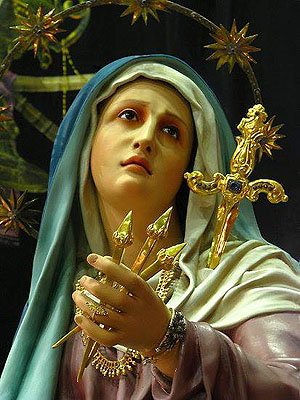


.jpg)