|
Slavery
|
| |
|
|
Slaves, submit yourselves to your
masters with all respect, not only to those who are
good and considerate, but also to those who are harsh.
|
|
1 Peter 2:18 (NIV)
|
 
Biblical Underpinning for Slavery
For many centuries slavery was perfectly acceptable to Christians.
Christians had no doubt that it was divinely sanctioned, and
they used a number of Old and New Testament quotations to prove
their case. Looking at the relevant passages it is clear that
the Bible does indeed endorse slavery. In the Old Testament
God approved the practice and laid down rules for buyers and
sellers (Exodus 21:1-11, Leviticus 25:44). Men are at liberty
to sell their own daughters (Exodus 21:7). Slaves can be inherited
(Leviticus 25:45-6). It is acceptable to beat slaves, since
they are property — a master who beats his slave to death
is not to be punished as long as the slave stays alive for a
day or two, as the loss of the master's property is punishment
enough:
And if a man smite his servant, or his maid, with a rod,
and he die under his hand; he shall be surely punished. Notwithstanding,
if he continue a day or two, he shall not be punished: for
he is his money. Exodus 21:20-211
 If
a slave is gored by a bull, it is the master, not the slave,
who is to be compensated (Exodus 21:32). Time and time again
the Old Testament confirms that slaves are property and their
lives are of little consequence. To prove the strength of Job's
faith, God sends Satan to test him by visiting disasters upon
him. Amongst these disasters is the killing of Job's numerous
slaves (Job 1). Neither God, nor Satan, nor the story's narrator
finds it at all odd that people should be killed just to prove
a point: they are only Job's property and their destruction
is naturally bracketed with the loss of his livestock and vineyards. If
a slave is gored by a bull, it is the master, not the slave,
who is to be compensated (Exodus 21:32). Time and time again
the Old Testament confirms that slaves are property and their
lives are of little consequence. To prove the strength of Job's
faith, God sends Satan to test him by visiting disasters upon
him. Amongst these disasters is the killing of Job's numerous
slaves (Job 1). Neither God, nor Satan, nor the story's narrator
finds it at all odd that people should be killed just to prove
a point: they are only Job's property and their destruction
is naturally bracketed with the loss of his livestock and vineyards.
The New Testament also regards slavery as acceptable. It instructs
slaves to accept their position with humility (Ephesians 6:5-8)
and to please their masters in everything (Titus 2:9, cf. Colossians
3:22). They are commanded to serve Christian slave owners better
than other masters (1 Timothy 6:1-2) "so that the name
of God and the teaching may not be defamed". Even oppressive
masters are to be obeyed according to 1 Peter 2:18. Jesus himself
mentioned slavery more than once according to the New Testament,
but never with the slightest hint of criticism of it. He even
glorified the master-slave relationship as a model of the relationship
between God and humankind (Matthew 18:23ff and 25:14ff). Christians
naturally interpreted this as not merely acceptance, but approval.
If Jesus had opposed slavery he would, they claimed, surely
have said so. .
Early Christianity and Slavery
In pre-Christian times and in non-Christian countries people
expressed doubts about slavery and sought to improve the lot
of slaves — the Stoic philosophers provide a notable example.
In pagan times slaves who escaped and sought sanctuary at a
holy temple would not be returned to their masters if they had
a justifiable complaint. When the Empire became Christian, escaped
slaves could seek refuge in a church, but they would always
be returned to their masters, whether they had a justifiable
complaint or not. When Christian slaves in the early Asian Church
suggested that community funds might be used to purchase their
freedom, they were soon disabused of their hopes, a line supported
by one of the greatest Church Fathers (Ignatius
of Antioch.). He declared that their ambition should be
to become better slaves, and they should not expect the Church
to gain their liberty for them2.
His orthodox approach followed the words of St Paul: "Each
one should remain in the situation which he was in when God
called him. Were you a slave when you were called? Don't let
it trouble you — although if you can gain your freedom,
do so." (1 Corinthians 7:20-21 NIV).
|
The Slave Market (c1882) by Gustave
Boulanger (1824 – 1888)
A Roman slave market - the older man sitting on the platform
is the auctioneer.
|
|
|
|
|
 When
the Roman Empire became Christian under the Emperor Constantine,
the institution of slavery remained unaltered, except for superficial
changes. For example, ceremonies of manumission were transferred
from temples to Christian Churches, and places of sanctuary
were restricted to Christian sites. When
the Roman Empire became Christian under the Emperor Constantine,
the institution of slavery remained unaltered, except for superficial
changes. For example, ceremonies of manumission were transferred
from temples to Christian Churches, and places of sanctuary
were restricted to Christian sites.
Church Fathers instructed the faithful not to let slaves get
above themselves, and the Church endorsed Saint
Augustine's view that slavery was ordained by God as a
punishment for sin3.
Augustine called on the free to give thanks because Christ and
his Church did not make slaves free, but rather made bad slaves
into good slaves. St. Augustine teaching that the institution
of slavery derives from God and is beneficial to both slaves
and masters would be cited by many later Popes as evidence,
indeed proof, of the acceptability of slavery. It was an integral
part of the Christian "Tradition"
one of the main sources of authority in the Church.
In 362 AD a Church Council at Gangra in Asia Minor excommunicated
anyone encouraging a slave to despise his master or to withdraw
from his service. This would in time be incorporated into Church
Law, where it would remain from the 13th to the 20th century.
 Soon
the Church would become the largest slave owner in the Roman
Empire. Bishops themselves owned slaves and accepted the usual
conventions. So did other churchmen. Slave collars dating from
around AD 500 have been found in Sardinia, stamped with the
sign of the cross. One mentions the name "Felix the Archdeacon"4.
"I am a slave of Felix the archdeacon: hold me lest I run
away". Some 40 collars (or slave pendants) survive from
antiquity, almost all of them from the fourth century, from
Rome, Africa and Sardinia. Many of the collars feature Christian
symbols such the chi-rho christogram or a Christian cross, showing
that the slave owners were Christians. We know of other slave
owning Christians in various ways, for example one, Ausonius
,recorded having tattooed his recaptured runaway slave on the
forehead 5
(the significance seems to have been guilt about tattooing,
because tattooing was banned by the bible) Soon
the Church would become the largest slave owner in the Roman
Empire. Bishops themselves owned slaves and accepted the usual
conventions. So did other churchmen. Slave collars dating from
around AD 500 have been found in Sardinia, stamped with the
sign of the cross. One mentions the name "Felix the Archdeacon"4.
"I am a slave of Felix the archdeacon: hold me lest I run
away". Some 40 collars (or slave pendants) survive from
antiquity, almost all of them from the fourth century, from
Rome, Africa and Sardinia. Many of the collars feature Christian
symbols such the chi-rho christogram or a Christian cross, showing
that the slave owners were Christians. We know of other slave
owning Christians in various ways, for example one, Ausonius
,recorded having tattooed his recaptured runaway slave on the
forehead 5
(the significance seems to have been guilt about tattooing,
because tattooing was banned by the bible)
Pagan slaves who wanted to become Christians required permission
from their masters. For many centuries, indeed right up to recent
times, servile birth was a bar to Christian ordination, and
the Church confirmed the acceptability of slavery in many other
ways. The Christian Emperor Constantine (or possibly his predecessor
Licinius) issued a law requiring slaves caught fleeing into
barbarian territories to be sent to the mines, or to have a
foot amputated6.
This law was not rescinded by the string of Christian Emperors,
who headed the Christian Church under the system of caesaropapalism.
The Christian Roman Empire actively helped slave owners to recover
fugitive slaves, and punished anyone giving them shelter. 7.
Priests and bishops were required by Cannon Law to return to
their masters any Christians seeking sanctuary in churches8.
Even slaves who sought refuge in monasteries were to be returned.9.
Ecclesiastical networks were employed in the identification
and recovery of fugitive slaves.10.
Saint Jerome
was one who shopped a fugitive slave of one of his friends11
 Around
600, Pope Gregory the Great approved of forcing Jewish slaves
to convert by "lashes and tortures"12.
When he needed Anglian slaves he wrote to a Church official
to procure them for him13.
On another occasion he had slaves procured from Sardinia.14.
In 650 Pope Martin I condemned anyone teaching slaves about
freedom or encouraging them to escape their bonds. Around
600, Pope Gregory the Great approved of forcing Jewish slaves
to convert by "lashes and tortures"12.
When he needed Anglian slaves he wrote to a Church official
to procure them for him13.
On another occasion he had slaves procured from Sardinia.14.
In 650 Pope Martin I condemned anyone teaching slaves about
freedom or encouraging them to escape their bonds.
Slavery in Medieval Christendom
A Church Council of Châlons in 813 decreed that slaves
belonging to different owners could not marry without their
owners' consent. It had been common for pagan Greeks and Romans
to emancipate their slaves, but the emancipation of the Church's
slaves was declared impossible, on the grounds that the slaves
were owned not by the clergy but by God himself, and only the
slave owner could legally dispose of his goods. Church slaves
were thus inalienable property. (This principle would be enshrined
in canon law in respect of monastic slaves under the Decretum
gratiani c.1140.) Church law contained other provisions
regulating the marriage of slaves15.
Here are a few examples:
To eject a slave girl from one's bed and take one free to
become a wife does not produce a second marriage but advances
decency. (Decretum gratiani, Case 32, q II, C11)
It is lawful matrimony when a woman is given to a man with
a concubine.
Not every woman joined to a man is his wife, just as not every
son is his father's heir. The bonds of marriage between free
persons and between co-equals are lawful, and the Lord established
them long before the beginnings of the Roman law. Thus, a
wife is different from a concubine, just as the slave girl
was different from the free woman [cf. Gal. 4:30]. (Decretum
gratiani, Case 32, q II, C12)
[on the question of who has the right to agree a marriage
of the daughter of a slave if she has a free uncle, with reference
to a specific case where the father was a slave of the church]:
A girl should obey the decision of her free uncle concerning
her marriage, not that of her slave father. The girl's father
was clearly your church's slave, and her uncle was of free
stock. We therefore decree that the choice of the niece's
husband belongs to her uncle, rather than to her father, because
his will is not free.
Gratian: So this approves her marrying her uncle's choice,
and clearly shows that she is lawfully joined. (Decretum
gratiani, Case 32, q III, C1)
 Gratian:
That one may seek children from a slave girl if one's wife
is sterile, is shown by the example of Abraham [Gen. 16:2-3],
who, because of his wife Sarai's sterility, went in to Hagar
the Egyptian to have children from her. Also, Jacob [Gen.
30:1-5], when he could not have children from Rachel, raised
them up from his slave girl. This was not merely because of
her sterility, for one reads that he also went in to Leah's
slave girl and sired children from her because of Leah's declining
fertility. This indicates that, on account of a wife's sterility,
one can lawfully seek children from a slave girl or some other
woman. Otherwise, Abraham and Jacob would be guilty of adultery.
(Decretum gratiani, Case 32, q IV, Part 1) Gratian:
That one may seek children from a slave girl if one's wife
is sterile, is shown by the example of Abraham [Gen. 16:2-3],
who, because of his wife Sarai's sterility, went in to Hagar
the Egyptian to have children from her. Also, Jacob [Gen.
30:1-5], when he could not have children from Rachel, raised
them up from his slave girl. This was not merely because of
her sterility, for one reads that he also went in to Leah's
slave girl and sired children from her because of Leah's declining
fertility. This indicates that, on account of a wife's sterility,
one can lawfully seek children from a slave girl or some other
woman. Otherwise, Abraham and Jacob would be guilty of adultery.
(Decretum gratiani, Case 32, q IV, Part 1)
Abraham, who had sons by a slave girl while his wife was
alive, was not guilty of adultery. (Decretum gratiani,
Case 32, q IV, C3)
Children inherit their parents' status. They are free who
issue from a free marriage. The children of a free man and
a slave girl are of servile condition. Those born always follow
the worse part. (Decretum gratiani, Case 32, q IV, C15)
A slave manumitted on condition that he become a monk or
serve a monastery should be compelled to obey the desire of
the one manumitting, or should be returned to servility if
he prefers that. (Decretals of Gregory IX, Book Four, Conditions
Set in Betrothals or Other Contracts, C. 2.)
If a free man has unknowingly contracted with a slave girl,
and did not consent when he discovered this, the matrimony
may be put asunder, and he can contract with another (Decretals
of Gregory IX, Book Four, Title VIII, C. 4).16
The Church found new reasons to take people into slavery. The
Third Synod of Toledo in 589 decreed that women found in the
houses of a clergyman in suspicious circumstances should be
sold into slavery by the clergyman's bishop17.
Another synod of 655 declared that priests' children should
be treated as slaves — an idea ratified in 1022 at Pavia
and around 1140 by the Decretum gratiani. In attempting
to enforce clerical celibacy popes revived the idea of taking
the wives and concubines of churchmen into slavery18.
Leo IX (Pope 1049-1054) had priests' wives taken into slavery
for service at the Lateran Palace19.
At the Synod of Melfi, in 1089, Pope Urban II tried the idea
against subdeacons' wives20.
In 1095 wives of priests were sold into slavery — presumably
the Lateran had a full complement of female slaves by then.
Saints, popes and Church officials approved the practice of
slavery for centuries. The Church's greatest scholastic authorities,
such as Thomas Aquinas, Albertus Magnus and Duns Scotus concurred.
As Aquinas explained, a slave was merely an "inspired tool
of his master" and a "non-member of society",
just like any other beast of burden. Slaves were listed in inventories
under "Church property". He defended slavery as having
been instituted by God as punishment for sin. He justified it
as being part of the 'right of nations' and of natural law.
He confirmed the view that children of a slave mother become
slaves even though they have not committed personal sin, a view
cited and confirmed by later Popes.
 Popes
sentenced millions to slavery, although the sentences could
not always be carried out. The Third Lateran Council 1179 imposed
slavery on those helping the Saracens. The same council also
imposed slavery on anyone who opposed the papacy. The citizens
of Venice were condemned to slavery in 1309, 1482, and again
in 1506. The same thing happened to the whole of England in
1508. Papal galleys went on slave-hunting expeditions along
the coast of Africa. Popes
sentenced millions to slavery, although the sentences could
not always be carried out. The Third Lateran Council 1179 imposed
slavery on those helping the Saracens. The same council also
imposed slavery on anyone who opposed the papacy. The citizens
of Venice were condemned to slavery in 1309, 1482, and again
in 1506. The same thing happened to the whole of England in
1508. Papal galleys went on slave-hunting expeditions along
the coast of Africa.
In 1226 the legitimacy of slavery was confirmed in the Corpus
Iuris Canonici, promulgated by Pope Gregory IX. This would
remain part of Church the law until 1913. Canon lawyers worked
out four "just titles" for holding slaves:
 slaves
captured in war, slaves
captured in war, - persons condemned to slavery for a crime;
- persons selling themselves into slavery, including a father
selling his child;
- children of a mother who is a slave.
Slavery was a major trade in Christendom. Until the early tenth
century the main Venetian export was slaves from central Europe.
The English word Slav is derived from the Middle English
word sclave, borrowed from Medieval Latin sclavus
meaning slave - a reminder of the European Christian slave trade
of the day in central Europe. This was not the only Christian
slave trade in Christendom. During the Crusades a large Mediterranean
slave trade was concentrated in Christian hands — the hands
of the military monks and men like Pelius, a papal legate. Later
the Genoese developed another major Mediterranean slave trade21.
The Portuguese Slave Trade
 Pope
Nicholas V issued the papal bull Dum diversas on 18 June,
1452. It authorised King Alfonso V of Portugal to reduce any
"Saracens (Muslims) and pagans and any other unbelievers
to perpetual slavery. He issued another bull Romanus pontifex
on January 5, 1455 also addressed to King Alfonso. It extended
dominion over newly discovered lands to the Catholic nations
of Europe. It sanctified the seizure of non-Christian lands,
and encouraged the enslavement of native, non-Christian peoples
throughout the World: Pope
Nicholas V issued the papal bull Dum diversas on 18 June,
1452. It authorised King Alfonso V of Portugal to reduce any
"Saracens (Muslims) and pagans and any other unbelievers
to perpetual slavery. He issued another bull Romanus pontifex
on January 5, 1455 also addressed to King Alfonso. It extended
dominion over newly discovered lands to the Catholic nations
of Europe. It sanctified the seizure of non-Christian lands,
and encouraged the enslavement of native, non-Christian peoples
throughout the World:
We, weighing all and singular the premises with due meditation,
and noting that since we had formerly by other letters of
ours granted among other things free and ample faculty to
the aforesaid King Alfonso -- to invade, search out, capture,
vanquish, and subdue all Saracens and pagans whatsoever, and
other enemies of Christ wheresoever placed, and the kingdoms,
dukedoms, principalities, dominions, possessions, and all
movable and immovable goods whatsoever held and possessed
by them and to reduce their persons to perpetual slavery,
and to apply and appropriate to himself and his successors
the kingdoms, dukedoms, counties, principalities, dominions,
possessions, and goods, and to convert them to his and their
use and profit -- by having secured the said faculty, the
said King Alfonso, or, by his authority, the aforesaid infante,
justly and lawfully has acquired and possessed, and doth possess,
these islands, lands, harbors, and seas, and they do of right
belong and pertain to the said King Alfonso and his successors.
|
Slaves being brought to Brazil in a Portuguese
Caravel
|
|
|
|
|
Benedictine monks still owned slaves in Brazil as late as 1864,
around the same time that clergymen in the southern states of
the USA were obliged to give up their slaves.
Spanish Slavery
The Spanish
Inquisition were keen slavers. A single inquisitor, Torquemada,
had 97,371 people condemned to slavery. The practice was not
restricted to mainland Spain. Spain also ruled an empire. Pope
Nicholas V, in his bull Romanus pontifex of 1455, had
given his blessing to the enslavement of conquered native people,
by Catholics, whether Portuguese or Spanish.
In 1493 (the year after Columbus discovered the America) Pope
Alexander VI made explicit the rights of Catholics in the Americas.
He authorised the King of Spain to enslave non-Christians of
the Americas at war with Catholic powers - in other words anyone
who resisted the invasion and seizure of their land.
Like other bishops, the popes themselves owned slaves —
Pope Innocent VIII accepted the gift of numerous slaves from
Malaga, given by the exceptionally devout Queen Isabella of
Castile in 1487.
To clear up any doubt about who was entitled to own slaves,
Pope Paul III confirmed in 1548 that all Christian men and all
members of the clergy had the right to own slaves.
The British Slave Trade
 The
record of the Anglican Church was no better than that of the
Roman Church. It was the universal opinion of churchmen that
God had ordained slavery, and clergymen had no qualms about
owning slaves themselves. Anglican slave traders were often
extremely devout, and widely respected by their fellow Christians.
It never occurred to them, or to their priests or ministers,
that slave trading might be immoral. The most famous English
slave trader, Sir John Hawkins, named his slave ships Angel,
Jesus and Grace of God. The
record of the Anglican Church was no better than that of the
Roman Church. It was the universal opinion of churchmen that
God had ordained slavery, and clergymen had no qualms about
owning slaves themselves. Anglican slave traders were often
extremely devout, and widely respected by their fellow Christians.
It never occurred to them, or to their priests or ministers,
that slave trading might be immoral. The most famous English
slave trader, Sir John Hawkins, named his slave ships Angel,
Jesus and Grace of God.
 Hawkins,
a cousin of Sir Francis Drake, had been granted permission from
Queen Elizabeth for his first voyage in 1562. He was allowed
to carry Africans to the Americas "with their own free
consent". He agreed to this condition, and set sail in
the Jesus, a ship lent by the Queen, which her father
had bought as Jesus of Lubeck from the Hanseatic League. Hawkins,
a cousin of Sir Francis Drake, had been granted permission from
Queen Elizabeth for his first voyage in 1562. He was allowed
to carry Africans to the Americas "with their own free
consent". He agreed to this condition, and set sail in
the Jesus, a ship lent by the Queen, which her father
had bought as Jesus of Lubeck from the Hanseatic League.
Hawkins had a reputation for being a religious man who required
his crew to "serve God daily". Sir Francis Drake,
who accompanied Hawkins, was also devoutly religious. Services
were held on board twice a day. Hawkins sold most of the slaves
in what is now the Dominican Republic. He came home with ships
laden with ivory, hides, and sugar. Queen Elizabeth, livid that
slaves had been acquired without their free consent, assailed
Hawkins for his detestable behaviour, but soon changed her opinion.
When she learned of the profits, the devout Elizabeth joined
in partnership with Hawkins to organise fresh expeditions. So
began the British slave trade. Hawkins was granted a coat of
arms with a crest consisting of a slave ("a bound negro
issuant proper.")
|
Packing slaves onto a deck of a slave
ship called The Brookes..
The iconic Brookes print, designed in Plymouth, UK, in
1788 depicted the conditions on board the slave ship The
image portrayed slaves arranged in accordance with the
Regulated Slave Trade Act of 1788. The Brookes was reportedly
allowed to stow 454 African slaves, by allowing a space
of 6 feet (1.8 m) by 1 foot 4 inches (0.41 m) to each
man; 5 feet 10 inches (1.78 m) by 1 foot 4 inches (0.41
m) to each women, and 5 feet (1.5 m) by 1 foot 2 inches
(0.36 m) to each child.
|
|
|
|
|
Churchmen owned slaves and were not particularly notable as
good masters. Indeed some of the worst masters were clergymen.
In the court of St Ann's in Jamaica in 1829, the Rev. G. W.
Bridges was charged with maltreating a female slave. For a trivial
mistake he had stripped her, tied her by the hands to the ceiling
so that her toes hardly touched the ground, then flogged her
with a bamboo rod until she was a "mass of lacerated flesh
and gore" from her shoulders to her calves. Cases like
this rarely came to court, but when they did they generally
ended in acquital, as in this case, so the Reverend gentleman
walked free.
The Reverend Richard Fuller summed up the Church's position
in 1845: “What God sanctioned in the Old Testament, and
permitted in the New, cannot be a sin”22.
|
Enslaved men, women and children
|
|
|
|
|
Only one Christian leader of any note was opposed to slavery,
John Wesley. Here are a few of his observations on slaves and
their treatment.
As to the punishments inflicted on them, says Sir Hans Sloan,
"They frequently geld them, or chop off half a foot:
After they are whipped till they are raw all over, some put
pepper and salt upon them: Some drop melted wax upon their
skin. Others cut off their ears, and constrain them to broil
and eat them. "For Rebellion," (that is, asserting
their native Liberty, which they have as much right to as
the air they breathe) "they fasten them down to the ground
with crooked sticks on every limb, and then applying fire
by degrees, to the feet and hands, they burn them gradually
upward to the head."
(John Wesley: Tracts and Letters on Various Subjects,
New York, 1827, vol X, p496-7)
And again, an account of Christian
sadism:
The
author of the history of Jamaica, wrote about the year 1740,
in his account of the sufferings of the negroes, says, The
people of that island have indeed the severest ways of punishing;
no country exceeds them in a barbarous treatment of their
slaves, or in the cruel methods by which they are put to death.
After confirming what is before said he adds, "They starve
them to death, with a loaf hanging over their mouths. I have
seen these unfortunate wretches gnaw the flesh off their shoulders,
and expire in all the frightful agonies of one under the most
horrible tortures. He adds, I incline to touch the hardship
which these poor creatures suffer in the tenderest manner,
from a particular regard which I have to many of their masters;
but I cannot conceal their sad circumstances entirely: the
most trivial error is punished with terrible whipping. I have
seen some of them treated in that cruel manner, for no other
reason but to satisfy the brutish pleasure of an overseer,
who has their punishment mostly at his discretion. I have
seen their bodies all in a gore of blood, the skin torn off
their backs with the cruel whip, beaten pepper and salt rubbed
in the wounds, and a large slick of sealing-wax dropped leisurely
upon them. It is no wonder, (adds this author) if the horrid
pain of such inhuman tortures incline them to rebel."
(John Wesley, A. M., Thoughts Upon Slavery, London:
Re-printed in Philadelphia, with notes, and sold by Joseph
Crookshank, 1778, p 25)
 On
the Law of Barbados, which imposed a light penalty for killing
a slave: On
the Law of Barbados, which imposed a light penalty for killing
a slave:
.... "If any negro under punishment, by his master,
or his order, for running away, or any other crime or misdemeanor,
shall suffer in life or member, no person whatever shall be
liable to any fine therefore. But if any man of WANTONNESS,
or only of BLOODY-MINDEDNESS OR CRUEL INTENTION, wilfully
kill a Negro of his own" (Now observe the severe punishment!)
"He shall pay into the public treasury fifteen pounds
sterling! And not be liable to any other punishment or forfeiture
for the same!"
(John Wesley, A. M., Thoughts Upon Slavery, London: Re-printed
in Philadelphia, with notes, and sold by Joseph Crookshank,
1778, p 32)
|
Detail of the above. This man has his
hands tied behind his back, and is hanging from a gibbet
by a metal hook, hooked around a single rib.
|
|
|
In Jamaica the killing of a slave appears to have been unremarkable:
Another instance fell under the immediate notice of a person
of credit, when in the island of Jamaica, now residing in
this city. Hearing a grievous cry, he went to the place from
whence it came, where he saw a young Negro woman of about
eighteen years of age, swung by her hands, with heavy weights
at her feet, and a man lashing her naked body with a hard
whip; making pauses from time to time, and flinging pickle
or salt and water on the wounds, the whip had made. The sight
was so horrible, that he turned from it and came home. Sometime
after, looking out, he saw this same young woman carried dead
on a board: She had been cruelly whipped to death; neither
did he observe that this pitious spectacle drew the concern
or hardly attention of the people.
(John Wesley, A. M., Thoughts Upon Slavery, London:
Re-printed in Philadelphia, with notes, and sold by Joseph
Crookshank, 1778, p 72)
|
Wesley's views on slavery were not shared
by his fellow Methodists - as this cartoon of 1844 points
out, slave holders had been permitted to be members of
God's Church since apostolic times, and abolitionists
were servants of the Devil.
|
|
|
|
|
Two vocal Methodists abolitionists, Laroy Sunderland and Orange
Scott, had faced such opposition from their coreligionists,
that they left the Methodist Episcopal (ME) Church and helped
organize the Wesleyan Methodist Church in 1843.
|
1792 British cartoon by Isaac Cruikshank
representing a true event, in which Captain John Kimber
had a 15 year old captive suspended, whipped, and tortured,
causing her death, for her 'virgin modesty.' Kimber was
tried for this and for the murder of another captive,
but was 'honorably acquitted.'
|
|
|
|
|
While Thomas Paine opposed slavery in America, his fellow freethinkers
opposed it in his native country. Granville Sharp, a British
humanitarian lawyer, sought to bring cases before the courts,
arguing that throwing slaves overboard to drown was murder.
(The prevailing Christian view was that a ship's captain was
free to jettison them, just like any other property23.)
Within a few years, by 1787, a campaign to abolish the Atlantic
slave trade was started by a group of Quakers24.
It was supported by non-believers. As the movement grew, various
nonconformist groups and some evangelical Christians joined
it, but all traditional Churches and mainstream Christian sects
consistently opposed it.
|
On November 29th, 1781 the crew of the
slave ship Zong threw 133 - 142 African slaves overboard
(because of a shortage of water). The owners subsequently
made an insurance claim for the loss of their "cargo".
The claim was disputed and gave rise to a legal case (Gregson
v Gilbert (1783) 3 Doug. KB 232). The (Christian) English
court held that in certain circumstances, the deliberate
killing of slaves was legal and that insurers could be
required to pay for the slaves' deaths, though in this
case the slave owners lost, due to evidence being introduced
suggesting fault on behalf of the captain and crew.
Image from French, A. M. (Austa Malinda),
Slavery in South Carolina and the ex-slaves; or, The
Port Royal Mission., New York, W.M. French, 1862
|
|
|
|
|
William Wilberforce is usually accredited with abolition of
the slave trade in the British Empire, although he came many
years after the first abolitionist campaigners. He too was an
unbeliever when he espoused abolition. Later as an evangelical
he was able to sit in Parliament (which unbelievers were not).
There he stood out amongst his fellow Christians as an exception.
He noted that those who opposed slavery were nonconformists
and godless reformers, and that Church people were indifferent
to the cause of abolition, or else actively obstructed it. His
support came from Quakers, Utilitarians and assorted freethinkers.
Like the freethinkers who had started the movement, he was condemned
by the mainstream Churches as presuming to know better than
the Bible. His successor, Sir Thomas Buxton, was another maverick,
an evangelical with Quaker sympathies.
 The
Church had enjoyed 1,500 years during which it had had the power
to ban slavery but had failed to do so, or even to have expressed
any desire to do so. (The Anglican Church's missionary organisation,
the Society for the Propagation of the Gospel in Foreign Parts,
had been branding its slaves on the chest with the word
SOCIETY to show who owned them. Bishops of London and archbishops
of York were involved in the management of the Society, while
its governing body included archbishops of Canterbury. One Archbishop
of Canterbury, the Most Rev Thomas Secker, wrote to a fellow
bishop in 1760 about slave deaths, his concern apparently being
for the financial implications: "I have long wondered and
lamented that the Negroes in our plantation decrease and new
supplies become necessary continually... Surely this proceeds
from some defect, both of humanity and even of good policy.
But we must take things as they are at present." The
Church had enjoyed 1,500 years during which it had had the power
to ban slavery but had failed to do so, or even to have expressed
any desire to do so. (The Anglican Church's missionary organisation,
the Society for the Propagation of the Gospel in Foreign Parts,
had been branding its slaves on the chest with the word
SOCIETY to show who owned them. Bishops of London and archbishops
of York were involved in the management of the Society, while
its governing body included archbishops of Canterbury. One Archbishop
of Canterbury, the Most Rev Thomas Secker, wrote to a fellow
bishop in 1760 about slave deaths, his concern apparently being
for the financial implications: "I have long wondered and
lamented that the Negroes in our plantation decrease and new
supplies become necessary continually... Surely this proceeds
from some defect, both of humanity and even of good policy.
But we must take things as they are at present."
Once reform was in the air, the mainstream churches opposed
it with all their power. They vilified reformers (including
Wilberforce) and attacked them for daring to question the plain
word of God. Anglican clergymen still owned slaves and continued
to oppose abolition well into the nineteenth century. One of
their number was the most effective supporter of slavery during
the 1820s abolitionist campaign in Jamaica25.
All mainstream Churches agreed with the traditional view that
slavery was ordained by God. To practice slavery was therefore
meritorious, and to try to stop the practice was sinful. With
the exception of Quakers, and John Wesley, all denominations
agreed.
|
The two hundredth anniversary of the
abolition of the British slave trade was commemorated
in 2007
|
|
|
|
|
In 1807 Britain became the first major power to permanently
abolish the slave trade, but slave owning was still legal in
the colonies. When the British parliament voted to abolish slavery
in the colonies in 1833, the Bench of Bishops voted against
— as they did on almost all reform bills. To get the bill
through, Parliament voted to compensate slave owners (There
was no compensation for the slaves themselves). The Abolition
of Slavery Act of 1833 provided for £20 million to
be paid to West Indian plantation slave owners in compensation
for the loss of their 'property'. The Anglican Church received
£8,823 8s 9d, for the loss of slave labour on its Codrington
plantation in the West Indies.
Individual Anglican Churchmen had to be compensated separately.
Henry Phillpotts, Bishop of Exeter, and three business associates
received nearly £13,00026.
|
Compensation recorded in the British
Parliamentary Papers 1836 (597) vol. 49.
(The total actually comes to £12,729 5s 2d)
|
|
The Bishop, the Right Rev Henry Philpotts, together
with three partners received:
£4,836 4sh 7d for 236 slaves in the parish
of Vere, Middlesex County, Jamaica.
£5,480 13sh 11d for 304 slaves in the parish
of Clarendon, Mdx, Jamaica.
£2, 412 6sh 8d for slaves also in the parish
of Clarendon.
Total of £12,729 4sh 4d for 665 slaves.
|
|
French Slavery in the New World - The
Code Noire
The Code Noir (The Black Code) sets out French slave policy
regarding the Islands of French America. The Code initially
took the form of King Louis XIV's edict of 1685. Subsequent
decrees modified a few of the code's provisions, but this first
document established the principles for the policing of slavery
up to 1789. The code set out a number of rights and responsibilities,
mainly concerning slavery but also mentioning Jews.
Below are some notable highlights. It lays great emphasis on
the Roman Catholic religion. For the full text click on the
following link to the Code
Noire.
… reports inform us of [our officer's] need
for our authority and our justice in order to maintain the discipline
of the Roman, Catholic, and Apostolic Faith in the islands.
Our authority is also required to settle issues dealing with
the condition and quality of the slaves in said islands.
Article I. … we enjoin all of our officers to chase
from our islands all the Jews who have established residence
there. As with all declared enemies of Christianity, we command
them to be gone within three months of the day of issuance
of the present [order], at the risk of confiscation of their
persons and their goods.
...
Article III. We forbid any religion other than the Roman,
Catholic, and Apostolic Faith from being practiced in public.
We desire that offenders be punished as rebels disobedient
of our orders. We forbid any gathering to that end, which
we declare to be conventicle, illegal, and seditious, and
subject to the same punishment as would be applicable to the
masters who permit it or accept it from their slaves.
Article IV. No persons assigned to positions of authority
over Negroes shall be other than a member of the Roman, Catholic,
and Apostolic Faith…
Article V. We forbid our subjects who belong to the so-called
"reformed" religion from causing any trouble or
unforeseen difficulties for our other subjects or even for
their own slaves in the free exercise of the Roman, Catholic,
and Apostolic Faith, at the risk of exemplary punishment.
Article VIII. We declare that our subjects who are not of
the Roman, Catholic, and Apostolic Faith, are incapable of
contracting a valid marriage in the future. We declare any
child born from such unions to be bastards, and we desire
that said marriages be held and reputed, and to hold and repute,
as actual concubinage.
Article XI. We forbid priests from conducting weddings between
slaves if it appears that they do not have their masters'
permission. We also forbid masters from using any constraints
on their slaves to marry them without their wishes.
Article XII. Children born from marriages between slaves
shall be slaves, and if the husband and wife have different
masters, they shall belong to the masters of the female slave,
not to the master of her husband.
Article XVI. We also forbid slaves who belong to different
masters from gathering, either during the day or at night,
under the pretext of a wedding or other excuse, either at
one of the master's houses or elsewhere, and especially not
in major roads or isolated locations. They shall risk corporal
punishment that shall not be less than the whip and the fleur
de lys, and for frequent recidivists and in other aggravating
circumstances, they may be punished with death, a decision
we leave to their judge. ..
Article XXXI. Slaves shall not be a party, either in court
or in a civil matter, either as a litigant or as a defendant,
or as a civil party in a criminal matter…
Article XXXVIII. The fugitive slave who has been on the run
for one month from the day his master reported him to the
police, shall have his ears cut off and shall be branded with
a fleur de lys on one shoulder. If he commits the same infraction
for another month, again counting from the day he is reported,
he shall have his hamstring cut and be branded with a fleur
de lys on the other shoulder. The third time, he shall be
put to death.
Article XLII. The masters may also, when they believe that
their slaves so deserve, chain them and have them beaten with
rods or straps…
Article XLIV. We declare slaves to be charges, and as such
enter into community property. They are not to be mortgaged,
and shall be shared equally between the co-inheritors without
benefit to the wife or one particular inheritor...
Slavery in North America
Slaves in the US were mere property, even in so-called free
states, as confirmed in the case of Dred Scott v. Sanford (60
U.S. 393 (1857)). A slave named Dred Scott tried to sue his
master, Dr. John Emerson, a surgeon in the US Army, for his
freedom and that of his wife and their two daughters, on the
grounds that they had moved to free states and that the slave
family, was therefore free. The United States Supreme Court
decided by 7–2 against Scott, finding that neither he nor
any other person of African ancestry could claim citizenship
in the United States, and therefore could not bring suit in
federal court under diversity of citizenship rules. The Court
held that Congress had no authority to prohibit slavery in federal
territories because slaves are personal property and the Fifth
Amendment to the Constitution protected property owners against
deprivation of their property without due process of law. According
to Chief Justice Roger B. Taney, the authors of the Constitution
had viewed all blacks as "beings of an inferior order,
and altogether unfit to associate with the white race, either
in social or political relations, and so far inferior that they
had no rights which the white man was bound to respect"
|
Virginia Statutes: ACT XII (1662)
That the children of slave women were always slaves themselves
was a principle of Church Law, that had been carried over
into Civil Law before the Revolution
( Under English common law, the father’s status determined
his children’s status)
|
|
Negro women's children to serve according to
the condition of the mother
Whereas some doubts have arisen whether children
got by any Englishman upon a negro woman should
be slave or free, Be it therefore enacted and declared
by this present grand assembly, that all children
borne in this country shall be held bond or free
only according to the condition of the mother, and
that if any Christian shall commit fornication with
a negro man or woman, he or she so offending shall
pay double the fines imposed by the former act.
|
|
|
Slave Advertisement, Charleston, South
Carolina, 1780s
Slaves were regarded like livestock - healthy specimens
commanded higher prices.
|
|
|
|
|
 Since
they were merely property, there could be no objection to branding
slaves just like any other animal. Neither was there any obligation
to treat them more humanely than animals in other ways. Their
prices depended on supply and demand like any other commodity.
Female breeders would be sold at premium prices after the importation
of African slaves to North America and the Caribbean ceased.
Sometimes slaves were hamstrung to stop them escaping. If they
had escaped before, they could have a leg amputated to stop
them doing so again. Once their working lives were over, they
were put down27.
Black slaves in the Caribbean and Americas received little education,
but what they were allowed was mainly religious. Preachers tended
to concentrate on biblical passages, such as those already quoted
that endorsed slavery and counselled passive acceptance of it.
Surviving texts show that among missionaries, the problem of
preventing slaves from enjoying themselves on the Sabbath was
more important than the question of slavery itself28. Since
they were merely property, there could be no objection to branding
slaves just like any other animal. Neither was there any obligation
to treat them more humanely than animals in other ways. Their
prices depended on supply and demand like any other commodity.
Female breeders would be sold at premium prices after the importation
of African slaves to North America and the Caribbean ceased.
Sometimes slaves were hamstrung to stop them escaping. If they
had escaped before, they could have a leg amputated to stop
them doing so again. Once their working lives were over, they
were put down27.
Black slaves in the Caribbean and Americas received little education,
but what they were allowed was mainly religious. Preachers tended
to concentrate on biblical passages, such as those already quoted
that endorsed slavery and counselled passive acceptance of it.
Surviving texts show that among missionaries, the problem of
preventing slaves from enjoying themselves on the Sabbath was
more important than the question of slavery itself28.
Here is John Wesley on the Law in Virginia. (Note that the
officials responsible for dealing with escaped slaves are not
state officials, but Church officials):
The law of Virginia ordains, "That no slave shall be
set free, under any pretence whatever, except for some meritorious
services, to be adjudged and allowed by the governor and council:
And that where any slave shall be set free by his owner, otherwise
than is herein directed, the church-wardens of the parish
wherein such Negro shall reside for the space of one month
are hereby authorized and required, to take up and sell the
said Negro, by public outcry."
And Wesley on the law of Virginia allowing any method of torturing
to death slaves who ran away from their owners:
"After proclamation is issued against slaves that run
away, it is lawful for any person whatsoever to KILL AND DESTROY
such slaves, by SUCH WAYS AND MEANS AS HE SHALL THINK FIT.
We have seen already some of the ways and means which have
been thought fit on such occasions. And many more might be
mentioned. One gentleman, when I was abroad thought fit to
roast his slave alive!
 Tellingly,
the pro-slavery Confederacy adopted the motto “Deo
Vindice”, (“God On Our Side”). Here
are just a few of the many documents (still available on the
internet) where nineteenth century Christians argue for slavery
in the USA and against the abolitionist arguments of "infidels"
- ie secularists Tellingly,
the pro-slavery Confederacy adopted the motto “Deo
Vindice”, (“God On Our Side”). Here
are just a few of the many documents (still available on the
internet) where nineteenth century Christians argue for slavery
in the USA and against the abolitionist arguments of "infidels"
- ie secularists
- A Defense of Southern Slavery by a Southern Clergyman
- 1851
- Bible Defense of Slavery by Rev. Josiah A.M. 1852
- An Essay on the Origin, Habits of the African Race
by John Jacobus Flournoy 1835 (Expounds on the "Curse
of Cain")
- Cotton is King and Pro-Slavery Arguments by E.N.
Elliot LLD, 1860, over 900 pages
- Slavery as Recognized in the Mosaic Civil Law by
Rev. Stuart Robinson
- Bible Servitude Re-Examined, with Special Reference to
Pro-Slavery Interpretations and Infidel Objections by
Rev. Reuben Hatch 1862
- Slavery Sanctioned by the Bible - A Tract for Northern
Christians 1861
- The American Churches the Bulwarks of American Slavery
by James Gillespie Birney 1885
- The Pro-slavery Argument, as Maintained by the Most Distinguished
Writers by William Harper, William Gilmore Simms, James
Henry Hammond, Thomas Roderick Dew 1852
- Religion and Slavery by Rev. James McNeilly, D.D.
(Presbyterian Minister) 1911
- The Right of American Slavery by True Worthy Hoit
1815
- The Christian Doctrine of Slavery by George Armstron
1857
- Does Slavery Christianize the Negro? by Thomas Wentworth
Higginson 1855
- Slavery Ordained by God by Rev. Fred. A. Ross, D.D.
- Review of Bishop Hopkins' Bible view of slavery by
JP Lundy 1863
- Slavery Examined in the Light of the Bible by Lee
Luther 1855
- Bible Vindicated: A Series of Essays on American Slavery
by Jonas Hartzel 1858
- The Interest in Slavery of the Southern non-slave-holder.
The Right of Peaceful Secession. Slavery in the Bible
by JDB De Bow 1860
- The Bible and Slavery - A Brief Examination of the Old
and New Testaments on Servitude 1867
- Southern Slavery and the Bible - A Scriptural refutation
of the principal arguments upon which the abolitionists rely.
A vindication of southern slavery from the Old and New Testaments
by EW Warren 1864
- Bible Slaveholding not Sinful by HD Ganse 1856 (poor
quality)
- Scriptural Researches on the Licitness of the Slave-trade
by R Harris 1788
- White Supremacy and Negro Subordination; Or, Negroes
a Subordinate Race, by John H. Van Evrie 1870
Dr. Cartwright discovered an illness ("Drapetomania")
peculiar to "negroes", which caused them to run away
from their slave masters if the masters were too harsh or too
kind. You can read the full text hereaaa.,
or an extract below.
|
Extract from "Diseases and Peculiarities
of the Negro Race," by Dr. Cartwright
De Bow's Review, Southern and Western States
Volume XI, New Orleans, 1851, AMS Press, Inc. New York,
1967
|
 If
the white man attempts to oppose the Deity's will, by
trying to make the negro anything else than "the
submissive knee-bender," (which the Almighty declared
he should be,) by trying to raise him to a level with
himself, or by putting himself on an equality with the
negro; or if he abuses the power which God has given
him over his fellow-man, by being cruel to him, or punishing
him in anger, or by neglecting to protect him from the
wanton abuses of his fellow-servants and all others,
or by denying him the usual comforts and necessaries
of life, the negro will run away; but if he keeps him
in the position that we learn from the Scriptures he
was intended to occupy, that is, the position of submission;
and if his master or overseer be kind and gracious in
his hearing towards him, without condescension, and
at the same time ministers to his physical wants, and
protects him from abuses, the negro is spell-bound,
and cannot run away. If
the white man attempts to oppose the Deity's will, by
trying to make the negro anything else than "the
submissive knee-bender," (which the Almighty declared
he should be,) by trying to raise him to a level with
himself, or by putting himself on an equality with the
negro; or if he abuses the power which God has given
him over his fellow-man, by being cruel to him, or punishing
him in anger, or by neglecting to protect him from the
wanton abuses of his fellow-servants and all others,
or by denying him the usual comforts and necessaries
of life, the negro will run away; but if he keeps him
in the position that we learn from the Scriptures he
was intended to occupy, that is, the position of submission;
and if his master or overseer be kind and gracious in
his hearing towards him, without condescension, and
at the same time ministers to his physical wants, and
protects him from abuses, the negro is spell-bound,
and cannot run away.
|
|
Escaped slaves in the US were hunted
down by professional hunters using dogs.
|
|
|
And here are a few interesting quotes, first from Rev. R. Furman,
D.D., Baptist, of South Carolina:
The right of holding slaves is clearly established in the
Holy Scriptures, both by precept and example.
James Henley Thornwell was an advocate of slavery. On May 26,
1850 he said the following, in The Rights and the Duties
of Masters, A Sermon Preached at the Dedication of a Church
Erected in Charleston, S.C.,for the Benefit and Instruction
of the Coloured Population:
The parties in this conflict are not merely abolitionists
and slaveholders—they are atheists, socialists, communists,
red republicans, jacobins, on one side, and the friends of
order and regulated freedom on the other. In one word, the
world is the battle ground—Christianity and Atheism the
combatants; and the progress of humanity at stake.
Bishop Meade, an Episcopal clergyman of
Virginia, cited in American Slavery and Colour by William
Chambers 1857, pointed out that a slave aught to regard his
master as God himself:
Having thus shewn you the chief duties you owe to your great
Master in heaven, I now come to lay before you the duties
you owe to your masters and mistresses here upon earth. And
for this you have one general rule, that you ought always
to carry in your minds, and that is, to do all service for
them as if you did it for God himself. Poor creatures! you
little consider when you are idle and neglectful of your masters'
business; when you steal, and waste, and hurt any of their
substance; when you are saucy and impudent; when you are telling
them lies and deceiving them; or when you prove stubborn and
sullen, and will not do the work you are set about without
stripes and vexation-you do not consider, I say, that what
faults you are guilty of towards your masters and mistresses,
are faults done against God himself, who hath set your masters
and mistresses over you in His own stead, and expects that
you will do for them just as you would do for Him. And pray
do not think that I want to deceive you when I tell you that
your masters and mistresses are God's overseers, and that,
if you are faulty towards them, God himself will punish you
severely for it in the next world, unless you repent of it,
and strive to make amends by your faithfulness and diligence
for the time to come..."
And Baptists:
"…the right of holding slaves is clearly established
in the Holy Scriptures, both by precept and example…
Had the holding of slaves been a moral evil, it cannot be
supposed that the inspired Apostles … would have tolerated
it for a moment in the Christian Church. In proving this subject
justifiable by Scriptural authority [Luke 12:47], its morality
is also proved; for the Divine Law never sanctions immoral
actions."
Richard Furman, Baptist State Convention, letter to South
Carolina Governor, 1822
The Roman Catholic Church was the largest corporate staveholder
in the Americas. Catholic institutions also held slaves. so
did religious orders. Jesuits who ran a Catholic educational
institution in Maryland were not atypical. They sold 272 enslaved
men, women, and children (including a two-month old infant)
in 1838 to help fund the institution (now known as Georgetown
University) founded by the first US Cardinal. The slaves had
been held on Jesuit plantations in Maryland. Their world had
been one dominated by priests who required them to attend Mass,
and whipped them at least as often as other slave masters. Some
had to be “dragged off by force to the ship,” bound
for New Orleans. They included children separated from their
parents28a.
Jesuits had sold off slaves before. As early as the 1780s they
had discussed the need to cull their stock of slaves. Other
universities including Brown, Columbia, Harvard and the University
of Virginia have publicly recognised their involvement in slavery.
Slaves were often donated to Church's and Church institutions
by prosperous parishioners.
Important questions for the Church were the extent of slave
owners' rights to flog or burn their human property, to split
up their families, and to demand sexual gratification from them29.
This last must have been a particular problem, since owners
could point to several biblical passages that take it for granted
that a slave girl is available for her master's sexual desires.
This was clearly difficult to square with the knowledge that
sex was sinful. The harm that was done to the slaves themselves
was not considered, although its effects were so severe that
they live on today. In the Americas it has left a legacy of
bitterness, hatred and social disruption30
that is likely to endure well into the third millennium.
|
An auction of slave women and their babies
|
|
|
|
|
Slavery was not confined to selected races or to members of
other religions: Christians routinely condemned their fellow
believers to slavery. John Knox for example spent 18 months
as a galley-slave under French Catholics. Cotton Mather, a Puritan
clergyman best known for his part in the infamous Salem Witch
Trials, plotted the enslavement of William Penn and his fellow
Quakers in 168231.
|
Cotton Mather, clergyman, one of the
most influential religious leaders in America,
was keen to enslave Quakers in 1682
|
 |
In the late eighteenth century popes still held slaves, as
did Anglican clergymen. It was still beyond question that slavery
was ordained by God and therefore unimpeachable.
|
This advertisement was placed in the
Colored Tennessean newspaper
in Nashville, Tennessee on October 7, 1865
It is a equest for information by Thornton Copeland who
had been separated from his mother, he and his mother
having been sold to different slave masters some twently
years earlier.
(It was, incidentally, normal practice for slaves to adopt
the surname of their masters)
|
|
|
|
|
 In
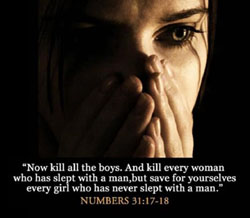
the second part of The Age of Reason, published in
1795, Thomas Paine noted that in the book of Numbers Moses had
given instructions as to how to treat Midianite captives. Essentially,
everyone was to be executed except virgins, whom the victors
were allowed to keep alive for themselves. God then gave instructions
as to how the booty, including 32,000 virgins, should be divided
up between the victors. Paine summarised the relevant passage:
"Here is an order to butcher the boys, to massacre the
mothers, and debauch the daughters"32.
In response to this, Bishop Watson of Llandaff pointed out that
the virgins had not been spared for any immoral purpose, as
Paine had wickedly suggested. Rather, he said, they were spared
so that they could be taken into slavery. Obviously, there could
be no ethical objection to this, since slavery was divinely
sanctioned. The bishop's rebuttal was perfectly acceptable to
mainstream Christians, who found sex objectionable but slavery
not at all objectionable. According to the Churches, slavery
was not merely permitted, it was obligatory. Slavery was a God-given
institution. To oppose what God had sanctioned was positively
sinful. In
the second part of The Age of Reason, published in
1795, Thomas Paine noted that in the book of Numbers Moses had
given instructions as to how to treat Midianite captives. Essentially,
everyone was to be executed except virgins, whom the victors
were allowed to keep alive for themselves. God then gave instructions
as to how the booty, including 32,000 virgins, should be divided
up between the victors. Paine summarised the relevant passage:
"Here is an order to butcher the boys, to massacre the
mothers, and debauch the daughters"32.
In response to this, Bishop Watson of Llandaff pointed out that
the virgins had not been spared for any immoral purpose, as
Paine had wickedly suggested. Rather, he said, they were spared
so that they could be taken into slavery. Obviously, there could
be no ethical objection to this, since slavery was divinely
sanctioned. The bishop's rebuttal was perfectly acceptable to
mainstream Christians, who found sex objectionable but slavery
not at all objectionable. According to the Churches, slavery
was not merely permitted, it was obligatory. Slavery was a God-given
institution. To oppose what God had sanctioned was positively
sinful.
|
A popular publication - still available
|
A Plan of National Colonization, advocating
the removal of free Blacks, by Rev. W. S. BR0WN, M. D.
|
|
|
|
In America opposition to slavery was first voiced by freethinkers
such as Benjamin Franklin and Thomas Paine. Initially a Quaker,
later a deist, Paine was widely condemned as an unbeliever.
He wrote an influential article against slavery in 1775, and
when he drafted the American Declaration of Independence the
following year, he included a clause against slavery that was
later struck out33.
Under Quaker influence, slavery was made illegal in the state
of Pennsylvania in 1780. Other campaigners included the rationalist
James Russell Lowell, the sceptical ex-preacher Ralph Waldo
Emerson, and the freethinker Wendell Phillips. Abolitionists
such as William Lloyd Garrison and John Brown had shifted away
from traditional Christianity after reading Thomas Paine.
Here, opposition to slavery is accurately characterised as
atheistic and godless
"God is introduced to give dignity and emphasis ...
and then He is banished. It was this very atheistic Declaration
[of Independence] which had inspired the 'higher law' doctrine
of the radical antislavery men. If the mischievous abolitionists
had only followed the Bible instead of the godless Declaration,
they would have been bound to acknowledge that human bondage
was divinely ordained. The mission of southerners was therefore
clear; they must defend the word of God against abolitionist
infidels."
Thomas Smyth, minister of 2nd Presbyterian Church of Charleston,
S.C. 11/21/1861
|
Slave Coffle, Near Paris, Kentucky, 1850s
|
|
|
|
|
Elsewhere Churches held out longer. Clergymen advocated slavery
and opposed abolitionist "infidels" on the traditional
Christian grounds that slavery was required by God. Here is
the Rev William S Plummer, DD of Richmond:
"... Lastly.- Abolitionists are like infidels, wholly
unaddicted to martyrdom for opinion's sake. Let them understand
that they will be caught if they come among us, and they will
take good heed to keep out of our way. There is not one man
among them who has any more idea of shedding his blood in
this cause, than he has of making war on the Grand Turk."
(https://utc.iath.virginia.edu/christn/chesjgbat.html)
According to Christian tradition, Blacks were inherently inferior,
a consequence of their descent from a biblical character called
Ham, which accounted for both their colour and their inferior
status. Here is one of thousands of statements of the Christian
position, from the Letters and Speeches of the Hon. James
H. Hammond, edited by the Christian gentleman himself in
1866 (He was a United States Senator):
The doom of Ham has been branded on the form and features
of his African descendants. The hand of fate has united his
color and destiny. Man cannot separate what God hath joined.
The Rev. J. C. Postell, in July, 1836, delivered an address
at a public meeting at Orangeburgh Court-house, S. C., in which
he maintains; 1. That slavery is a judicial visitation. 2. That
it is not a moral evil. 3. That it is supported by the Bible.
He thus argues his second point:-
It is not a moral evil. The fact that slavery is of Divine
appointment, would be proof enough with the Christian, that
it could not be a moral evil. But when we view the hordes
of savage marauders and human cannibals enslaved to lust and
passion, and abandoned to idolatry and ignorance, to revolutionise
them from such a state, and enslave them where they may have
the gospel, and the privileges of Christians; so far from
being a moral evil, it is a merciful visitation. If slavery
was either the invention of man or a moral evil, it is logical
to conclude, the power to create has the power to destroy.
Why then has it existed? And why does it now exist amidst
all the power of legislation in state and church, and the
clamor of abolitionists? It is the Lord's DOINGS AND MARVELLOUS
IN OUR EYES: and had it not been done for the best, God alone,
who is able, long since would have overruled it. IT IS BY
DIVINE APPOINTMENT." (https://utc.iath.virginia.edu/christn/chesjgbat.html)
The Catholic and Anglican Churches were not alone. In 1843
some 1,200 Methodist ministers owned slaves in the USA. Under
popular pressure generated by secular thinkers, all of the mainstream
Churches (except the Southern Baptists) performed a volte-face
during the nineteenth century. When enough of their members
had moved over to the abolitionist cause, the Churches followed.
God had always condoned, sanctioned and even demanded the practice
of slavery, but slavery was no longer acceptable. God must have
changed his mind. Priests, bishops and popes felt obliged to
cease owning slaves. Slavery was criticised for the first time
by a pope (Gregory XVI) in 1839, but it was still permissable
after its abolition in the USA:
"Slavery itself, considered as such in its essential
nature, is not at all contrary to the natural and divine law,
and there can be several just titles of slavery and these
are referred to by approved theologians and commentators of
the sacred canons.... It is not contrary to the natural and
divine law for a slave to be sold, bought, exchanged or given."
(20 June 1866 decision (No. 1293) of the Holy Office (cited
in Bokenkotter's A Concise History of the Catholic Church
and by J. F. Maxwell in “The Development of Catholic
Doctrine Concerning Slavery,” World Jurist 11
(1969–70): 306–7))
It was not until the Berlin Conference of 1884 that Roman Catholic
countries started to fall into line with Protestant ones on
the question of slavery, agreeing that it should be suppressed.
In 1888 Pope Leo XIII declared in In plurimis that
the Church was now opposed to it - though Church Law on the
topic remained unchanged.
In the USA the pattern was similar: nineteenth century churchmen
advocated slavery, though secular forces opposed it. It was
a commonplace that "Slavery is of God". Christian
ministers wrote almost half of all defences of slavery published
in America. The Churches routinely produced such defences. Along
with these defences, Christian Churches circulated biblical
texts on the subject of Negro inferiority, and the need for
total unquestioning obedience. A civil war was fought before
the Christian South was forced to abandon slavery in 1863. Yet
the Southern Presbyterian Church could still resolve in 1864
that it was their peculiar mission to conserve the institution
of slavery, and to make it a blessing to both master and slave.
Frederick Douglass on Slavery and Christianity
 Black
slaves were generally not permitted to learn to read or write,
since education was seen as a threat to God's natural order.
An American slave who adopted the name Frederick Douglass was
exceptional in that he learned to read and write in secret.
After he was granted his freedom he campaigned against slavery
and wrote about his life. His writings are of particular interest,
not only because of his personal experience, but also because
of his lucid style. He stood as a living confutation to slaveholders'
arguments that slaves did not have the intellectual capacity
to function as a citizen. An outstanding orator, he became a
leader of the abolitionist movement. Although a Christian believer
himself, his testimony against mainstream Christians is excoriating.
Here it is in a nutshell. Black
slaves were generally not permitted to learn to read or write,
since education was seen as a threat to God's natural order.
An American slave who adopted the name Frederick Douglass was
exceptional in that he learned to read and write in secret.
After he was granted his freedom he campaigned against slavery
and wrote about his life. His writings are of particular interest,
not only because of his personal experience, but also because
of his lucid style. He stood as a living confutation to slaveholders'
arguments that slaves did not have the intellectual capacity
to function as a citizen. An outstanding orator, he became a
leader of the abolitionist movement. Although a Christian believer
himself, his testimony against mainstream Christians is excoriating.
Here it is in a nutshell.
Were I to be again reduced to chains of slavery, next to
that enslavement, I should regard being the slave of a religious
master the greatest calamity that could befall me.... [I]
hate the corrupt, slaveholding, women-stripping, cradle plundering,
partial and hypocritical Christianity of this land34.
And here it is, in more detail:
. . . I am filled with unutterable loathing when I contemplate
the religious pomp and show, together with the horrible inconsistencies,
which every where surround me. We have men-stealers for ministers,
women-whippers for missionaries, and cradle-plunderers for
church members. The man who wields the blood-clotted cow skin
(whip) during the week fills the pulpit on Sunday, and claims
to be a minister of the meek and lowly Jesus. The man who
robs me of my earnings at the end of each week meets me as
a class-leader on Sunday morning, to show me the way of life,
and the path of salvation. He who sells my sister, for purposes
of prostitution, stands forth as the pious advocate of purity.
He who proclaims it a religious duty to read the Bible denies
me the right of learning to read the name of the God who made
me. He who is the religious advocate of marriage robs whole
millions (of slaves) of its sacred influence, and leaves them
to the ravages of wholesale (moral) pollution. The warm defender
of the sacredness of the family relation is the same that
scatters whole families, - sundering husbands and wives, parents
and children, sisters and brothers, leaving the hut vacant,
and the hearth desolate. We see the thief preaching against
theft, and the adulterer against adultery. We have men sold
to build churches, women sold to support the gospel, and babes
sold to purchase Bibles for the poor heathen! all for the
glory of God and the good of souls! The slave auctioneer's
bell and the church-going bell chime in with each other, and
the bitter cries of the heart-broken slave are drowned in
the religious shouts of his pious master. Revivals of religion
and revivals in the slave-trade go hand in hand together.
The slave prison and the church stand near each other. The
clanking of fetters and the rattling of chains in the prison,
and the pious psalm and solemn prayer in the church, may be
heard at the same time. The dealers in the bodies and souls
of men erect their stand in the presence of the pulpit, and
they mutually help each other. The dealer gives his blood-stained
gold to support the pulpit, and the pulpit, in return, covers
his infernal business with the garb of Christianity. Here
we have religion and robbery the allies of each other-devils
dressed in angels' robes, and hell presenting the semblance
of paradise."
I assert most unhesitatingly, that the religion of the South
is a mere covering for the most horrid crimes - a justifier
of the most appalling barbarity, a sanctifier of the most
hateful frauds, and a dark shelter under which the darkest,
foulest, grossest, and most infernal deeds of slave holders
find the strongest protection. Were I to be again reduced
to the chains of slavery, next to that enslavement, I should
regard being the slave of a religious master the greatest
calamity that could befall me... I... hate the corrupt, slave
holding, women-whipping, cradle-plundering, partial and hypocritical
Christianity of this land."
And he said this - indicating that slave owners who become
Christians actually became worse masters:
... and when you tell me that there are some Christian slave-holders
in the States, I tell you, as well might you talk of sober-drunkards.
Just as if the lash in the hands of a Christian is not as
injurious to my back as it would be in the hands of a wicked
man. As far as my experience goes, I would rather suffer under
the hands of the latter, and, I tell you, as I have mentioned
in my narrative, that next to being a slave, there is no greater
calamity than being the slave of a Christian slave holder.
I say this from my own experience .... Some persons have taken
offence at my saying that Slaveholders become worse after
their conversion.
As Douglass pointed out in the same speech, in his time all
Southern Baptists were in favour of slavery, because any who
espoused abolition were thrown out of the Church.
I beg now to introduce to your notice a little of the doings
of one or two of the Churches of America, and I shall begin
with the Baptist Church. This Church is congregational in
its organization and government, but its congregations are
united by what is called a Triennial Convention, the object
of which is to spread the Gospel among the heathen. At the
last but one of these conventions, in the City of Baltimore,
the Rev. Dr. Johnston, of South Carolina, presided, and he
on this occasion asserted the doctrine that when any institution
becomes established by law, a Christian man may innocently
engage to uphold it. The President of the Baptist convention
is a slaveholder himself. He is a man-stealer. The Secretary
of the convention is another man-stealer, and most of the
other office-bearers were manstealers — were thieves.
During the progress of the business, there was one man in
one of the committees, who was found to be an Abolitionist
— Elon Galusha. This man is now, I trust, in Heaven.
He dared to say that a slave was a man, and that slavery ought
to be abolished. For this, the members of his church cut him
off — though he was a man of talent and of unblemished
character, and, as a minister of the gospel, unparalleled.
Another great Baptist minister, the Rev. Lucius Bowles, congratulated
his brethren that there was "a pleasing degree of unity
among the Baptists through the land, for the southern brethren
were all slave-holders.35.
Here is another passage from the same speech concerning married
slaves
I have now to speak of them in the State of Virginia, where
men regularly enter into the raising or breeding of slaves,
as a business, just as cattle are raised for the Smithfield
market; and where the marriage institution is set aside. In
some cases it becomes the interest of the slave holder to
separate two slaves (male and female) already married. When
the question was proposed to the Baptist Society there, whether
parties thus separated might marry again, the answer was,
that this separation being tantamount to the civil death of
either of the parties, to forbid the second marriage in either
case, would be to expose to Church censure those who did so
for disobedience. Here we find a deliberate setting aside
of the Marriage Institution, and the deliberate sanction of
a wholesale system of adultery and concubinage; and, yet the
persons who authorise and enforce such wickedness calling
themselves Christians!
Abolition of Slavery
Slave owning by Christians continued for centuries despite
criticism from rationalists and freethinkers. The story now
propagated by some Churches — that they were responsible
for abolition — is simply false. The first country to abolish
slavery, was France, under an anticlerical revolutionary government
in the 1790s36.
Opposition to slavery was developed by the very people that
the Christian Churches regarded as their worst enemies: blaspheming
philosophers, atheists, Deists and Quakers: men like Thomas
Paine and Benjamin Franklin.
|
Benjamin Franklins' Address to the
Public, 1789
promoting the abolition of slavery
|
|
|
| |
Abolition came in Britain in the early nineteenth century,
in the teeth of fierce opposition from the Anglican Church,
and it was achieved through the efforts of an alliance of unbelievers,
freethinkers, Utilitarians, Quakers and fringe Christians who
galvanised public opinion. In the USA it came in the second
half of the century, again in the face of intense opposition
from the Churches.
|
The Unitarian Wedgwood family and the
Darwin family family were closely related. (Charles Darwin
was Josiah Wedgwood's Grandson). Both families included
prominent abolitionists. This provided traditionalist
Christians with a seam of humour - likening and making
fun of the godless idea of regarding black people as brothers,
and the godless Darwinian idea of regarding apes as cousins.
One line of humour was to suggest that evolutionists should
create a Gorilla Emancipation Society - making a parallel
with the Slave Emancipation Society, another was to play
on the motto of the Slave Emancipation Society: "Am
I not a man and a brother". Wedgwood's medallions
bearing the motto had become iconic - so famous that they
probably accelerated abolition in the UK.
|
|
A Jasper-ware cameo, designed and produced
by Josiah Wedgwood, 1787
|
Cartoon from Punch
London 18 May 1851
|
 |
|
| |
|
The abolitionists won largely because slavery was no longer
financially viable. The alliance of Church and slave owners
lost the battle in one country after another because of monetary
considerations. Following traditional teachings, and unrestrained
by Western economics or political correctness, Christians in
Ethiopia are still making captured prisoners into slaves well
into the twenty First century. The simple, if embarrassing,
truth is that no Christian society has ever abolished slavery
while the practice continued to be profitable.
|
Even after the abolition of slavery,
traditional slave punishments continued for many years.
|
|
|
|
|
In 1995, the Southern Baptist Convention officially apologised
for its earlier defense of slavery. The Church of England apologised
for its part in 2006. In a debate held by the Church's governing
body, before the vote Rev Simon Bessant described the Church's
central role in the slave trade, saying: "We were at the
heart of it." and "We were directly responsible for
what happened. In the sense of inheriting our history, we can
say we owned slaves, we branded slaves, that is why I believe
we must actually recognise our history and offer an apology."37.
The Catholic Church has moved its position slowly over the
centuries. From as early as 1435 Popes have condemned "indiscriminate"
slavery38. These
statements are sometimes cited as evidence that the Church has
long been opposed to slavery, but on the contrary it supported
the practice of slavery into the twentieth century. In 1839
Pope Gregory XVI criticised the international Negro slave trade,
but without condemning the institution of slavery or the practice
of owning slaves. In 1866, the Holy Office in an instruction
signed by Pope Pius IX declared:
Slavery itself, considered as such in its essential nature,
is not at all contrary to the natural and divine law, and
there can be several just titles of slavery, and these are
referred to by approved theologians and commentators of the
sacred canons … It is not contrary to the natural and
divine law for a slave to be sold, bought, exchanged or given".
After the American Civil War, the Vatican was asked for an
authoritative statement on slavery,following the adoption of
the 13th amendment to the U. S. Constitution, which banned slavery.
In an Instruction dated 20 June 1866 the "Holy Office",
which rules on matters of faith and teaching, declared :
"Slavery, considered as such in its essential nature,
is not at all contrary to the natural and divine law. There
can be several just titles of slavery and these are referred
to by approved theologians and commentators of the sacred
canons [of the Catholic Church]. It is not contrary to the
natural and divine law for a slave to be sold, bought, exchanged
or given."
Popes continued to own slaves until they lost control of the
Papal States in the nineteenth century. In 1888, after all countries
other than the Vatican State, had abandoned the practice of
slavery, Pope Leo XIII condemned slavery in general terms. In
1918 a new Code of Canon Law promulgated by Pope Benedictus
XV condemned 'selling any person as a slave'. There was still
no condemnation of slave owning, only of slave trading - so
three of the four "just titles" still held. In Gaudium
et spes, 1965, the Second Vatican Council finally gave up
on slavery, denouncing all violations of human integrity. To
date the Catholic Church has not apologised for it's part in
any of the Slave Trades it established or participated in. In
March 2000, Pope Jean Paul II, hinted at his Church's culpability
asking unspecified people for forgiveness for unspecified crimes
committed by unspecified Catholics against unspecified victims39.
|
Slavery - still a charged issue in the
USA
|
|
|
|
|
 There
are still Christians prepared to uphold the traditional Christian
line on slavery. In 1996 Charles Davidson, a devout Christian
Senator from Alabama, said that slavery had been good for blacks,
and pointed out that the practice had biblical approval, citing
the traditional prooftexts such as Leviticus 25:44 and 1 Timothy
6:140. There
are still Christians prepared to uphold the traditional Christian
line on slavery. In 1996 Charles Davidson, a devout Christian
Senator from Alabama, said that slavery had been good for blacks,
and pointed out that the practice had biblical approval, citing
the traditional prooftexts such as Leviticus 25:44 and 1 Timothy
6:140.
Many Christian books and websites seek to establish that Black
slavery was fundamentally different from Roman slavery. According
to them, Roman slavery was a much more benign system, and this
was the system referred to in the Bible. The argument is flawed
in two ways. First, the rules applied to Black slavery, and
Christian justification for it, were based on the Old Testament,
which regulated the rules for Jews, not Romans. Rules about
slave owning were similar across many ancient societies, so
apologists sometimes try to regard them as the same thing. But
even if slavery had been based on Roman practices in the New
Testament, then the argument still does not work. The important
differences between Roman slavery and Christian slavery do not
lie in the rules. They are almost the same, and where they differ
the Christian rules are generally harsher than the Roman rules.
Slaves were bought and sold, often at auction. Prisoners captured
in war were enslaved. The children of slaves also became slaves.
The master had a right to control slave marriage and regulate
slave family life - regarding slaves as breeding stock. Slave-girls
were available for sex. As one Roman said of his time, Whoever
heard of a man prosecuted for sleeping with his concubine? Escaped
slaves were hunted. Rewards were offered for their return. Once
returned they could be punished in the most cruel ways, not
merely flogging, but amputation of a foot or "half a foot".
It is certainly true that Roman slavery was often more benign
than Christian. We know that Roman slaves were often educated,
well treated, given good food and medical attention, appointed
to responsible offices, and even treated as friends. But this
reflects the relative level of civilisation of the society and
the individual slave owners. If Roman slave owners behaved better
than Christian slave owners, it is because pagan Romans were
more compassionate and civilised than later Christians. For
identification, Christians chose to brand their slaves where
pagans had merely tattooed them, but the purpose and the rules
were almost identical.
Christian Slavery in Africa
Long after slavery had been abolished in Europe and America,
Christians continued to practice slavery in Africa. The devoutly
Catholic King Leopold II of the Belgians for example established
a colony known as the Congo Free State. It was established with
the express intention of spreading Christianity, and catholic
missionaries went in large numbers. Between 1885 and 1908, the
king's agents enslaved millions, many of whom were mutilated
or killed for failing to work hard enough.
|
Congo Free State, Slaves c 1905
|
|
|
|
|
|
| |
|
Congo Free State Slaves c 1904
Failure to pay taxes often resulted in the offenders
being condemned to slavery
|
|
|
|
|
|
| |
|
A slave is whipped with a chicotte
— a bull whip made of hippopotamus hide
Congo Free State c. 1905
|
|
|
|
|
|
For more on slavery in the Congo Free State, and the role of
the Christian Churches, see Christian
atrocities.
|
Slavery was also practiced in Australia,
well into the twentieth century,
unofficially, but with the informal approval of both Church
and State
|
|
|
|
|
Documents
| |
| |
|
|
| |
|
Runaway Slave Poster, in the US Library
of Congress
|
|
|
| |
| |
|
|
| |
|
Great Sale of Slaves, Lexington, 1855
- Bucks, Wenches and a Picininny
|
|
|
| |
|
Slave Chains from west Africa (Royal
Albert memorial Museum, Exeter)
|
|
|
| |
| |
|
|
| |
| |
|
|
| |
| |
|
|
| |
| |
|
|
| |
| |
|
|
| |
| |
|
|
| |
| |
|
|
| |
| |
|
|
| |
|
Slave Coffle
|
|
|
| |
| |
|
|
| |
| |
|
|
| |
| |
|
|
| |
|
Slave Transport in Africa
|
|
|
| |
| |
|
|
| |
| |
|
|
| |
|
William F. Talbott of Lexington, Kentuckee
|
|
|
| |
|
Slave sale, Charleston
|
|
|
| |
|
Advertisement from Philadelphia’s
American Weekly Mercury, 1738
|
|
|
| |
| |
|
|
| |
| |
|
|
| |
| |
|
|
| |
| |
|
|
| |
| |
|
|
| |
|
A slave baby being forceably separated
from its mother
|
|
|
| |
|
|
| |
| |
|
|
|
The Official Medallion of the British
Anti-Slavery Society English potter Josiah Wedgewood
|
 |
| |
|
An idea of the reality of slavery
|
|
|
| |
|
Everyday life under the Christian hegenomy,
captured in stone
|
|
|
|
|
|
Slave masks, collars and shackles
|
|
|
| |
|
US Slave Collar - Reproduction by Fabrice
Monteiro
|
|
|
| |
|
US Slave Collar - Reproduction by Fabrice
Monteiro
|
|
|
|
|
|
US Slave Collar - Reproduction by Fabrice
Monteiro
|
|
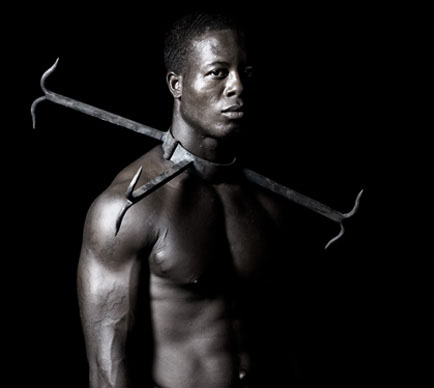
|
|
|
|
|
|
US Slave Collar - the bells make it difficult
to escape
|
|
|
|
|
US Slave Collar - Reproduction by Fabrice
Monteiro
|
|
|
|
|
US Slave Collar - Reproduction by Fabrice
Monteiro
|
|
|
|
|
Slave mask - still in use in Christian
countries in Africa - design unchanged
|
|
|
| |
|
US Slave Collar - Reproduction by Fabrice
Monteiro
|
|
|
|
|
Pope Damasus - One of many slaver Popes
Under Damasus's rule, women and children were bought
and sold as sex slaves to increase funding for the Catholic
Church
|
|

|
|
|
|
|
|
|
|
|
Anyone who helped a slave escape commited
a kind of theft - since a slave was property,
If caught they were branded SS (for slave stealer) on
the hand
|
|
|
|
|
Jonathan Walker was an American reformer
who became a national hero in 1844 when he was tried
and sentenced as a slave stealer following his attempt
to help seven runaway slaves find freedom.
He was branded on his hand by the United States Government
with the markings S.S. for "Slave Stealer"..
|
|
|
| |
|
Franklin and Armfield Office, was started
in 1828 by Isaac Franklin and John Armfield. The office
was known to have been the largest slave trading firm
in the antebellum south. At its height in the 1830s, the
firm transported between 1,000 and 1,200 slaves from Alexandria
to New Orleans each year. It closed in 1836. The office
still stands at 1315 Duke Street in Alexandria, Virginia.
|
|
|
|
|
| |
|
Another design of collar
|
|
|
| |
|
Slave shackles
|
|
|
| |
|
Slave collar and mask. The collar has
a croos welded onto it.
|
|
|
| |
|
Auction of a slave and her daughter.
Possibly one lot. Possibly not.
|
|
|
| |
|
Marcella Dunn's gravestone (photo courtesy
of Kimberly Borchard)
|
 |
| |
|
Francis Bok, former Sudanese slave
|
|
|
| |
|
Slave collars and shackles
|
|
|
| |
|
another run-away slave, 1854 - note that
his wife is owned by a different slave-master
|
|
|
| |
|
The Slave Triangle
|
|
|
| |
|
Close packing of slaves athwart one deck
of the Brookes
|
|
|
| |
|
Slave Children Onboard the Daphne
|
|
|
| |
|
Abolition by Granger
|
|
|
| |
|
“Salve Auction” in Richmond,
Virginia. February 16, 1881 edition of The Illustrated
London News
|
|
|
| |
| |
|
|
| |
|
child-slave
|
|
|
| |
|
|
| |
| The Voice of the Clergy (Philadelphia, 1864). When
Pennsylvania Democrats republished Episcopal Bishop John
Henry Hopkins's proslavery work The Bible View of Slavery
as a campaign document, the Episcopal clergy of Pennsylvania
published this denunciation of it. |
|
|
| |
|
|
|
|
| |
| |
|
|
| |
| |
|
|
| |
| |
|
|
| |
| |
|
|
| |
| |
|
|
| |
|
Slave auction block in Florida
|
|
|
| |
| |
Other areas of social reform:
|
|
|
|
|
|
|
|
|
|
|
|
|
|
|
|
|
|
|
|
|
|
|
|
|
|
|
|
|
|
|
|
|
|
|
|
|
|
Buy the Book from Amazon.com
|
|
|
|
|
|
Buy the Book from Amazon.co.uk
|
|
|
| |
| |
| More Books |
|
|
|
| |
The Code Noir (The Black Code)
Edict of the King:
On the subject of the Policy regarding the Islands of French
America
March 1685
Recorded at the sovereign Council of Saint Domingue, 6 May
1687.
Louis, by the grace of God, King of France and Navarre: to
all those here present and to those to come, GREETINGS. In that
we must also care for all people that Divine Providence has
put under our tutelage, we have agreed to have the reports of
the officers we have sent to our American islands studied in
our presence. These reports inform us of their need for our
authority and our justice in order to maintain the discipline
of the Roman, Catholic, and Apostolic Faith in the islands.
Our authority is also required to settle issues dealing with
the condition and quality of the slaves in said islands. We
desire to settle these issues and inform them that, even though
they reside infinitely far from our normal abode, we are always
present for them, not only through the reach of our power but
also by the promptness of our help toward their needs. For these
reasons, and on the advice of our council and of our certain
knowledge, absolute power and royal authority, we have declared,
ruled, and ordered, and declare, rule, and order, that the following
pleases us:
Article I. We desire and we expect that the Edict of 23 April
1615 of the late King, our most honored lord and father who
remains glorious in our memory, be executed in our islands.
This accomplished, we enjoin all of our officers to chase from
our islands all the Jews who have established residence there.
As with all declared enemies of Christianity, we command them
to be gone within three months of the day of issuance of the
present [order], at the risk of confiscation of their persons
and their goods.
Article II. All slaves that shall be in our islands shall be
baptized and instructed in the Roman, Catholic, and Apostolic
Faith. We enjoin the inhabitants who shall purchase newly-arrived
Negroes to inform the Governor and Intendant of said islands
of this fact within no more that eight days, or risk being fined
an arbitrary amount. They shall give the necessary orders to
have them instructed and baptized within a suitable amount of
time.
Article III. We forbid any religion other than the Roman, Catholic,
and Apostolic Faith from being practiced in public. We desire
that offenders be punished as rebels disobedient of our orders.
We forbid any gathering to that end, which we declare to be
conventicle, illegal, and seditious, and subject to the same
punishment as would be applicable to the masters who permit
it or accept it from their slaves.
Article IV. No persons assigned to positions of authority over
Negroes shall be other than a member of the Roman, Catholic,
and Apostolic Faith, and the master who assigned these persons
shall risk having said Negroes confiscated, and arbitrary punishment
levied against the persons who accepted said position of authority.
Article V. We forbid our subjects who belong to the so-called
"reformed" religion from causing any trouble or unforeseen difficulties
for our other subjects or even for their own slaves in the free
exercise of the Roman, Catholic, and Apostolic Faith, at the
risk of exemplary punishment.
Article VI. We enjoin all our subjects, of whatever religion
and social status they may be, to observe Sundays and the holidays
that are observed by our subjects of the Roman, Catholic, and
Apostolic Faith. We forbid them to work, nor make their slaves
work, on said days, from midnight until the following midnight.
They shall neither cultivate the earth, manufacture sugar, nor
perform any other work, at the risk of a fine and an arbitrary
punishment against the masters, and of confiscation by our officers
of as much sugar worked by said slaves before being caught.
Article VII. We forbid them also to hold slave markets or any
other market on said days at the risk of similar punishments
and of confiscation of the merchandise that shall be discovered
at the market, and an arbitrary fine against the sellers.
Article VIII. We declare that our subjects who are not of the
Roman, Catholic, and Apostolic Faith, are incapable of contracting
a valid marriage in the future. We declare any child born from
such unions to be bastards, and we desire that said marriages
be held and reputed, and to hold and repute, as actual concubinage.
Article IX. Free men who shall have one or more children during
concubinage with their slaves, together with their masters who
accepted it, shall each be fined two thousand pounds of sugar.
If they are the masters of the slave who produced said children,
we desire, in addition to the fine, that the slave and the children
be removed and that she and they be sent to work at the hospital,
never to gain their freedom. We do not expect however for the
present article to be applied when the man was not married to
another person during his concubinage with this slave, who he
should then marry according to the accepted rites of the Church.
In this way she shall then be freed, the children becoming free
and legitimate. . . .
Article XI. We forbid priests from conducting weddings between
slaves if it appears that they do not have their masters' permission.
We also forbid masters from using any constraints on their slaves
to marry them without their wishes.
Article XII. Children born from marriages between slaves shall
be slaves, and if the husband and wife have different masters,
they shall belong to the masters of the female slave, not to
the master of her husband.
Article XIII. We desire that if a male slave has married a
free woman, their children, either male or female, shall be
free as is their mother, regardless of their father's condition
of slavery. And if the father is free and the mother a slave,
the children shall also be slaves. . . .
Article XV. We forbid slaves from carrying any offensive weapons
or large sticks, at the risk of being whipped and having the
weapons confiscated. The weapons shall then belong to he who
confiscated them. The sole exception shall be made for those
who have been sent by their masters to hunt and who are carrying
either a letter from their masters or his known mark.
Article XVI. We also forbid slaves who belong to different
masters from gathering, either during the day or at night, under
the pretext of a wedding or other excuse, either at one of the
master's houses or elsewhere, and especially not in major roads
or isolated locations. They shall risk corporal punishment that
shall not be less than the whip and the fleur de lys, and for
frequent recidivists and in other aggravating circumstances,
they may be punished with death, a decision we leave to their
judge. We enjoin all our subjects, even if they are not officers,
to rush to the offenders, arrest them, and take them to prison,
and that there be no decree against them. . . .
Article XVIII. We forbid slaves from selling sugar cane, for
whatever reason or occasion, even with the permission of their
master, at the risk of a whipping for the slaves and a fine
of ten pounds for the masters who gave them permission, and
an equal fine for the buyer.
Article XIX. We also forbid slaves from selling any type of
commodities, even fruit, vegetables, firewood, herbs for cooking
and animals either at the market, or at individual houses, without
a letter or a known mark from their masters granting express
permission. Slaves shall risk the confiscation of goods sold
in this way, without their masters receiving restitution for
the loss, and a fine of six pounds shall be levied against the
buyers. . . .
Article XXVII. Slaves who are infirm due to age, sickness or
other reason, whether the sickness is curable or not, shall
be nourished and cared for by their masters. In the case that
they be abandoned, said slaves shall be awarded to the hospital,
to which their master shall be required to pay six sols
per day for the care and feeding of each slave. . . .
Article XXXI. Slaves shall not be a party, either in court
or in a civil matter, either as a litigant or as a defendant,
or as a civil party in a criminal matter. And compensation shall
be pursued in criminal matters for insults and excesses that
have been committed against slaves. . . .
Article XXXIII. The slave who has struck his master in the
face or has drawn blood, or has similarly struck the wife of
his master, his mistress, or their children, shall be punished
by death. . . .
Article XXXVIII. The fugitive slave who has been on the run
for one month from the day his master reported him to the police,
shall have his ears cut off and shall be branded with a fleur
de lys on one shoulder. If he commits the same infraction
for another month, again counting from the day he is reported,
he shall have his hamstring cut and be branded with a fleur
de lys on the other shoulder. The third time, he shall be
put to death.
Article XXXIX. The masters of freed slaves who have given refuge
to fugitive slaves in their homes shall be punished by a fine
of three hundred pounds of sugar for each day of refuge.
Article XL. The slave who has been punished with death based
on denunciation by his master, and who is not a party to the
crime for which he was condemned, shall be assessed prior to
his execution by two of the principal citizens of the island
named by a judge. The assessment price shall be paid by the
master, and in order to satisfy this requirement, the Intendant
shall impose said sum on the head of each Negro. The amount
levied in the estimation shall be paid for each of the said
Negroes and levied by the [Tax] Farmer of the Royal Western
lands to avoid costs. . . .
Article XLII. The masters may also, when they believe that
their slaves so deserve, chain them and have them beaten with
rods or straps. They shall be forbidden however from torturing
them or mutilating any limb, at the risk of having the slaves
confiscated and having extraordinary charges brought against
them.
Article XLIII. We enjoin our officers to criminally prosecute
the masters, or their foremen, who have killed a slave under
their auspices or control, and to punish the master according
to the circumstances of the atrocity. In the case where there
is absolution, we allow our officers to return the absolved
master or foreman, without them needing our pardon.
Article XLIV. We declare slaves to be charges, and as such
enter into community property. They are not to be mortgaged,
and shall be shared equally between the CO-inheritors without
benefit to the wife or one particular inheritor, nor subject
to the right of primogeniture, the usual customs duties, feudal
or lineage charges, or feudal or seigneurial taxes. They shall
not be affected by the details of decrees, nor from the imposition
of the four-fifths, in case of disposal by death or bequeathing.
. . .
Article XLVII. Husband, wife and prepubescent children, if
they are all under the same master, may not be taken and sold
separately. We declare the seizing and sales that shall be done
as such to be void. For slaves who have been separated, we desire
that the seller shall risk their loss, and that the slaves he
kept shall be awarded to the buyer, without him having to pay
any supplement. . . .
Article LV. Masters twenty years of age may free their slaves
by any act toward the living or due to death, without their
having to give just cause for their actions, nor do they require
parental advice as long as they are minors of 25 years of age.
Article LVI. The children who are declared to be sole legatees
by their masters, or named as executors of their wills, or tutors
of their children, shall be held and considered as freed slaves.
. . .
Article LVIII. We declare their freedom is granted in our islands
if their place of birth was in our islands. We declare also
that freed slaves shall not require our letters of naturalization
to enjoy the advantages of our natural subjects in our kingdom,
lands or country of obedience, even when they are born in foreign
countries.
Article LIX. We grant to freed slaves the same rights, privileges
and immunities that are enjoyed by freeborn persons. We desire
that they are deserving of this acquired freedom, and that this
freedom gives them, as much for their person as for their property,
the same happiness that natural liberty has on our other subjects.
Versailles, March 1685, the forty second year of our reign.
Signed LOUIS,
and below the King.
Colbert, visa, Le Tellier.
Read, posted and recorded at the sovereign council of the coast
of Saint Domingue, kept at Petit Goave, 6 May 1687, Signed Moriceau.
Source: Édit du Roi,
Touchant la Police des Isles de l'Amérique Française (Paris,
1687), 28–58.
Notes 1 The Authorised Version
invariably uses the word servant where the natural
translation is slave. Most modern translations use
the word slave (a more accurate rendering of the Hebrew
"ebhedh, Greek doulos) — masters
buy and sells slaves not servants.
2. Ignatius's letter to
Polycarp 4. See Andrew Louth (ed.), Maxwell Staniforth
(trans.) Early Christian Writings, p 110.
3. St Augustine, City
of God, Book XIX, Chapter 15.
4. Fox, Pagans
and Christians, p 298, citing G Sotgiu, Arch. Class.
25/6 (1973-4) 688. Felix's collar was an inscribed bronze collarof
the late fifth or early sixth century AD, worn by a slave of
the Christian archdeacon in Sardinia, reproduced in G H R Horsley
(ed), New Documents illustrating Early Christianity (Macquarie
University, North Ryde, New South Wales, 1981, pp 140-141. The
inscription runs S[ervus sum] Felicis ar[ch]idiac[oni]: tene
me ne fugiam, translated into English: "I am a slave of
Felix the archdeacon: hold me lest I run away", Frederick
Fyvie Bruce, The Epistles to the Colossians, to Philemon,
and to the Ephesians, William. B. Eerdmans Publishing, Michigan
1984, p 198.
5. Kyle Harper, Slavery
in the Late Roman World, AD 275-425, Cambridge University
Press, p 258.
6. Ibid, p 258.
7. Ibid, p 258.
8. Ibid, p 259
9. Keith Bradley,
Slavery and Society at Rome, Cambridge University Press,
p 148, citing the longer monastic rules of Basil, Bishop of
Caesaria, in the 370's
10. Kyle Harper,
Slavery in the Late Roman World, AD 275-425, Cambridge
University Press, p 259
11. Kyle Harper,
Slavery in the Late Roman World, AD 275-425, Cambridge University
Press, p 258
12. Kyle Harper,
Slavery in the Late Roman World, AD 275-425, Cambridge University
Press, p 498
13. Kyle Harper,
Slavery in the Late Roman World, AD 275-425, Cambridge University
Press, p 498, citing Greg Mag Ep 6:10
14. Kyle Harper,
Slavery in the Late Roman World, AD 275-425, Cambridge University
Press, p 498, citing Greg Mag Ep 9:124}
15. Decretum
gratiani, Case. 32: Misuse of Marriage q. 3: Marriage of
Slaves.
16. The
fuller relevant passages are:
Let matrimony be put asunder when a free man has unknowingly
contracted with a slave girl, unless he had relations with
her after discovering this.
Alexander the III to the Guardian and Prior of Mortari.
The woman M., the bearer of the present letter, set out to
us that, after her husband had lived with her a long time,
he objected to the blemish of her servile condition and asserted
that she was a slave, and that he thought she was free when
he took her as wife.
This matter was treated before our venerable brother, the
bishop of Asti, and the woman, who feared that she would be
injured there, appealed to our hearing. After a short delay
this man withdrew the lawsuit he had initiated. Both are alive.
Therefore, by apostolic decree, we command Your Discretion,
since you have inquired concerning this: Summon the parties
before you and carefully investigate the truth of this matter.
If it is clear to you that this man knew the woman carnally
after he heard she was a slave, admonish him and compel him
to take her and treat her as his wife with marital affection.
But if this is not the case, and a decree of divorce is to
be given, have restitution made to the woman of the money
she gave the said man in dowry, as this is just. (Decretals
of Gregory IX, Book Four, The Marriage of Slaves, C. 2)
If a free man has unknowingly contracted with a slave girl,
and did not consent when he discovered this, the matrimony
may be put asunder, and he can contract with another.
Innocent III to Bishop H.
You know that it has come to our hearing that our beloved
son G., the cardinal priest under the title of Santa Maria
in Trastevere, legate of the Apostolic See, separated our
beloved son R., a nobleman and knight, from a certain woman
because of an error about her condition.
By apostolic decree, therefore, we command Your Fraternity:
Carefully investigate the truth of this matter and, if it
is clear to you that this knight contracted with the slave
girl unknowingly and, afterwards, when he understood her condition,
did not consent to her by word or deed (the reason their union
was put asunder by the cardinal), you may, by apostolic authority,
grant him permission to contract with another woman. (Decretals
of Gregory IX, Book Four, Title VIII, C. 4)
17. Uta Ranke-Heinemann,
Eunuchs for the Kingdom of Heaven, p 104.
18. A number of cases
of women being taken into slavery on the orders of Church authorities
are cited by Uta Ranke-Heinemann, Eunuchs for the Kingdom
of Heaven, pp 89-93.
19. Uta Ranke-Heinemann,
Eunuchs for the Kingdom of Heaven, p 91.
20. Decretum Gratiani,
pars. 2, dist. 32, c10 (Hefele, C. J. Konziliengeschichte,
vol. V (1863) p 175 ).
21. Steven Runciman,
A History of the Crusades, vol. 3, p 357.
22. F G Wood, The
Arrogance of Faith, A A Knoopf (New York, 1990), p 59
23. The issue generally
came to court only because of insurance claims, slaves being
property like any other. A key case (concerning a ship called
the "Zong" from which slaves had been jettisoned)
was heard in 1783. See Walvin, Black Ivory A History of
British Slavery, pp 16-22.
24. James Walvin, Black
Ivory A History of British Slavery, p 304.
25. James Walvin, Black
Ivory A History of British Slavery, p 190.
26. To his credit Rowan
Williams, the Archbishop of Canterbury, marshalled a public
apology in 2006 for the Anglican Church's role in promoting
slavery https://www.guardian.co.uk/uk/2006/feb/09/religion.world
27. For these and
other examples of torture and mistreatment of slaves, see Scott,
A History of Torture, ch XIV, especially pp 126-7.
28. James Walvin, Black
Ivory A History of British Slavery, p 184.
28a. "272 Slaves
Were Sold to Save Georgetown. What Does It Owe Their Descendants?",
New York Times, 16 April, 2016. https://www.nytimes.com/2016/04/17/us/georgetown-university-search-for-slave-descendants.html
retrieved 23 September 2016. See also https://www.nytimes.com/2016/09/02/us/slaves-georgetown-university.html.
Link to the Report of The working
group on slavery, memory, and reconciliation to the president
of georgetown university, washington, d.c., Summer 2016
aaa. "Diseases and
Peculiarities of the Negro Race," by Dr. Cartwright (in
DeBow's Review), De Bow's Review, Southern and Western States,
Volume XI, New Orleans, 1851, AMS Press, Inc. New York, 1967
|
|
DRAPETOMANIA, OR THE DISEASE CAUSING NEGROES
TO RUN AWAY.
It is unknown to our medical authorities, although
its diagnostic symptom, the absconding from service,
is well known to our planters and overseers...
In noticing a disease not heretofore classed among
the long list of maladies that man is subject to, it
was necessary to have a new term to express it. The
cause in the most of cases, that induces the negro to
run away from service, is as much a disease of the mind
as any other species of mental alienation, and much
more curable, as a general rule. With the advantages
of proper medical advice, strictly followed, this troublesome
practice that many negroes have of running away, can
be almost entirely prevented, although the slaves be
located on the borders of a free state, within a stone's
throw of the abolitionists.
If the white man attempts to oppose the Deity's will,
by trying to make the negro anything else than "the
submissive knee-bender," (which the Almighty declared
he should be,) by trying to raise him to a level with
himself, or by putting himself on an equality with the
negro; or if he abuses the power which God has given
him over his fellow-man, by being cruel to him, or punishing
him in anger, or by neglecting to protect him from the
wanton abuses of his fellow-servants and all others,
or by denying him the usual comforts and necessaries
of life, the negro will run away; but if he keeps him
in the position that we learn from the Scriptures he
was intended to occupy, that is, the position of submission;
and if his master or overseer be kind and gracious in
his hearing towards him, without condescension, and
at the same time ministers to his physical wants, and
protects him from abuses, the negro is spell-bound,
and cannot run away.
According to my experience, the "genu flexit"
-- the awe and reverence, must be exacted from them,
or they will despise their masters, become rude and
ungovernable, and run away. On Mason and Dixon's line,
two classes of persons were apt to lose their negroes:
those who made themselves too familiar with them, treating
them as equals, and making little or no distinction
in regard to color; and, on the other hand, those who
treated them cruelly, denied them the common necessaries
of life, neglected to protect them against the abuses
of others, or frightened them by a blustering manner
of approach, when about to punish them for misdemeanors.
Before the negroes run away, unless they are frightened
or panic-struck, they become sulky and dissatisfied.
The cause of this sulkiness and dissatisfaction should
be inquired into and removed, or they are apt to run
away or fall into the negro consumption. When sulky
and dissatisfied without cause, the experience of those
on the line and elsewhere, was decidedly in favor of
whipping them out of it, as a preventive measure against
absconding, or other bad conduct. It was called whipping
the devil out of them.
If treated kindly, well fed and clothed, with fuel
enough to keep a small fire burning all night--separated
into families, each family having its own house--not
permitted to run about at night to visit their neighbors,
to receive visits or use intoxicating liquors, and not
overworked or exposed too much to the weather, they
are very easily governed--more so than any other people
in the world. When all this is done, if any one of more
of them, at any time, are inclined to raise their heads
to a level with their master or overseer, humanity and
their own good require that they should be punished
until they fall into that submissive state which it
was intended for them to occupy in all after-time, when
their progenitor received the name of Canaan or "submissive
knee-bender." They have only to be kept in that
state and treated like children, with care, kindness,
attention and humanity, to prevent and cure them from
running away.
DYSAETHESIA AETHIOPICA, OR HEBETUDE OF MIND AND OBTUSE
SENSIBILITY OF BODY--A DISEASE PECULIAR TO NEGROES--CALLED
BY OVERSEERS, " RASCALITY."
Dysaesthesia Aethiopica is a disease peculiar to negroes,
affecting both mind and body in a manner as well expressed
by dysaesthesia, the name I have given it, as could
be by a single term. There is both mind and sensibility,
but both seem to be difficult to reach by impressions
from without. There is a partial insensibility of the
skin, and so great a hebetude of the intellectual faculties,
as to be like a person half asleep, that is with difficulty
aroused and kept awake. It differs from every other
species of mental disease, as it is accompanied with
physical signs or lesions of the body discoverable to
the medical observer, which are always present and sufficient
to account for the symptoms. It is much more prevalent
among free negroes living in clusters by themselves,
than among slaves on our plantations, and attacks only
such slaves as live like free negroes in regard to diet,
drinks, exercise, etc. It is not my purpose to treat
of the complaint as it prevails among free negroes,
nearly all of whom are more or less afflicted with it,
that have not got some white person to direct and to
take care of them. To narrate its symptoms and effects
among them would be to write a history of the ruins
and dilapidation of Hayti, and every spot of earth they
have ever had uncontrolled possession over for any length
of time. I propose only to describe its symptoms among
slaves.
From the careless movements of the individuals affected
with the complaint, they are apt to do much mischief,
which appears as if intentional, but is mostly owing
to the stupidness of mind and insensibility of the nerves
induced by the disease. Thus, they break, waste and
destroy everything they handle,--abuse horses and cattle,--tear,
burn or rend their own clothing, and, paying no attention
to the rights of property, steal others, to replace
what they have destroyed. They wander about at night,
and keep in a half nodding sleep during the day. They
slight their work,--cut up corn, cane, cotton or tobacco
when hoeing it, as if for pure mischief. They raise
disturbances with their overseers and fellow-servants
without cause or motive, and seem to be insensible to
pain when subjected to punishment. The fact of the existence
of such a complaint, making man like an automaton or
senseless machine, having the above or similar symptoms,
can be clearly established by the most direct and positive
testimony. That it should have escaped the attention
of the medical profession, can only be accounted for
because its attention has not been sufficiently directed
to the maladies of the negro race. Otherwise a complaint
of so common an occurrence on badly-governed plantations,
and so universal among free negroes, or those who are
not governed at all,--a disease radicated in physical
lesions and having its peculiar and well marked symptoms
and its curative indications, would not have escaped
the notice of the profession. The northern physicians
and people have noticed the symptoms, but not the disease
from which they spring. They ignorantly attribute the
symptoms to the debasing influence of slavery on the
mind without considering that those who have never been
in slavery, or their fathers before them, are the most
afflicted, and the latest from the slave-holding South
the least. The disease is the natural offspring of negro
liberty--the liberty to be idle, to wallow in filth,
and to indulge in improper food and drinks.
|
29. James Walvin,
Black Ivory A History of British Slavery, p 187.
30. Psychological studies
have found evidence of religion still being responsible for
"psychological bondage" amongst African Americans
well into the twentieth century. See Argyle and Beit-Hallahmi,
The Social Psychology of Religion, p 108, citing W.
H. Grier and P. M. Cobbs, The Jesus Bag, McGraw Hill
(New York, 1971).
31. Letter dated
September 15, 1682, from Cotton Mather [1663-1728] to John Higginson
[1616-1708]:, quoted (in a footnote) by Joseph Campbell in The
Hero With a Thousand Faces. cited by Professor Robert Phillips,
American Government and Its Problems, Houghton Mifflin,
1941, and by Dr. Karl Menninger, Love Against Hate, Harcourt, Brace and Company, 1942, p. 211":
To ye aged and beloved, Mr. John Higginson [1616-1708]:
There be now at sea a ship called Welcome, which has on board
100 or more of the heretics and malignants called Quakers,
with W. Penn, who is the chief scamp, at the head of them.
The General Court has accordingly given sacred orders to Master
Malachi Huscott, of the brig Porpoise, to waylay the said
Welcome slyly as near the Cape of Cop as may be, and make
captive the said Penn and his ungodly crew, so that the Lord
may be glorified and not mocked on the soil of this new country
with the heathen worship of these people. Much spoil can be
made of selling the whole lot to Barbadoes, where slaves fetch
good prices in rum and sugar and we shall not only do the
Lord great good by punishing the wicked, but we shall make
great good for His Minister and people.
Yours in the bowels of Christ,
Cotton Mather
32. Thomas Paine,
The Age of Reason, p 92. The biblical reference is
to Numbers 31:13-18.
33. Tribe, 100 Years
of Freethought, p 21.
34. Frederick Douglass,
Autobiographies: Narrative of a Life, My Bondage and My
Freedom, Life and Times, Henry L. Gates, Jr., ed. (New
York, Library of America, 1994), cited by Sagan, The Demon-Haunted
World, p 343.
35. Frederick Douglass,
"Baptists, Congregationalists, the Free Church, and Slavery:
An Address Delivered in Belfast, Ireland, on December 23, 1845."
Belfast News Letter, December 26, 1845 and Belfast Northern
Whig, December 25, 1845. Blassingame, John (et al, eds.).
The Frederick Douglass Papers: Series One--Speeches,
Debates, and Interviews. New Haven: Yale University Press, 1979.
Vol. I.
36. Slavery within England
itself had been confirmed to be contrary to the common law in
1772. The slave trade was made illegal in 1807 and ranked with
piracy from 1824. Slavery was made illegal in all British territories
in 1833.
37. BBC News, 8 February
2006, Church apologises for slave trade, https://news.bbc.co.uk/2/hi/uk_news/4694896.stm
38. Examples
of Popes condemning "indiscriminate" slavery (without
denying the four 'just titles' for owning slaves) include: Pope
Eugenius IV condemning the indiscriminate enslavement of natives
in the Canary Islands in 1435, Pope Paul III condemning the
indiscriminate enslavement of Indians in South America in 1537,
Pope Urban VIII condemning the indiscriminate enslavement of
Indians in South America in 1639, Pope Benedict XIV condemning
the indiscriminate enslavement of natives in Brazil in 1741.
39. The Guardian, 13
March 2000, Pope Says Sorry for Sins of Church. (The title
is misleading since the pope failed to mention any "sins
of the Church"). https://www.guardian.co.uk/world/2000/mar/13/catholicism.religion
also, https://news.bbc.co.uk/2/hi/europe/674246.stm
40. "Gospel Truth",
The Independent on Sunday, 15 th May 1996.
|
|
|


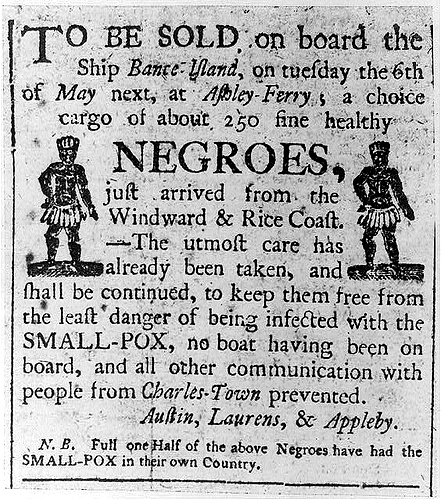
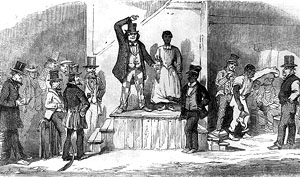


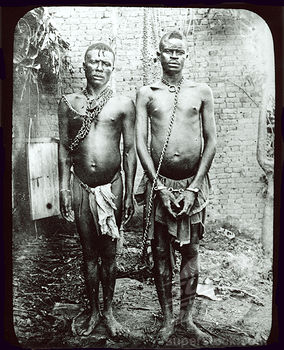
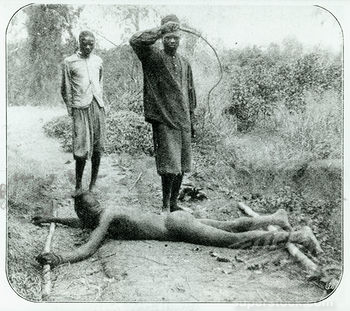


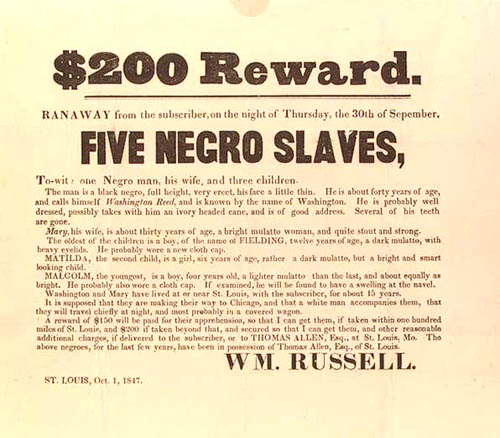

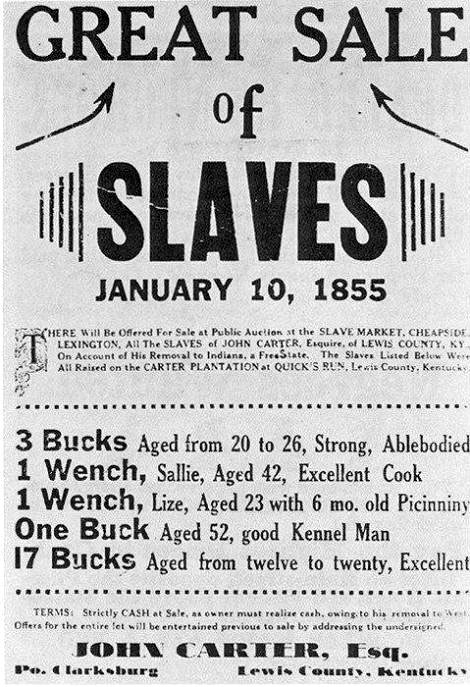


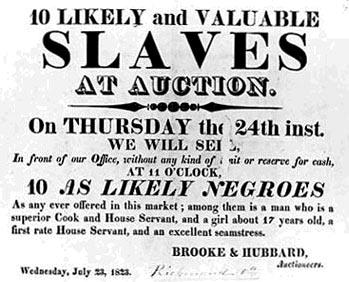


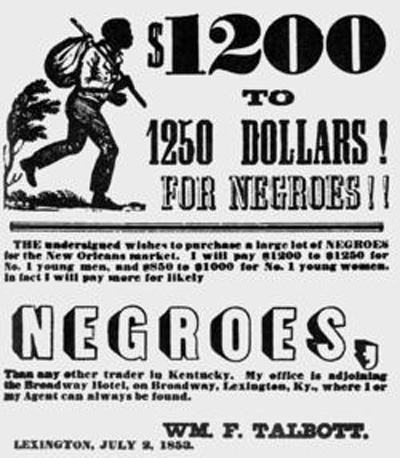


.jpg)