|
Christian Deceptions 3: Fabricating Records
|
| |
|
|
An honest man's the noblest work
of God.
An honest God's the noblest work of man.
|
|
Alexander Pope (1688-1744), An
Essay on Man
Samuel Butler (1835-1902), Further Extracts
|
Even by carefully selecting appropriate texts and destroying
inconvenient ones, it was still not possible to create a comprehensive
body of writing to support Christian orthodoxy. The answer was
to fabricate suitable material, which was not difficult for
an organisation that exercised a strict monopoly over reading
and writing. These texts could then be miraculously discovered.
This technique has a venerable history, even a among the Jews.
For example the book of Deuteronomy had been discovered hidden
in the Temple at Jerusalem by King Josiah. This discovery confirmed
the King's views during a major doctrinal controversy.
It is not now generally regarded as being as miraculous as his
supporters thought
As we have already seen, the early Christians were accused
of continuously tampering with their gospels, and the surviving
early texts that we have confirm that they did. No two early
manuscripts are identical, and scribes felt free to "improve"
the text by deleting, moving or amending chunks of it, or by
adding their own. Sects accused each other of tampering, and
with good cause. Was Jesus an ordinary man, or was he God incarnate?
The gospels could be altered to suit the editor's own views.
As one early sect said of another "…they laid hands
unblushingly on the Holy Scriptures, claiming to have corrected
them"*. It is probably
true that not all of the Christians who tampered in this way
regarded themselves as dishonest. Perhaps some of them really
did think that they were "correcting" the texts, because
it was so obvious to them that the texts should have said what
they themselves believed.
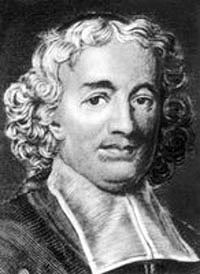  Throughout
the Christian era scholars have known that the scriptures were
extensively tampered with. Here for example is Father Jean Meslier
(1664-1729), a French Catholic priest who was also an atheist
(sic), discussing this point around the year 1700: Throughout
the Christian era scholars have known that the scriptures were
extensively tampered with. Here for example is Father Jean Meslier
(1664-1729), a French Catholic priest who was also an atheist
(sic), discussing this point around the year 1700:
It is no use saying that the Gospel stories have always been
regarded as holy and sacred, and that they have been faithfully
preserved without any tampering. It was common practice among
the writers who copied these stories to add, delete or alter
the text as seemed good to them. The Christians themselves
cannot deny this; for St. Jerome said explicitly in many places
in his Prologues that the text had been corrupted and falsified,
having already been through the hands of many people who added
and cut out what they pleased; with the result, as he said,
that there were as many different readings as there were different
texts*.
Some unlikely documents were put into circulation, such as
correspondence between Jesus and King Abgar V of Edessa*.
In some versions Jesus promised that the city of Edessa would
enjoy freedom from conquest. There were bogus records of Jesus"
trial, and several forged versions of a letter supposedly sent
by Pilate to the Emperor Tiberius concerning the crucifixion.
There was also a host of forged letters from the apostles, from
the various Marys, and from other gospel characters. Testimonial
letters appeared, purportedly from those miraculously healed
by Jesus, for example from a blind man whose sight had been
restored.
In the sixth century someone, probably a Monophysite Christian,
fabricated theological writings that purported to have been
written by Dionysius the Areopagite, who is mentioned in Acts
17:34. These writings were accepted as genuine and had a great
influence on both Eastern and Western Churches. They were for
many centuries the best "proof" of Mary's bodily
Assumption into Heaven. Another key document justifying the
same doctrine is the Cogitis me, a document purportedly
written by St Jerome but almost certainly fabricated by Paschasius
Radbert, a ninth century Abbot of Corbie (near Soissons in modern
France)*. Claims made by
this forgery are still repeated during masses in the Roman Church*.
Letters appeared from St Paul to Aristotle. Paul also supposedly
wrote six letters to Seneca, and received eight back. All were
Christian forgeries.
|
Historiated (ie Illuminated) initial
and beginning of text of the bogus correspondence between
St Paul and Seneca. Forger monks imagined ancient letters
to have been illuminated just like their own documents.
(Sp Coll MS Hunter 231 (U.3.4), a 14th century manuscript.)
|
|
|
A second century Christian acting "out of love of Paul"
forged a book, the Acts of Paul and Thecla, purporting
to describe his activities*.
Paul himself had been aware of the danger of forgery. He warned
his readers against teachings contained in some letter purporting
to be from him and made a point of writing the final passages
of his letters in his own hand to prove their authenticity (2
Thessalonians 3:17). The Apostolic Constitutions are
another fabrication. They purport to be written in the name
of Jesus" apostles and warn about books falsely claiming
to be written in the name of Jesus" apostles. A
document called 3 Corinthians is another known forgery,
a fabrication by the same priest who forged the Acts of
Paul and Thecla. Yet another "orthodox" forgery
was the Epistula apostolorum, supposedly written by
the eleven disciples remaining after Judas's betrayal.
Bogus lists of bishops were produced to bolster the fiction
of apostolic succession for important bishoprics. Bogus accounts
of martyrdoms were circulated to bolster the fictions that Christians
had been badly persecuted and that they had reacted with great
bravery. Given the poor state of Christian scholarship many
impositions succeeded for a long time. A popular and influential
work concerning the Virgin Mary claimed that she was elected
Queen of the Temple Virgins as a young girl, and that bishops
came to venerate her*.
Apparently it did not occur to the author or his readers that
there could not have been any bishops at that time. Letters
from Mary Magdalene to Lazarus discovered as late as the nineteenth
century fooled many Church scholars, despite the fact that they
were written in French. A work falsely ascribed to Albertus
Magnus (c.1193-1280), who became St Albert, was regarded with
such awe on account of its supposed authorship that no one noticed
until 1952 that it contradicted his known views*.
Many of these forgeries should have been easy to detect, even
those not written in French. They included anachronisms and
other simple mistakes. For example, early Jewish Christians
were known as Ebionites from the Hebrew term meaning the
poor, but Tertullian
assumed that they were named after a man called Ebion.
Soon, Christians were quoting from the writings of the odious
Ebion, in order to refute his followers*.
Letters were exchanged between people who were not contemporaries,
or else discussed people who were not yet born, or mentioned
cities that were not yet founded. There were letters too from
characters such as Prester John, a fictitious Christian ruler
in the distant Orient. Since standards of Church scholarship
were not high, almost any imposture was likely to succeed.
|
Book of Hours of Catherine of Clèves,
fifteenth century.
Medieval people seem to have no idea that things had ever
been different to how they were then. Invented medieval
stories were often given away by anachronisms. Similarly
biblical scenes were depicted in ways that now seem humourous.
Here, among numerous anachronisms, the infant Jesus learns
to walk with the help of a Medieval stroller
|
|
|
Not only were new works fabricated, genuine ones were doctored.
Passages were inserted into non-Christian works in order to
suggest that even non-Christians were impressed by Jesus or
by Christianity. A sympathetic reference to Jesus was for example
inserted into the writings of the historian Josephus*.
Writings of other Church Fathers were doctored to suit current
tastes. When Irenaeus of
Lyons's tract against heresies was translated into Latin
in the early fifth century, the opportunity was taken to omit
those parts that by then had themselves come to smack of heresy.
When Rufinus of Aquileia translated Origen's On First Principles
he openly admitted that he had altered the text to make it conform
to current orthodox thought. Origen himself had held that it
was acceptable to lie to less intelligent Christians, as long
as it bolstered belief. Generally it seems that many Christians
felt free to manipulate facts in favour of what they perceived
as divine truth. Dionysius, Bishop of Corinth (c.170), protested
that other Christians were changing and forging his letters,
just as they had tampered with the scriptures*:
When my fellow Christians invited me to write letters to
them I did so. These the devil's apostles have filled
with tares, taking away some things and adding others. For
them the woe is reserved. Small wonder then if some of them
have dared to tamper even with the word of the Lord Himself,
when they have conspired to mutilate my own humble efforts.
Cyprian, a Bishop of Carthage (c.250) also revealed that Christians
had been forging letters in his name*.
As one authority has pointed out, in the 200 years from around
AD 400, false letters were added to the collections of almost
every early Christian letter writer*.
In fact it is impossible to be sure that any single surviving
Christian document was written by its purported author and is
free from amendment.
Christians practised all manner of fabrication. They even tampered
with written records of oracles. Seven volumes of Apolline oracles
were edited by a Christian hand around the beginning of the
sixth century, and a further four bogus volumes were added to
produce the collection called On True Belief. They
also fabricated verses of the Sibylline Oracles,
complete with chunks of gospel history supposedly seen in visions
by sibyls long before New Testament times. By the Middle Ages,
12 of the old pagan sibyls were agreed to have predicted the
coming of Christ, and indeed the whole Christian story. The
fiction of the sibyls" prescience is still upheld in the
Roman Catholic Missal:
|
Dies irae, dies illa
Solvet saeclum in favilla
Teste David cum Sibylla*
|
That day, the day of wrath
Will turn the universe to ashes
As David foretells, and the Sibyl too
|
Frauds continued throughout the Middle Ages. A forged Appeal
of the Eastern Emperor for help in saving the Holy Land
was circulated in a successful attempt to whip up enthusiasm
for the First Crusade. Material concerning controversial opinions
was particularly vulnerable. Thus for example the whole edifice
of the Immaculate Conception is built on forgeries and documents
wrongly attributed to prestigious authors. According to taste
one could follow (pseudo)Jerome or (pseudo)Augustine, or any
one of numberless other documents by pseudo-authors. At least
one of the sermons of St Bonaventure (d. 1274) — the one
dealing with Mary's Assumption — is spurious*.
Sometimes the fraud was false attribution. The works of unknown
authors were passed off as the work of more prestigious figures.
The work of the little known Saxon Eadmer was passed off as
that of his more prestigious master, Anselm. Often the fraud
was much greater and more obvious. As we have seen, claims to
Church authority were bolstered by a series of major forgeries
including the Symmachan Forgeries, the Donation of Constantine, and the False
(Pseudo-Isidorian) Decretals. The papal chancery poured
out a stream of forgeries for many centuries, and schools of
forgers flourished under a long series of popes. One notable
culprit was Pope Gregory VII, who in the eleventh century used
old and new forgeries to justify his every whim. Under his direction,
pliant clerics amended ancient documents, changing their meaning,
sometimes to make them say the opposite of what they had originally
said. Churchmen created new documents purporting to be old ones
and bolstered all manner of papal claims. A huge fabricated
superstructure of falsehood was raised, buttressed by earlier
forgeries and founded on yet earlier ones.
To any scholars who looked into the matter it would have been
clear that many of these authoritative Church documents were
crude forgeries. Instead, they were cited in infallible papal
bulls by men in personal daily contact with God and incorporated
into the Concordia discordantium canonum, more popularly
known as the Decretum gratiani. This Decretum
was an authoritative code of canon law compiled in the middle
of the twelfth century by a Benedictine monk called Gratian,
who compiled bogus documents in addition to genuine ones. It
was through this document that torture was formally justified
by the Church as a way of obtaining confessions. Much later
theology was based on the Decretum, including the work
of Thomas Aquinas, whose Summa Theologica in turn forms
the basis for modern Roman Catholic doctrine. Thus, the authority
for this doctrine is compromised, if not completely invalidated.
 Pope
Gregory I used the False Decretals to justify his expanding
claims to temporal power. From the fifteenth century, at least,
these decretals were widely known to be fake, and yet the Church
insisted that they were not*.
The Italian humanist and educator Lorenzo Valla demonstrated
conclusively that the Donation
of Constantine was also a forgery, as was the
famous letter from Jesus to King Abgar — and so too letters
from St Paul to Seneca and many other important documents that
had been regarded as genuine for centuries. Valla's scholarship
was impeccable, but the Church continued to maintain that the
forgeries were genuine. It took more than 300 years for the
Roman Church to accept, in a roundabout way, that it had been
wrong. Some Roman Catholic writers still seem to be unaware
that the Donation
of Constantine is known to be a forgery, repeating
its claim that a Roman Emperor ceded his temporal authority
to the Church. Pope
Gregory I used the False Decretals to justify his expanding
claims to temporal power. From the fifteenth century, at least,
these decretals were widely known to be fake, and yet the Church
insisted that they were not*.
The Italian humanist and educator Lorenzo Valla demonstrated
conclusively that the Donation
of Constantine was also a forgery, as was the
famous letter from Jesus to King Abgar — and so too letters
from St Paul to Seneca and many other important documents that
had been regarded as genuine for centuries. Valla's scholarship
was impeccable, but the Church continued to maintain that the
forgeries were genuine. It took more than 300 years for the
Roman Church to accept, in a roundabout way, that it had been
wrong. Some Roman Catholic writers still seem to be unaware
that the Donation
of Constantine is known to be a forgery, repeating
its claim that a Roman Emperor ceded his temporal authority
to the Church.
Nothing was too sacred to be tampered with. The creeds were
amended to make them conform to the requirements of the Western
Church, to the anger and bewilderment of the Eastern Churches.
The records of ecumenical councils were tampered with too, when
it suited. Thus records of the Council of Nicæa were doctored
to confirm the primacy of the Roman Church. Whenever Eastern
scholars brought out a copy of an ancient text to prove a point,
Rome would attempt to refute it with a forgery. For centuries
the Orthodox Church knew Rome as the home of forgeries. The
role of women in the early Church was also something of a problem
in later times when the priesthood became a male monopoly. Inconvenient
evidence about the role (or even the existence) of women in
the early Church was suppressed, so that it became possible
to justify women's exclusion from the priesthood by reference
to the (fictitious) practices of the early Church. At least
partly on the strength of other forged documents women were
prevented from serving at the altar in any capacity*.
 Most
people were illiterate in the Middle Ages, but Church art could
be used to sustain convenient fictions. Art confirmed thetheologians"
favourite theories, papering over the fact that these theories
had no biblical support. For example, the four evangelists (the
purported writers of the gospels of Matthew, Mark, Luke and
John) were shown taking dictation from the Holy Ghost, sometimes
with an angel guiding their hands. This suggested that the gospels
were divinely inspired and authoritative, simultaneously avoiding
the uncomfortable facts that they were inconsistent and that
their writers had never even met the historical Jesus, nor as
far as we know each other. When the Bible mentions a messenger
(Greek angelos), the word was often translated as angel.
With no effort at all a human messenger was converted into a
semi-divine one. In the Bible they had no wings and were likely
to be mistaken for ordinary people, but in art they could sprout
wings and fly, which looked much more impressive. Most
people were illiterate in the Middle Ages, but Church art could
be used to sustain convenient fictions. Art confirmed thetheologians"
favourite theories, papering over the fact that these theories
had no biblical support. For example, the four evangelists (the
purported writers of the gospels of Matthew, Mark, Luke and
John) were shown taking dictation from the Holy Ghost, sometimes
with an angel guiding their hands. This suggested that the gospels
were divinely inspired and authoritative, simultaneously avoiding
the uncomfortable facts that they were inconsistent and that
their writers had never even met the historical Jesus, nor as
far as we know each other. When the Bible mentions a messenger
(Greek angelos), the word was often translated as angel.
With no effort at all a human messenger was converted into a
semi-divine one. In the Bible they had no wings and were likely
to be mistaken for ordinary people, but in art they could sprout
wings and fly, which looked much more impressive.
|
Queen Anne of Brittany praying with Sainte
Anne, Sainte Ursule et Sainte Hélène.
In art it is impossible to tell who is real, who is dead,
and who is imaginary.
|
|
|
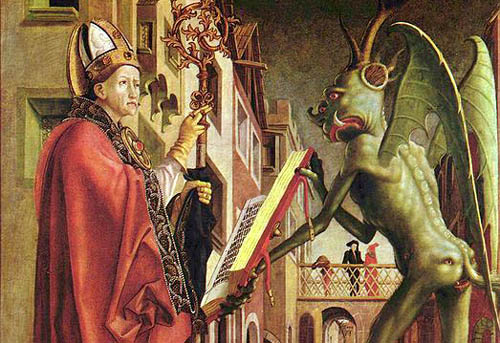
.jpg "Saint Jerome wearing an anachronistic cardinal's hat") It
was always safer to show fictions in the form of pictures. St
Jerome wearing a cardinal's
hat suggested that cardinals had existed since early times,
which they had not. Joseph was conventionally shown as an extremely
old man, which seemed to confirm the story, otherwise unsupported,
that he had never engaged in sexual intercourse with Mary. A
pope baptising the Emperor Constantine invited all manner of
false conclusions : that a pope had existed at that time, that
popes were in a position to baptise emperors, that emperors
were subordinate to popes, and so on. In fact Constantine was
hardly aware of the Bishop of Rome and was known to have been
baptised on his deathbed by a heretic.
The Donation
of Constantine was also a popular subject in Christian
art, ostensibly confirming the fiction that Constantine had
handed over his temporal power to Pope Sylvester. It
was always safer to show fictions in the form of pictures. St
Jerome wearing a cardinal's
hat suggested that cardinals had existed since early times,
which they had not. Joseph was conventionally shown as an extremely
old man, which seemed to confirm the story, otherwise unsupported,
that he had never engaged in sexual intercourse with Mary. A
pope baptising the Emperor Constantine invited all manner of
false conclusions : that a pope had existed at that time, that
popes were in a position to baptise emperors, that emperors
were subordinate to popes, and so on. In fact Constantine was
hardly aware of the Bishop of Rome and was known to have been
baptised on his deathbed by a heretic.
The Donation
of Constantine was also a popular subject in Christian
art, ostensibly confirming the fiction that Constantine had
handed over his temporal power to Pope Sylvester.
|
St-Silvester, the Pope, Baptises the
Emperor Constantine, detail of a painting by Jacopo Vignali.
The painting contains many deliberate errors. Silvester
was not known as "pope".
He did not wear a tripple crown. He did not baptise Constantine.
|
|
|
The Pope's triple crown served many purposes. On St Peter's
head it confirmed that the papacy dated from apostolic times.
On Christ's head it confirmed the Pope as Christ's vicar on
Earth. On Aaron's head it confirmed the continuity of the Christian
priesthood from Old Testament times. Such pictures smoothed
over all manner of difficulties and confirmed a wide variety
of fictions concerning priests and popes.
|
Saint Peter wearing the papal tiara
with a trple crown, suggesting an apostolic succession
of popes
from Peter himself. In fact the triple crown was invented
over a millennium after Peter's death.
Statue of Saint Peter in Saint Peter's Basilica, Rome
|
|
|
|
Christ wearing a papal tiara, further bolstering the apparent
significance of the tripple crown
Van Eyck, detail from the The Ghent Altarpiece, painted
1432.
|
|
|
|
God the Father shown wearing the papal tiara with a trple
crown,
suggesting a quasi-divine status for the popes
This example is from a painting of the Annunciation dated
1562 by an artist of the Bruge school
purchased by the National Gallery of Ireland in 1951 (NGI
1223)
|
|
|
|
God wearing a triple crown
Melchior Broederlam, The Annunciation 1393-99 (detail),
Musée des Beaux-Arts, Dijon, France
|
|
|
| |
|
God wearing a triple crown - stained
glass window in a Languedoc Church
|
|
|
In the gospels the Virgin Mary is a peripheral character, worthy
of little respect, and spoken to rather sharply by her own eldest
son. But as her cult grew, this could easily be ignored. In
art she became more imposing, more important, more queenly,
more divine. She started wearing heavenly crowns and acquired
a halo. In time, her status was raised above that of angels.
In early medieval art Mary had knelt in front of Gabriel when
he appeared to her. In later art, when Mary had developed a
more important role, Gabriel knelt in front of her.
Mary Kneeling before Gabriel,
depicted in the first half of the fifteenth century,
before the Cult of Mary became popular and when
Gabriel had a higher status than Mary.
Fra Angelico. Annunciation. c. 1441.
Fresco, 176 x 148. Museo di San Marco,
Cell 3, Florence, Italy
|
|
|
|
|
Vol II, Fig 9. Gabriel Kneeling
before Mary,
depicted in the second half of the fifteenth
century,
after the Cult of Mary became popular
and Mary gained a higher status than Gabriel.
Sandro Botticelli, 1489-1490, Annunciation,
Tempera on panel 150 × 156 cm
Uffizi, Florence
|
|
|
|
Events in the Old Testament were frequently paired with those
of the New, with details added to reinforce the supposed prefiguration
of the New Testament by the Old. For example Abraham's sacrifice of his son Isaac was shown as prefiguring God's sacrifice of his son Jesus. Isaac was shown carrying the wood
to make an altar on which he is to die, just as Jesus was shown
carrying the wooden cross on which he is to die. By painting
similar pictures flimsy parallels were converted into accurate
predictions.
For the select few who were allowed to learn to read and write
in the Middle Ages, the most popular books were accounts of
the lives of Christian saints and especially their miraculous
powers. These stories purported to be straight historical accounts
and were known as legends. The word legend
(from the Latin legere. to read) did not then imply
that the accounts were fictitious. Rather, the sheer improbability
of these accounts resulted in the word acquiring its present
suggestion of untruth. Reading works like the Golden Legend,
by Jacobus de Voragine, it is easy to see why even the most
credulous should regard them as works of fiction. They were
patently made-up stories designed to impress. No one now defends
them as factual accounts, but they were originally presented
as literal accounts, invested with ecclesiastical authority.
The author, a Dominican, became an archbishop, and is now regarded
as a saint by his follow Dominicans. Many of the saints whose
lives were detailed had never existed at all; others had been
pagan gods. Some had existed but were represented as participating
in events that seemed impressive at the time but appear preposterous
now.
|
Saint Theophilus the Penitent or Theophilus
of Adana (died ca. 538) was the archdeacon of Adana, Cilicia
in the sixth century Church. according to Eutychianus
of Adana an "eye witness", he made a deal with
the Devil to gain an ecclesiastical position.
Here Saint Theophilus renounces his deal with the Devil
(detail of a painting by Michael Pacher.)
|
|
|
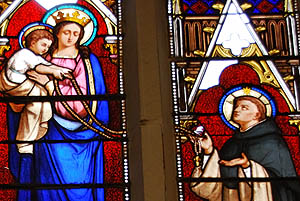 Histories
were invented retrospectively to explain all manner of things.
For example, after the use of rosaries had been adopted, it
became expedient to rationalise their origin. According to Dominican
historians, Christian rosaries derive from a chaplet of beads
"Our Lady's Crown of Roses" given to St Dominic (1170-1221)
by the Virgin Mary in a vision. In fact Alain de la Roche in
the fifteenth century was the first to connect rosaries with
St Dominic, and as a prominent Roman Catholic authority concedes,
he "based his revelations on the imaginary testimony of
writers that never existed"*.
He was far from being an isolated or exceptional case. Rosaries,
incidentally, were copied from Muslims, who had picked them
up from Buddhists and Hindus. Histories
were invented retrospectively to explain all manner of things.
For example, after the use of rosaries had been adopted, it
became expedient to rationalise their origin. According to Dominican
historians, Christian rosaries derive from a chaplet of beads
"Our Lady's Crown of Roses" given to St Dominic (1170-1221)
by the Virgin Mary in a vision. In fact Alain de la Roche in
the fifteenth century was the first to connect rosaries with
St Dominic, and as a prominent Roman Catholic authority concedes,
he "based his revelations on the imaginary testimony of
writers that never existed"*.
He was far from being an isolated or exceptional case. Rosaries,
incidentally, were copied from Muslims, who had picked them
up from Buddhists and Hindus.
In pre-Christian times educated people had seen the need for
objective histories. Thucydides (c.460-c.401 BC) had aimed at
a rational and impartial account of history. The gods play no
active role in his work. His writing is detachment, critical,
and free of platitudes and moral judgments. Many of his principles
are considered best practice in history writing today. Cicero
(106-43 BC) said that a historian should not write what is false,
nor conceal what is true, nor entertain the least suspicion
of favouritism or prejudice. Christianity adopted exactly the
opposite view. The Church abandoned impartial history in favour
of propaganda. Christian chroniclers saw no need for objective
truth because their version of the truth was the only truth.
Since they enjoyed an enforced monopoly over reading and writing,
we have only their side of the story: we hear of virtuous bishops
and holy emperors overcoming all obstacles with the visible
assistance of God. We hear less about frauds, failures, crimes
and disagreements. Histories were fabricated to suit the Church.
Chronicles are consistently partisan and otherwise unreliable,
and it is possible to get near the truth only when there is
another side of the story. The history of the Crusades, for
example, is as well known as it is because of rival chroniclers
whose partisan works (though often tampered with) can be compared
to each other and to Byzantine, Muslim and other records.
In almost all areas, the truth according to impartial modern
historians is less flattering than the traditional accounts
taught in schools. In the traditional versions, Christians were
on the right side. Deliberate distortions continue. Modern histories
of the Church often give the impression that the Churches supported
the abolition of capital punishment, penal reform, democracy,
human rights and a host of freedoms, when in fact they opposed
all of these things. The American Civil War has become a war
in which Christianity vanquished a number of un-Christian practices
like slavery and established wholesome traditional Christian
ideas like liberty, equality and democracy. The truth is exactly
the opposite, since it was the South that was supporting the
traditional Christian practice of slavery, and the North pursuing
the secular principles of the founders of the Constitution.
Texts are still being tampered with to make the facts fit the
fictions. For example Lincoln's address at Gettysburg made
no mention of God, yet when it is cited now the words "under
God" are often added after the words "this nation".
If we had to rely on Church historians we would hear that Christians
were almost solid in their opposition to Nazism, which as we
shall see later is far from the truth. Almost no textbook will
give estimates of the numbers of people killed by Christian
Churches or at Christian Churches" behest: pagans, Jews,
Muslims, Cathars, supposed witches, heretics, schismatics, rationalists,
disabled children, or any other group. Many books confirm the
fiction that various reforms were carried out by Christians
in the face of fierce opposition from unspecified quarters.
Few mention that reform was in almost all cases driven through
by popular opinion, led by people outside mainstream Christianity.
Key names such as those of Thomas Paine, George Holyoake and
Annie Besant are simply omitted from school history books. Other
names are omitted too, such as those of the numerous professors
who lost their Chairs for accepting scientific facts or for
bringing biblical analysis to public attention.
Recent history is adjusted to put the Churches on what is now
regarded as the right side. Thus hardly any child leaves school
knowing that the Nazi treatment of the Jews was copied point
for point from traditional Christian techniques, even from Church
statutes. Neither will they have any clue that there had been
many Nazi priests and bishops during World War II, both Roman
Catholic and Protestant. No criticism of the Church will have
been heard. However well established the truth, it simply will
not appear in popular books. No school child learns that the
Christian Church consistently supported slavery and torture,
corporal and capital punishment, and mass killings, or that
it opposed almost all social reform. One could visit 1,000 church
bookshops without ever finding a single book that betrayed a
hint of any of this.
Trial records disappear. Original accounts of visions disappear.
Books disappear. Paintings disappear. Recods of clerical crimes
disappear. Photographs disappear or are re-touched. Churches
have become so accustomed to manipulating records that they
sometimes forget that in the age of the internet it is not as
easy as it once was. A photograph of the Greek Orthodox Patriarch
Kirill I posted on his website in April 2012 showed him wearing
a watch worth at least $30,000. He had previously denied owning
such a watch, and the photograph (below left) was quickly replaced
by an edited version with the watch covered up (below right).
Patriarch Kirill then insisted in an interview with a Russian
journalist that he had never worn such a watch, and that any
photographs showing him wearing it must have been doctored to
add the watch (anticipating the danger of of anyone having copied
the incriminating photograph before it was doctored). But His
Holiness had not realised that his photo-editor had failed to
remove the reflection of the Patriarch's watch on the shiny
table. When this was pointed out, a Church spokeman admitted
that the photograph had been doctored through a "technical
mistake" - decling to coment on the fact that His Holiness,
champion of public morality, had been caught out in the most
blatent deception.
|
A Breguet watch on the left wrist of
Patriarch Kirill I, left, vanished in a doctored photo
(right)
but its reflection on the table remained.
|
 |
Evidence continues to be massaged in many ways as tastes change.
One can visit cities such as Rome, Madrid, Avignon, and Toledo
and enjoy guided tours of religious buildings without hearing
the least hint that they housed ecclesiastical torture chambers.
These torture chambers were seen by numerous reliable witnesses
(like the prison reformer John Howard ) up to the nineteenth
century, but now they have apparently vanished. Perhaps they
have been destroyed; perhaps they are merely no longer open
to visitors. Little by little, all evidence of the uncomfortable
past is being eliminated. Coats of arms have been sanitised,
to make them more religious and less bellicose. Coronets, swords
and crests have been removed from clerical arms. Similarly,
hymnals are updated to reflect current tastes. Politically incorrect
hymns or verses of hymns have disappeared without trace. In
England alone, many hundreds of millions of hymnals were printed
with hymns condoning the oppression of women, the acceptance
of poverty and the acceptability of racist ideas, yet it is
now difficult to find one even in a second-hand bookshop. At
the time of writing traditionalist Christians are complaining
about the trend for Christmas Carols to be sanitised by removing
terms with a feudal and male resonance like Lord and King. It
is already difficult to find copies of traditional prayer books
containing old services, for example for the expulsion of lepers,
formal cursings, and the special Anglican anti-Roman Catholic
service for 5 th November. How many people have ever seen the
text of a service of excommunication, once so popular?
There is also great selectivity in what children and television
watchers are told about the beliefs of well-known people. Every
Sunday the public media feature television cooks, footballers,
singers, and popular entertainers who all avow their deep Christian
faith. Unsympathetic philosophers and scientists, and even liberal
theologians, are almost never given similar opportunities to
express their ideas. The beliefs of well-known people are suppressed
and frequently distorted. Few children ever learn that writers
such as Shelley, George Eliot, Mark Twain and H. G. Wells were
non-believers, nor that intellectual giants like Darwin, Freud,
Einstein and Russell all became atheists*.
Neither are they told that Hitler, Stalin, Franco, Pétain
and Mussolini were all Christian believers, most of them benefiting
from particularly devout families*.
Again, reformers like Lord Shaftesbury, Florence Nightingale,
and William Wilberforce are falsely portrayed as orthodox Christians,
while the most dedicated true reformers, who were non-Christians,
such as Thomas Paine, John Stewart Mill and Jeremy Bentham,
are almost totally ignored in school history books. It is arguable
that the Christian Churches have carried out one of the most
successful whitewash jobs in history.
|
|
|
|
|
|
|
|
|
|
|
|
|
|
|
|
|
|
|
|
|
|
|
|
|
|
|
|
|
|
|
|
|
|
|
|
|
|
Buy the Book from Amazon.com
|
|
|
|
|
|
Buy the Book from Amazon.co.uk
|
|
|
| |
| |
| More Books |
|
|
|
| |
The Donation of Constantine
(c.750-800)
The most famous forgery in history was for centuries the basis
of papal claims. It was probably forged shortly after the middle
of the eighth century to assist Pope Stephen II in his negotiations
with the Frankish Mayor of the Palace, Pepin the Short. The
Pope anointed Pepin as king in 754, enabling, his Carolingian
family to supplant the old Merovingian royal line, and to become
the rulers of the Franks in law as well as in fact. In return,
Pepin promised to give to the Pope lands in Italy which the
Lombards had taken from Byzantium. The promise was fulfilled
in 756. The forgery made it possible to interpret Pepin's grant
as a restoration.
One of the key lines "And we ordain
and decree that [the pope] shall have the supremacy as well
over the four chief seats Antioch, Alexandria, Constantinople
and Jerusalem, as also over all the churches of God in the whole
world" was also the biggest giveaway: at the time
of the claimed date of the document, Constantinople had not
yet been founded.
The text below comes Ffrom Zeumer's edition, published in Berlin
in 1888, v. Brunner-Zeumer: "Die Constantinische Schenkungsurkunde")
translated in Ernest F. Henderson, Select Historical Documents
of the Middle Ages, (London: George Bell, 1910), pp. 319-329
In the name of the holy and indivisible Trinity, the Father,
namely, and the Son and the Holy Spirit. The emperor Caesar
Flavius Constantine in Christ Jesus, the Lord I God our Saviour,
one of that same holy Trinity,-faithful merciful, supreme,
beneficent, Alamannic, Gothic, Sarmatic, Germanic, Britannic,
Hunic, pious, fortunate, victor and triumpher, always august:
to the most holy and blessed father of fathers Sylvester,
bishop of the city of and to all his successors the pontiffs, who are about to sit upon Rome and pope, the chair of St.
Peter until the end of time - also to all the most reverend
and of God beloved catholic bishops, subjected by this our
imperial decree throughout the whole world to this same holy,
Roman church, who have been established now and in all previous
times-grace, peace, charitv, rejoicing, long-suffering, mercv,
be with you all from God the Father almighty and from Jesus
Christ his Son and from the Holy Ghost. Our most gracious
serenity desires, in clear discourse, through the page of
this our imperial decree, to bring to the knowledge of all
the people in the whole world what things our Saviour and
Redeemer the Lord Jesus Christ, the Son of the most High Father,
has most wonderfully seen fit to bring about through his holy
apostles Peter and Paul and by the intervention of our father
Sylvester, the highest pontiff and the universal pope. First,
indeed, putting forth, with the inmost confession of our heart,
for the purpose of instructing the mind of all of you, our
creed which we have learned from the aforesaid most blessed
father and our confessor, Svlvester the universal pontiff;
and then at length announcing the mercy of God which has been
poured upon us.
For we wish you to know,, as we have signified through our
former imperial decree, that we have gone away, from the worship
of idols, from mute and deaf images made by hand, from devilish
contrivances and from all the pomps of Satan; and have arrived
at the pure faith of the Christians, which is the true light
and everlasting life. Believing, according to what he-that
same one, our revered supreme father and teacher, the pontiff
Sylvester - has taught us, in God the Father, the almighty
maker of Heaven and earth, of all things visible and invisible;
and in Jesus Christ, his only Son, our Lord God, through whom
all things are created; and in the Holy Spirit, the Lord and
vivifier of the whole creature. We confess these, the Father
and the Son and the Holy Spirit, in such way that, in the
perfect Trinity, there shall also be a fulness of divinity
and a unity of power. The Father is God, the Son is God, and
the Holy Spirit is God; and these three are one in Jesus Christ.
There are therefore three forms but one power. For God, wise
in all previous time, gave forth from himself the word through
which all future ages were to be born; and when, by that sole
word of His wisdom, He formed the whole creation from nothing,
He was with it, arranging all things in His mysterious secret
place.
Therefore, the virtues of the Heavens and all the material
part of the earth having been perfected, by the wise nod of
His wisdom first creating man of the clay of the earth in
His own image and likeness, He placed him in a paradise of
delight. Him the ancient serpent and envious enemy, the devil,
through the most bitter taste of the forbidden tree, made
an exile from these joys; and, be being expelled, did not
cease in many ways to cast his poisonous darts; in order that,
turning the human race from the way of truth to the worship
of idols, he might persuade it, namely to worship the creature
and not the creator; so that, through them (the idols), he
might cause those whom he might be able to entrap in his snares
to be burned with him in eternal punishment. But our Lord,
pitying His creature, sending ahead His holy prophets, announcing
through them the light of the future life-the coming,' that
is, of His Son our Lord and Saviour Jesus Christ-sent that
same only begotten Son and Word of wisdom: He descending from
Heaven on account of our salvation, being born of the Holy
Spirit and of the Virgin Mary,-the word was made flesh and
d welt among us. He did not cease to be what He had been,
but began to be what He had not been, perfect God and perfect
man: as God, performing miracles; as man, sustaining human
sufferings. We so learned Him to be very man and very God
by the preaching of our father Sylvester, the supreme pontiff,
that we can in no wise doubt that He was very, God and very
man. And, having chosen twelve apostles, He shone with miracles
before them and an innumerable multitude of people. We confess
that this same Lord Jesus Christ fulfilled the law and the
prophets; that He suffered, was crucified, on the third day
arose from the dead according to the Scriptures; was received
into Heaven, and sitteth on the right hand of the Father.
Whence He shall come to judge the quick and the dead, whose
kingdom shall have no end. For this is our orthodox creed,
placed before us by our most blessed father Sylvester, the
supreme pontiff. We exhort, therefore, all people, and all
the different nations, to hold, cherish and preach this faith;
and, in the name of the Holy Trinity, to obtain the grace
of baptism; and, with devaout heart, to adore the Lord Jesus
Christ our Saviour, who with the Father and the Holy Spirit,
lives and reigns through infinite ages; whom Sylvester our
father, the universal pontiff, preaches. For He himself, our
Lord God, having pit on me a sinner, sent His holy apostles
to visit us, and caused the light of his splendour to shine
upon us. And do ye rejoice that I, having been withdrawn from
the shadow, have come to the true light and to the knowledge
of truth. For, at a time when a mighty and filthy leprosy
had invaded all the flesh of my, body, and the care was administered
of many physicians who came together, nor by that of any one
of them did I achieve health: there came hither the priests
of the Capitol, saving to me that a font should be made on
the Capitol, and that I should fill this with the blood of
innocent infants; and that, if I bathed in it while it was
warm, I might be cleansed. And very many innocent infants
having been brought together according to their words, when
the sacrilegious priests of the pagans wished them to be slaughtered
and the font to be filled with their blood: Our Serenity perceiving
the tears of the mothers, I straightway abhorred the deed.
And, pitying them, I ordered their own sons to be restored
to them; and, giving them vehicles and gifts, sent them off
rejoicing to their own. That day having passed therefore-the
silence of night having come upon us-when the time of sleep
had arrived, the apostles St. Peter and Paul appear, saying
to me: "Since thou hast placed a term to thy vices, and
hast abhorred the pouring forth of innocent blood, we are
sent by, Christ the Lord our God, to give to thee a plan for
recovering thy health. Hear, therefore, our warning, and do
what we indicate to thee. Sylvester - the bishop of the city
of Rome - on Mount Serapte, fleeing they persecutions, cherishes
the darkness with his clergy in the caverns of the rocks.
This one, when thou shalt have led him to thyself, will himself
show thee a pool of piety; in which, when he shall have dipped
thee for the third time, all that strength of the leprosy
will desert thee. And, when this shall have been done, make
this return to thy Saviour, that by thy order through the
whole world the churches may be restored. Purify thyself,
moreover, in this way, that, leaving all the superstition
of idols, thou do adore and cherish the living and true God
-- who is alone and true -- and that thou attain to the doing
of His will.
Rising, therefore, from sleep, straightway I did according
to that which I bad been advised to do by, the holy apostles;
and, having summoned that excellent and benignant father and
our enlightener - Svlvester the universal pope-I told him
all the words that had been taught me by the holy apostles;
and asked him who where those gods Peter and Paul. But he
said that they where not really called gods, but apostles
of our Saviour the Lord God Jesus Christ. And again we began
to ask that same most blessed pope whether he had some express
image of those apostles; so that, from their likeness, we
might learn that they were those whom revelation bad shown
to us. Then that same venerable father ordered the images
of those same apostles to be shown by his deacon. And, when
I had looked at them, and recognized, represented in those
images, the countenances of those whom I had seen in my dream:
with a great noise, before all my satraps [there
were no such Roman officials. Satrap is a Persian title],
I confessed that they were those whom I had seen in my dream.
Hereupon that same most blessed Sylvester our father, bishop
of the city of Rome, imposed upon us a time of penance-within
our Lateran palace, in the chapel, in a hair garment,-so that
I might obtain pardon from our Lord God Jesus Christ our Saviour
by vigils, fasts, and tears and prayers, for all things that
had been impiously done and unjustly ordered by me. Then through
the imposition of the hands of the clergy, I came to the bishop
himself; and there, renouncing the pomps of Satan and his
works, and all idols made by hands, of my own will before
all the people I confessed: that I believed in God the Father
almighty, maker of Heaven and earth, and of all things visible
and invisible; and in Jesus Christ, His only Son our Lord,
who was born of the Holy Spirit and of the Virgin Mary. And,
the font having been blessed, the wave of salvation purified
me there with a triple immersion. For there 1, being placed
at the bottom of the font, saw with my own eyes a band from
Heaven touching me; whence rising, clean, know that I was
cleansed from all the squalor of leprosy. And, I being raised
from the venerable font-putting on white raiment, be administered
to me the sign of the seven-fold holy Spirit, the unction
of the holy oil; and he traced the sign of the holy cross
on my brow, saying: God seals thee with the seal of His faith
in the name of the Father and the Son and the Holy Spirit,
to signalize thy faith. All the clergy replied: "Amen."
The bishop added, "peace be with thee."
And so, on the first day after receiving the mystery of the
holy baptism, and after the cure of my body from the squalor
of the leprosy, I recognized that there was no other God save
the Father and the Son and the Holy Spirit; whom the most
blessed Sylvester the pope doth preach; a trinity in one,
a unity in three. For all the gods of the nations, whom I
have worshipped up to this time, are proved to be demons;
works made by the hand of men; inasmuch as that same venerable
father told to us most clearly how much power in Heaven and
on earth He, our Saviour, conferred on his apostle St. Peter,
when finding him faithful after questioning him He said: "Thou
art Peter, and upon this rock (petrani) shall I build My Church,
and the gates of bell shall not prevail against it."
Give heed ye powerful, and incline the ear of .your hearts
to that which the good Lord and Master added to His disciple,
saying: and I will give thee the keys of the kingdom of Heaven;
and whatever thou shalt bind on earth shall be bound also
in Heaven, and whatever thou shalt loose on earth shall be
loosed also in Heaven." This is very wonderful and glorious,
to bind and loose on earth and to have it bound and loosed
in Heaven.
And when, the blessed Sylvester preaching them, I perceived
these things, and learned that by the kindness of St. Peter
himself I had been entirely restored to health: I together
with all our satraps and the whole senate and the nobles and
all the Roman people, who are subject to the glory of our
rule -considered it advisable that, as on earth he (Peter)
is seen to have been constituted vicar of the Son of God,
so the pontiffs, who are the representatives of that same
chief of the apostles, should obtain from us and our empire
the power of a supremacy greater than the earthly clemency
of our imperial serenity is seen to have had conceded to it,-we
choosing that same prince of the apostles, or his vicars,
to be our constant intercessors with God. And, to the extent
of our earthly imperial power, we decree that his holy Roman
church shall be honoured with veneration; and that, more than
our empire and earthly throne, the most sacred seat of St.
Peter shall be gloriously exalted; we giving to it the imperial
power, and dignity of glory, and vigour and honour.
And we ordain and decree that he shall have the supremacy
as well over the four chief seats Antioch, Alexandria, Constantinople
and Jerusalem, as also over all the churches of God in the
-whole world. And he who for the time being shall be pontiff
of that holy Roman church shall be more exalted than, and
chief over, all the priests of the whole world; and, according
to his judgment, everything which is to be provided for the
service of God or the stability of the faith of the Christians
is to be administered. It is indeed just, that there the holy
law should have the seat of its rule where the founder of
holy laws, our Saviour, told St. Peter to take the chair of
the apostleship; where also, sustaining the cross, he blissfully
took the cup of death and appeared as imitator of his Lord
and Master; and that there the people should bend their necks
at the confession of Christ's name, where their teacher, St.
Paul the apostle, extending his neck for Christ, was crowned
with martyrdom. There, until the end, let them seek a teacher,
where the holy body of the teacher lies; and there, prone
and humiliated, let them perform I the service of the heavenly
king, God our Saviour Jesus Christ, where the proud were accustomed
to serve under the rule of an earthly king.
Meanwhile we wish all the people, of all the races and nations
throughout the whole world, to know: that we have constructed
within our Lateran palace, to the same Saviour our Lord God
Jesus Christ, a church with a baptistry from the foundations.
And know that we have carried on our own shoulders from its
foundations, twelve baskets weighted with earth, according
to the number of the holy apostles. Which holy church we command
to be spoken of, cherished, venerated and preached of, as
the head and summit of all the churches in the whole world-as
we have commanded through our other imperial decrees. We have
also constructed the churches of St. Peter and St. Paul, chiefs
of the apostles, which we have enriched with gold and silver;
where also, placing their most sacred bodies with great honour,
we have constructed their caskets of electrum, against which
no force of the elements prevails. And we have placed a cross
of purest gold and precious gems on each of their caskets,
and fastened them with golden keys. And on these churches
for the endowing of divine services we have conferred estates,
and have enriched them with different objects; and, through
our sacred imperial decrees, we have granted them our gift
of land in the East as well as in the West; and even on the
northern and southern coast;-namely in Judea, Greece, Asia,
Thrace, Africa and Italy and the various islands: under this
condition indeed, that all shall be administered by the hand
of our most blessed father the pontiff Sylvester and his successors.
For let all the people and the nations of the races in the
whole world rejoice with us; we exhorting all of you to give
unbounded thanks, together with us, to our Lord and Saviour
Jesus Christ. For He is God in Heaven above and on earth below,
who, visiting us through His holy apostles, made us worthy
to receive the holy sacrament of baptism and health of body.
In return for which, to those same holy apostles, my masters,
St. Peter and St. Paul; and, through them, also to St. Sylvester,
our father,-the chief pontiff and universal pope of the city
of Rome,-and to all the pontiffs his successors, who until
the end of the world shall be about to sit in the seat of
St. Peter: we concede and, by this present, do confer, our
imperial Lateran palace, which is preferred to, and ranks
above, all the palaces in the whole world; then a diadem,
that is, the crown of our head, and at the same time the tiara;
and, also, the shoulder band,-that is, the collar that usually
surrounds our imperial neck; and also the purple mantle, and
crimson tunic, and all the imperial raiment; and the same
rank as those presiding over the imperial cavalry; conferring
also the imperial sceptres, and, at the same time, the spears
and standards; also the banners and different imperial ornaments,
and all the advantage of our high imperial position, and the
glory of our power.
And we decree, as to those most reverend men, the clergy
who serve, in different orders, that same holy Roman church,
that they shall have the same advantage, distinction, power
and excellence by the glory of which our most illustrious
senate is adorned; that is, that they shall be made patricians
and consuls,-we commanding that they shall also be decorated
with the other imperial dignities. And even as the imperial
soldiery, so, we decree, shall the clergy of the holy Roman
church be adorned. And I even as the imperial power is adorned
by different offices-by the distinction, that is, of chamberlains,
and door keepers, and all the guards,-so we wish the holy
Roman church to be adorned. And, in order that the pontifical
glory may shine forth more fully, we decree this also: that
the clergy of this same holy Roman church may use saddle cloths
of linen of the whitest colour; namely that their horses may
be adorned and so be ridden, and that, as our senate uses
shoes with goats' hair, so they may be distinguished by gleaming
linen; in order that, as the celestial beings, so the terrestrial
may be adorned to the glory of God. Above all things, moreover,
we give permission to that same most holy one our father Sylvester,
bishop of the city of Rome and pope, and to all the most blessed
pontiffs who shall come after him and succeed him in all future
times-for the honour and glory of Jesus Christ our Lord,-to
receive into that great Catholic and apostolic church of God,
even into the number of the monastic clergy, any one from
our senate, who, in free choice, of his own accord, may wish
to become- a cleric; no one at all presuming thereby to act
in a haughty manner.
We also decreed this, that this same venerable one our father
Sylvester, the supreme pontiff, and all the pontiffs his successors,
might use and bear upon their heads-to the Praise of God and
for the honour of St. Peter-the diadem; that is, the crown
which we have granted him from our own head, of purest gold
and precious gems. But he, the most holy pope, did not at
all allow that crown of gold to be used over the clerical
crown which he wears to the glory of St. Peter; but we placed
upon his most holy head, with our own hands, a tiara of gleaming
splendour representing the glorious resurrection of our Lord.
And, holding the bridle of his horse, out of reverence for
St. Peter we performed for him the duty of groom; decreeing
that all the pontiffs his successors, and they alone, may
use that tiara in processions.
In imitation of our own power, in order that for that cause
the supreme pontificate may not deteriorate, but may rather
be adorned with power and glory even more than is the dignity
of an earthly rule: behold we-giving over to the oft-mentioned
most blessed pontiff, our father Sylvester the universal pope,
as well our palace, as has been said, as also the city of
Rome and all the provinces, districts and cities of Italy
or of the western regions; and relinquishing them, by our
inviolable gift, to the power and sway of himself or the pontiffs
his successors-do decree, by this our godlike charter and
imperial constitution, that it shall be so arranged; and do
concede that they (the palaces, provinces etc.) shall lawfully
remain with the holy Roman church.
Wherefore we have perceived it to be fitting that our empire
and the power of our kingdom should be transferred and changed
to the regions of the East; and that, in the province of Byzantium,
in a most fitting place, a city should be built in our name;
and that our empire should there be established. For, where
the supremacy of priests and the bead of the Christian religion
has been established by a heavenly ruler, it is not just that
there an earthly ruler should have jurisdiction.
We decree, moreover, that all these things which, through
this our imperial charter and through other godlike commands,
we have established and confirmed, shall remain uninjured
and unshaken until the end of the world. Wherefore, before
the living God, who commanded us to reign, and in the face
of his terrible judgment, we conjure, through this our imperial
decree, all the emperors our successors, and all our nobles,
the satraps also and the most glorious senate, and all the
people in the ,A-hole world now and in all times previously
subject to our rule: that no one of them, in any way allow
himself to oppose or disregard, or in any way seize, these
things which, by our imperial sanction, have been conceded
to the holy Roman church and to all its pontiffs. If anyone,
moreover,-which we do not believe - prove a scorner or despiser
in this matter, he shall be subject and bound over to eternal
damnation; and shall feel that the holy chiefs of the apostles
of God, Peter and Paul, will be opposed to him in the present
and in the future life. And, being burned in the nethermost
hell, he shall perish with the devil and all the impious.
The page, moreover, of this our imperial decree, we, confirming
it with our own hands, did place above the venerable body
of St. Peter chief of the apostles; and there, promising to
that same apostle of God that we would preserve inviolably
all its provisions, and would leave in our commands to all
the emperors our successors to preserve them, we did hand
it over, to be enduringly and happily possessed, to our most
blessed father Sylvester the supreme pontiff and universal
pope, and, through him, to all the pontiffs his successors
-God our Lord and our Saviour Jesus Christ consenting.
And the imperial subscription: May the Divinity preserve
you for many years, oh most holy and blessed fathers.
Given at Rome on the third day before the Kalends of April,
our master the august Flavius Constantine, for the fourth
time, and Galligano, most illustrious men, being consuls.
Notes § The Sibylline Oracles
are a collection of twelve books of prophecies supposedly made
by sibyls —women regarded as prophets or oracles by the
ancient Greeks and Romans.
§ Constantine was
at least half-pagan throughout his life, unusually superstitious,
and responsible for the deaths of his own eldest son and of
one of his brothers-in-law, and for the deaths of many others, even after his supposed conversion. He had his second wife
boiled alive in her bath. The account of his conversion was
dubious, and the most reliable version tampered with, but this
could not be known by anyone familiar only with the conventional
depictions of the event.
§ Most versions available
on the internet refer to "this nation under God",
yet the Hay and Nicolay versions kept by the Library of Congress
refer simply to "this nation" and make no reference
to God anywhere in the text.
§. Eusebius,
The History of the Church, 5:28. The particular passage
quoted is by a member of the divine-Jesus faction against the
human-Jesus faction.
§. Jean Meslier,
Mon Testament, extracts published by Voltaire, Extrait
du Testament de J. Meslier, 1762 (Ch 1, 2) and cited in
translation by Knight, Humanist Anthology, p 24.
§. Quoted by Eusebius,
The History of the Church, 1:13. The text of the correspondence
cited differs from the surviving Syriac text.
§. Graef, Mary,
vol. 1, pp 176-8.
§. "Mary is
"the Virgin who alone has destroyed all the wickedness
of the heresies", a saying which, carrying the authority
of St Jerome, is still
recited in the Tract of the Roman Mass of the Common of the
Blessed Virgin in Lent and in certain Offices" — Graef,
Mary, vol. 1, p 178.
§. Tertullian,
De baptismo, 17 reveals that the Acts of Paul
were forged by a priest.
§. Vita Beatae
Virginis Mariae et Salvatoris Rhythmica, pp 881ff.
§. The work in question
is the Mariale Super Misses Est. See Graef, Mary,
vol. 1, pp 266-271.
§. Both Tertullian
and Hippolytus thought
that the sect was named after a man called Ebion. (Tertullian,
De Praescriptione Haereticorum, 33, Hippolytus, Philosophumena;
(or the Refutation of all Heresies) ...7.35.i.)
§. Different texts
of Josephus disagree significantly on passages that mention
Jesus or his brother James. For example the passage quoted in
Eusebius's Ecclesiastical
History 23 (also known to Origen) is not in surviving known
manuscripts. See also the note in Feldman's translation of Josephus
Antiquities XVIII:iii.3 (pp 63-64).
§. Eusebius,
The History of the Church, 4:23:12.
§. Cyprian, Epistles,
9.2.
§. R. M. Grant,
Journal of Theological Studies (1962) vol. 13.
§. Order of
Mass for the Dead, "Sequentia" (often called
Dies Irae), 1.1.
§. St Bonaventure,
Commentary on the Sentences, Sermon 6. See Graef, Mary,
vol. 1, pp 281 and 288ff.
§. For example
Nicholas of Cusa and John Torquemada both knew them to be forgeries
in the fifteenth century, so did Renaissance scholars, including
Erasmus.
§. The Second Pseudo-Isidorian
Decretal, a blatant forgery, criticised the practice of allowing
women to touch sacred vessels or linen. It was cited as papal
authority for centuries.
§. H. Thurston,
Catholic Encyclopedia, under "rosary".
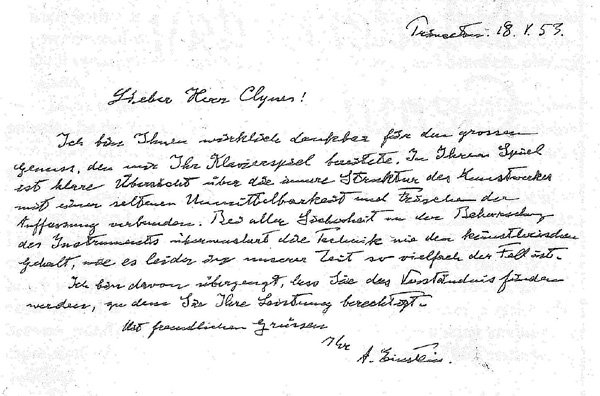
§. Although it
was well known that Einstein had abandoned his faith at the
age of 12, for many years religious apologists claimed that
Einstein must have believed in God (because he sometimes used
the word God — as in “I don"t believe that God
plays dice”). The apologists" claim was destroyed
by the discovery in 2008 of a hand-written letter, written in
German by Einstein to the philosopher Eric Gutkind in 1954 just
a year before his death in which he described all religions
as “childish superstitions”. God is represented
as a product of human weakness and the Bible as ‘pretty
childish’.
More at: https://news.upickreviews.com/einstein-letter-sells-for-404k#sthash.kXx5xgwN.dpuf
See https://www.telegraph.co.uk/news/1951333/Einstein-thought-religions-were-'childish'.html#continue
§. There have been
a number of attempts to portray Hitler as not being a Roman
Catholic or even Christian. (The topic is hotly contested by
editors of Wikipedia). For a thorough treatment of the extensive
evidence that he remained a Catholic throughout his adult life
(including his own writings, speeches, use of biblical quotations,
use of Church precedents, reports from friends, Nazi artefacts,
photographs, etc) see https://www.nobeliefs.com/Hitler1.htm.
Stalin remained an Orthodox believer even as his regime discouraged
religious belief. His original vocation had been as a priest
and he had studied at the Tiflis (now Tblisi) Theological Seminary.
|
|
|