|
Persecutions of so-called Pagans & Heathens
|
| |
|
|
Heathen: A benighted creature who
has the folly
to worship something he can see and feel.
|
|
Ambrose Bierce, The Devil's Dictionary
|
Up until the time of Constantine, Christianity was a small
and inconsequential sect. During his reign Christians won positions
of prominence and power. Those who opposed Christianity, "enemies
of true religion", were stripped of their honours, and
those who had supported the previous, pagan, emperor were executed*.
Eusebius, a bishop, gloated
over the fate of people who had elected to worship other gods.
They were accused of fraud, subjected to "elaborate tortures"
to confirm the charges, then handed over to the executioner*.
By the end of Constantine's reign all pagan cults were being
discouraged, and temples were being destroyed. Toleration was
under threat. As Gibbon noted:
The edict of Milan, the great charter of toleration, had
confirmed to each individual of the Roman world the privilege
of choosing and professing his own religion. But this inestimable
privilege was soon violated; with the knowledge of truth the
emperor imbibed the maxims of persecution; and the sects which
dissented from the Catholic Church were afflicted and oppressed
by the triumph of Christianity*.
The Edict of Milan had been issued by the emperors Constantine
and Licinius in 313, and gave official support to the toleration
of Christianity. As soon as Christians became influential, the
issue of toleration was no longer so important to them. By 330
Constantine was prohibiting pagan rites in Constantinople, his
new capital. By around 350 the performance of a pagan sacrifice
had become a capital offence*.
A few years later, in 391, under Theodosius I, Christianity
became the only recognised religion of the Empire. In time the
Church, supported by pliant Christian emperors, would eliminate
its many rivals, although it would take centuries to achieve
a total monopoly. Already, by the middle of the fourth century
the Christians were being accused of cruelty exceeding that
of wild animals*. All religions
except Christianity were suppressed, sacred property was confiscated,
holy treasures were seized, temples and shrines were destroyed
or taken over as new churches. The ancient rights of sanctuary
that had been enjoyed by followers of all religions at their
burial grounds were abrogated.
Followers of other religions could be killed with impunity.
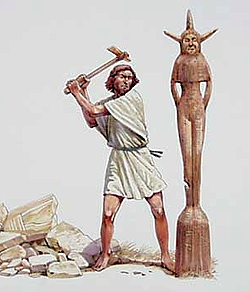
Dozens of Old Testament passages could be, and were, cited to
prove that God approved of mass murder, as in the book of Ezekiel
where God orders death for those who have been weeping for Tamuz
and those who have been facing and worshipping the sun:
Slay utterly old and young, both maids, and little children,
and women
(Ezekiel 9:6)
One incident typifies the approach of the Church as it was
in transition to becoming the dominant power. This incident
was recorded by a number of sources that have survived. In modern
terminology Hypatia
was a university librarian, mathematician,
astronomer
and neo-platonist philosopher.
All of these things made her an enemy of the Christians. They
regarded all books (except Christian works) as satanic, and
therefore to be destroyed. Mathematicians and astronomers they
regarded as magicians and conjurers. Pholosophers were considered
enemies of Christianity. On top of all this Hypatia was a respected
teacher, famous for her learning and her lectures. One of Hypatia's
pupils was Synesius of Cyrene. It is through some of his letters
to her that we know that she created an astrolabe and a planesphere
as well as equipment for distilling water, for measuring the
level of water, and for determining the specific gravity of
liquids.
  All
of this made caused her to be seen as an enemy. Worse still,
she was a woman as well as a lecturer, and the Bible very clearly
banned women from holding any position of authority over men.
Christian leaders had every incentive to see her disappear,
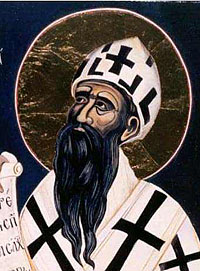
and the city seethed with resentment. In 412, a man named Cyril
became the Patriarch of Alexandria. He encouraged the belief
among the people that Hypatia's friendship the prefect of Egypt,
was the cause of civil disruption of Egypt. And it was - in
so far as Cyril managed to generate ever increasing civil disruption
through his accusations. In March 415, Cyril convinced a mob
of religious fanatics that the death of Hypatia would bring
peace back to Alexandria. In response, the fanatics caught Hypatia
on her way to the Library. Here is one of several accounts of
what happened six years after Theodosius became Emperor
and Bishop of Bishops All
of this made caused her to be seen as an enemy. Worse still,
she was a woman as well as a lecturer, and the Bible very clearly
banned women from holding any position of authority over men.
Christian leaders had every incentive to see her disappear,
and the city seethed with resentment. In 412, a man named Cyril
became the Patriarch of Alexandria. He encouraged the belief
among the people that Hypatia's friendship the prefect of Egypt,
was the cause of civil disruption of Egypt. And it was - in
so far as Cyril managed to generate ever increasing civil disruption
through his accusations. In March 415, Cyril convinced a mob
of religious fanatics that the death of Hypatia would bring
peace back to Alexandria. In response, the fanatics caught Hypatia
on her way to the Library. Here is one of several accounts of
what happened six years after Theodosius became Emperor
and Bishop of Bishops
There was a woman at Alexandria named Hypatia, daughter of
the philosopher Theon, who made such attainments in literature
and science, as to far surpass all the philosophers of her
own time. Having succeeded to the school of Plato and Plotinus,
she explained the principles of philosophy to her auditors,
many of whom came from a distance to receive her instructions.
On account of the self-possession and ease of manner, which
she had acquired in consequence of the cultivation of her
mind, she not infrequently appeared in public in the presence
of the magistrates. Neither did she feel abashed in coming
to an assembly of men. For all men on account of her extraordinary
dignity and virtue admired her the more. Yet even she fell
a victim to the political jealousy which at that time prevailed.
For, as she had frequent interviews with Orestes [Prefect
of Egypt], it was calumniously reported among the Christian
populace, that it was she who prevented Orestes from being
reconciled to the bishop. Some of them therefore, hurried
away by a fierce and bigoted zeal, whose ringleader was a
reader named Peter, waylaid her returning home, and dragging
her from her carriage, they took her to the church called
Caesareum, where they completely stripped her, and then murdered
her with tiles [or shells]. After tearing her body in pieces,
they took her mangled limbs to a place called Cinaron, and
there burnt them. This affair brought not the least opprobrium,
either upon Cyril, or upon the whole Alexandrian Church. And
surely nothing can be farther from the spirit of Christianity
than the allowance of massacres, fights, and transactions
of that sort. *
 Cyril
is now venerated by Christians as Saint Cyril of Alexandria.
After this, anyone who failed to display the required enthusiasm
for the Christian god was dealt with severely. Charges were
laid by informants. Perjured evidence was presented to, and
accepted by, partisan tribunals. Confessions were extracted
with the help of torture. Young and old alike were induced to
implicate their friends and families. Many were executed. The
lucky ones were merely imprisoned or exiled. In some provinces
prisoners, exiles and fugitives from Christian intolerance were
said to account for more than half of the population. Property
was confiscated, and the Church grew rich. Cyril
is now venerated by Christians as Saint Cyril of Alexandria.
After this, anyone who failed to display the required enthusiasm
for the Christian god was dealt with severely. Charges were
laid by informants. Perjured evidence was presented to, and
accepted by, partisan tribunals. Confessions were extracted
with the help of torture. Young and old alike were induced to
implicate their friends and families. Many were executed. The
lucky ones were merely imprisoned or exiled. In some provinces
prisoners, exiles and fugitives from Christian intolerance were
said to account for more than half of the population. Property
was confiscated, and the Church grew rich.
According to St Augustine and others, Jesus had clearly authorised
forcible conversions: "Go out into the highways and hedges,
and compel them to come in, that my house may be filled"
(Luke 14:23). Whole countries were won over in this way. The
Saxons were forcibly converted at sword point. Charlemagne offered
them the choice of adopting Christianity or instant death. In
a single day, according to Christian Chronicles, 4,500 Saxons
chose to die rather than forsake their own religion.
The pattern was similar in Franconia after the death of Clovis
in 511. First, Christians were favoured at court. Then non-Christian
public worship was prohibited. Soon, even private worship was
made illegal, and forcible conversions were enforced from 625
under Dagobert I.
The pattern was similar in England. Pope Gregory the Great
initially authorised the destruction of pagan temples, but later
reconsidered the benefits of a more practical approach. On reflection
he decided that the temples should be siezed and converted into
churches. Now only the pagan icons were to be destroyed and
replaced by Christian relics. To assure continuity he also authorised
the sacrifice of oxen even after the temples had been converted
into churches with Christian alters*.
Christian chroniclers did not always make records of the pagans
they executed for refusing to convert, but archaeologists can
sometimes reconstruct events. The Execution Cemetry at Sutton
Hoo contains the bones of hundreds of Saxons, which is difficult
to explain except as one of an unknown number of mass executions
of Saxons who refused to convert. There was more chance of a
written record when rival Christians were executed. Catholic
missionaries like King Ethelfrid killed not only pagans but
defenceless Christian monks who belonged to the original Christian
Church of the British Isles and so were regarded as rivals.
Bede records that some 1,200 unarmed Celtic monks were killed
by Ethelfrid's Catholic forces at the Battle of Chester in 616*.
 Late
in the tenth century Russia was converted when Prince Vladimir
adopted Christianity. His subjects were given the choice of
Christian baptism in the river Dneiper or drowning in it. Vladimir
is now a saint. Soon afterwards Norway was converted under King
Olav (or Ólafur) Tryggvasson, again largely at the point
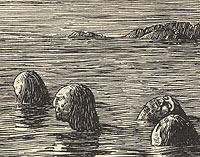
of the sword. He found elaborate ways to kill those who refused
to become Christians. According to Heimskringla, an Old Norse
saga, written Snorri Sturluson) he had male völvas (shamans)
tied up a skerry at ebb, so they drowned slowly as the tide
came in. Other leaders who refused to convert to Christianity
were killed in other ways. Eyvind Kinnrifi was killed by having
a brazier of hot coals placed on his belly. Raud the Strong's
murder was even more imaginative. The king ordered him to be
bound to a beam with his face pointed upward. Olaf ordered a
drinking horn to be put into Raud's mouth, and forced a snake
in by holding a red-hot iron at the opening of the horn. It
is not clear whether the snake poisoned or suffocated him. Otto's
army met the armies of King Harald I of Denmark and Haakon Jarl
the ruler of Norway under the Danish king, at Danevirke, near
Schleswig. When Otto won a large battle there, he forced Harald
and Haakon convert to Christianity, along with with their entire
armies. Other Scandinavians, Slavs, and many other peoples were
converted in the same way. Olaf too is now a saint. Late
in the tenth century Russia was converted when Prince Vladimir
adopted Christianity. His subjects were given the choice of
Christian baptism in the river Dneiper or drowning in it. Vladimir
is now a saint. Soon afterwards Norway was converted under King
Olav (or Ólafur) Tryggvasson, again largely at the point
of the sword. He found elaborate ways to kill those who refused
to become Christians. According to Heimskringla, an Old Norse
saga, written Snorri Sturluson) he had male völvas (shamans)
tied up a skerry at ebb, so they drowned slowly as the tide
came in. Other leaders who refused to convert to Christianity
were killed in other ways. Eyvind Kinnrifi was killed by having
a brazier of hot coals placed on his belly. Raud the Strong's
murder was even more imaginative. The king ordered him to be
bound to a beam with his face pointed upward. Olaf ordered a
drinking horn to be put into Raud's mouth, and forced a snake
in by holding a red-hot iron at the opening of the horn. It
is not clear whether the snake poisoned or suffocated him. Otto's
army met the armies of King Harald I of Denmark and Haakon Jarl
the ruler of Norway under the Danish king, at Danevirke, near
Schleswig. When Otto won a large battle there, he forced Harald
and Haakon convert to Christianity, along with with their entire
armies. Other Scandinavians, Slavs, and many other peoples were
converted in the same way. Olaf too is now a saint.
The Christianisation of Iceland was much less bloody than usual,
although it shows the technique. A Saxon missionary, Friedrich
arrived in the tenth century but was forced to leave when his
assistant Thorvaldur killed too many locals. In AD 1000 King
Olav of Norway (Ólafur Tryggvason again) was possessed
by one of his periodic bouts of Christian zeal. As an Icelandic
historian, Jón Hjálmarsson, relates:
King Ólafur's first missionary to Iceland was Stefnir
Thorgilsson, a native of Iceland, who started by attacking
and breaking down heathen temples, and was promptly exiled.
Next, the King sent a Flemish priest named Thangbrandur, who
had reached Norway via England. He managed to baptise several
of the noble Icelandic chieftains, but as he could not tolerate
any opposition and killed several men who spoke against him,
he too had to leave the country*.
Further Christian missionaries so destabilised the country
that Thorgeir, the lawspeaker, was asked to decide what should
be done. A liberal and tolerant pagan himself, he decided that
the best way to keep the peace was that Christianity should
be adopted as the national religion, but that the people should
be allowed to keep many of their traditional practices, including
the right to worship in private whatever gods they chose. It
seemed to be more than fair. Hjálmarsson says of the
conversion:
The introduction of Christianity in Iceland was a peaceful
and almost unique historical event. It was quite different
from the prolonged conflicts, warfare and bloodshed which
customarily accompanied Christianization in most other countries.
This peaceful settlement arose probably more for political
than religious reasons.
Within 16 years the exemptions for traditional practices, including
the liberty to worship other gods, was abrogated. Christians
now denied the liberty of worship that they had previously advocated
for themselves. Within a century compulsory tithes were introduced.
Soon the Benedictines and Augustinians would introduce the abuses
and corruption common in mainland Europe.
Outside Europe non-Christian Peoples were persecuted and exterminated
for centuries. The options were conversion to Christianity or
either death or slavery.
Over many centuries Christians killed thousands, perhaps millions,
for the crime of not being Christian or sometimes for the crime
of not being sufficiently Christian. Some were killed by the
sword, some burned alive, some drowned, some buried alive, some
garrotted,
some forced to face wild animals. Traditional Christian history
books rarely find room for this side of the story, nor the role
of bishops, priests, monks and friars.
|
In 1452, Pope Nicholas V issued the papal
bull Dum diversas, which legitimized the slave
trade, and allowed prisoners of war to be taken into slavery.
It specifically granted Afonso V of Portugal the right
to reduce any "Saracens, pagans and any other unbelievers"
to hereditary slavery.
The Pope had purportedly given Spanish
Catholics sovereinty over the New World. This was made
explicit in the Requerimiento (Spanish for "demand")
of 1513. This was a written declaration of sovereignty
and war, read by the Spanish to assert their sovereignty
over the Americas. The Requerimiento had been written
by Council of Castile jurist Juan López de Palacios
Rubios. It was used to justify the assertion that God,
through historical Saint Peter and appointed Papal successors,
held authority as ruler over the entire Earth; and that
the Inter caetera Papal Bull, of 4 May 1493 by
Pope Alexander VI, conferred title over all the Americas
to the Spanish monarchs.
|
|
... So their Highnesses are kings and lords of
these islands and land of Tierra-firme by virtue
of this donation: and some islands, and indeed almost
all those to whom this has been notified, have received
and served their Highnesses, as lords and kings,
in the way that subjects ought to do, with good
will, without any resistance, immediately, without
delay, when they were informed of the aforesaid
facts. And also they received and obeyed the priests
whom their Highnesses sent to preach to them and
to teach them our Holy Faith; and all these, of
their own free will, without any reward or condition,
have become Christians, and are so, and their Highnesses
have joyfully and benignantly received them, and
also have commanded them to be treated as their
subjects and vassals; and you too are held and obliged
to do the same.
|
|
|
"Tierra-firme" denotes the
whole American continent. The catch is in the mention
of vassals.
Any disobedience by vassals made them treasonable, and
hence liable to be taken into slavery. The Requerimiento
was read out in Latin, so the locals could not understand
a word of it, and so had no opportunity to respond at
all..
|
The Spanish capture of the Inca Empire gives a good idea of
the methods used and the contemporary standard of Christian
morality. The Spanish laid a ambush for Atahualpa, the Inca
(ie the Inca Emperor) at Cajamarca in 1532. A Dominican friar
Vicente de Valverde went out to greet Atahualpa, armed Spanish
troops having concealed themselves. The friar invited the Inca
to come inside to talk and dine with the Spanish commander,
Pizarro. Atahualpa demanded the return of everything the Spaniards
had already stolen since they landed. Valverde then spoke about
the Catholic religion, probably delivering a standard speech
called the requerimiento, This speech required the listener
to submit to the authority of the Spanish Crown and accept the
Christian faith. Valverde gave the Inca his breviary which,
he threw away.
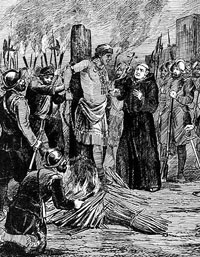 Valverde
hurried away calling on the Spanish troops to attack. Spanish
infantry and cavalry came out of their hiding places and charged
the Inca's retinue, killing many of them, while the rest fled
in panic. Pizarro led the charge on Atahualpa and managed to
capture him. The Spaniards later sacked the Inca camp, where
they found great treasures of gold, silver, and emeralds. Attempting
to ransom his life, the captive Atahualpa offered to fill a
large room once with gold and twice with silver within two months.
But treasure only bought a little time. After a few months the
Spanish staged a trial and found Atahualpa guilty of revolting
against the Spanish, practicing idolatry, and other crimes.
He was sentenced to execution by being burned alive. Atahualpa
was horrified by this, since (like the Catholics) he believed
that his soul would not be able to go on to the afterlife if
the body were burned. Friar Vicente de Valverde told Atahualpa
that if he agreed to convert to the Catholic faith, he would
have the sentence commuted. Atahualpa agreed to be baptized
into the Catholic faith and was given the name Juan Santos Atahualpa
- even though it was clear that he was converting only to avoid
being burned. Atahualpa was strangled with a garrote
on August 29, 1533. Following his execution, his clothes and
at least part of his body of were burned, and the remains given
a Christian burial. The Inca Empire was now Spanish. Valverde
hurried away calling on the Spanish troops to attack. Spanish
infantry and cavalry came out of their hiding places and charged
the Inca's retinue, killing many of them, while the rest fled
in panic. Pizarro led the charge on Atahualpa and managed to
capture him. The Spaniards later sacked the Inca camp, where
they found great treasures of gold, silver, and emeralds. Attempting
to ransom his life, the captive Atahualpa offered to fill a
large room once with gold and twice with silver within two months.
But treasure only bought a little time. After a few months the
Spanish staged a trial and found Atahualpa guilty of revolting
against the Spanish, practicing idolatry, and other crimes.
He was sentenced to execution by being burned alive. Atahualpa
was horrified by this, since (like the Catholics) he believed
that his soul would not be able to go on to the afterlife if
the body were burned. Friar Vicente de Valverde told Atahualpa
that if he agreed to convert to the Catholic faith, he would
have the sentence commuted. Atahualpa agreed to be baptized
into the Catholic faith and was given the name Juan Santos Atahualpa
- even though it was clear that he was converting only to avoid
being burned. Atahualpa was strangled with a garrote
on August 29, 1533. Following his execution, his clothes and
at least part of his body of were burned, and the remains given
a Christian burial. The Inca Empire was now Spanish.
|
Funeral of Atahualpa (1868), by Luis
Montero (1828-1869), Museo de Arte de Lima
A fanciful painting, in which the only accurate feature
is the prominent role of Dominican friars.
|
|
|
Spanish Catholics were soon controlling all aspects of life
in South America - political, religious and economic, for the
benefit of the Spanish temporal and spiritual hierarchies, largely
through reducciones. The reducciones were massive
relocations of indigenous populations into Spanish settlement
towns. By consolidating scattered populations, the Spanish were
able to control indigenous peoples more easily and efficiently.
Before the reducciones, Indians throughout Peru and colonial
South America lived in small dispersed villages. Now they lived
in towns, often away from the lands they knew how to cultivate.
The purpose of the massive resettlement program "was to
establish direct state control and to facilitate the church's
Christianization of the native population, while enhancing the
collection of the tribute tax and the allocation of labor."
The systems of forced tribute tax and forced labor, known as
mita in Spanish, became much easier to enforce.
|
This engraving is from Theodor de Bry's
1594-1596 edition of La Historia del Mondo Nuovo
by Girolamo Benzoni, originally published in 1565. It
depicts starving Spaniards cutting down the bodies of
thieves hanged by Pedro de Mendoza in order to eat them.
While falsely representing non-Christians as cannibals,
Spanish Catholics were themselves practising canibalism,
as their Crusader forbears had.
|
|
|
According to Dominicans there were a number of legitimate reasons
justifying conquest. War was justified if the indigenous people
refused free transit and commerce; if they caused Christian
converts to return to their own religion; if there were a large
enought number of converted Christians; if the indigenous people
lacked just laws, magistrates, agricultural techniques, and
so on. In practice this meant that war could be justified anywhere
at any time, and war carried the right to enslave anyone fighting
on the other side.
|
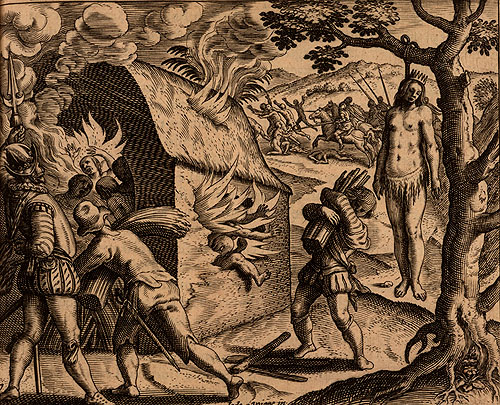
Another illustration from Theodor de
Bry's texts depicting a narrative by Bartolomé
de las Casas (a Donican Friar), published in 1552 in Seville.
It contained case histories of Spanish maladministration
and Spanish cruelty in their colonies. Across Protestant
Europe it provided evidence of the Spanish and Catholic
culpability in bad government and genocide. The engraver
Theodor de Bry and his sons sold these texts to merchants
visiting Frankfurt and affected European public opinion.
The 1598 edition in Latin bore this de Bry imprint.
Shown here is an Indian queen who was
hanged in Hispaniola, while dwellings were burned and
villagers hunted down or burned alive.
|
 |
Wherever they arrived, the pattern was much the same, forced
conversion, destruction, torture and murder. In 1557, Pedro
de Santander, an official of the Catholic Church, spelled out
the King Philip II of Spain the biblical justification for killing
the indiginous peoples of Florida:
This is the Land of Promise, possessed by idolaters, the
Amorite, Amulekite, Moabite, Canaanite. This is the land promised
by the Eternal Father to the Faithful, since we are commanded
by God in the Holy Scriptures to take it from them, being
idolaters, and, by reason of their idolatry and sin, to put
them all to the knife, leaving no living thing save maidens
and children, their cities robbed and sacked, their walls
and houses levelled to the earth.
(Cited by Stephen T Newcomb, Pagans in
the Promised Land, Fulcrum Publishing, 2008, p 50)
The French experience was similar, but less intense as it lacked
papal support. Some Indians adopted new ways once disease and
violence had decimated their communities. Others rejected European
ways, and pointed out the arrogance of their claims of cultural
superiority. Some of the Indian leaders put their cases in ways
that have strong resonance today (to be recorded by traders
rather than missionaries). One Micmac chief, tired of hearing
about the superiority of France and French Catholics, was moved
to remark "Learn now, my brother, once for all, because
I must open to thee my heart: there is no Indian who does not
consider himself infinitely more happy and more powerful than
the French."*
|
The experience of the native peoples
of North America was similar
From the begining of the twenty-first century, the blogosphere
has become a vehicle for
recognition of the enormity ofthe role of Christian Europe,
sometimes simplified or exaggerated.
|
|
|
|
William Bradford 1590-1657 describes a massacre of Pequod
Indians, including women and children, as a "sweet
sacrifice". Prayers were offered to God for his assistance.
William Bradford, History of Plymouth
Plantation, 1606-1646.
Ed. William T. Davis. New York: Charles Scribner's Sons,
1908.
1637, The Pequod War (spellings modernised by the
webmaster)
|
So they went on, and so ordered their march, as the
Indians brought them to a forte of the enemies (in which
most of their chief men were) before day. They approached
the same with great silence, and surrounded it both
with English and Indians, that they might not break
out; and so assaulted them with great courage, shooting
amongst them, and entered the forte with all speed;
and those that first entered found sharp resistance
from the enemy, who both shot at and grappled with them;
others ran into their houses, and brought out fire,
and set them on fire, which soon took in their matts,
and, standing close together, with the wind, all was
quickly on a flame, and thereby more were burnt to death
then was otherwise slain; it burned their bowstrings,
and made them unserviceable. Those that escaped the
fire were slain with the sword; some hewed to pieces,
others rune throw with their rapiers, so as they were
quickly dispatched, and very few escaped. It was conceived
they thus destroyed about 400. At this time. It was
a fearful sight to see them thus frying in the fire,
and the streams of blood quenching the same, and horrible
was the stink and scent thereof; but the victory seemed
a sweet sacrifice, and they gave the prayers thereof
to God, who had wrought so wonderfully for them, thus
to enclose their enemies in their hands, and give them
so speedy a victory over so proud and insulting an enemy.
|
For more on this the persecution of non-Christians, see
|
|
|
|
|
|
|
|
|
|
|
|
|
|
|
|
|
|
|
|
|
|
|
|
|
|
|
|
|
|
|
|
|
|
|
|
|
|
Buy the Book from Amazon.com
|
|
|
|
|
|
Buy the Book from Amazon.co.uk
|
|
|
| |
| |
| More Books |
|
|
|
| |
Notes §. Eusebius, The History of the Church, 9:11.
§. Eusebius, The History of the Church, 9:11 , referring to Theotecnus and his partners.
§. Gibbon, The Decline and Fall of the Roman Empire , Penguin, p 385.
§. Pollock and Maitland, The History of English Law, p 3.
§. Gibbon, The
Decline and Fall of the Roman Empire, Penguin p ???. {Ch.
xxi, note 161, citing Ammianus [Check this] 4SOGR p 178}.
§. Socrates Scholasticus:
Of Hypatia the Female Philosopher, cited Ecclesiastical History,
Bk VI: Chap. 15. The Murder of Hypatia (late 4th Cent.). "This
happened in the month of March during Lent, in the fourth year
of Cyril's episcopate, under the tenth consulate of Honorius,
and the sixth of Theodosius".
§. Letter from Pope Gregory to Milletus AD 601 cited by the Venerable Bede in his Ecclesiastical History of the English Nation ch XXX. “ .... the temples of the idols in that nation ought not to be destroyed; but let the idols that are in them be destroyed; let holy water be made and sprinkled in the said temples, let altars be erected, and relics placed. For if those temples are well built, it is requisite that they be converted from the worship of devils to the service of the true God; .... celebrate the solemnity with religious feasting, and no more offer beasts to the Devil, but kill cattle to the praise of God in their eating.” For the full text see https://www.sacred-texts.com/chr/bede/hist032.htm English translation by A.M. Sellar, ed, 1907.
§. Bede's Ecclesiastical History of England, ed. by A.M. Sellar, [1907], Chapter II at https://www.sacred-texts.com/chr/bede/hist038.htm. The massacre of Christian monks was justified by the fact that they were praying for the wrong Christian faction: ""If then they cry to their God against us, in truth, though they do not bear arms, yet they fight against us, because they assail us with their curses." He, therefore, commanded them to be attacked first, and then destroyed the rest of the impious army, not without great loss of his own forces. About twelve hundred of those that came to pray are said to have been killed, and only fifty to have escaped by flight."
§. Jón Hjálmarsson,
History of Iceland, (Iceland Review, 1993), pp 29,
32, 33, 44 and 71.
§. the following
text comes from History Matters: https://historymatters.gmu.edu/d/5828/
"Your People Live Only Upon Cod": An Algonquian
Response to European Claims of Cultural Superiority
From the start of colonization, Indians and Europeans viewed
each other across a wide cultural gulf. Sure about the superiority
of their civilization, European missionaries and teachers tried
to convert Indians to Christianity and the European way of life.
Some Indians did adopt new ways after disease and violence had
decimated their communities; others rejected the European entreaties
and pointed out the arrogance of these claims of cultural superiority.
French priest Chrestian LeClerq traveled among the eastern Algonquian
people who lived in what are now the Maritime Provinces of Canada.
He recorded a Micmac leader's eloquent response to these attempts
at "reform" that pointed out how difficult Europeans
found it to live in Indian country. If France was such a terrestrial
paradise, he asked, why were colonists making their way across
the Atlantic to live in the forests of North America?
|
Source: William F. Ganong, trans. and
ed., New Relation of Gaspesia, with the Customs and
Religion of the Gaspesian Indians,by Chrestien LeClerq
(Toronto: Champlain Society, 1910), pp103-06.
|
|
I am greatly astonished that the French have so
little cleverness, as they seem to exhibit in the
matter of which thou hast just told me on their
behalf, in the effort to persuade us to convert
our poles, our barks, and our wigwams into those
houses of stone and of wood which are tall and lofty,
according to their account, as these trees. Very
well! But why now, do men of five to six feet in
height need houses which are sixty to eighty? For,
in fact, as thou knowest very well thyself, Patriarch
- do we not find in our own all the conveniences
and the advantages that you have with yours, such
as reposing, drinking, sleeping, eating, and amusing
ourselves with our friends when we wish? This is
not all, my brother, hast thou as much ingenuity
and cleverness as the Indians, who carry their houses
and their wigwams with them so that they may lodge
wheresoever they please, independently of any seigneur
whatsoever? Thou art not as bold nor as stout as
we, because when thou goest on a voyage thou canst
not carry upon thy shoulders thy buildings and thy
edifices. Therefore it is necessary that thou prepares
as many lodgings as thou makest changes of residence,
or else thou lodgest in a hired house which does
not belong to thee. As for us, we find ourselves
secure from all these inconveniences, and we can
always say, more truly than thou, that we are at
home everywhere, because we set up our wigwams with
ease wheresoever we go, and without asking permission
of anybody. Thou reproachest us, very inappropriately,
that our country is a little hell in contrast with
France, which thou comparest to a terrestrial paradise,
inasmuch as it yields thee, so thou safest, every
kind of provision in abundance. Thou sayest of us
also that we are the most miserable and most unhappy
of all men, living without religion, without manners,
without honour, without social order, and, in a
word, without any rules, like the beasts in our
woods and our forests, lacking bread, wine, and
a thousand other comforts which thou hast in superfluity
in Europe. Well, my brother, if thou dost not yet
know the real feelings which our Indians have towards
thy country and towards all thy nation, it is proper
that I inform thee at once. I beg thee now to believe
that, all miserable as we seem in thine eyes, we
consider ourselves nevertheless much happier than
thou in this, that we are very content with the
little that we have; and believe also once for all,
I pray, that thou deceivest thyself greatly if thou
thinkest to persuade us that thy country is better
than ours. For if France, as thou sayest, is a little
terrestrial paradise, art thou sensible to leave
it? And why abandon wives, children, relatives,
and friends? Why risk thy life and thy property
every year, and why venture thyself with such risk,
in any season whatsoever, to the storms and tempests
of the sea in order to come to a strange and barbarous
country which thou considerest the poorest and least
fortunate of the world? Besides, since we are wholly
convinced of the contrary, we scarcely take the
trouble to go to France, because we fear, with good
reason, lest we find little satisfaction there,
seeing, in our own experience, that those who are
natives thereof leave it every year in order to
enrich themselves on our shores. We believe, further,
that you are also incomparably poorer than we, and
that you are only simple journeymen, valets, servants,
and slaves, all masters and grand captains though
you may appear, seeing that you glory in our old
rags and in our miserable suits of beaver which
can no longer be of use to us, and that you find
among us, in the fishery for cod which you make
in these parts, the wherewithal to comfort your
misery and the poverty which oppresses you. As to
us, we find all our riches and all our conveniences
among ourselves, without trouble and without exposing
our lives to the dangers in which you find yourselves
constantly through your long voyages. And, whilst
feeling compassion for you in the sweetness of our
repose, we wonder at the anxieties and cares which
you give yourselves night and day in order to load
your ship. We see also that all your people live,
as a rule, only upon cod which you catch among us.
It is everlastingly nothing but cod - cod in the
morning, cod at midday, cod at evening, and always
cod, until things come to such a pass that if you
wish some good morsels, it is at our expense; and
you are obliged to have recourse to the Indians,
whom you despise so much, and to beg them to go
a-hunting that you may be regaled. Now tell me this
one little thing, if thou hast any sense: Which
of these two is the wisest and happiest - he who
labours without ceasing and only obtains, and that
with great trouble, enough to live on, or he who
rests in comfort and finds all that he needs in
the pleasure of hunting and fishing? It is true,
that we have not always had the use of bread and
of wine which your France produces; but, in fact,
before the arrival of the French in these parts,
did not the Gaspesians live much longer than now?
And if we have not any longer among us any of those
old men of a hundred and thirty to forty years,
it is only because we are gradually adopting your
manner of living, for experience is making it very
plain that those of us live longest who, despising
your bread, your wine, and your brandy, are content
with their natural food of beaver, of moose, of
waterfowl, and fish, in accord with the custom of
our ancestors and of all the Gaspesian nation. Learn
now, my brother, once for all, because I must open
to thee my heart: there is no Indian who does not
consider himself infinitely more happy and more
powerful than the French.
|
|
|
|
|