| |
|
|
I never saw, heard, nor read that
the clergy were beloved in any nation where Christianity
was the religion of the Country. Nothing can render
them popular but some degree of persecution.
|
|
Jonathan Swift (1667-1745), Thoughts
on Religion
|
Anyone who has benefited from a conventional Western education
will be familiar with the dreadful persecutions endured by untold
numbers of early Christians. According to the conventional story
these early Christians were meek and innocent, and invariably
went to the lions with extraordinary bravery inspired by their
great faith. For their part, the Roman oppressors were brutal
and merciless, and killed the unfortunate Christians for no
better reason than that they chose a new and harmless faith.
Yet even these heartless pagans could not help but be impressed
by the fortitude of their victims. The steadfast courage of
Christians as they were torn to shreds by wild animals in the
Coliseum was astonishing to all who witnessed it.
|
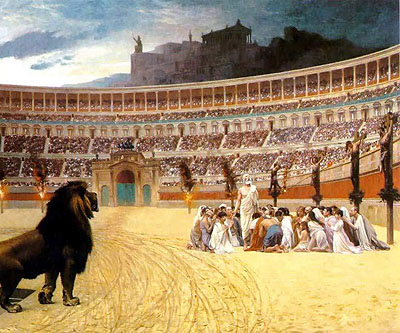
Detail from The Christian Martyrs' Last
Prayer by Leon Gerome (1824–1904)
This is a nineteenth century fantasy painting, commissioned
William T. Walters of Baltimore in 1863
|
|
|
Enjoyable as the story is, it is flawed in almost every respect,
a fact that has been known to scholars for many centuries, and
to the educated classes at least since the publication of The
Decline and Fall of the Roman Empire in the last quarter
of the eighteenth century. Religious persecution was virtually
unknown in the ancient world. The Romans especially were universally
tolerant. Their principal reactions to the religions of others
were interest and occasional amusement. Their toleration did
not extend to cults that acted merely as a cover for sedition
or criminality, but all genuine faiths were respected and protected.
As far as we know, no one in the classical world hit upon the
idea of exterminating others because of the god they chose to
worship1. As
Gibbon put it, quoting Seneca the Younger: "The various
modes of worship which prevailed in the Roman world, were all
considered by the people as equally true, by the philosopher
as equally false, and by the magistrate as equally useful. And
thus toleration produced not only mutual indulgence, but even
religious concord"2.
|
Third-century AD mosaic in the Museum
of El Djem (Tunisia).
This image is often used as an example of how Christians
were martyred in the Coliseum. The truth is that we have
not a single example of Christians being killed in the
Coliseum in this way. This image shows the punishment
of Damnatio ad bestias by which the worst criminals
were executed.This mode of execution was used under a
long line of Christian Emperors. The practice of damnatio
ad bestias was abolished in Rome only in 681 AD. It
was used after that in the Byzantine Empire. The bishop
of Saare-Lääne was sentencing criminals to
damnatio ad bestias at the Bishop's Castle in modern
Estonia into the Middle Ages.
|
|
|
How strict the Roman principle of tolerance was is illustrated
by the Roman attitude to the Jews, the sole dissenters from
the religious harmony of the ancient world. Gibbon noted of
Jewish beliefs that "according to the maxims of universal
toleration, the Romans protected a superstition which they despised"3.
Soldiers were transferred or executed for offending Jewish sensibilities.
Legions by-passed Judæa to avoid offence by carrying the
imperial portraits on their standards across Jewish soil. The
Judæan coinage was unique within the Roman provinces in
that it did not bear the Emperor's face, again because of Jewish
sensibilities. In place of emperor worship, the Jews were permitted
to show their respect for the State by offering sacrifices on
behalf of the Emperor. Jews could become full Roman citizens
— Paul of Tarsus was one of many. All in all, the Romans
were flexible and tolerant.
There was no obvious reason why Christians should not have
been tolerated as the Jews were, and yet they were not. Christians
seem to have provoked a great deal of hostility and to have
made themselves outstandingly unpopular. Tacitus wrote around
AD 110 that they were "notoriously depraved". Nero,
he noted, had arrested Christians in Rome for arson and for
other antisocial behaviour4.
Suetonius (AD 70-160) recorded that Claudius expelled them from
Rome for causing continual disturbances5.
Because of widespread misgivings about them, Pliny the Younger
made enquiries but found only squalid superstition carried to
great length6.
One way or another Christians made enemies everywhere. Some
Christian leaders, like Cyprian, Bishop of Carthage, noted that
Christians deserved the treatment they were getting7.
The philosopher Celsus disapproved of their intolerance. In
248 Origen noted that hostility to the Church was increasing
rapidly. Soon the citizens of Antioch were asking that Christians
be forbidden from living in their city8.
The citizens of Nicomedia made similar requests9,
and so did other cities.
In 312 the Emperor Maximin Daia was being petitioned to suppress
the disloyal Christians10.
Despite popular dislike of the Christians, the authorities were
generally still tolerant. In response to Pliny's requests for
guidance the Emperor Trajan advised moderation. There should
be no general inquisition. Anonymous accusers should be ignored,
and accusations made by responsible citizens should be properly
investigated.
Christians were sporadically investigated by the authorities,
mainly because they were believed to have been promoting sedition.
They seem to have been unnecessarily secretive and did little
or nothing to counter beliefs that they opposed the established
government, apparently because they did oppose the established
government. They reviled the Imperial capital, referring to
it as the Whore of Babylon. They looked forward to
its destruction (as in Revelation 14:8). They prayed for the
end of the world: "Let grace come and let this world pass
away"11.
Indeed it was widely believed that they tried a number of times
to ignite fires that would destroy the world and hasten the
coming of their new kingdom.
Christians were also accused of cannibalism and incest. The
charge that they ate human flesh might well have arisen through
misinterpretations of the Lord's Supper. Had not their dead
leader claimed that "Except ye eat the flesh of the Son
of man, and drink his blood, ye have no lifein you" (John
6:53)? If the charge was mistaken, then the mistake could easily
have been explained. Instead, accused Christians refused to
explain their practices or to refute stories that they ate children
at their ceremonies. Some declined to answer any questions at
all — even refusing to give their names or nationalities12.
Sometimes they lied, for example claiming to be Old Testament
characters like Elijah or Daniel. They also refused to take
oaths.
  No
doubt the accusations of cannibalism were mistaken, but Christians
were certainly guilty of other crimes. Infused with the truth
of their own religion they were openly hostile to the religions
of others, in a manner frequently amounting to criminal behaviour.
They reviled the Roman and other gods,
razed temples, set fires, vandalised sacred sites, destroyed
images, and incited riots. Since Christians considered vandalism
directed at the holy places of other religions to be entirely
justifiable, they did not seek to conceal it once they came
to power. When Christians were executed for vandalism or arson,
their fellow believers openly acclaimed them as martyrs and
saints. According to Christian martyrologies Theodore of Amasea
(aka St. Theodore Tyro) was a soldier in the Roman Army at Pontus
on the Black Sea. He became a Christian, deserted from the army
and set fire to the temple of Cybele near Amasea in Pontus.
For this he was executed, and is now acclaimed as a martyr and
a saint. Christian hagiographies claim that Saint Martin of
Tours (a soldier charged with cowardice, who either deserted
or was cashiered from the Roman army) was another prolific arsonist,
causing his followers to destroy countless non-Christian holy
places. He ordered the destruction of temples, altars and sculptures
in Gaul. Gibbon tells us of Martin and another fanatical Christian
saint in Chapter XXVIII of his Decline and Fall of the Roman
Empire. No
doubt the accusations of cannibalism were mistaken, but Christians
were certainly guilty of other crimes. Infused with the truth
of their own religion they were openly hostile to the religions
of others, in a manner frequently amounting to criminal behaviour.
They reviled the Roman and other gods,
razed temples, set fires, vandalised sacred sites, destroyed
images, and incited riots. Since Christians considered vandalism
directed at the holy places of other religions to be entirely
justifiable, they did not seek to conceal it once they came
to power. When Christians were executed for vandalism or arson,
their fellow believers openly acclaimed them as martyrs and
saints. According to Christian martyrologies Theodore of Amasea
(aka St. Theodore Tyro) was a soldier in the Roman Army at Pontus
on the Black Sea. He became a Christian, deserted from the army
and set fire to the temple of Cybele near Amasea in Pontus.
For this he was executed, and is now acclaimed as a martyr and
a saint. Christian hagiographies claim that Saint Martin of
Tours (a soldier charged with cowardice, who either deserted
or was cashiered from the Roman army) was another prolific arsonist,
causing his followers to destroy countless non-Christian holy
places. He ordered the destruction of temples, altars and sculptures
in Gaul. Gibbon tells us of Martin and another fanatical Christian
saint in Chapter XXVIII of his Decline and Fall of the Roman
Empire.
In Gaul, the holy Martin, bishop of Tours, marched at the
head of his faithful monks to destroy the idols, the temples,
and the consecrated trees of his extensive diocese; .... In
Syria, the divine and excellent Marcellus, as he is styled
by Theodoret, a bishop animated with apostolic fervor, resolved
to level with the ground the stately temples within the diocese
of Apamea. ... Elated with victory, Marcellus took the field
in person against the powers of darkness; a numerous troop
of soldiers and gladiators marched under the episcopal banner,
and he successively attacked the villages and country temples
of the diocese of Apamea. ... A small number of temples was
protected by the fears, the venality, the taste, or the prudence,
of the civil and ecclesiastical governors. The temple of the
Celestial Venus at Carthage, whose sacred precincts formed
a circumference of two miles, was judiciously converted into
a Christian church; and a similar consecration has preserved
inviolate the majestic dome of the Pantheon at Rome. But in
almost every province of the Roman world, an army of fanatics,
without authority, and without discipline, invaded the peaceful
inhabitants; and the ruin of the fairest structures of antiquity
still displays the ravages of those [Christian] Barbarians
...
 Surviving
accounts of martyrdom, even though they are fictitious, tell
us how Christians were expected to behave, and how pagan rulers
might react. These stories are revealing. Here for example is
the story of the martyrdom of the fictitious Saint Christopher
from The Passion of St. Christopher (BHL 1764), before he became
a giant, in later accounts. He arrived in Antioch, from a distant
land, with a dog's head and boars' tusks [sic]. Having been
miraculously provided with the ability to speak a language he
did not know, the first thing he does is to publicly describe
the Roman gods as cursed demons [2]. He then claims in front
of soldiers that he is suffering under a "tyrant"
[5] - even though he has only just arrived - and says that the
soldiers' father [presumably meaning the King] is Satan. The
solders offer to let him rest [6], but he wants no delay and
says to them, "Let us go to the king, therefore, that we
might receive a better crown [of martyrdom]." [8]. When
Christopher sees the king he addresses him "O most unfortunate
and corrupt king". [9]Refusing to worship he says "Do
what you want, then: for I will not offer sacrifice to the demons
who are deaf, just as you yourself are also deaf." [9]
The king now tries to convert Christopher with the help of a
couple of prostitutes, but Christopher turns the tables and
converts one of them, Gallenice, so that she can tortured and
martyred.[14]. The other, Aquilina, also converts and seeks
her own death. The kings begs her to "take pity on yourself",
but she is determined. She topples over and breaks into pieces
statues of Jupiter, Apollo and Hercules [16]. As a result she
is tortured and executed [18]. Christopher brought again before
the king, now induces the soldiers to desert and be martyred.
Christopher addresses the king as "Demon of many forms,
son of Satan" [22]. The King tries to have Christopher
burned alive, but instead, by God's will, 30 houses and many
pagans are burned alive [23] causing 10,000 people to convert
[24]. After some more miracles the King summons Christopher
again, and Christopher now addresses him as "Inventor of
every wickedness, disciple of the devil, partner in eternal
damnation," The King finally sentences him to death, after
which a great earthquake, kills the crowd then present. [27]
after which Christopher achieves the martyrdom he had worked
so hard for [27]. Surviving
accounts of martyrdom, even though they are fictitious, tell
us how Christians were expected to behave, and how pagan rulers
might react. These stories are revealing. Here for example is
the story of the martyrdom of the fictitious Saint Christopher
from The Passion of St. Christopher (BHL 1764), before he became
a giant, in later accounts. He arrived in Antioch, from a distant
land, with a dog's head and boars' tusks [sic]. Having been
miraculously provided with the ability to speak a language he
did not know, the first thing he does is to publicly describe
the Roman gods as cursed demons [2]. He then claims in front
of soldiers that he is suffering under a "tyrant"
[5] - even though he has only just arrived - and says that the
soldiers' father [presumably meaning the King] is Satan. The
solders offer to let him rest [6], but he wants no delay and
says to them, "Let us go to the king, therefore, that we
might receive a better crown [of martyrdom]." [8]. When
Christopher sees the king he addresses him "O most unfortunate
and corrupt king". [9]Refusing to worship he says "Do
what you want, then: for I will not offer sacrifice to the demons
who are deaf, just as you yourself are also deaf." [9]
The king now tries to convert Christopher with the help of a
couple of prostitutes, but Christopher turns the tables and
converts one of them, Gallenice, so that she can tortured and
martyred.[14]. The other, Aquilina, also converts and seeks
her own death. The kings begs her to "take pity on yourself",
but she is determined. She topples over and breaks into pieces
statues of Jupiter, Apollo and Hercules [16]. As a result she
is tortured and executed [18]. Christopher brought again before
the king, now induces the soldiers to desert and be martyred.
Christopher addresses the king as "Demon of many forms,
son of Satan" [22]. The King tries to have Christopher
burned alive, but instead, by God's will, 30 houses and many
pagans are burned alive [23] causing 10,000 people to convert
[24]. After some more miracles the King summons Christopher
again, and Christopher now addresses him as "Inventor of
every wickedness, disciple of the devil, partner in eternal
damnation," The King finally sentences him to death, after
which a great earthquake, kills the crowd then present. [27]
after which Christopher achieves the martyrdom he had worked
so hard for [27].
This story is entirely typical - a wish for death, abuse of
the authorities, pagan pleas for Christians to have mercy on
themselves, mass conversions and martyrdoms, the miraculous
killing of countless pagans, miracles, large fires, the destruction
of temples or statues, and finally the desired martyrdom of
the protagonist. Tucked away in these stories are some enticing
elements that hint at the nature of true "martyrdoms".
We know from independent records that Christians sought their
own martyrdom. We know that rulers begged them to have mercy
on themselves. We know that Christians destroyed temples and
statues. We know that Christians were frequently accused of
arson. In fact, apart from the miracles, both sources tell the
same story: how some Christians sought and finally achieved
their own deaths.
 Christian
crimes such as arson seem to have been motivated by apocalyptic
literature like the Book of Revelations. The idea was that they
could trigger not just the destruction of Rome but the end of
the world, and hence the promised day of Judgement which would
ensure their place in heaven. (If this sounds improbable then
it is worth bearing in mind that there are many Christians today
in the USA, including influential politicians, who hold almost
identical views. So called “End-Timers” will freely
admit that they seek to trigger a Third World War, since this
will, they believe, herald the End of the World, and the consequent
Day of Judgement.) Christian
crimes such as arson seem to have been motivated by apocalyptic
literature like the Book of Revelations. The idea was that they
could trigger not just the destruction of Rome but the end of
the world, and hence the promised day of Judgement which would
ensure their place in heaven. (If this sounds improbable then
it is worth bearing in mind that there are many Christians today
in the USA, including influential politicians, who hold almost
identical views. So called “End-Timers” will freely
admit that they seek to trigger a Third World War, since this
will, they believe, herald the End of the World, and the consequent
Day of Judgement.)
 The
Romans thought Christians were atheists. They denied the gods
and were known to revere a condemned criminal who had been executed
for his opposition to the state. They declined to acknowledge
the head of state, refusing to refer to Caesar by his honorific
Lord. For them Jesus was the only Lord and
the only ruling monarch13.
People believed that this sort of disrespect angered the gods.
The gods sent famines, droughts and plagues to punish the Empire
for allowing such blasphemy. By the fourth century the phenomenon
was proverbial: "no rain because of the Christians". The
Romans thought Christians were atheists. They denied the gods
and were known to revere a condemned criminal who had been executed
for his opposition to the state. They declined to acknowledge
the head of state, refusing to refer to Caesar by his honorific
Lord. For them Jesus was the only Lord and
the only ruling monarch13.
People believed that this sort of disrespect angered the gods.
The gods sent famines, droughts and plagues to punish the Empire
for allowing such blasphemy. By the fourth century the phenomenon
was proverbial: "no rain because of the Christians".
Christianity defeated and wiped out the old faith of the
pagans. Then with great fervour and diligence it strove to
cast out and utterly destroy every last possible occasion
of sin; and in doing so it ruined or demolished all the marvelous
statues, besides the other sculptures, the pictures, mosaics
and ornaments representing the false pagan gods; and as well
as this it destroyed countless memorials and inscriptions
left in honor of illustrious persons who had been commemorated
by the genius of the ancient world in statues and other public
monuments….their tremendous zeal was responsible for
inflicting severe damage on the practice of the arts, which
then fell into total confusion.
Giorgio Vasari (1511-1574), Lives of the Artists.
|
Saint Aemilianus, known for his destruction
of ancient temples and libraries
Here he is shown using ropes to pull down a statue.
His followers are breaking up statues with picks and axes.
|
|
|
Christians were not only cultural vandals, perjurers and blasphemers;
they were also treasonable army deserters (like Theodore of
Amasea and Martin of Tours). As Robin Fox Lane, a prominent
Oxford historian, notes of the supposed persecutions prompted
by an edict of the Emperor Gallienus:
We know of at least one martyrdom which followed its despatch,
but it occurred in a province which was not at first under
Gallienus's control: otherwise, we have no knowledge of martyrdoms,
as opposed to Christian fictions of them, between 260 and
the 290s. When we find Christians being martyred, they are
soldiers in the army. The charge against them is not their
religion and their refusal to sacrifice, but their refusal
to serve in the ranks, an offence which was punishable on
other grounds14.
Christian leaders actively encouraged soldiers to desert from
the army. So all in all there was plenty of evidence that Christians
were seditious. They did little or nothing to counter the charge,
again apparently because it was true. Paul himself had been
accused not only of stirring up trouble but also of offending
against Caesar (Acts 25:8). The fact that Christians posed a
threat to public order is demonstrated by an imperial decree
that they might practise their faith unmolested as long as they
were not "scheming against the Roman Government" and
according to another decree "on condition that they do
nothing contrary to public order"15.
Christians were widely hated and became the victims of mob violence
throughout the Empire. It cannot have been surprising in view
of their open displays of disloyalty and hostility to the state,
their trouble making, their arson and vandalism, and their refusal
to refute a range of charges from sedition to baby-eating. There
must also be a suspicion that Christians were adept at murdering
their enemies. Time and time again surviving records boast of
the untimely deaths of these enemies. They died in agony with
their insides mysteriously eaten away, they unexpectedly committed
suicide in private, or they somehow toppled over cliffs. Invariably
these deaths are explicitly or implicitly attributed to God
by Christian chroniclers. Those who do not believe in murder-miracles
might suspect that God enjoyed the benefit of his followers'
assistance.
Despite all this, the persecution of Christians was slight,
intermittent, and limited geographically. Moreover it was not
religiously motivated. The authorities were invariably cautious
about proceeding against Christians. In the few cities where
they were thought to pose a threat only a few of those suspected
were charged. Not all of those were indicted. Of those indicted,
not all were convicted, while those who were convicted were
generally imprisoned or exiled, many subsequently being reprieved
under the terms of amnesties. It is certainly true that criminals
were torn apart by animals in the Coliseum in front of an audience,
but we have not a single account of an innocent Christian, or
indeed any Christian at all being fed to the lions there. The
familiar Christian stories of pagan audiences baying for innocent
Christian blood is pure fantasy. Most of this fantasy dates
from the Middle ages, and is marked by anachronism, self contradiction
and stereotyped sadomasochistic
themes.
Despite their crimes, ancient rights of sanctuary were extended
to the most guilty Christians. Under Roman law all burial places
were regarded as sacrosanct, so all Christian criminals enjoyed
inviolable sanctuary in the catacombs.
If we look at those who are generally held responsible for
the persecution of Christians we encounter another surprise.
Instead of bloodthirsty monsters we find men of culture and
moderation. The emperor most usually cited as a bloodthirsty
monster, Diocletian, turns out to have been a humane, prudent,
and magnanimous statesman, whose reign, as Gibbon pointed out,
was more illustrious than that of any of his predecessors16.
For most of his reign the Christians appear to have suffered
no persecution at all, and one cannot help but wonder what happened
towards the end of his reign to excite his displeasure. In his
most savage persecution Diocletian was responsible for perhaps
2,000 Christian deaths throughout the known world, though this
may be an overestimate. To put things in scale it might be noted
that in centuries to come Christian churchmen would be responsible
for the deaths of ten times as many Christians in a single city
in a single day17.
 title="Saint Ignatius: martyr of suicide?"A
major reason for the execution of Christians in Roman times
was that they actively sought their own deaths. They believed
that martyrdom guaranteed immediate and automatic admission
to Paradise. As Eusebius
said, they despised this transient life18.
Many of them therefore sought their complimentary ticket to
the hereafter — "glorious fulfilment" Eusebius
called it19.
Christians spoke of winning the crown of martyrdom,
as though death was the ultimate prize. Ignatius
of Antioch., a famous early martyr, who won his crown early
in the second century, would probably have been released if
he had wanted to be. He begged the church at Rome not to intervene
with the authorities on his behalf. In a letter to them he said
"it is going to be very hard to get to God unless you spare
me your intervention" (Ignatius's Letter to the Romans
1 ). He was yearning for death with all the passion of a lover
(Romans 7 ) and he wanted no more of what men call life (Romans
8 ). He mentioned his yearning for death in another letter,
and said that he was praying for combat with the lions (Letters
to the Trallians 4 and 10). His death wish shines through all
his surviving letters. So does his delight at being bound in
chains during his journey to execution. He clearly sees himself
as a sacrifice (Romans 4), and in another letter considers himself
invested with a title worthy of a god (Letter to the Magnesians
1). We do not know what he did to warrant his arrest, but we
do know that he wanted to die. Yet the modern Church regards
him not as a suicide, but as a saint.
title="Saint Ignatius: martyr of suicide?"A
major reason for the execution of Christians in Roman times
was that they actively sought their own deaths. They believed
that martyrdom guaranteed immediate and automatic admission
to Paradise. As Eusebius
said, they despised this transient life18.
Many of them therefore sought their complimentary ticket to
the hereafter — "glorious fulfilment" Eusebius
called it19.
Christians spoke of winning the crown of martyrdom,
as though death was the ultimate prize. Ignatius
of Antioch., a famous early martyr, who won his crown early
in the second century, would probably have been released if
he had wanted to be. He begged the church at Rome not to intervene
with the authorities on his behalf. In a letter to them he said
"it is going to be very hard to get to God unless you spare
me your intervention" (Ignatius's Letter to the Romans
1 ). He was yearning for death with all the passion of a lover
(Romans 7 ) and he wanted no more of what men call life (Romans
8 ). He mentioned his yearning for death in another letter,
and said that he was praying for combat with the lions (Letters
to the Trallians 4 and 10). His death wish shines through all
his surviving letters. So does his delight at being bound in
chains during his journey to execution. He clearly sees himself
as a sacrifice (Romans 4), and in another letter considers himself
invested with a title worthy of a god (Letter to the Magnesians
1). We do not know what he did to warrant his arrest, but we
do know that he wanted to die. Yet the modern Church regards
him not as a suicide, but as a saint.
Other Christians also committed public suicide, vying to kill
themselves before anyone else did. At Alexandria an old woman
called Apollonia voluntarily jumped into a fire and was burned
to ashes20.
At Nicomedia "men and women alike leapt on to the pyre
with an inspired and mystical fervour"21.
Fellow martyrs must have sought their deaths even more fervently,
for in the early centuries the Church criticised many of its
own number as suicides. So did non-Christians. For Romans, suicide
was generally an honourable death if carried out with discretion.
No one thought less of Seneca, for example, because he took
his own life. The Emperor Marcus Aurelius (AD 121-180) had no
objection to suicide in principle, but he found the Christian
examples vulgar and theatrical. The Roman authorities begged
accused Christians to spare themselves. Judges tried to find
reasons not to execute them. They were allowed to relent and
save their lives right up to the last moment. Some did. Possibly
most did. But a few fervent ones would be satisfied with nothing
short of their crown of martyrdom.
The death of Polycarp, a Bishop of Smyrna (modern Izmir) in
AD 155 or 156, is well known to modern Christians but the circumstances
are not quite so well known. His crimes, including the destruction
of sacred images, were sufficient to incite the "whole
mass of Smyrnaeans, gentiles and Jews alike" to boil with
anger. According to Eusebius
he was burned alive in order to fulfil a prophecy revealed to
him in a dream. The Smyrnaeans were sufficiently generous to
play their part in its fulfilment22.
A little earlier a Christian called Germanicus had faced death
there. The governor urged him to have pity on his own youth,
but Germanicus desired a speedy release from this world. He
was faced with savage beasts, and when they failed to attack
him he dragged one of the animals towards him, and goaded it,
no doubt with the required result23.
Origen, destined to become a Church Father, craved martyrdom
as a boy. His fervour cannot have been as vigorous as that of
others, for it was frustrated by his mother's expedient of hiding
his clothes. Still, the young Origen
played his part and sent letters to his father encouraging him
to face a martyr's death instead24.
His father did die, leaving a destitute widow and seven children,
whereupon the eldest child, the divinely inspired 17-year-old
Origen, now the head of the household, left home and got himself
adopted by a rich female heretic. After this, as a teacher,
he inspired a clutch of his pupils to embrace martyrdom as well
Somehow Origen never quite got round to winning his own crown
of martyrdom.
 Those
who witnessed Christian martyrdom-suicides were bewildered and
horrified by the Christian desire for death. Perpetua and her
pregnant slave Felicity were two Christian women driven by this
desire. Romans were too civilised to kill pregnant women, so
Felicity was obliged to live. She was delighted when she gave
birth prematurely, since the birth meant that she could now
win her crown of martyrdom25.
The two women succeeded in securing their deaths in Carthage
in AD 203, Felicity's breasts still wet with milk for her new-born
infant. Christians were impressed. Others were appalled. A few
years earlier a group of Christians had approached a proconsul
in Asia, asking him to have them killed. "Unhappy men!"
he said "if you are thus weary of your lives, is it so
difficult to find ropes and precipices?"26
Neither are these isolated incidents. There were numerous cases
of Christians, alone or in groups, explicitly asking to be martyred,
sometimes turning up with their hands already bound27.
It is hardly surprising that pagans dumped the bodies of Christian
"martyrs" in the same place as other suicides27a
- they presumably failed to notice any distinction. Those
who witnessed Christian martyrdom-suicides were bewildered and
horrified by the Christian desire for death. Perpetua and her
pregnant slave Felicity were two Christian women driven by this
desire. Romans were too civilised to kill pregnant women, so
Felicity was obliged to live. She was delighted when she gave
birth prematurely, since the birth meant that she could now
win her crown of martyrdom25.
The two women succeeded in securing their deaths in Carthage
in AD 203, Felicity's breasts still wet with milk for her new-born
infant. Christians were impressed. Others were appalled. A few
years earlier a group of Christians had approached a proconsul
in Asia, asking him to have them killed. "Unhappy men!"
he said "if you are thus weary of your lives, is it so
difficult to find ropes and precipices?"26
Neither are these isolated incidents. There were numerous cases
of Christians, alone or in groups, explicitly asking to be martyred,
sometimes turning up with their hands already bound27.
It is hardly surprising that pagans dumped the bodies of Christian
"martyrs" in the same place as other suicides27a
- they presumably failed to notice any distinction.
Even including suicides the number of those executed was not
great. Reliable numbers are hard to come by, but where they
are available they are low. Eusebius
described a mere 146 of them in the whole Empire, and some of
those sound rather fanciful to modern ears. Polycarp, the Episcopal
vandal already mentioned — "destroyer of our gods"
— became the twelfth martyr in Smyrna in the middle of
the second century28.
This number included martyrs from nearby Philadelphia (modern-day
Alaşehir), and may well have included genuine criminals
as well as suicides. The Church Father Origen stated openly
that few Christians had died for their faith. They were he said
"easily counted"29.
The fact is that we do not know how many Christians died during
the persecutions of the first few centuries. In all probability
they numbered only a few thousand. If we discount those who
were genuinely guilty of sedition, those who chose not to mount
a defence, and those who actively sought their own deaths, we
may not have any real martyrs left at all. For centuries, Christian
suicides continued to be hailed as martyrs. Thomas Becket is
one of many examples30.
In any case it is certain that in total the number of Christians
who died at the hands of pagan persecutors can have been at
most only a tiny fraction of the number who later died at the
hands of their fellow Christians. From the reign of the first
Christian emperor onwards, Christians were persecuted far more
savagely by other Christians than they were by anyone else.
|
The Myth of Persecution, by Candida
Moss, professor of New Testament and Early Christianity
at the University of Notre Dame, South Bend, Indiana in
the USA was published by Harper Collins in 2013 (ISBN
978-0-06-210452-6 )
Professor Moss demonstrates that the "Age of Martyrdom",
when Christians suffered persecution from the Roman authorities
and lived in fear of being thrown to the lions, is fictional.
There was never sustained, targeted persecution of Christians
by Imperial Roman authorities. Most stories of individual
martyrs are pure invention, and even the oldest and most
historically accurate stories of martyrs and their sufferings
have been altered and re-written by later editors, so
that it is impossible to know for sure what any of the
martyrs actually thought, did or said, or what happened
to them.
|
|
|
We still hear occasional stories of how Christians are viciously
persecuted for their beliefs. Such stories were told of the
treatment of Christians in the USSR before the thawing of relations
between East and West in the late 1980s. Strangely, they lost
their appeal when Soviet communism crumbled and it became possible
to investigate the allegations. A good example was provided
by Vasily Shipilov, a Christian Priest who had been imprisoned
in the Soviet Union for his religious convictions. The Reverend
Dick Rogers had led an international campaign for the release
of this persecuted Christian hero. In 1988 Shipilov was released.
When he visited Britain he turned out to have been imprisoned
not for his religious beliefs but for vagrancy. He was not a
priest and was uncertain whether he had ever been baptised31.
We also discovered that the Orthodox hierarchy, far from being
persecuted by the communists, had been working with them and
had been paid money for their extensive cooperation. If religious
propaganda can distort contemporary truth so wildly, one must
wonder how much it might have done over two millennia.
We now look at the other side of the coin and review a few
of the principal groups that have been persecuted by Christians.
Here the evidence of heavy and sustained persecution is stronger:
|
|
|
|
|
|
|
|
|
|
|
|
|
|
|
|
|
|
|
|
|
|
|
|
|
|
|
|
|
|
|
|
|
|
|
|
|
|
Buy the Book from Amazon.com
|
|
|
|
|
|
Buy the Book from Amazon.co.uk
|
|
|
| |
| |
| More Books |
|
|
|