| |
|
|
Hell is paved with the skulls of priests.
|
|
|
  Since
the Bible fails to mention certain doctrines and practices that
are now considered characteristically Christian, some branches
of Christianity have looked to early traditions to justify them.
But the results are disappointing. Few genuine traditions can
be justified in this way, and worse still, early authorities
often confirm many practices that are now regarded as unacceptable.
For example, a return to the earliest practices would mean that
no religious icons would be allowed, either pictures or statues.
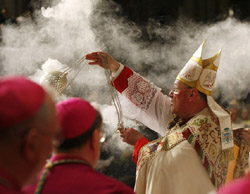
The use of incense would be prohibited as pagan. On the other
hand, Christians would hold love feasts, and celebrate the Sabbath
on Saturdays. Easter would be celebrated on the 14th day of
the Jewish month of Nisan. Infants would not be baptised, and
adults would not be baptised except between Easter and Pentecost.
Baptisms would then involve the triple immersion of the naked
baptismal candidate. There would be no sacrament of confession
or penance, or if we accept the earliest (third century) practices
there would be only public penance (exomologesis),
permitted once after baptism1.
There would be no priests or bishops, only elders and supervisors,
freely elected by the community. Since
the Bible fails to mention certain doctrines and practices that
are now considered characteristically Christian, some branches
of Christianity have looked to early traditions to justify them.
But the results are disappointing. Few genuine traditions can
be justified in this way, and worse still, early authorities
often confirm many practices that are now regarded as unacceptable.
For example, a return to the earliest practices would mean that
no religious icons would be allowed, either pictures or statues.
The use of incense would be prohibited as pagan. On the other
hand, Christians would hold love feasts, and celebrate the Sabbath
on Saturdays. Easter would be celebrated on the 14th day of
the Jewish month of Nisan. Infants would not be baptised, and
adults would not be baptised except between Easter and Pentecost.
Baptisms would then involve the triple immersion of the naked
baptismal candidate. There would be no sacrament of confession
or penance, or if we accept the earliest (third century) practices
there would be only public penance (exomologesis),
permitted once after baptism1.
There would be no priests or bishops, only elders and supervisors,
freely elected by the community.
The whole area of "tradition" is riddled with difficulties.
The early Church leader and writer Tertullian, who invented
the idea of appealing to tradition, used it to justify the practice
of triple immersion at baptism, the requirement that the Eucharist
should be taken in the early morning, and the prohibition of
kneeling at Easter or on Sundays. There is no doubt about the
position of the early Church on these matters and it is for
this reason that various reformed Churches have returned to
at least some of these ancient practices.
The Roman Church is in a less comfortable position. It purports
to give great weight to tradition — the importance of traditions
dating back to the apostles was emphasised by the Council of
Trent (Session 4). Yet it has persecuted and killed people for
the heresies of adhering to apostolic practices — rejecting
infant baptism, keeping the Sabbath on Saturday, celebrating
Easter on the 14th of Nisan, and so on. Protestant Churches
have also persecuted and killed other Christians (e.g. Anabaptists)
for such "heresies". It is strange enough that apostolic
practices are sometimes at variance with mainstream Christian
views. Worse is the fact that not a single Church doctrine can
be justified by appeal to a reliable apostolic tradition.
In the absence of any first-hand apostolic record, Christian
scholars often referred to the Fathers of the Church —
early Christians who left a written record of doctrine and practices.
The Roman Church purports to ascribe authority to them equal
to that accorded to the gospels. But there are problems here
as well. In the first place the earliest Fathers knew nothing
of doctrines such as the Incarnation or Trinity, and so were
liable to make statements that are now heretical. Also, on many
matters the Church Fathers contradict each other, and where
they unanimously concur they often condemn practices that are
now common, for example, the wearing of distinctive clothing
by clerics. Often, specific directions by the Fathers are simply
ignored. Hippolytus instructed Christians to pray at the third,
sixth, and ninth hours of the day, a practice mentioned by many
early authorities, such as Tertullian, Origen of Alexandria,
and Cyprian, Bishop of Carthage. The practice was inconvenient
so it was dropped for those not belonging to religious Orders
(though Muslims manage to follow similar rules, taking care
to face a certain direction, as Christians once did, and adopting
the same posture for prayer as early Christians).
The Fathers held strong views on a wide range of matters. As
Gibbon observed:
In their censures of luxury the fathers were extremely minute
and circumstantial; and among the various articles that excite
their pious indignation we may enumerate false hair, garments
of any colour except white, instruments of music, vases of
gold or silver, downy pillows (as Jacob reposed his head on
a stone), white bread, foreign wines, public salutations,
the use of warm baths, and the practice of shaving the beard,
which, according to Tertullian,
is a lie against our own faces and an impious attempt to improve
the works of the Creator2.
The Roman Church's commitment to tradition is widely regarded
as questionable. The Church has never attempted to collect together
a comprehensive body of tradition, and it is not unknown for
Roman Catholic writers to be charged by other Christians with
being evasive, and even "fugitive", on the subject3.
This is not altogether surprising since numerous Roman doctrines
are not evidenced by the Church Fathers, and are universally
acknowledged to date from later times (papal infallibility,
the Immaculate Conception, and Mary's Assumption, to name
but three ).
It is difficult to find any Church Fathers who were consistently
orthodox by modern standards. Indeed the problem of deciding
who counted as a Church Father was much like deciding which
books were canonical. People tended to include anyone who agreed
with them and to reject anyone who did not. Since there were
so few accepted Fathers, broad agreement was eventually reached,
though once again there is no definitive list, and Eastern and
Western Churches still accord vastly different weights to different
Fathers4. Since it was
difficult, often impossible, to find orthodox writers who confirmed
certain doctrines or practices, Churches were driven to accept
as authoritative men who had been condemned as heretics. Some
of them had been considered heretical even in their own day.
Their original writings were conveniently "lost" or
tampered with. Many of these early Christians had extremely
unfortunate views on sex and punishment, shared extreme anti-Semitic
views, and firmly believed a range of absurdities. The most
influential were:
 St
Ignatius of Antioch (AD c.35-c.107). Ignatius was an
unusually credulous man, given to embellishing stories, and
with an unusual personality (he prayed for his own death, preferably
by horrific means). He held that only bishops could conduct
baptisms and love feasts5
- he is the first writer to hint that "bishops" might
be different from "presbyters", and that Christ might
be something more than human. He left little else of doctrinal
value, and what little he did leave is universally acknowledged
to have been radically tampered with by later Christians. By
the 5th century, his letters had been enlarged by spurious writings,
and the original letters had been supplemented with interpolations,
created to posthumously enlist Ignatius as a witness in contemporary
theological disputes. The purported eyewitness account of his
martyrdom is also thought to be a forgery from around the same
time. St
Ignatius of Antioch (AD c.35-c.107). Ignatius was an
unusually credulous man, given to embellishing stories, and
with an unusual personality (he prayed for his own death, preferably
by horrific means). He held that only bishops could conduct
baptisms and love feasts5
- he is the first writer to hint that "bishops" might
be different from "presbyters", and that Christ might
be something more than human. He left little else of doctrinal
value, and what little he did leave is universally acknowledged
to have been radically tampered with by later Christians. By
the 5th century, his letters had been enlarged by spurious writings,
and the original letters had been supplemented with interpolations,
created to posthumously enlist Ignatius as a witness in contemporary
theological disputes. The purported eyewitness account of his
martyrdom is also thought to be a forgery from around the same
time.
 St
Clement of Rome (fl. AD c.96). Clement wrote letters
that were initially accepted into but later rejected from the
canon of Christian scripture. They deal largely with the great
dissent then current within the Church, and suggest that there
was no established bishopric at Rome during his lifetime6.
(Ironically his name was later included in lists of early popes,
though different lists have him as first, second, third or fourth
in line from Peter). According to acta dating from the 4th century,
Clement was banished from Rome to the Chersonesus during the
reign of Emperor Trajan, and set to work in a stone quarry.
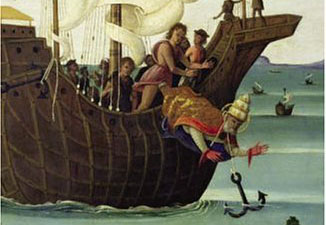
He was allegedly killed by being tied to an anchor and thrown
from a boat into the Black Sea. St
Clement of Rome (fl. AD c.96). Clement wrote letters
that were initially accepted into but later rejected from the
canon of Christian scripture. They deal largely with the great
dissent then current within the Church, and suggest that there
was no established bishopric at Rome during his lifetime6.
(Ironically his name was later included in lists of early popes,
though different lists have him as first, second, third or fourth
in line from Peter). According to acta dating from the 4th century,
Clement was banished from Rome to the Chersonesus during the
reign of Emperor Trajan, and set to work in a stone quarry.
He was allegedly killed by being tied to an anchor and thrown
from a boat into the Black Sea.
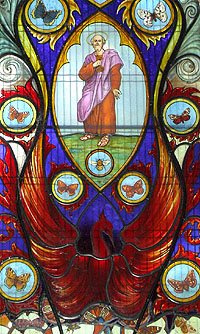
Clement used the terms bishop and presbyter interchangeably
- a reminder that bishops had not separated off as a higher
office at this time. Clement seems to have been as credulous
as others of his age (he was convinced in the reality of the
phoenix). The stained glass window on the right shows him along
with his fabulous phoenix. Much of his surviving work is now
known to be forged, and little is known of his life or beliefs.
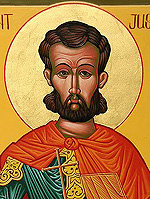 St
Justin Martyr (AD c.100-c.165). Justin was a man generally
acknowledged to have been of no great intelligence, nor philosophical
nor literary skill. He had studied Stoic and Pythagorean philosophy,
but had failed to comprehend either and turned instead to Christianity.
His writings are of little doctrinal value. He was concerned
mainly to refute various charges made against Christians by
members of other religions. He has been accused of believing
in two Gods, having referred to the Word (logos)
as "second God". According to him Christ was worshipped
in the "second rank", and the Holy Spirit in the "third
rank", a view that is now regarded as heretical7 St
Justin Martyr (AD c.100-c.165). Justin was a man generally
acknowledged to have been of no great intelligence, nor philosophical
nor literary skill. He had studied Stoic and Pythagorean philosophy,
but had failed to comprehend either and turned instead to Christianity.
His writings are of little doctrinal value. He was concerned
mainly to refute various charges made against Christians by
members of other religions. He has been accused of believing
in two Gods, having referred to the Word (logos)
as "second God". According to him Christ was worshipped
in the "second rank", and the Holy Spirit in the "third
rank", a view that is now regarded as heretical7
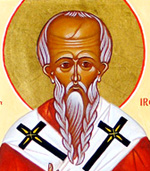 St
Irenaeus of Lyons (AD c.130-c.200). Irenaeus was another
exceptionally credulous man, who believed stories that are now
accepted to be apocryphal8.
Like many of his contemporaries, Irenaeus accepted the millenarian
heresy, the belief in a 1,000-year period of divine rule following
Christ's imminent return to living on Earth. For this reason
he was not well regarded by the Eastern Churches. His writings
have not been preserved in the original Greek, and Latin translations
show evidence of his views having been edited to erase evidence
of his heresy9.
His idea of the Incarnation was that the Word (logos)
was God the Father incarnate in Jesus Christ — a view now
considered heretical. He also held that Jesus died as a ransom
paid to Satan10,
a view that might well have come to be regarded as heretical
if it had not been almost universal until the eleventh century. St
Irenaeus of Lyons (AD c.130-c.200). Irenaeus was another
exceptionally credulous man, who believed stories that are now
accepted to be apocryphal8.
Like many of his contemporaries, Irenaeus accepted the millenarian
heresy, the belief in a 1,000-year period of divine rule following
Christ's imminent return to living on Earth. For this reason
he was not well regarded by the Eastern Churches. His writings
have not been preserved in the original Greek, and Latin translations
show evidence of his views having been edited to erase evidence
of his heresy9.
His idea of the Incarnation was that the Word (logos)
was God the Father incarnate in Jesus Christ — a view now
considered heretical. He also held that Jesus died as a ransom
paid to Satan10,
a view that might well have come to be regarded as heretical
if it had not been almost universal until the eleventh century.
 St
Clement of Alexandria (AD c.150-c.215). Clement held
Gnostic views, denying that Christ had experienced the physical
passions of an ordinary man and holding that he had been exempt
from human desire11.
Such views would later be condemned as heretical. Clement is
also known to have suppressed authentic gospel material that
he wanted kept for an inner élite. He expressed doubts
as to whether he even wanted to be associated with those who
called themselves orthodox and found it hard to use the word
without a half-ironic apology.12
Clement's work draws on Stoic philosophy and pagan literature.
He dated the creation of the world to 5592 B.C. In his Stromata,
he condemns Christians who actively seek martyrdom. His writing
show him to be married. He was once revered in the Roman Catholic
Church, but his name was removed from the Roman Martyrology
in 1586 by Pope Sixtus V because of his documented views. The
date, cause and location of his death are unknown, so he was
in any case only ever a martyr in the original sense of being
a "witness".. St
Clement of Alexandria (AD c.150-c.215). Clement held
Gnostic views, denying that Christ had experienced the physical
passions of an ordinary man and holding that he had been exempt
from human desire11.
Such views would later be condemned as heretical. Clement is
also known to have suppressed authentic gospel material that
he wanted kept for an inner élite. He expressed doubts
as to whether he even wanted to be associated with those who
called themselves orthodox and found it hard to use the word
without a half-ironic apology.12
Clement's work draws on Stoic philosophy and pagan literature.
He dated the creation of the world to 5592 B.C. In his Stromata,
he condemns Christians who actively seek martyrdom. His writing
show him to be married. He was once revered in the Roman Catholic
Church, but his name was removed from the Roman Martyrology
in 1586 by Pope Sixtus V because of his documented views. The
date, cause and location of his death are unknown, so he was
in any case only ever a martyr in the original sense of being
a "witness"..
 (Quintus
Septimus Florens) Tertullian (AD c.160-c.225). Like
many later Christians, Tertullian delighted in the prospect
of his enemies suffering in Hell. He adopted Montanist views
(see page 123), which came to be considered heretical, and held
that the orthodox line was the heretical one. He accused bishops
of Rome of the Sabellian heresy, the doctrine that Father, Son,
and Spirit represent different states (or modes or aspects)
of a single god at different times (see also page 123). Around
fifteen works in Latin or Greek are "lost", some of
them as recently as the 9th century. Two books addressed to
his wife confirm that he was married. He despised Greek philosophy,
and regarded Plato, Aristotle, and other Greek thinkers as forefathers
of heretics (De anima, iii.). Like most of his fellow Fathers,
Tertullian is often described as misogynistic, in his case on
the basis of the contents of his 'De Cultu Feminarum,'
: "Do you not know that you are Eve? The judgment of God
upon this sex lives on in this age; therefore, necessarily the
guilt should live on also. You are the gateway of the devil;
you are the one who unseals the curse of that tree, and you
are the first one to turn your back on the divine law; you are
the one who persuaded him whom the devil was not capable of
corrupting; you easily destroyed the image of God, Adam. Because
of what you deserve, that is, death, even the Son of God had
to die.” (section I.I, part 2, trans. C.W. Marx). And again
with reference to Eve,, "For straightway that impatience
conceived of the devil's seed, produced, in the fecundity of
malice, anger as her son; and when brought forth, trained him
in her own arts." (On Patience 5:15). He died fulminating
against the faction that is now regarded as orthodox. (Quintus
Septimus Florens) Tertullian (AD c.160-c.225). Like
many later Christians, Tertullian delighted in the prospect
of his enemies suffering in Hell. He adopted Montanist views
(see page 123), which came to be considered heretical, and held
that the orthodox line was the heretical one. He accused bishops
of Rome of the Sabellian heresy, the doctrine that Father, Son,
and Spirit represent different states (or modes or aspects)
of a single god at different times (see also page 123). Around
fifteen works in Latin or Greek are "lost", some of
them as recently as the 9th century. Two books addressed to
his wife confirm that he was married. He despised Greek philosophy,
and regarded Plato, Aristotle, and other Greek thinkers as forefathers
of heretics (De anima, iii.). Like most of his fellow Fathers,
Tertullian is often described as misogynistic, in his case on
the basis of the contents of his 'De Cultu Feminarum,'
: "Do you not know that you are Eve? The judgment of God
upon this sex lives on in this age; therefore, necessarily the
guilt should live on also. You are the gateway of the devil;
you are the one who unseals the curse of that tree, and you
are the first one to turn your back on the divine law; you are
the one who persuaded him whom the devil was not capable of
corrupting; you easily destroyed the image of God, Adam. Because
of what you deserve, that is, death, even the Son of God had
to die.” (section I.I, part 2, trans. C.W. Marx). And again
with reference to Eve,, "For straightway that impatience
conceived of the devil's seed, produced, in the fecundity of
malice, anger as her son; and when brought forth, trained him
in her own arts." (On Patience 5:15). He died fulminating
against the faction that is now regarded as orthodox.
|
Bodleian, MS. Douce 134 folio 077v
Jesus and the heavenly host above watching the torments
of those in hell below
|
 |
 St
Hippolytus (AD c.170-c.236). Hippolytus was a prolific
Greek writer and another supporter of the millenarian heresy,
whose works have been "lost" in the original. Later
Latin versions of his Apostolic Traditions have clearly
been tampered with. He was elected Bishop of Rome in competition
to the existing bishop (Callistus), who claimed that Hippolytus
believed in two gods. Hippolytus accused two bishops of Rome
(Zephyrinus and Callistus) of heresy and attacked two others
Urban I (222–230) and Pontian (230–235). Hippolytus
belonged to a Christian group (Novatians) now considered heretical,
though he is more usually described as a schismatic. Most of
his works were "lost", the usual fate of works considered
heretical by the majority faction. From the little that remains
we know that he represented the Logos as Sophia, God's
female agent in creation; as a transgendered maker of wine (like
Dionysus); and as the sun-god Helios who rides across the sky
in a chariot. A martyrdom was invented for Hippolytus, based
on another, pre-Christian, Hippolytus who was dragged to death
by wild horses. The Eastern Orthodox Church celebrates the feast
of "St Hippolytus Pope of Rome" on January 30. In
the West Hippolytus is now regarded as the first anti-pope,
and also as a saint. He is the patron saint of horses, a reference
to his fictitious martyrdom. St
Hippolytus (AD c.170-c.236). Hippolytus was a prolific
Greek writer and another supporter of the millenarian heresy,
whose works have been "lost" in the original. Later
Latin versions of his Apostolic Traditions have clearly
been tampered with. He was elected Bishop of Rome in competition
to the existing bishop (Callistus), who claimed that Hippolytus
believed in two gods. Hippolytus accused two bishops of Rome
(Zephyrinus and Callistus) of heresy and attacked two others
Urban I (222–230) and Pontian (230–235). Hippolytus
belonged to a Christian group (Novatians) now considered heretical,
though he is more usually described as a schismatic. Most of
his works were "lost", the usual fate of works considered
heretical by the majority faction. From the little that remains
we know that he represented the Logos as Sophia, God's
female agent in creation; as a transgendered maker of wine (like
Dionysus); and as the sun-god Helios who rides across the sky
in a chariot. A martyrdom was invented for Hippolytus, based
on another, pre-Christian, Hippolytus who was dragged to death
by wild horses. The Eastern Orthodox Church celebrates the feast
of "St Hippolytus Pope of Rome" on January 30. In
the West Hippolytus is now regarded as the first anti-pope,
and also as a saint. He is the patron saint of horses, a reference
to his fictitious martyrdom.
 Origen
of Alexandria (AD c.185-254). Origen was a biblical
critic, teacher and writer. Most of his works have been "lost".
Of those that are extant most are known only in translation.
He was accused of holding beliefs that would later be regarded
as heretical ("Adoptionist"). He held that Jesus Christ
was divine, but only in a lesser sense than the Father13.
He said that Christian worship should be directed solely to
the Father and not to Christ, a view that was later to become
heretical, as were a number of his other teachings. He also
held that all beings will eventually be saved, even Satan himself,
a view that was heretical for many centuries but is now fashionable
again. Like some of his contemporaries he voluntarily castrated
himself to remove a sinful source of temptation. He insisted
on observing Jesus" instructions, such as the ones about
not carrying an extra coat and not wearing shoes (Matthew 10:10).
During his lifetime he was deposed from the priesthood and deprived
of his teaching post by the Bishop of Alexandria. He was also
condemned by the Bishop of Rome and by a synod of Egyptian bishops.
St Jerome held that he
had deliberately tried to mislead the orthodox into heresy.
Views attributed to him were condemned by further bishops, emperors
and councils. To clear up any remnant of doubt, Origen's teachings
were condemned by the Second Ecumenical Council of Constantinople
in 553. Origen
of Alexandria (AD c.185-254). Origen was a biblical
critic, teacher and writer. Most of his works have been "lost".
Of those that are extant most are known only in translation.
He was accused of holding beliefs that would later be regarded
as heretical ("Adoptionist"). He held that Jesus Christ
was divine, but only in a lesser sense than the Father13.
He said that Christian worship should be directed solely to
the Father and not to Christ, a view that was later to become
heretical, as were a number of his other teachings. He also
held that all beings will eventually be saved, even Satan himself,
a view that was heretical for many centuries but is now fashionable
again. Like some of his contemporaries he voluntarily castrated
himself to remove a sinful source of temptation. He insisted
on observing Jesus" instructions, such as the ones about
not carrying an extra coat and not wearing shoes (Matthew 10:10).
During his lifetime he was deposed from the priesthood and deprived
of his teaching post by the Bishop of Alexandria. He was also
condemned by the Bishop of Rome and by a synod of Egyptian bishops.
St Jerome held that he
had deliberately tried to mislead the orthodox into heresy.
Views attributed to him were condemned by further bishops, emperors
and councils. To clear up any remnant of doubt, Origen's teachings
were condemned by the Second Ecumenical Council of Constantinople
in 553.
|
Origen emasculating himself,
Roman de la Rose, France 15th century, Bodleian Library,
MS. Douce 195, fol. 122v.
|
|
|
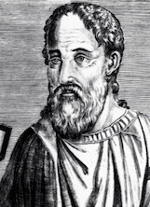 Eusebius
of Caesarea c.260-c.340). Eusebius is regarded as the
Father of Church history. He was a supporter of the Libyan preacher
Arius (c.256-336) and his heresy that Jesus Christ was not coequal
with the Father, until he was pressured to subscribe to the
new official line at the first great Council of the Church.
He said that Jesus shared the glory of God, but only in the
sense that the saints shared the same glory14.
Like St Justin Martyr he
thought of the Holy Spirit as being lower than either the Father
or the Son, describing it as "in the third rank",
"a third power", and "third from the Supreme
Cause"15.
He was accused of adultery, among other things, on the evidence
of a prostitute, and was replaced as leader of the moderate
party. His history contains statements that still smack of the
Arian heresy16. Eusebius
of Caesarea c.260-c.340). Eusebius is regarded as the
Father of Church history. He was a supporter of the Libyan preacher
Arius (c.256-336) and his heresy that Jesus Christ was not coequal
with the Father, until he was pressured to subscribe to the
new official line at the first great Council of the Church.
He said that Jesus shared the glory of God, but only in the
sense that the saints shared the same glory14.
Like St Justin Martyr he
thought of the Holy Spirit as being lower than either the Father
or the Son, describing it as "in the third rank",
"a third power", and "third from the Supreme
Cause"15.
He was accused of adultery, among other things, on the evidence
of a prostitute, and was replaced as leader of the moderate
party. His history contains statements that still smack of the
Arian heresy16.
 St
John Chrysostom (c.347-407). John was an anti-Semite
who interpreted the Bible literally and historically rather
than allegorically, Chrysostom he provided moral and financial
support to Christian monks (who were enforcing the Christian
emperors' anti-Pagan laws) by destroying temples and shrines
in Phoenicia and nearby regions. In his homilies he thundered
against popular amusements such as theatre and horse races,
setting the tone for many centuries of repression of non-Christian
enjoyments. He shared some of the heretical views of Origen. St
John Chrysostom (c.347-407). John was an anti-Semite
who interpreted the Bible literally and historically rather
than allegorically, Chrysostom he provided moral and financial
support to Christian monks (who were enforcing the Christian
emperors' anti-Pagan laws) by destroying temples and shrines
in Phoenicia and nearby regions. In his homilies he thundered
against popular amusements such as theatre and horse races,
setting the tone for many centuries of repression of non-Christian
enjoyments. He shared some of the heretical views of Origen.
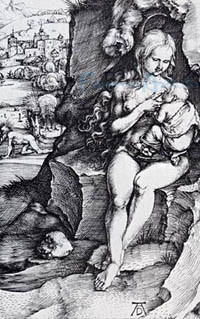 According
to Christian tradition when John Chrysostom was a hermit in
the desert, he was approached by a princess in distress. The
great Saint, imagining she was a demon, refused to help, but
she convinced him that she was a Christian and would be devoured
by wild beasts if she were not allowed to take refuge in his
cave. He let her in and had sex with her. In an attempt to hide
his sin, the great saint took the princess outside and threw
her over a precipice. He then went off to beg absolution, which
was refused. Chrysostom then made a vow that he would never
rise from the ground until his sins were expiated. For years
he lived like a beast, crawling on all fours, feeding on wild
grass and roots. Miraculously, the princess reappeared, alive,
and suckling the saint's baby, who pronounced his father's sins
forgiven. The scene was popular a subject for Christian engravers
and artists, including Albrecht Dürer, Hans Sebald Beham
and Lucas Cranach the Elder. Whatever the truth of this story,
Chrysostom was deposed from his post of Patriarch of Constantinople
by the synod of the Oak in 403, and condemned and banished with
the consent of the emperor, then the head of the Church. He
was recalled but then banished again and died in exile, a heretic.
He was later rehabilitated and is now considered a saint. According
to Christian tradition when John Chrysostom was a hermit in
the desert, he was approached by a princess in distress. The
great Saint, imagining she was a demon, refused to help, but
she convinced him that she was a Christian and would be devoured
by wild beasts if she were not allowed to take refuge in his
cave. He let her in and had sex with her. In an attempt to hide
his sin, the great saint took the princess outside and threw
her over a precipice. He then went off to beg absolution, which
was refused. Chrysostom then made a vow that he would never
rise from the ground until his sins were expiated. For years
he lived like a beast, crawling on all fours, feeding on wild
grass and roots. Miraculously, the princess reappeared, alive,
and suckling the saint's baby, who pronounced his father's sins
forgiven. The scene was popular a subject for Christian engravers
and artists, including Albrecht Dürer, Hans Sebald Beham
and Lucas Cranach the Elder. Whatever the truth of this story,
Chrysostom was deposed from his post of Patriarch of Constantinople
by the synod of the Oak in 403, and condemned and banished with
the consent of the emperor, then the head of the Church. He
was recalled but then banished again and died in exile, a heretic.
He was later rehabilitated and is now considered a saint.
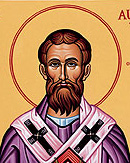 St
Augustine of Hippo (354-430). Augustine was brought
up as a Christian, but took a mistress and abandoned his religion.
He considered the Old Testament to be a collection of old wives"
fables, though he himself was unusually gullible, even by standards
of the day17.
In 374 he converted to a rival religion, Manichæism, and
managed to convert some friends as well. But he never managed
to graduate as one of the elect. Some nine years after his conversion
he became a neoplatonist and then converted back to Christianity,
in response to an oracle. He introduced new doctrines into the
Church, drawn largely from his Manichæan phase. His views
about the evils of sex seem to be due partly to guilt about
his mistresses18,
and partly to his Manichæan training, a fact recognised
by at least one of his contemporaries. His views on contraception
are not consistent with those of the Roman Church19.
He was frankly predestinarian (believing people are powerless
to change their destiny). He also mentioned the death of the
Virgin Mary, not remarkable at the time, but now contrary to
Roman dogma. He was also open to charges of a heresy called
Sabellianism or Modal Monarchianism. His consecration as coadjutor
bishop in 395 was illegal, contravening the eighth canon of
Nicæa. He is known as the Father
of the Inquisition, and his writings were used to justify a
range of Christian teachings including the treatment of heretics
and the acceptability of Christian
slavery. St
Augustine of Hippo (354-430). Augustine was brought
up as a Christian, but took a mistress and abandoned his religion.
He considered the Old Testament to be a collection of old wives"
fables, though he himself was unusually gullible, even by standards
of the day17.
In 374 he converted to a rival religion, Manichæism, and
managed to convert some friends as well. But he never managed
to graduate as one of the elect. Some nine years after his conversion
he became a neoplatonist and then converted back to Christianity,
in response to an oracle. He introduced new doctrines into the
Church, drawn largely from his Manichæan phase. His views
about the evils of sex seem to be due partly to guilt about
his mistresses18,
and partly to his Manichæan training, a fact recognised
by at least one of his contemporaries. His views on contraception
are not consistent with those of the Roman Church19.
He was frankly predestinarian (believing people are powerless
to change their destiny). He also mentioned the death of the
Virgin Mary, not remarkable at the time, but now contrary to
Roman dogma. He was also open to charges of a heresy called
Sabellianism or Modal Monarchianism. His consecration as coadjutor
bishop in 395 was illegal, contravening the eighth canon of
Nicæa. He is known as the Father
of the Inquisition, and his writings were used to justify a
range of Christian teachings including the treatment of heretics
and the acceptability of Christian
slavery.
 St
Jerome (c.342-420.) Jerome was a scholar with a reputation
for being offensive to his fellow scholars. He was responsible
for creating the version of the Bible called the Vulgate. He
surrounded himself by wealthy women in Rome and was involved
in a series of scandals there. He left Rome in disgrace, after
one of his female acolytes died from the severity of her bodily
mortification. He settled in Bethlehem, along with selected
women followers. St
Jerome (c.342-420.) Jerome was a scholar with a reputation
for being offensive to his fellow scholars. He was responsible
for creating the version of the Bible called the Vulgate. He
surrounded himself by wealthy women in Rome and was involved
in a series of scandals there. He left Rome in disgrace, after
one of his female acolytes died from the severity of her bodily
mortification. He settled in Bethlehem, along with selected
women followers.
Other important early theologians, now dismissed as heretics,
are nevertheless cited when they agree with the currently acceptable
line, especially when they provide the only support for the
point in question. Among them are Helvidius (who held that Jesus
had brothers) ; Jovinian (d. c.405), a monk who was excommunicated
for criticising fasting and celibacy, and for suggesting that
Mary lost her virginity in giving birth ; and Vigilantius (fl.
c.400), who deprecated popular devotions, such as vigils and
the cultus of the saints, as pagan practices.
It would be fair to say that the most significant thing that
the Church Fathers establish is that much Christian doctrine
was developed in the fourth century, or afterwards.
|
|
|
|
|
|
|
|
|
|
|
|
|
|
|
|
|
|
|
|
|
|
|
|
|
|
|
|
|
|
|
|
|
|
|
|
|
|
Buy the Book from Amazon.com
|
|
|
|
|
|
Buy the Book from Amazon.co.uk
|
|
|
|