| |
|
|
What mean and cruel things men do
for the love of God
|
|
W. Somerset Maugham (1874-1965), A
Writer's Notebook
|
  During
the whole period of 1,500 years or so that the Church enjoyed
absolute power the concept of penal reform was unknown. Prisons
in 1800 were as insanitary, cramped, infested and dangerous
as they had been when the Roman Empire first adopted Christianity.
Prisoners had virtually no rights, were subjected to violence
and arbitrary punishment, could expect little or no medical
assistance, and were likely to die of disease or starvation
before their release. The prime purposes of gaol were punishment
and retribution. During
the whole period of 1,500 years or so that the Church enjoyed
absolute power the concept of penal reform was unknown. Prisons
in 1800 were as insanitary, cramped, infested and dangerous
as they had been when the Roman Empire first adopted Christianity.
Prisoners had virtually no rights, were subjected to violence
and arbitrary punishment, could expect little or no medical
assistance, and were likely to die of disease or starvation
before their release. The prime purposes of gaol were punishment
and retribution.
Bishop's gaols were no better than others, and were frequently
worse. They provided a source of funds to their owners. In the
Bishop of Ely's prison, men were chained to the floor, with
heavy iron bars across their legs and spiked collars around
their necks. They lived and often died like this unless they
were prepared to pay a fee for "easement of irons".
The Prince Bishop of Durham owned the county gaol at Durham,
which was for centuries a profitable enterprise, and other bishops
around the country, indeed throughout Christendom, supplemented
their fortunes from the suffering of their prisoners. Food,
if any, was often limited to bread and water: "the bread
and water of affliction" (1 Kings 22:27). Such a diet guaranteed
death sooner or later, usually within months.
|
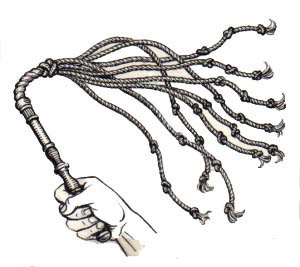
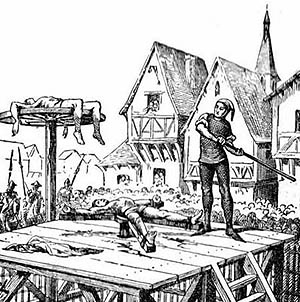
In Christian times flogging was commonplace.
Victims included monks and nuns, children, soldiers and
sailers, the mentally ill, penitants, criminals, servants
and slaves, prisoners and those who offended the Church,
including noblemen and kings.
|
|
|
 The
Bishop of Winchester's prison on the South bank of the Thames,
the original "Clink", has given its name to a slang
term for all prisons*.
As it was near to the Thames the lower cells tended to flood
at high tide, so prisoners unable to provide the requisite bribes
could be done away with effortlessly by drowning. Otherwise
the Clink was much like other bishops" prisons. Men, women
and children were held, often illegally without charge. They
lived without light, sanitary facilities, medical attention,
bedding, heating, clothes, or proper food, and survived either
by bribery or begging. The
Bishop of Winchester's prison on the South bank of the Thames,
the original "Clink", has given its name to a slang
term for all prisons*.
As it was near to the Thames the lower cells tended to flood
at high tide, so prisoners unable to provide the requisite bribes
could be done away with effortlessly by drowning. Otherwise
the Clink was much like other bishops" prisons. Men, women
and children were held, often illegally without charge. They
lived without light, sanitary facilities, medical attention,
bedding, heating, clothes, or proper food, and survived either
by bribery or begging.
For some crimes the Church favoured public humiliation - being
forced to wear absurd masks, being stripped and flogged, or
restrained while having things thrown at them. One formalised
sentence was the Amende honorable. The Amende honorable
was a form of punishment used within Christendom from the middle
ages up to the eighteenth century. It was a Church sponsored
form of public humiliation. In the middle ages the Church imposed
it on people without any form of judicial trial. Later it became
a sentence imposed by courts following a form of trial, generally
conducted in Church courts, they it was also imposed under Civil
Law. The condemned man or woman was stripped naked or sometimes
allowed a shift or breaches for modesty. Like other penitents
they carried a large candle in their hands, which were sometimes
bound. The condemned was led to the church door or even into
the church, wearing a noose around their neck by which they
were pulled along, usually by the public executioner. (The amende
honourable was sometimes though not always a part of capital
punishment. It was for example incorporated into larger rituals
of capital punishment such as the French version of drawing
and quartering for treason). Barefoot, the condemned had to
walk or crawl before a judge, bishop or other assembled clergy
at the altar, admit their supposed error and beg for pardon.
Sometimes they would also be publically scourged. In France
a pardon granted by the church was binding on the state, regardless
of the severity of the crime. Humiliation and submission to
God and the Church were the principle features of the procedure.
An accurate depiction of the amende honourable features in the
film Le Retour de Martin Guerre.
|
Alphonse Legros (1837-1911), Une amende
honorable, salon de 1868
Amende honorable was part of the punishment under the
French blasphemy law
passed in 1825 under the Restoration
|
|
|
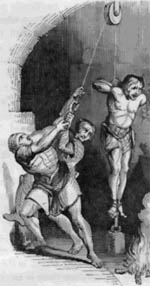 Cristian
tortures took many forms. People were restrained by irons and
fetters, sometimes locked into agonising positions with neck,
wrists and ankles held within inches of each other. After a
short time in this position they were permanently disabled.
Alternatively prisoners could be racked, beaten, flogged or
otherwise abused. One method was to keep their feet in water
until they rotted. Cristian
tortures took many forms. People were restrained by irons and
fetters, sometimes locked into agonising positions with neck,
wrists and ankles held within inches of each other. After a
short time in this position they were permanently disabled.
Alternatively prisoners could be racked, beaten, flogged or
otherwise abused. One method was to keep their feet in water
until they rotted.
Corruption was rife, so that it was possible for example to
establish brothels inside prisons. Money was extorted for anything
and everything. Prisoners were even charged for lodging, for
the chains that restrained them and for the torture inflicted
on them. In 1194 sixpence was charged for fitting a ferramente,
an iron collar. This was the equivalent of thousands of pounds
today. Those with wealthy relatives could avoid the worst suffering
and indignities. Money would buy privileges such as food and
drink, better cells, a bed, a chamber pot, candles, relief from
irons, conjugal visits, and so on. Money would also allow privileged
prisoners to avoid the whipping post, the cucking stool, and
other tortures and indignities*.
The Church accepted all this. God had no objection to it —
Churchmen pointed out that if he had disapproved, he would have
said so in the Bible.
|
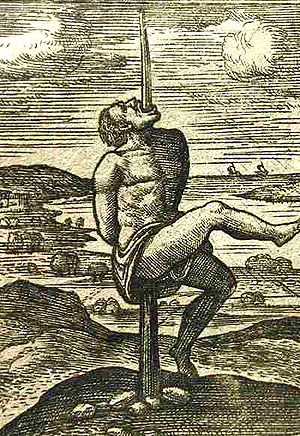
Vlad III, Prince of Wallachia (1431–1476),
was also known by his patronymic name: Dracula. He was
posthumously dubbed Vlad the Impaler. A Catholic convert,
he was famed for his cruelty, persecuting Romanies
and impaling his enemies, including prisoners of war.
He was regarded as a hero by the Catholic Church, and
provided a model for Bram Stoker's Dracula.
|
|
|
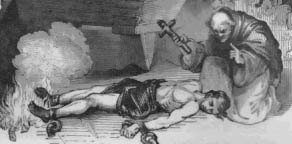 The
pioneer of modern penology was an Italian rationalist, the Marquis
Cesare Beccaria-Bonesana, who published Dei Delitti e delle
Pene (On Crimes and Punishments) in 1764, claiming
that the prevention of crime, not punishment, should be the
prime aim of an enlightened society, and that crime was deterred
by the likelihood of detection rather than the severity of punishment.
The Inquisition condemned his ideas. For the Churches the prime
purpose was punishment and retribution, as affirmed by the Bible,
not rehabilitation, which was not mentioned in the Bible. The
pioneer of modern penology was an Italian rationalist, the Marquis
Cesare Beccaria-Bonesana, who published Dei Delitti e delle
Pene (On Crimes and Punishments) in 1764, claiming
that the prevention of crime, not punishment, should be the
prime aim of an enlightened society, and that crime was deterred
by the likelihood of detection rather than the severity of punishment.
The Inquisition condemned his ideas. For the Churches the prime
purpose was punishment and retribution, as affirmed by the Bible,
not rehabilitation, which was not mentioned in the Bible.
|
Detail of "Flagellation of a Female
Samboe Slave." John Gabriel Stedman,
Narrative, of a Five Years' Expedition, against the revolted
Negroes of Surinam . . . from the year 1772, to
1777 (London, 1796), vol. 1, facing p. 326. (Copy
in the John Carter Brown Library at Brown University).
Stedman witnessed this event in 1774. The victim was an
eighteen-year old girl who was given 200 lashes for having
refused to have intercourse with an overseer - a demand
sanctioned by the Bible.
|
|
|
 The
movementfor penal reform in England was led by Jeremy Bentham,
who was influenced by Beccaria. Bentham, a Utilitarian philosopher,
was roundly condemned by churchmen as an atheist with unrealistic
dreams. He was the impetus behind many reforms including those
implemented by Lord Brougham in 1832. He even designed the first
modern prison (the Panopticon ). Atheists like Charles Bradlaugh
and Annie Besant, Quakers like Elizabeth Fry , and other nonconformists
like John Howard supported reform. Fry formed a reform association
in 1817, and Howard gave his name to one founded at a Quaker
meeting in 1866. People like these opposed contemporary prison
practices such as the treadmill, hard labour and corporal punishment. The
movementfor penal reform in England was led by Jeremy Bentham,
who was influenced by Beccaria. Bentham, a Utilitarian philosopher,
was roundly condemned by churchmen as an atheist with unrealistic
dreams. He was the impetus behind many reforms including those
implemented by Lord Brougham in 1832. He even designed the first
modern prison (the Panopticon ). Atheists like Charles Bradlaugh
and Annie Besant, Quakers like Elizabeth Fry , and other nonconformists
like John Howard supported reform. Fry formed a reform association
in 1817, and Howard gave his name to one founded at a Quaker
meeting in 1866. People like these opposed contemporary prison
practices such as the treadmill, hard labour and corporal punishment.
Charles Bradlaugh and Annie Besant held the revolutionary view
that prisons should be "moral Hospitals"*.
The idea that gaols should be primarily for rehabilitation was
entirely a secular one. So were the beliefs that prisoners had
rights; that they were entitled to basic sanitation, and freedom
from flogging, torture and mutilation; and that they should
receive access to medical attention, adequate nutrition, and
education. The sole contribution of the Church was to ensure
that attendance at chapel was made obligatory.
|
Prisoners at the whipping post in Delaware
1907
Whipping posts and stocks were both part of the USA's
Christian heritage from Europe.
B oth were abolished only after secular oppinion came
to predominate, later in the twentieth century.
|
|
|
 All
advances in penal reform were made as secular forces wrested
power from the Churches. In Britain, the Howard League for
Penal Reform, named after John Howard, is the successor
to a number of humanist organisations, and its executive is
still largely humanist. Their successes include the acceptance
of rehabilitation in penal theory, and the abolition of capital
and corporal punishment. All
advances in penal reform were made as secular forces wrested
power from the Churches. In Britain, the Howard League for
Penal Reform, named after John Howard, is the successor
to a number of humanist organisations, and its executive is
still largely humanist. Their successes include the acceptance
of rehabilitation in penal theory, and the abolition of capital
and corporal punishment.
|
Flagellation and the Flagellants, by
the Rev William Cooper, London, 1869
|
|
|
|
Flogging, caning, birching and the tawse
were all common in religious institutions well into the
twentieth century - abbeys, monasteries, convents, nunaries,
seminaries and Church schools. We have no idea how many
deaths resulted because the cause of death was often not
recorded, or if it was it could easily be mis-stated.
|
|
|
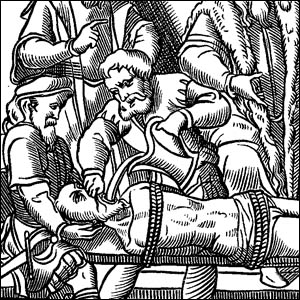
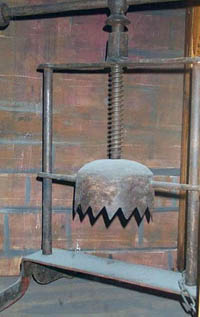
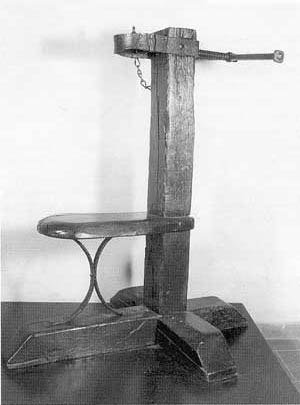
Torture
For well over a millenium Christians practiced torture, until
Enlighment ideas superceded traditional Christian morality,
and torture began to be slowly eradicated from Christendom.
As we have already seen, some jurisdictions had rejected the
practice of torture but the Church had insisted that Church
Law must take precedence, and Church Law not only permitted
torture, but required it in certain circumstances. On one famous
occasion a pope wrote to a king of England insisting that Knights
Templars be tortured, even though it was contrary to the Law
of the land.
The torture practiced in bishops' prisons and Inuisitions was
as inhumane as that practiced in any castle dungeon. The Bishop
of Winchester's prison in Southwark, the original Clink, was
a notable example for many centuries.
The Catholic Church has carefully sanitised it's own torture
chambers. They disappeared from popular tourist trails in late
Victorian times, but not until secular prison reformers had
noted their content and recorded their practices. Below are
a few reminders of practices that were so long considered consonant
with Christian morality:
|
Hand Crusher.
|
 |
| |
| |
|
Brand with the name of Jesus. IHS is
the so called Christogram, representing the first three
letters of the Greek name of Jesus, iota-eta-sigma,
|
|
|
| |
|
Many Popes, Cardinals, Bishops, Inquisitors
and saints (including Saint Thomas Beckets and Saint Thomas
Moore) were branders and torturers. As well as the Christogram
churchmen branded people with crosses and with letters:
A for Adulterer, B for Blasphemer, etc, Sometimes in the
forehead, sometimes in the cheek, sometimes on the chin.
|
|
|
| |
|
Hand brand, for use on felons or deserters,
England, 1642-1649
|
|
|
| |
|
The Inquisition generally ensured that
their instruments of torture were blessed
and sprinkled with holy water
|
|
|
| |
|
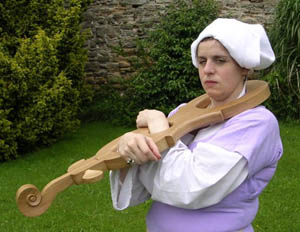
a Shrew's Fiddle
|
|
|
| |
|
A reproduction Shrew's Fiddle, showing
how it was used
|
|
|
| |
|
An iron shrew's fiddle - many instruments
of humiliation-torture were furnished with bells to amuse
onlookers.
|
|
|
| |
|
Neck Crusher
|
|
|
| |
| |
|
|
| |
|
The Scavenger's Daughter, invented at
the Tower of London.
The victim was trapped in a cramped position for extended
periods.
|
|
|
| |
|
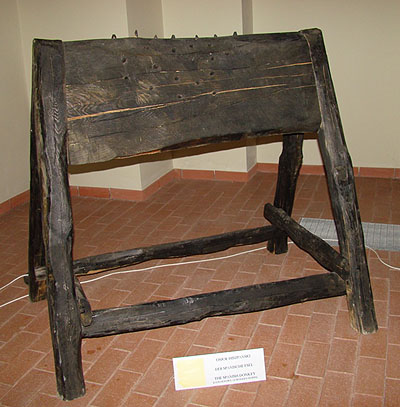
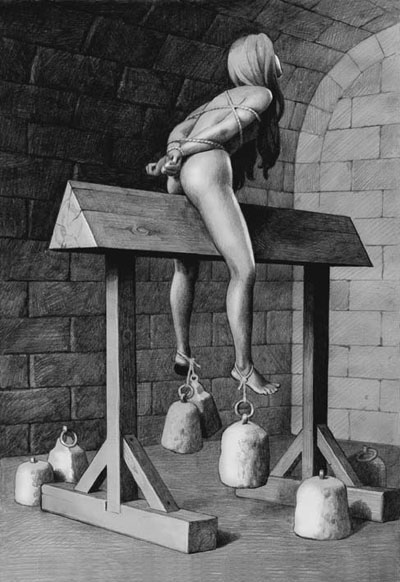
The Spanish Donkey, or Wooden Horse,
also known as the Crib. Victims were forced to sit on
the spikes for extended periods, often with weights attached
to their feet.
|
|
|
| |
| |
|
The Spanish Donkey, or Wooden Horse,
or Crib, showing how it was used.
|
|
|
| |
|
Prisoners were often chained to an immovable
object, or to a heavy ovject. The object was not only
to immobilize the victim, but also to cause pain: note
the spikes on the inside of the iron ring.
|
|
|
| |
|
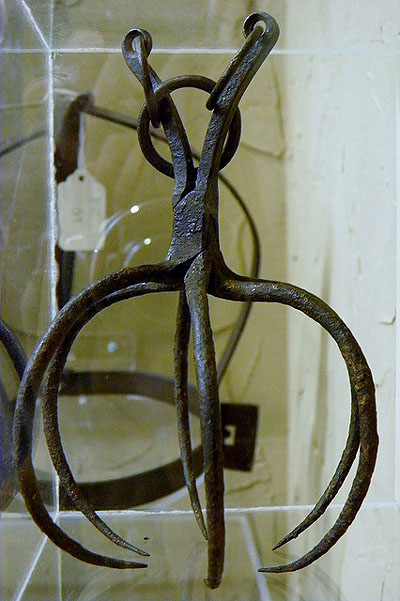
Witch's Spider
|
|
|
| |
|
Spanish Ticklers
|
|
|
| |
|
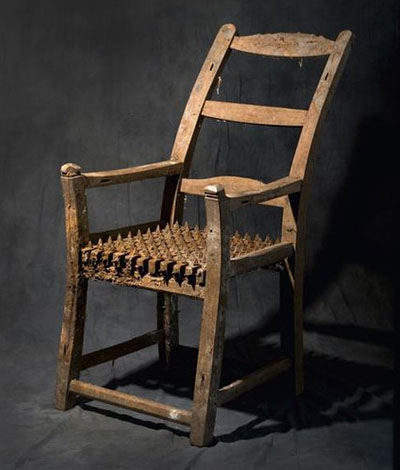
Torture Chair, Prague Castle, Czech Republic
|
|
|
| |
|
Torture Chair, sometimes called a witches'
chair
|
|
|
| |
|
The strapado was the favourite method
of tortureadopted by the Inquisition
|
|
|
| |
|
A third of Nazis were Protestant. The
other two thirds were Catholic, so it is no surprise that
traditional Catholic torture methods were readily adopted
by the Nazis.
|
|
|
| |
|
Iron shoe. A screw mechanism allows the
torturer to crush the victims foot. The bell is presumably
fitted for entertainment purposes. Museum of Tortures,
Peter and Paul Fortress, St. Petersburg, Russia
|
|
|
| |
|
One of several varieties of Spanish Boot
|
|
|
| |
|
The British Library, ms. Roy.10.E.IV
f.187.
|
|
|
| |
|
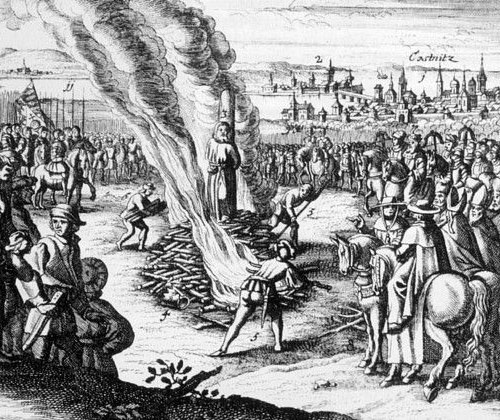
The execusion of Jan Hus, condemned to
be burned as a heretic by the Council of Constance, 1415,
after having been promised safe conduct.
|
|
|
| |
|
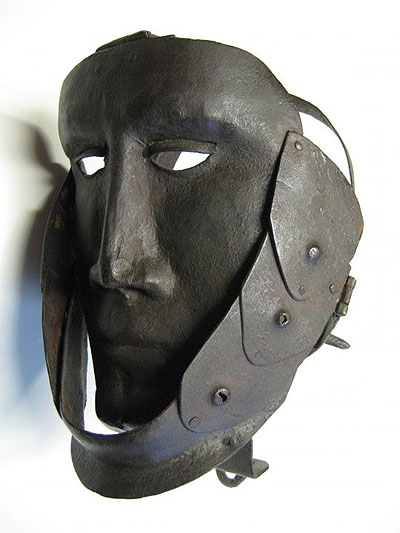
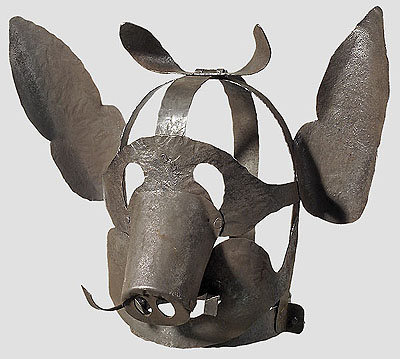
Mask of Shame. Wrought Iron. German.
Circa 1650
Irom masks were used for many purposes: to disguise executioners,
to conceal the identity of prisoners, to humiliate and
to torture.
|
|
|
| |
|
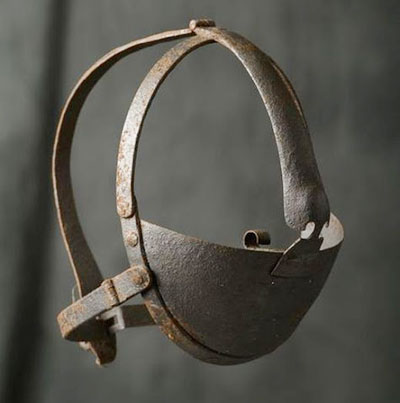
This is a Branks. Bystanders could attach
various items to the hooks provided for that purpose.
|
|
|
| |
|
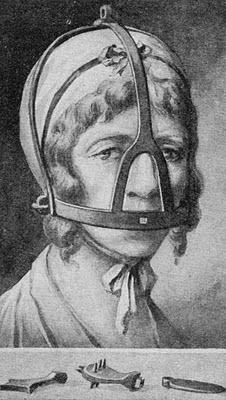
The Scold's Bridle. In the foreground
are various imouth-pieces that can be fitted to restrict
speach and cause acute pain.
|
|
|
| |
|
Torture mask, popular for slaves owned
by Christians.
Note the piece that projects into the mouth, depressing
the victim's tongue.
|
|
|
| |
|
Shame mask. Pig's snouts and donkey's
ears were both common features of shame masks.
|
|
|
| |
| |
|
Shame mask with lolling tongue
|
|
|
| |
|
17th -18th century iron executioner's
mask, Tower of London exhibit.
|
|
|
| |
| |
|
The Iron Maiden was a late arrival -
possibly based on the earlier coffin torture which was
similar, but lacked the spikes. The first reference to
an execution with the Maiden that has yet come to light
stems from 1515, although the instrument had been in use
for several decades by then. According to Wolfgang Schild,
Die Eiserne Jungfrau, 2002 on 14 August, 1515 a
forger of coins was placed inside an Iron Maiden, and
the doors shut “slowly, so that the very sharp points
penetrated his arms, and his legs in several places, and
his belly and chest, and his bladder and the root of his
member, and his eyes, and his shoulders, and his buttocks,
but not enough to kill him; and so he remained making
great cry and lament for two days, after which he died”
|
|
|
| |
|
Virgin of Nuremberg
|
|
|
| |
| |
|
|
| |
| |
|
|
| |
| |
|
|
| |
| |
|
|
| |
| |
|
|
| |
| |
|
|
| |
| |
|
|
| |
| |
|
|
| |
| |
|
|
| |
| |
|
|
| |
| |
|
|
|
|
| |
|
|
| |
| |
|
|
| |
| |
|
|
|
|
| |
|
|
| |
|
Tongue Tearer - Used to remove the tongues
of blasphemers and others who made observations that the
Church did not approve of.
|
|
|
| |
| |
| |
More social issues:
|
|
|
|
|
|
|
|
|
|
|
|
|
|
|
|
|
|
|
|
|
|
|
|
|
|
|
|
|
|
|
|
|
|
|
|
|
|
Buy the Book from Amazon.com
|
|
|
|
|
|
Buy the Book from Amazon.co.uk
|
|
|
| |
| |
| More Books |
|
|
|