| |
|
|
They that approve a private opinion,
call it opinion; but they that mislike it, heresy: and
yet heresy signifies no more than private opinion.
|
|
Thomas Hobbes, Leviathan
|
In the first century there was no heresy for the simple reason
that there was no orthodoxy. The "heresies" referred
to in old translations of the New Testament are merely differences
of opinion*. Small Christian
communities believed what they wanted to and worshipped as they
chose. As we have seen, there were no central authorities, no
set rituals, no agreed canon of scripture, no Church hierarchy
and no established body of doctrine. In line with the toleration
practised throughout the Empire, each group of Christians was
free to believe whatever it wanted. The natural consequence
of this state of affairs was that ideas and practices in different
communities diverged.
Towards the end of the second century Irenaeus,
Bishop of Lyons, saw the dangers of numerous opinions developing.
He attempted to establish an orthodox body of teaching. He wrote
a five-volume work against heresies, and it was he who compiled
a canon of the New Testament. He also claimed that there was
only one proper Church, outside of which there could be no salvation.
Other Christians were heretics and should be expelled, and if
possible destroyed. The first Christian Emperor agreed. Gibbon
summarises the edict that announced the destruction of various
heretics:
After a preamble filled with passion and reproach, Constantine
absolutely prohibits the assemblies of the heretics and confiscates
their public property to the use either of the revenue or
of the catholic church. The sects against whom the Imperial
severity was directed appear to have been the adherents of
Paul of Samosata; the Montanists of Phrygia, who maintained
an enthusiastic succession of prophecy; the Novatians, who
sternly rejected the temporal efficacy of repentance; the
Marcionites and Valentinians, under whose leading banners
the various Gnostics of Asia and Egypt had insensibly rallied;
and perhaps the Manichæans who had recently imported
from Persia a more artful composition of oriental and Christian
theology.
The design of extirpating the name, or at least of restraining
the progress, of these odious heretics was prosecuted with
vigour and effect. Some of the penal regulations were copied
from the edicts of Diocletian; and this method of conversion
was applauded by the same bishops who had felt the hand of
oppression and had pleaded for the rights of humanity*.
Further laws against heresy appeared in 380 under the Christian
Emperor Theodosius I, who laid down the new rule:
We command that those persons who follow this rule shall
embrace the name of Catholic Christians. The rest, however,
whom we adjudge demented and insane, shall sustain the infamy
of heretical dogmas, their meeting places shall not receive
the name of churches, and they shall be smitten first by divine
vengeance and secondly by the retribution of our own initiative,
which we shall assume in accordance with divine judgement*.
St Augustine taught that error has no rights. He cited biblical
texts to justify the use of compulsion, notably Luke 14:16-23
(especially Luke 14:23). Had not Christ himself blinded St Paul
in order to make him see the true light? According to Augustine,
coercion using "great violence" was justified. He
made a distinction between unbelievers, who persecuted because
of cruelty, and Christians, who persecuted because of love.
A war to preserve or restore the unity of the Church was a just
war, a bellum Deo auctore, a war waged by God himself.
  He
also found a way to avoid churchmen getting blood on their hands:
dissension against the Church amounted to dissension against
the State, so anyone condemned by the Church should be punished
by the State. Centuries in the future such ideas would culminate
in the activities of the Inquisition, which also required the
secular authority to execute its judgements of blood. Augustine
is often recognised explicitly as the father of the Inquisition,
since he was responsible for adopting Roman methods of torture
for the purposes of the Church in order to ensure uniformity.
Already, in 385, the first recorded executions for heresy had
been carried out under Emperor Maximus at the request of Spanish
bishops. Priscillian, Bishop of Ávila, had been charged
with witchcraft, although his real crime seems to have been
agreeing with Gnostic opinions. Along with his companions he
was tried and tortured. They confessed and were executed. The
Church now had precedents for both witch-hunting and for persecuting
heretics , with a moral unpinning provided by St Augustine. He
also found a way to avoid churchmen getting blood on their hands:
dissension against the Church amounted to dissension against
the State, so anyone condemned by the Church should be punished
by the State. Centuries in the future such ideas would culminate
in the activities of the Inquisition, which also required the
secular authority to execute its judgements of blood. Augustine
is often recognised explicitly as the father of the Inquisition,
since he was responsible for adopting Roman methods of torture
for the purposes of the Church in order to ensure uniformity.
Already, in 385, the first recorded executions for heresy had
been carried out under Emperor Maximus at the request of Spanish
bishops. Priscillian, Bishop of Ávila, had been charged
with witchcraft, although his real crime seems to have been
agreeing with Gnostic opinions. Along with his companions he
was tried and tortured. They confessed and were executed. The
Church now had precedents for both witch-hunting and for persecuting
heretics , with a moral unpinning provided by St Augustine.
In theory heresy was the denial of some essential Christian
doctrine, publicly and obstinately*.
In practice any deviation from the currently orthodox line could
be judged heretical. By the fifth century there were over 100
active statutes in the Empire concerning heresy. From St Augustine
onward, for well over 1,000 years, virtually all Christian theologians
agreed that heretics should be persecuted, and most agreed that
they should be killed. Heresy was explicitly identified as akin
to leprosy. It was a disease that threatened to destroy a healthy
body of believers if they strayed from the Church's view of
religious orthodoxy, just as leprosy was a disease that threatened
the healthy bodies of individuals if they strayed from the Church's
view of sexual orthodoxy. Diseases like this had to be eradicated
at all costs. St Thomas Aquinas thought it virtuous to burn
heretics and favoured the option of burning them alive. From
around the turn of the millennium, executing heretics became
ever more common, and the grounds for doing so became ever more
absurd. A group of Christians at Goslar in Germany who declined
to kill chickens were executed for heresy in 1051.
A long series of popes supported the extirpation of those who
disagreed with the current papal line. Arnold of Brescia, a
pupil of Abélard, shared his master's critical views
of the Church, and also embraced the republican ideals of ancient
Rome. He held that papal authority was a usurpation and that
the wealth and power of the Church was unchristian. He led a
movement to re-establish a Roman republic and return the clergy
to apostolic poverty. He was hanged and then burned as a heretic
in 1155 by Pope Adrian IV.
Waldensians, Vaudois
 The
Waldensians, or Vaudois, followers of Peter Waldo of Lyon, provided
the next major target. They gave their money to the poor and
preached the Christian gospel. Waldo attracted the hatred of
the clergy when he commissioned a translation of the Bible into
Occitan, the language of what is now southern France. The Waldensians
started off as perfectly orthodox Roman Catholics, but after
reading the bible their heresies mushroomed. They denied the
temporal authority of priests and objected to papal corruption.
They rejected numerous accretions, including the Mass, prayers
for the dead, indulgences, confessions, penance, church music,
the reciting of prayers in Latin, the adoration of saints, the
adoration of the sacrament, killing, and the swearing of oaths.
They also allowed women to preach. They were excommunicated
as heretics in 1184 at the Council of Verona, and persecuted
with zeal for centuries. The
Waldensians, or Vaudois, followers of Peter Waldo of Lyon, provided
the next major target. They gave their money to the poor and
preached the Christian gospel. Waldo attracted the hatred of
the clergy when he commissioned a translation of the Bible into
Occitan, the language of what is now southern France. The Waldensians
started off as perfectly orthodox Roman Catholics, but after
reading the bible their heresies mushroomed. They denied the
temporal authority of priests and objected to papal corruption.
They rejected numerous accretions, including the Mass, prayers
for the dead, indulgences, confessions, penance, church music,
the reciting of prayers in Latin, the adoration of saints, the
adoration of the sacrament, killing, and the swearing of oaths.
They also allowed women to preach. They were excommunicated
as heretics in 1184 at the Council of Verona, and persecuted
with zeal for centuries.
Tthey were formally declared schismatics
by Pope Lucius III in 1184 at the Synod of Verona, In 1211,
more than 80 Waldensians were burned as heretics at Strasbourg.
They were declared to be heretics during the Fourth Lateran
Council in 1215. The Council stated that their principal error
was "contempt for ecclesiastical power", but they
were also accused of teaching "innumerable errors"
which the council did not specify. Any deviation from Catholic
teaching was an "error", and priovided sufficient
grounds to incur the death penalty. Persecutions were soon stepped
up.
|
Mass Burning of the Waldensians in Toulouse
in the 13th century,
by an anonymous 17th Century engraver
|
|
|
 In
a single day in 1393, 150 Waldensians were burned at Grenoble.
Survivors fled to remote valleys in the Alps. In
a single day in 1393, 150 Waldensians were burned at Grenoble.
Survivors fled to remote valleys in the Alps.
As usual, the Catholic propaganda machine swung into action
to prove the satanic nature of the Church's enemies. Waldensians
were accused of various enormities identical to those supposedly
committed by Cathars and witches. All of them worshipped black
cats. They milked the handles of brooms into buckets. They used
the brooms to fly - churchmen drew pictures of them doing it
(see right)
In 1487 Pope Innocent VIII issued a bull for the extermination
of the Vaudois. In response, Alberto de' Capitanei, archdeacon
of Cremona, organized a crusade and launched offensives in the
provinces of Dauphine and Piedmont. The areas were devasted
and survivers fled to Provence and to southern Italy. On 1 January
1545 King Francis I of France issued an order called the "Arrêt
de Mérindol". He assembled an army against the Waldensians
of Provence, which carried out another series of massacres.
Deaths in the Massacre of Mérindol ranged from hundreds
to thousands, depending on the estimates, and several villages
were devastated
|
Persecution of Waldensians in Piedmont
Men, women and children were hanged, drowned, forced over
precipices, stabbed or clubbed to death
|
|
|
 In
January 1655 the Duke of Savoy commanded the Waldensians to
attend Mass or remove themselves to the upper valleys, giving
them twenty days to sell their houses and lands. The order,
in the middle of winter, was intended to force the Waldensians
to attend mass, but ; most of them chose to take to the remote
upper valleys, Old men, women, little children and the sick
"waded through the icy waters, climbed the frozen peaks,
and at length reached the homes of their impoverished brethren
of the upper Valleys, where they were warmly received."
By mid-April, the Duke, having failed in his objective tried
another approach. He sent troops into the upper valleys and
required that the locals to quarter them in their homes, On
24 April 1655, at 4 a.m., the signal was given for a general
massacre. Catholic forces are reported to have unleashed a campaign
of looting, rape, torture, and murder. According to a report
by a Peter Liegé: In
January 1655 the Duke of Savoy commanded the Waldensians to
attend Mass or remove themselves to the upper valleys, giving
them twenty days to sell their houses and lands. The order,
in the middle of winter, was intended to force the Waldensians
to attend mass, but ; most of them chose to take to the remote
upper valleys, Old men, women, little children and the sick
"waded through the icy waters, climbed the frozen peaks,
and at length reached the homes of their impoverished brethren
of the upper Valleys, where they were warmly received."
By mid-April, the Duke, having failed in his objective tried
another approach. He sent troops into the upper valleys and
required that the locals to quarter them in their homes, On
24 April 1655, at 4 a.m., the signal was given for a general
massacre. Catholic forces are reported to have unleashed a campaign
of looting, rape, torture, and murder. According to a report
by a Peter Liegé:
"Little children were torn from the arms of their mothers,
clasped by their tiny feet, and their heads dashed against
the rocks; or were held between two soldiers and their quivering
limbs torn up by main force. Their mangled bodies were then
thrown on the highways or fields, to be devoured by beasts.
The sick and the aged were burned alive in their dwellings.
Some had their hands and arms and legs lopped off, and fire
applied to the severed parts to staunch the bleeding and prolong
their suffering. Some were flayed alive, some were roasted
alive, some disemboweled; or tied to trees in their own orchards,
and their hearts cut out. Some were horribly mutilated, and
of others the brains were boiled and eaten by these cannibals.
Some were fastened down into the furrows of their own fields,
and ploughed into the soil as men plough manure into it. Others
were buried alive. Fathers were marched to death with the
heads of their sons suspended round their necks. Parents were
compelled to look on while their children were first outraged
[raped], then massacred, before being themselves permitted
to die."
Some 1,700 Waldensians were slaughtered. This well documented
attrocity became known as the Piedmont Easter. It aroused indignation
throughout Europe (and prompted John Milton to write a poem
"On the Late Massacre in Piedmont"). Protestant rulers
offered sanctuary to surviving Waldensians. Oliver Cromwell
threatened to send military forces to their rescue. Councillors
of the city of Amsterdam chartered ships to take 167 Waldensians
to their colony in the New World (Delaware) on Christmas Day
1656. A few who stayed behind in Piedmont formed a guerilla
resistance movement..
|
The Murder of the children of Waldensians.
Detail from Samuel Moreland's "History of the Evangelical
Churches of the Valleys of Piedmont" published in
London in 1658.
|
|
|
|
In Piedmont in the middle of the seventeenth century,
further attempts were made to extirpate them. Anyone in
Villaro who declined to go to a Roman Catholic Mass was
liable to be crucified upside down, but there was some
variation in the manner of killing in other towns. Some
were maimed and left to die of starvation, some had strips
of flesh cut off their bodies until they bled to death,
some were stoned, some impaled alive upon stakes or hooks.
Daniel Rambaut had his toes and fingers cut off in sections:
one joint being amputated each day in an attempt to make
him recant and accept the Roman faith. Some had their
mouths stuffed with gunpowder, which was then ignited.
Paolo Garnier of Roras was castrated, then skinned alive.
Children were killed in various ways before the eyes of
their parents. Those few who escaped to the mountains
were mostly killed by exposure, starvation or disease*.
In France, in 1685 Louis XIV revoked the 1598 Edict of
Nantes, and more massacres followed, with many more thousands
losing their lives for the crime of disagreeing with Catholic
doctrine.
|
|
|
This image is found on page 345
of Samuel Moreland's "History of the Evangelical
Churches of the Valleys of Piedmont" published
in London in 1658. It is one of a number of prints
illustrating the massacre of the Waldenses in Provence
in 1655. The woman being tortured to death here
is Anna, daughter of Giovanni Charboniere of La
Torre.
|
 |
|
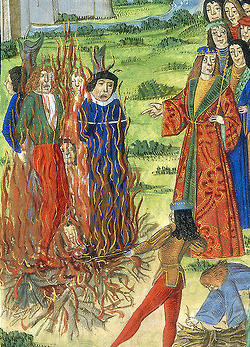
Heretics burned at the stake, British
Library, Royal 20 E III f.177v, 1487
|
|
|
The Ever-expanding concept of Heresy
 The
term heresy covered ever more and more areas of belief. Paschal
II, who occupied the papal throne between 1099 and 1118, claimed
(quoting a forged document) that anyone who disagreed with the
apostolic see was a heretic. In 1199, Pope Innocent III declared
heresy to be high treason against God, having already called
for the execution of those who persisted in their heresies after
being excommunicated. He also said that those who interpret
literally Jesus" statements about limiting their statements
to a straight Yes or No were heretics worthy of death —
confirming that those who refused to swear in court should be
executed. In 1229 Pope Gregory IX declared that it is the duty
of every Roman Catholic to persecute heretics. He preached a
crusade against the Stedingers, a Germanic people living near
the River Weser, whose heresy amounted to no more than rejecting
the temporal authority of the Archbishop of Bremen. An army
of 40,000 was raised under the bishops of Ratzebourg, Lubeck,
Osnabrück, Münster and Minden. Of the 11,000 or so
Stedingers able to bear arms, most were slaughtered on the field
of battle. The rest were killed later, many of them being drowned
in the Weser along with women, children and old men. The
term heresy covered ever more and more areas of belief. Paschal
II, who occupied the papal throne between 1099 and 1118, claimed
(quoting a forged document) that anyone who disagreed with the
apostolic see was a heretic. In 1199, Pope Innocent III declared
heresy to be high treason against God, having already called
for the execution of those who persisted in their heresies after
being excommunicated. He also said that those who interpret
literally Jesus" statements about limiting their statements
to a straight Yes or No were heretics worthy of death —
confirming that those who refused to swear in court should be
executed. In 1229 Pope Gregory IX declared that it is the duty
of every Roman Catholic to persecute heretics. He preached a
crusade against the Stedingers, a Germanic people living near
the River Weser, whose heresy amounted to no more than rejecting
the temporal authority of the Archbishop of Bremen. An army
of 40,000 was raised under the bishops of Ratzebourg, Lubeck,
Osnabrück, Münster and Minden. Of the 11,000 or so
Stedingers able to bear arms, most were slaughtered on the field
of battle. The rest were killed later, many of them being drowned
in the Weser along with women, children and old men.
 Following
the apostolic commands of Pope Innocent IV, the Archbishop of
Narbonne consigned 200 heretics to the flames in 1243. All manner
of activities constituted heresy. It was heretical to eat meat
on Friday, to read the Bible, to know Greek, to criticise a
cleric, to refuse to pay Church taxes, or to deny that money
lending was sinful. St Augustine's idea that error has no rights
became a favourite of persecutors, and the great saint was often
cited as authority for oppression of all sorts. Under Pope John
XXII and later fourteenth century popes, Franciscan spirituals
were burned at the stake for such behaviour as claiming that
Christ and the apostles had not owned property, preaching absolute
poverty, wearing traditional hoods and habits and refusing to
lay up stores of food. The Apostolicals, a sect founded in 1300,
tried to live like the apostles. The luckier ones were burned
at the stake like the sect's founder, but others suffered worse
fates. Dulcino of Novara, the successor to the founder, was
publicly torn to pieces with hooks, as was his wife. Following
the apostolic commands of Pope Innocent IV, the Archbishop of
Narbonne consigned 200 heretics to the flames in 1243. All manner
of activities constituted heresy. It was heretical to eat meat
on Friday, to read the Bible, to know Greek, to criticise a
cleric, to refuse to pay Church taxes, or to deny that money
lending was sinful. St Augustine's idea that error has no rights
became a favourite of persecutors, and the great saint was often
cited as authority for oppression of all sorts. Under Pope John
XXII and later fourteenth century popes, Franciscan spirituals
were burned at the stake for such behaviour as claiming that
Christ and the apostles had not owned property, preaching absolute
poverty, wearing traditional hoods and habits and refusing to
lay up stores of food. The Apostolicals, a sect founded in 1300,
tried to live like the apostles. The luckier ones were burned
at the stake like the sect's founder, but others suffered worse
fates. Dulcino of Novara, the successor to the founder, was
publicly torn to pieces with hooks, as was his wife.
The Knights Templar were accused of heresy in the early fourteenth
century. The charges are generally acknowledged to have been
trumped up by King Philip of France and inspired by his desire
to seize their wealth. A Church Council was summoned to consider
the question, but despite extensive torture, there was not enough
evidence to proceed against the Templars, let alone to condemn
them. When King Philip turned up with an army, Pope Clement
V, a puppet of the French monarchy, forced the unwilling council
to reconsider, and the Order was dissolved*.
Clement had already permitted individual Templars throughout
Western Christendom to be tortured and burned as heretics to
appease the king. Under torture they had confirmed that they
rendered feudal homage to the Devil. This idea was largely responsible
for the belief that there existed organised groups of people
who worshipped Satan, much as Christians worshipped God —
and this belief was in turn largely responsible for making witches
into malignant agents of the Devil.
|
Churchmen exhuming John Wycliffe, and
burning his bones.
John Wycliffe (c. 1320 – 1384) was an English Scholastic
philosopher, theologian, lay preacher, reformer and university
teacher at Oxford University. On 4 May 1415, thirty years
after his death, the Council of Constance declared Wycliffe
a heretic and under the ban of the Church. It was decreed
that his books be burned and his remains be exhumed. The
exhumation was carried out in 1428 when, at the command
of Pope Martin V, his remains were dug up, burned, and
the ashes cast into the River Swift.
|
|
|
 Cecco
d"Ascoli, an Italian scientist, was burned at the stake
in 1327 for having calculated the date of Jesus" birth
using the stars. But there were more significant heresies than
astrology. Movements to reform the Church, based on the teachings
of John Wycliffe (England), Jan Hus (Bohemia) and Gerard Groot
(Netherlands) were all condemned as heretical, although their
popularity guaranteed their survival. In time these teachings
would trigger the Reformation. Heresy still covered everything
from refusing to take oaths to refusal to pay church tithes.
Any deviation from Church norms was enough to merit death: vegetarianism,
the rejection of infant baptism, even holding the (previously
orthodox) view that people should be given both bread and wine
at Mass. Cecco
d"Ascoli, an Italian scientist, was burned at the stake
in 1327 for having calculated the date of Jesus" birth
using the stars. But there were more significant heresies than
astrology. Movements to reform the Church, based on the teachings
of John Wycliffe (England), Jan Hus (Bohemia) and Gerard Groot
(Netherlands) were all condemned as heretical, although their
popularity guaranteed their survival. In time these teachings
would trigger the Reformation. Heresy still covered everything
from refusing to take oaths to refusal to pay church tithes.
Any deviation from Church norms was enough to merit death: vegetarianism,
the rejection of infant baptism, even holding the (previously
orthodox) view that people should be given both bread and wine
at Mass.
|
The condemnation of Jan Hus took place
on 6 July 1415, in the presence of the assembly of the
Council of Constance in the Cathedral. After the High
Mass and Liturgy, Hus was led into the church. The Bishop
of Lodi delivered an oration on the duty of eradicating
heresy; then some theses of Hus and Wycliffe and a report
of Hus's trial were read. Executioners undressed Hus and
tied his hands behind his back with ropes, and bound his
neck with a chain to a stake. Wood and straw were piled
up so that they covered him to the neck. He was then burned
at the stake, and his ashes thrown into the Rhine River.
He is shown here wearing a heretics cap.
|
|
|
In 1482, under Pope Sixtus IV, 2,000 heretics were burned in
the tiny state of Andalusia alone. Pope Leo X condemned Martin
Luther in 1520 for daring to say that burning heretics was against
the will of God. Evidently he thought it presumptuous for an
ordinary human being to claim to know God's will. Perhaps he
was right, because Luther changed his mind in 1531 and started
advocating the death penalty for heretics and blasphemers. He
thought it should be a capital offence to deny the resurrection
of the dead or the reality of Heaven and Hell.
Translating the Bible into vernacular languages, or helping
with the printing of such versions of the Bible, was heresy
according to the Roman Church. Generally, in Europe, women were
buried alive for this offence. Men were burned alive. One printer
in Paris was burned on a pyre of his own books. In the sixteenth
century William Tyndale translated the Bible into English. In
danger of arrest and in fear for his life he fled the country.
He was arrested in the Netherlands, and in 1536 was executed
for heresy for agreeing with the Lutheran doctrine of justification
by faith.
|
Copper engraving by Jan
Luyken from the 1685 edition of the Martyrs' Mirror.
This woman is about to be burned alive in Amsterdam in
1571 for the crime of believing in adult baptism.
Tied to a ladder, she will be tipped face first into a
fire.
|
|
|
Anabaptists, the precursors of modern Baptists, were persecuted
by Roman Catholics, Lutherans and Calvinists alike. The Anabaptists"
main crimes were to call for social reform, to favour adult
baptism over infant baptism, and to embrace pacifism —
they would not kill, condone capital punishment or serve in
armies. They also allegedly advocated ancient Antinomian views*.Their
leaders died in various ways. Thomas Münzer was burned
at the stake in 1525. Feliz Manz drowned in 1526 (drowning was
a favourite way of executing Anabaptists because of their views
on baptism). Michael Sattler had his tongue cut out, was mutilated
by red-hot pincers, and was burned alive in 1527 for a range
of beliefs, none of which would now merit a criminal prosecution.
When a whole town, Münster, went over to the Anabaptists
in the 1530s, Roman Catholics and Protestants joined forces
to retake the city. The Anabaptist leaders were publicly tortured
to death with red-hot pincers and their bodies put on public
display outside a church.
|
In January 1536, the Anabaptist leaders,
John of Leiden, Bernhard Knipperdolling and Bernhard Krechting,
were tortured and executed in the marketplace of Münster.
Their bodies were exhibited in three cages, which hung
from the steeple of St. Lambert's Church. Their bones
were later removed , but the cages still hang there.
|
 |
The range of offences that were considered heretical was flexible
and ever-expanding. It was still a crime to read the Bible or
cite inappropriate passages from it. A Protestant writing master
from Toledo was burned at the stake in 1676 for having decorated
a room with the full text of the Ten Commandments. (The Roman
Church has traditionally omitted the first part of the second
commandment — the one that forbids the worship of images.)
 In
England the persecution of heretics was less popular than elsewhere
in Europe, but not unknown. A group of refugees, probably Cathars,
who denied the necessity for baptism, matrimony and the Mass,
fled from the continent to England under Henry II to escape
persecution. In 1166, at Oxford, they were tried by an ecclesiastical
court with the King himself presiding, and were found guilty
of heresy. Since no statute or precedent existed for sentencing,
they were seared on the forehead with hot irons, whipped through
the streets, stripped to the waist, and sent into the countryside
to die of exposure in the winter snow. No one would offer them
food or shelter. To have done so would have been to disobey
the word of God (2 John 10) and to abet heresy, and would therefore
have been sinful and unchristian. In
England the persecution of heretics was less popular than elsewhere
in Europe, but not unknown. A group of refugees, probably Cathars,
who denied the necessity for baptism, matrimony and the Mass,
fled from the continent to England under Henry II to escape
persecution. In 1166, at Oxford, they were tried by an ecclesiastical
court with the King himself presiding, and were found guilty
of heresy. Since no statute or precedent existed for sentencing,
they were seared on the forehead with hot irons, whipped through
the streets, stripped to the waist, and sent into the countryside
to die of exposure in the winter snow. No one would offer them
food or shelter. To have done so would have been to disobey
the word of God (2 John 10) and to abet heresy, and would therefore
have been sinful and unchristian.
John Wycliffe, the proto-Protestant rector of Lutterworth in
Leicester, was the most eminent scholar at Oxford, giving him
a measure of protection during his lifetime, especially since
there was then still no official statute in England covering
the offence of heresy. On the other side of Europe, Jan Hus,
the Rector of Prague University, was heavily influenced by Wycliffe's
ideas, and refused to surrender his books when ordered to do
so by the Pope. Supported by King Wenceslas he denounced the
practice of granting indulgences. His preaching spread Wycliffe's
ideas far and wide. Then, travelling under a safe conduct from
the emperor Sigismund, he was arrested and tried by the Church
Council of Constance. The council disregarded his safe conduct
on the grounds that a Church Council did not need to keep faith
with a heretic. Hus was burned on 6 th July 1415, making him
a Czech national hero. Hussite ideas spread rapidly from Bohemia
to Austria, Silesia, Saxony, Brandenburg, Bavaria and Hungary.
Attempts at reconciliation with the Roman Church failed, and
the Reformation loomed another step closer.
Back in England the Church had no way to deal with Wycliffe
or his followers, who were called Lollards. The Archbishop of
Canterbury, William Courtney, and his bishops filled in the
omission by forging an Act of Parliament to deal with heresy.
But Parliament spotted the imposture and the House of Commons
petitioned the King in 1383 to annul this bogus statute "never
assented to nor granted by the Commons"*.
Genuine mild statutes were passed three years later, but the
Church was still not happy. Prelates insisted on the death penalty,
and a series of statutes, called de haeretico comburendo,
were passed in 1401, under King Henry IV, introducing the death
penalty for heresy. They failed to define the offence, so heresy
would continue to be whatever the Church said it was. Once convicted,
the heretic was handed over to the sheriff, who had no option
but to execute the Church's judgement. Unrepentant heretics
were to be publicly burned to death, as they were on the continent.
The statutes came too late to catch John Wycliffe himself, but
they caught many of his followers.
King Henry IV had introduced the death penalty not only for
heresy but also for possession of a bible. Now it was a capital
crime to disagree with the Church, or read its holy scriptures,
and bishops made it clear they would enforce the new law.
 William
Sawtrey, a Norfolk curate and a Lollard, preached in London
and attracted the attention of Archbishop Thomas Arundel. Sawtrey
was summoned to appear before a convocation at St. Paul's. Following
his trial Sawtrey was condemned as a heretic and was burned
in chains at Smithfield in 1401. William
Sawtrey, a Norfolk curate and a Lollard, preached in London
and attracted the attention of Archbishop Thomas Arundel. Sawtrey
was summoned to appear before a convocation at St. Paul's. Following
his trial Sawtrey was condemned as a heretic and was burned
in chains at Smithfield in 1401.
Lollards continued to be condemned to the stake up until the
1530s. Others were caught too. Around 1520 the diocese of Lincoln
alone was convicting over 100 people a year for the crime of
"not thinking catholickly"*.
Ever careful with its money, the Church offered 40 days reduction
of one's time in Purgatory for every faggot of sticks contributed
for the stake. Responsible parents encoraged their children
to collect as much kindling as possible, making parents and
children alike complicit in burning people alive for their thought
crimes.
The families of heretics were often treated as heretics too,
including children and even new-born babies. In one infamous
case Katherine Cawches and her two daughters were burned alive
on the Isle of Guernsey on 18 July 1556. One of the daughters,
Perotine Massey, was pregnant. In pagan times pregnant women
could not be executed, but Catholics in the sixteenth century
had no qualms about killing the unborn. A jury aquitted the
women of the crime they were charged with, but a Catholic Dean
and four Rectors in an Ecclesiastical court found them guilty
of heresy (for not attending church). All three were condemned
to be burned at the stake. Witnesses reported that Perotine
gave birth as she burned. The newborn baby boy was rescued by
a bystander but then cast back into the flames. As the dead
mother's uncle later complained in one of the surviving records
of the incident "the baby born of one of them being taken
up and cast into the fire again, four being executed, though
only three had been condemned."*
|
The Burning of Katherine Cawches And
Her Two Daughters On the Isle of Guernsey on 18 July 1556.
This is a coloured woodcut from Foxe's Book of Martyr's
- based on eye-witness and official reports and showing
the newborn baby in the flames.
|
|
|
Espousing unorthodox views, however trivial, could result in
death. In 1528 Patrick Hamilton was burned at St Andrews for
holding heretical opinions, notably a denial of the freedom
of the will. In 1546 Anne Askew was burned at Smithfield because
of her beliefs about the Eucharist. In 1592 Henry Barrow and
John Greenwood, who preached congregationalism*,
were hanged at Tyburn for "obstinately refusing to come
to church". Unitarians were executed in 1612 in London
and Lichfield, and one in 1651 in Dumfries. William Prynne,
a Puritan lawyer, published criticisms of Archbishop Laud. For
this he had his ears hacked off by the public hangman in 1633.
Along with others he was charged again and tried by the Star
Chamber in 1637. The others charged had their ears cropped,
and as it was discovered that Prynne still had stumps left on
the side of his head, these were severed too. He was also branded
on the cheeks, and then imprisoned for life along with the others.
After Thomas Hobbes (1588-1679) published his book Leviathan
in 1651 , the English bishops wanted to have him killed. They
used their influence in the House of Lords to sponsor a motion
to have him burned as a heretic soon after the Restoration*.
The philosopher feared for his life when, in October 1666, Parliament
talked about reviving the old statutes De haeretico comburendo
of 1401, which had fallen into disuse. But nothing came of the
bishops" fulminations, and Hobbes escaped prosecution.
Leviathan was merely condemned by Parliament, and Hobbes
was ordered to stop writing controversial books. The old statutes
were repealed the following year. From that time on, no one
in England need live in fear of burning for heresy. In Ireland
the heresy law was repealed in 1696, and in most of Continental
Europe much later. A schoolmaster was hanged in Spain in 1826
for heresy. His heresy had been to substitute the words "Praise
be to God" in place of "Ave Maria" in school
prayers.
Because of secular laws the Churches now have more difficulty
in persecuting heretics, but persecution is still part of mainstream
Christian thought. The oath taken by Roman Catholic bishops
at their consecration includes the following undertaking "with
all my power I will persecute and make war upon heretics".
|
|
|
|
|
|
|
|
|
|
|
|
|
|
|
|
|
|
|
|
|
|
|
|
|
|
|
|
|
|
|
|
|
|
|
|
|
|
Buy the Book from Amazon.com
|
|
|
|
|
|
Buy the Book from Amazon.co.uk
|
|
|
| |
| |
| More Books |
|
|
|





.jpg)