| |
|
|
whatsoever your sickness is, know
you certainly, that it is God's visitation.
|
|
Book of Common Prayer, Order for the
Visitation of the Sick
|
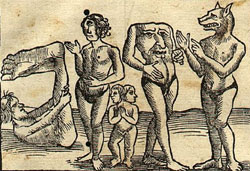  Traditional
Christian doctrine held that illness was caused by sin. This
belief was exactly in line with the gospels1
and was specifically confirmed by the Lateran Council in 1215.
So it was that for centuries the sick and dying could safely
be shunned and ignored. They must have deserved their condition,
and attempts to help them were attempts to defy God's will.
Monstrous human births were caused by the Devil having corrupted
infants' souls, even before birth. Traditional
Christian doctrine held that illness was caused by sin. This
belief was exactly in line with the gospels1
and was specifically confirmed by the Lateran Council in 1215.
So it was that for centuries the sick and dying could safely
be shunned and ignored. They must have deserved their condition,
and attempts to help them were attempts to defy God's will.
Monstrous human births were caused by the Devil having corrupted
infants' souls, even before birth.
The belief was universal in Christianity, and carried over
from Catholicism into Protestant sects at the Reformation. Here
are a few examples from Martin Luther:
A large number of deaf, crippled and blind people are afflicted
solely through the malice of the demon. And one must in no
wise doubt that plagues, fevers and every sort of evil come
from him.
and it was not only physical problems, mental problems were
also attributable to Satan.
As for the demented, I hold it certain that all beings deprived
of reason are thus afflicted only by the Devil.
and anyone who doubted demonic causes for illness were ridiculed
(and where possible tried as heretics)
Idiots, the lame, the blind, the dumb, are men in whom the
devils have established themselves: and all the physicians
who heal these infirmities, as though they proceeded from
natural causes, are ignorant blockheads....
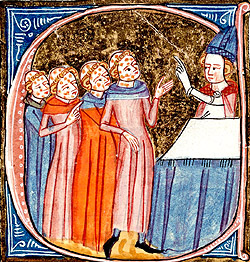 Since
disease-causing demons were God's punishment for sin, it was
clearly a pious duty to accept that punishment. To minimise
it or seek to avoid it would be further sin. This attitude led
to a form of fatalism still widespread in the East and once
common in Western Christendom too. If God wants a person to
suffer or die, it is plainly blasphemous for that person to
try to avoid their fate. Since the victims of plague were destined
to die by God's decree, the disease could not really be contagious
in any conventional sense, and there was no point in taking
precautions against catching it. Many thousands of devout Christians
thus suffered avoidable death and suffering. For example, during
the Black Death in Britain in 1665, pious Christians declined
to take precautions for the protection of their families, claiming
that they did not wish to pervert God's will. As Daniel Defoe
noted, places where this fatalistic attitude was common suffered
significantly higher mortality rates than elsewhere. Well into
the twentieth century, devout Christians relied on Psalm 91,
which they said clearly confirmed that God would protect them
from pestilence and other evils. The devout were held to be
immune from epidemics, whatever the evidence might be. To be
inoculated against disease was to doubt God's word, and therefore
plainly sinful. So it was that many of the devout, and their
trusting children, died unnecessarily in epidemics following
the advice, or the orders, of their religious leaders. Since
disease-causing demons were God's punishment for sin, it was
clearly a pious duty to accept that punishment. To minimise
it or seek to avoid it would be further sin. This attitude led
to a form of fatalism still widespread in the East and once
common in Western Christendom too. If God wants a person to
suffer or die, it is plainly blasphemous for that person to
try to avoid their fate. Since the victims of plague were destined
to die by God's decree, the disease could not really be contagious
in any conventional sense, and there was no point in taking
precautions against catching it. Many thousands of devout Christians
thus suffered avoidable death and suffering. For example, during
the Black Death in Britain in 1665, pious Christians declined
to take precautions for the protection of their families, claiming
that they did not wish to pervert God's will. As Daniel Defoe
noted, places where this fatalistic attitude was common suffered
significantly higher mortality rates than elsewhere. Well into
the twentieth century, devout Christians relied on Psalm 91,
which they said clearly confirmed that God would protect them
from pestilence and other evils. The devout were held to be
immune from epidemics, whatever the evidence might be. To be
inoculated against disease was to doubt God's word, and therefore
plainly sinful. So it was that many of the devout, and their
trusting children, died unnecessarily in epidemics following
the advice, or the orders, of their religious leaders.
Lepers were treated as God required in
the Old Testament:
He is a leprous man, he is unclean: the priest shall pronounce
him utterly unclean; his plague is in his head. And the leper
in whom the plague is, his clothes shall be rent, and his
head bare, and he shall put a covering upon his upper lip,
and shall cry, Unclean, unclean.
Leviticus 13:44-45
God had condemned lepers to a living death, so Christians behaved
accordingly. A ceremony was performed for the living dead parallel
to that for the fully dead. When someone was thought to have
contracted the disease, a neighbour would denounce the unfortunate
person to the Church. An investigation would then be undertaken
on behalf of the Church, often without medical assistance. If
leprosy was established the parish priest would perform the
"Office for the Seclusion of a Leper". He would go
to the afflicted person's house, sprinkle the person with holy
water, and offer him or her the chance to make confession for
the last time. The afflicted person was then taken to the local
Church where he or she was made to adopt a pose "in the
manner of a dead man" before the altar, beneath trestles
covered by black cloth. The idea was that the leper should resemble
a body in a coffin. During the service, lepers were informed
that their disease was God's punishment for sin, and sometimes,
paradoxically, that this was a special divine favour. According
to the ritual used at Vienna, the priest would say: "My
friend, it pleaseth Our Lord that thou shouldst be infected
with this malady, and thou hast great grace at the hands of
Our Lord that he desireth to punish thee for thy iniquities
in this world"2.
After a ceremony the leper was dragged backwards or otherwise
escorted out of the church. Earth was cast at his or her feet,
as into a new grave, while the priest said "Be thou dead
to the world, but alive again unto God". The person was
then admonished never to enter a church or other public place
again, and was banished from the community. Lepers were dead
not only spiritually and socially but also legally. They could
not inherit property. At the Council of Westminster in 1200
they were forbidden to make wills or appear in court. The Church
taught that the exterior physical body reflected the interior
soul, so anyone with such a dreadful disease must have been
excessively sinful. Leprosy was believed either to be a venereal
disease or to be caused by lustful thoughts. Either way, leprosy
was the visible sign of a soul corroded by the vitriol of sexual
sin
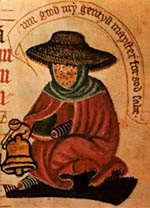 Since
lepers were by definition given to sin, and excluded from the
community of good Christians, they provided convenient scapegoats.
By marginalising them, Christendom made them into targets for
unwholesome fantasies. Like all other minority groups they were
accused of unlikely crimes. In 1321, for example, they were
accused of poisoning wells in France. Lepers in Périgueux
were rounded up and tortured until they confessed their guilt,
and were then burned at the stake. The confessions prompted
a terror similar to that more usually generated by Jews and
witches. A story grew that a huge network of lepers, funded
by the Muslims and aided by the Jews, had planned to poison
all water supplies in the land. Forged letters turned up confirming
the foul plot. King Philip V ordered the arrest of all lepers
in France. Those who failed to confess were to be tortured.
Those who did confess were to be burned alive, their goods being
forfeit to the King. No records were kept of how many lepers
died as a result3. Since
lepers were by definition given to sin, and excluded from the
community of good Christians, they provided convenient scapegoats.
By marginalising them, Christendom made them into targets for
unwholesome fantasies. Like all other minority groups they were
accused of unlikely crimes. In 1321, for example, they were
accused of poisoning wells in France. Lepers in Périgueux
were rounded up and tortured until they confessed their guilt,
and were then burned at the stake. The confessions prompted
a terror similar to that more usually generated by Jews and
witches. A story grew that a huge network of lepers, funded
by the Muslims and aided by the Jews, had planned to poison
all water supplies in the land. Forged letters turned up confirming
the foul plot. King Philip V ordered the arrest of all lepers
in France. Those who failed to confess were to be tortured.
Those who did confess were to be burned alive, their goods being
forfeit to the King. No records were kept of how many lepers
died as a result3.
|
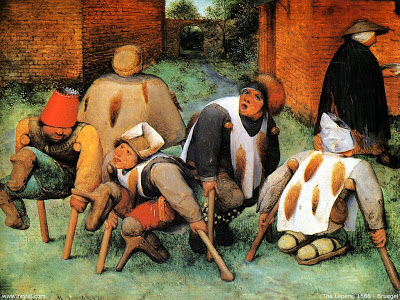
Pieter Bruegel the Elder, The Cripples
(aka The Beggars), 1568
Universal Social Services are modern secular concepts,
initially unknown to (and later opposed by) traditional
Christian Churches
|
|
|
No Christian thought to try to find a cure for leprosy. It
would be presumptuous to do that. For the holiest Christians
like the
Blessed Angela of Foligno, the nearest one could get to
being useful was to drink from the suppurating sores of a leper.
 Equating
sin with illness is now widely considered absurd, though it
is has been confirmed even by liberal denominations even in
recent times. A report of the Anglican Church from the Lambeth
Conference in 1958 confirmed the principle while shifting ground
to avoid the traditional implications, so that the blame did
not need to be pinned on any individual: "It is cruel and
false to brand every sufferer as a sinner: much suffering and
sickness is due to the sin either of other persons or of society
in general". Since then the whole subject has become an
embarrassment, except to a few sects that continue to hold to
the traditional teaching. Mainstream clergymen go to extreme
lengths to pretend that the biblical passages that confirm the
link between sin and illness do not exist, or else mean something
quite different. It is left to fringe Christians to uphold the
traditional line and use exorcism to cast out sin and so cure
diseases. Equating
sin with illness is now widely considered absurd, though it
is has been confirmed even by liberal denominations even in
recent times. A report of the Anglican Church from the Lambeth
Conference in 1958 confirmed the principle while shifting ground
to avoid the traditional implications, so that the blame did
not need to be pinned on any individual: "It is cruel and
false to brand every sufferer as a sinner: much suffering and
sickness is due to the sin either of other persons or of society
in general". Since then the whole subject has become an
embarrassment, except to a few sects that continue to hold to
the traditional teaching. Mainstream clergymen go to extreme
lengths to pretend that the biblical passages that confirm the
link between sin and illness do not exist, or else mean something
quite different. It is left to fringe Christians to uphold the
traditional line and use exorcism to cast out sin and so cure
diseases.
|
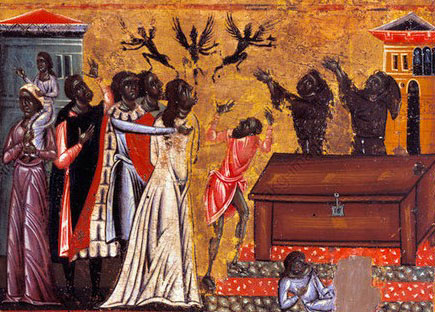
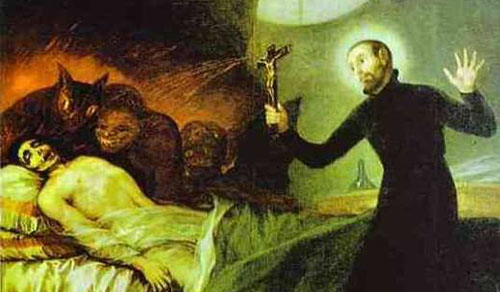
Demons used to be common and visible
Saint Francis of Assisi, An Exorcist of Demons
|
|
|
| |
|
Saint Francis Borgia performing an exorcism,
detail of a painting by Francisco Goya
|
 |
 Not
so long ago Christians accepted the views of St Augustine that
deaf mutes were debarred from the faith4.
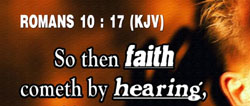
Like Augustine, they cited St Paul's assertion that "faith
cometh by hearing" (Romans 10:17). The deaf were thus incapable
of becoming Christians. For centuries they were marginalised,
rejected and persecuted by all right-thinking Christians. The
Church would not allow them to marry, nor to inherit. The deaf
were not the only ones persecuted in this way — so were
those with other disabilities, since disabilities were also
evidence of God's unfavourable judgement. As late as the 1970s
Roman Catholic priests were protesting publicly about Communion
being given to disabled children. Not
so long ago Christians accepted the views of St Augustine that
deaf mutes were debarred from the faith4.
Like Augustine, they cited St Paul's assertion that "faith
cometh by hearing" (Romans 10:17). The deaf were thus incapable
of becoming Christians. For centuries they were marginalised,
rejected and persecuted by all right-thinking Christians. The
Church would not allow them to marry, nor to inherit. The deaf
were not the only ones persecuted in this way — so were
those with other disabilities, since disabilities were also
evidence of God's unfavourable judgement. As late as the 1970s
Roman Catholic priests were protesting publicly about Communion
being given to disabled children.
 Another
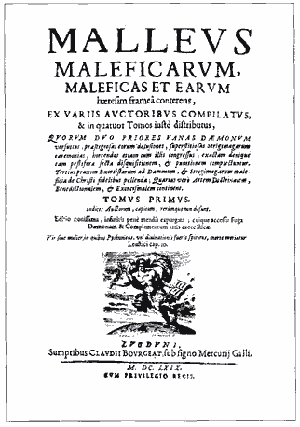
idea propounded by the Church, and explained in Malleus
Maleficarum5,
was that God allowed demons to steal children and substitute
subhuman infants, called changelings, in their place.
This was likely to happen to children before they had been baptised,
or before their mother had been churched. Such stories were
used to encourage baptism and churching, and also to explain
the existence of weak and sickly children. Sometimes children
had withered limbs, or were deaf, blind, mentally impaired or
crippled. Roman Catholics and Protestants alike imagined that
these handicapped children — these changelings — were
not human beings at all. Martin Luther, for example, advised
that they be drowned. They were he said only lumps of flesh
lacking a soul6.
He could vauch for their existence from his personal experience:
"I myself saw and touched at Dessay, a child of this sort,
which had no human parents, but had proceeded from the Devil.
He was twelve years old, and, in outward form, exactly resembled
ordinary children". The Devil often exchanged sickly imps
in place of healthy children. As Luther pointed out "The
Devil, too, sometimes steals human children; it is not infrequent
for him to carry away infants within the first six weeks after
birth, and to substitute in their place imps...". Of course,
murdering Satan's imps did not constitute murder. Luther's view
was not an isolated exception. Walter Bachmann, who made a study
of Christian attitudes to changelings, summed up the position
as follows: Another
idea propounded by the Church, and explained in Malleus
Maleficarum5,
was that God allowed demons to steal children and substitute
subhuman infants, called changelings, in their place.
This was likely to happen to children before they had been baptised,
or before their mother had been churched. Such stories were
used to encourage baptism and churching, and also to explain
the existence of weak and sickly children. Sometimes children
had withered limbs, or were deaf, blind, mentally impaired or
crippled. Roman Catholics and Protestants alike imagined that
these handicapped children — these changelings — were
not human beings at all. Martin Luther, for example, advised
that they be drowned. They were he said only lumps of flesh
lacking a soul6.
He could vauch for their existence from his personal experience:
"I myself saw and touched at Dessay, a child of this sort,
which had no human parents, but had proceeded from the Devil.
He was twelve years old, and, in outward form, exactly resembled
ordinary children". The Devil often exchanged sickly imps
in place of healthy children. As Luther pointed out "The
Devil, too, sometimes steals human children; it is not infrequent
for him to carry away infants within the first six weeks after
birth, and to substitute in their place imps...". Of course,
murdering Satan's imps did not constitute murder. Luther's view
was not an isolated exception. Walter Bachmann, who made a study
of Christian attitudes to changelings, summed up the position
as follows:
It is doubtful if the handicapped have ever, in any other
cultural domain in human history, been more wronged and despised
or treated with greater intolerance and inhumanity, than in
Christendom7.
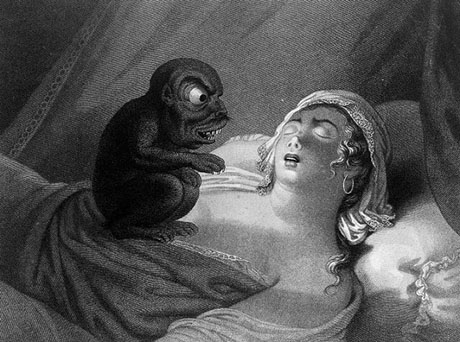
Changelings were sometimes regarded as half-breeds, the offspring
of a human woman and an elf or other supernatural being. In
other cases, unwanted children were regarded as Cambions. According
to theologians, demons would adopt female form to seduce sleeping
men and obtain their semen, then adopt male form to seduce sleeping
women, and impregnate them with their ill-gotten semen. The
offspring of such a union was a Cambion. The demon in female
form was a succubus, and in male form was an incubus.
St. Augustine in De Civitate Dei affirmed that there
were too many attacks by incubi to deny them. Saint Thomas Aquinas
also affirmed their existence, as did the Inquisitors' handbook
Malleus Maleficarum.8.
|
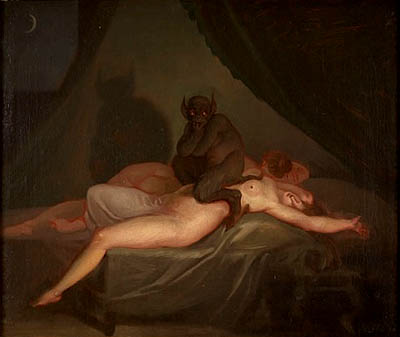
Nightmare (1800) by Nicolai Abraham
Abildgaard (1743 - 1809) .
Oil on canvas, 35.3 x 41.7 cm. Vestsjaellands Art Museum,
Denmark.
An incubus sits on a the chest of a sleeping woman, her
husband unaware, next to her.
|
|
|
| |
|
Another incubus, still familiar in the
nineteenth century.
Detail, Jean Pierre Simon, Nightmare, 1810, Welcome
Library
|
 |
Since Christian shrines healed worthy Christians of their sins
and illnesses, it followed that if no healing was forthcoming,
then the sufferer cannot be a worthy Christian. Countless incurable
children were therefore left to perish if no saint saw fit to
heal them - since by definition such children cannot have been
of value to God. Others survived by being adopted into less
religiously rigorous families. In the thirteenth century, Margaret
of Citta-Di-Castello, also known Margaret of Metola, was abandoned
by her rich Christian parents when a cure for her blindness
was not granted at a shrine. She was raised by a poor family,
even though she was blind, dwarfed, hunchbacked and lame, and
survived to become a notable visionary in the Catholic Church,
though not a saint, presumably because of her physical deformities
(which traditionally are not permitted in holy places).
The bible is clear that deformities render a person unfit to
be a Jewish priest, and the Church interpreted the relevant
passages as referring also to Christian priests:
The Lord said to Moses, “Say to Aaron: ‘For the
generations to come none of your descendants who has a defect
may come near to offer the food of his God. No man who has
any defect may come near: no man who is blind or lame, disfigured
or deformed; no man with a crippled foot or hand, or who is
a hunchback or a dwarf, or who has any eye defect, or who
has festering or running sores or damaged testicles. No descendant
of Aaron the priest who has any defect is to come near to
present the food offerings to the Lord. He has a defect; he
must not come near to offer the food of his God. He may eat
the most holy food of his God, as well as the holy food; yet
because of his defect, he must not go near the curtain or
approach the altar, and so desecrate my sanctuary. I am the
Lord, who makes them holy.’” (Leviticus 21:16-23)
So it was that any bodily deformities debar a man from becoming
a priest. Even today physically handicapped priests are rare
- and explicable by injuries sustained after ordination. God
had no use for the physically impaired. Historically, physical
handicaps were, along with servile birth and illegitimacy, bars
to ordination. Canon 1029 of the Roman code of canon law still
requires those to be ordained to have "appropriate physical
qualities".
Hubert Ahaus, "Holy Orders."
The Catholic Encyclopedia.
Vol. 11. New York: Robert Appleton Company, 1911.
|
The first requisite for lawful ordination is a Divine
vocation; by which is understood the action of God,
whereby He selects some to be His special ministers,
endowing them with the spiritual, mental, moral, and
physical qualities required
for the fitting discharge of their order and inspiring
them with a sincere desire to enter the ecclesiastical
state for God's honor and their own sanctification.
The reality of this Divine call is manifested in general
by sanctity of life, right faith, knowledge corresponding
to the proper exercise of the order to which one is
raised, absence of physical defects,
the age required by the canons ...
|
Some diseases, handicaps and injuries were sufficient to prevent
people being allowed in Christian congregations at all. For
example, genital injuries debarred men from attending church:
"No one who is emasculated or has his male organ cut off
shall enter the assembly of the LORD." (Deuteronomy 23:1).
Other examples we have already seen include Deafness being a
bar to being a Christian, and lepers who were not permitted
to enter churches after a priest has read the service for the
dead for them (on the discovery of their disease, not their
death). In all cases the justification for exclusion was biblical.
|
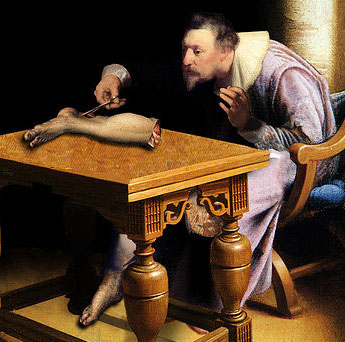
"Philip Verheyen dissecting his
amputated limb", detail, Anonymous artist, c. 1715-1730.
Philip Verheyen had been a theology
student destined for the priesthood, until his lower leg
had to be amputated in 1675, debarring him from his vocation.
(He kept his severed leg and subsequently became a famous
anatomist and surgeon)
|
|
|
Mental infirmity, like physical infirmity, was a punishment
from God. An interesting question for theologians was the degree
of mental infirmity required to render a person subhuman. This
was important because sub-humans were mere animals with no human
souls. Without a soul they were not entitled to the privileges
of humanity. They could not benefit from baptism nor from legal
privileges. Like the excommunicated and outlaws, they were non-persons.
They could not bear witness in court, make wills or bring legal
actions. They were outside of Christian society and therefore
outside the law, so it could not be an offence to defraud them,
torture them or even kill them. A vestige of this problem survives
in the word cretin, derived from the word Chrétien
meaning Christian. A cretin, though suffering from iodine
deficiency, might still have enough mental capacity to warrant
being baptised, and thus being regarded as human. Anyone with
less mental capacity than a cretin was non-human and so, like
the deaf, unworthy of baptism. For theologians they were mere
"lumps of flesh" - self sustaining giant tumours without
souls, or rights, or any place in Christian society.
Christian ideas and priorities are made clear in its surviving
buildings. Almost every ancient village in Europe has a church,
but almost none had a hospital in the modern sense of the word
before the Enlightenment. Before then hospitals were religious
institutions built to offer hospitality to travelers. Very few
provided medical care to the poor — Saint Bartholemew's
Hospital in London is notable precisely because of its uniqueness.
Surgery was prohibitted in religious hospitals because churchmen
were not permitted to shed blood. Care was therefore generally
of the type offered more recently by "Mother Theresa"
- no medical intervention, no anasthetics, just basic care and
a focus on religious conversion before death. The nearest the
Church came to hospital in the modern sense was a Lazar House
or leprosaria, a place to enforce the segregation of lepers;
or mad house, such as Bethlehem Hospital ("Bedlam"),
to enforce the segregation of the insane.
In the 18th century, the Age of Enlightenment, modern hospitals
began to appear, serving medical needs and staffed by qualified
physicians and surgeons. The goal of these hospitals was to
use modern methods to cure patients rather than save their souls.
They were founded by private individuals and secular authorities.
For the first time since classical times, a clear distinction
emerged between medicine and poor relief. Within the hospitals,
separate specialist departments were set up for different types
of patient. In England a voluntary hospital movement began in
the early 18th century, with hospitals being founded in London.
Westminster Hospital, founded in 1719, was promoted by a private
bank (Hoare & Co). Guy's Hospital, founded in 1724, was
funded from the bequest of Thomas Guy, a wealthy merchant. Other
medical hospitals were founded in British cities through the
eighteenth century, generally paid for by private subscriptions,
often by Quakers, not by other religious institutions. Soon
public dispensaries would be established too, providing medicine
to the poor, free of charge. The first true hospital in North
America was the Pennsylvania hospital, founded by Benjamin Franklin
and fellow Quaker Thomas Bond in Philadelphia in 1751. Patients
were treated free of charge and the hospital was funded through
private donations.
Vestiges of traditional Christian attitudes remain - many Churches
still discriminate against the handicapped in a variety of ways
- employment, marriage, rights within the Church, etc although
secular laws are slowly eliminating the ways they are allowed
to discriminate. For example it took an anti-discrimination
suit by the American Civil Liberties Union against the Oral
Roberts University in the twenty-first century before disabled
people were allowed on the campuses of all the God-inspired
evangelical American universities9.
It is notable that the worst excesses were particularly Christian.
Before the Churches' rise to power, non-Christians had formed
rational explanations for illness and infirmity. Socrates (in
Plato's Cratylus) recognised that the deaf were just
as intelligent as everyone else. When the Church was most powerful,
the only people effectively exempt from its rules — rich
and influential nobles — were able to teach their deaf
children to read and write. In this way they circumvented Church
restrictions, and such children were permitted to marry and
inherit. If churchmen had thought about this, they could easily
have reached the same conclusion as Socrates.
More social issues:
|
|
|
|
|
|
|
|
|
|
|
|
|
|
|
|
|
|
|
|
|
|
|
|
|
|
|
|
|
|
|
|
|
|
|
|
|
|
Buy the Book from Amazon.com
|
|
|
|
|
|
Buy the Book from Amazon.co.uk
|
|
|
| |
| |
| More Books |
|
|
|