| |
|
|
My choicest political adviser is God,
who told me to run for the Presidency.
|
|
Rev. Pat Robertson, quoted in the
Church Times , March 1988
|
When all countries lived under absolutist governments, the
Churches enjoyed a much closer relationship with the State than
they do in democratic societies. The Church happily accommodated
some of the cruellest rulers in history.
In recent centuries the Roman Church has always favoured authoritarian
regimes that have allowed it privileges, while opposing liberal
and democratic governments that have not. For example, in 1862
Pius IX concluded a concordat with the right-wing Roman Catholic
President of Ecuador, who had achieved power through a coup
against the liberal government. Roman Catholicism was to be
the only religion permitted and was to be given a dominant role
in the country's affairs. The Church was granted total control
of education. This was the sort of arrangement that the Church
would try to emulate wherever it could.
As it still does today, the Church felt itself competent to
give direction on political matters. Pius IX forbade Roman Catholics
from engaging in Italy's new democratic process, either as candidates
or voters. Pius's successor, Leo XIII (pope 1878-1903), was
a keen critic of socialism and other political theories. His
successor, Pius X, who reigned between 1903 and 1914, consistently
criticised and suppressed liberal and socialist influences.
On the other hand he was exceedingly tolerant of right-wing
groupings such as Action Française in France
and Azione Cattolica in Italy. Pope Pius XI (pope 1922-1939)
had equally clear ideas about the suitability of national governments.
He was a fierce opponent of communism. Much more acceptable
were the politics of Mussolini, Hitler, and Franco, all of whom
were Roman Catholics.
In 1928 Pius reached an easy accommodation with Mussolini,
under which civil divorce was not to be permitted in Italy.
Under the terms of a concordat the following year, priests in
Italy who left the Church were to be penalised, for example
by being precluded from certain jobs. Under the terms of the
Lateran Treaty, the Pope recognised the state of Italy with
Rome as its capital, getting in return the Vatican City as an
independent state, an indemnity for the loss of the Papal States,
and an undertaking that Roman Catholicism should be the state
religion of Italy. Catholicism became the only recognised religion
in Italy with monopoly control over areas like births, education,
marriages and deaths. Mussolini described the Pope as a "good
Italian", and the Pope described Mussolini as “a
man sent by Providence”. He also declared that the treaty
had "given Italy back to God". Pius must have been
highly impressed by Mussolini's ability, since he encouraged
him to use it by invading and colonising Abyssinia (modern Ethiopia)
in 1935. One of the justifications for carrying out various
atrocities including the use of poison gas was the that local
attachment to Monophysite belief — an early form of Christianity
regarded by the Catholic Church as heretical.
  A
Catholic political party “Catholic Action” was founded
in Italy and emulated in Spain, Portugal and Croatia to promote
Catholic and fascist interests. Extreme right wing movements
were openly supported by the Catholic Church in Austria, Hungary
and Slovakia. So too in the Republic of Ireland where the Blue
Shirt Movement — modelled on Hitler's Brownshirts and Mussolini's
Blackshirts — was dedicated equally to fascism and the
Catholic Church, neither party regarding this as anything other
than natural. Religious profession was part of the membership
requirement. Blue Shirt volunteers fought for Franco during
the Spanish Civil War. A
Catholic political party “Catholic Action” was founded
in Italy and emulated in Spain, Portugal and Croatia to promote
Catholic and fascist interests. Extreme right wing movements
were openly supported by the Catholic Church in Austria, Hungary
and Slovakia. So too in the Republic of Ireland where the Blue
Shirt Movement — modelled on Hitler's Brownshirts and Mussolini's
Blackshirts — was dedicated equally to fascism and the
Catholic Church, neither party regarding this as anything other
than natural. Religious profession was part of the membership
requirement. Blue Shirt volunteers fought for Franco during
the Spanish Civil War.
Franco enjoyed the most cordial relations with the papacy.
The Pope had denounced the separation of Church and State in
Republican Spain and supported Franco when he started the Spanish
Civil War in 1936. For his part Franco felt himself to have
been appointed by God, and considered the civil war to be a
holy war. A devout Christian, he persecuted atheists and habitually
carried around the mummified arm of St Theresa of Ávila.
He even granted the Blessed Virgin Mary the rank of Field Marshal
in the Spanish army. The Roman Church supported Franco throughout.
His overthrow of the elected government was hailed as La
Crujada — “the Crusade”.
|
Anti Falangist propaganda in Spain clearly
linked Christianity (represented by the bishop's mitre)
with Nazism (represented by the swastica) and fascism
(represented by the fasces-bomb, and with blood-shed and
death.
|
|
|
When Franco won his holy Crujada, Pius XII (pope 1939-1958)
sent him a telegram congratulating him on his "Catholic
victory". Divorce became illegal, adultery became a criminal
offence, and religious education was made compulsory, with the
Church controlling the textbooks. Children had to be given at
least one name with adequate religious connotations. Some 25,000
civil marriages were declared invalid. A concordat with the
Vatican in 1953 made it illegal to publish works of religion
or philosophy without the approval of the Roman Catholic Church.
 The
Church had a slightly less easy time with Nazi Germany yet did
not find too much difficulty with the relationship. In 1933
the Roman Catholic bishops in Germany, at a conference at Fulda,
voted down a resolution critical of Nazism. Instead they issued
a pastoral letter expressing gratitude to Hitler for his moral
stance, their ideas of morality being concerned with matters
like family planning and mixed bathing1.
Like many other Christian leaders, Cardinal Faulhaber thought
Hitler to be a good Christian, although he had doubts about
some of his "evil associates". The
Church had a slightly less easy time with Nazi Germany yet did
not find too much difficulty with the relationship. In 1933
the Roman Catholic bishops in Germany, at a conference at Fulda,
voted down a resolution critical of Nazism. Instead they issued
a pastoral letter expressing gratitude to Hitler for his moral
stance, their ideas of morality being concerned with matters
like family planning and mixed bathing1.
Like many other Christian leaders, Cardinal Faulhaber thought
Hitler to be a good Christian, although he had doubts about
some of his "evil associates".
In general, the Roman Church adopted a positive attitude towards
Hitler's regime. As soon as he came to power in 1933 Rome advised
that there would be no support for any policy of opposition.
A concordat between Germany and Rome concluded in the same year
reassured Roman Catholics that the German State was legitimate
and acceptable. Pope Pius XI had little difficulty in negotiating
his concordat with Nazi Germany. It followed an established
authoritarian model of the Lateran treaties2.
It explicitly documented the symbiotic relationship between
Church and State, binding them together in the traditional manner.
Article 16, for example, included a bishops" oath of loyalty
to the State, and Article 30 a prayer for the Third Reich3.
As a Roman Catholic himself, Hitler made basic decisions concerning
the Roman Catholic Church personally, leaving the Protestant
Churches to his Protestant colleagues. No Christian Church seriously
opposed Hitler, and many supported him. Some even regarded him
as a new redeemer, sent by God. In 1936 Hitler warned Cardinal
Faulhaber that: "unless National Socialism gets the better
of Bolshevism, all is up in Europe for Christianity and the
Church"4.
|
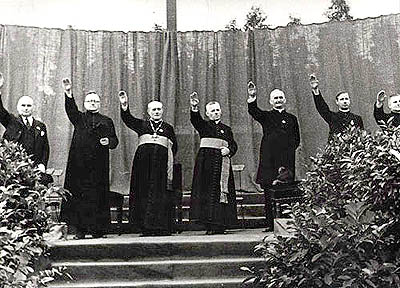
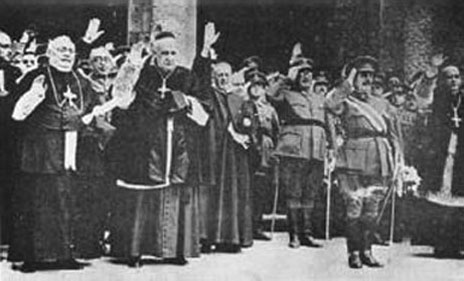
Priests salute Hitler at a Catholic youth
rally in the Berlin-Neukölln stadium in August 1933
|
|
|
 Hitler
had been brought up as a Roman Catholic, and would certainly
have absorbed anti-Semitism from his earliest years. In a speech
made in April 1922 he had spoken about his own Christian feelings5,
and said that it was not merely possible for a Christian
to be anti-Semitic, it was necessary for a Christian
to be anti-Semitic6.
Again, he wrote in Mein Kampf: Hitler
had been brought up as a Roman Catholic, and would certainly
have absorbed anti-Semitism from his earliest years. In a speech
made in April 1922 he had spoken about his own Christian feelings5,
and said that it was not merely possible for a Christian
to be anti-Semitic, it was necessary for a Christian
to be anti-Semitic6.
Again, he wrote in Mein Kampf:
"…I believe that I am acting in accordance with
the will of the Almighty Creator: by defending myself against
the Jew, I am fighting for the word of the Lord"7.
Nazi ideas about the Jews and measures against them were not
the invention of contemporary minds, they were what the Church
had been saying and doing for centuries. There was nothing at
all new in Nazi anti-Semitism. It was simply repackaged traditional
Christian anti-Semitism. Within Hitler's lifetime the Jesuit
Order's statutes prohibited membership to anyone failed to prove
that he had no “Jewish blood” within five generations.
This was cited in the 1930s by both Nazis and Italian Fascists
in support of their anti-Semitic ideas.
|
Neither were Hitler's intentions secret. He promised
the annihilation of the Jews for example in a well documented
speech on 30 January 1939. His whole panoply of persecution
was founded on Christian precedents. Hitler's Nuremberg
laws of 1935 had been modelled in part on the decrees
of Popes Innocent III and Paul IV. Jews were once again
deprived of civil rights, and marriage between German
Christians and Jews was once again forbidden. When the
Nazis confined Jews to specified districts they consciously
called those districts ghettos, maintaining respectability
by emphasising that what they were doing was exactly what
the Roman Church had done. The link was explicit. Before
the war Hitler had boasted to Bishop Berning of Osnabrück
that he would do nothing that the Church had not done
for 1,500 years8.
|
|
The Church at Neisse in Silesia
(modern-day Nysa in southwest Poland). An oven here
was a forerunner of the ovens used in Nazi concentration
camps. During a nine-year period In mid-17th-century
Neisse, more than two thousand girls and women,
and at least two babies, were roasted to death in
this heavily Catholic town
(Karen Farrington, Punishment and Torture,
Bounty Books, 2001)
|
|
|
|
|
Victims of the Inquisition being put
into ovens to be roasted alive. Most victims were Jews.
|
|
|
 Before
the Holocaust Hitler had encouraged the expulsion of Jews from
Germany, just as Pope Leo VII had done in 937, almost exactly
1,000 years before. Denial of citizenship to Jews dated from
the earliest days of Christian power. So too the denial of civil
rights and the restrictions on practising medicine. Public humiliation
of old Jews was another traditional Christian pastime. Nor did
the Nazis invent the idea of making Jews wear distinctive badges;
they simply adopted Church practices, even down to the colour
yellow. Other minority groups had also been forced to wear distinctive
"badges of infamy" by the Church, and new minorities
were obliged to wear them under the Nazis. The SS used much
the same propaganda techniques to whip up hatred against the
Jews as the Dominicans and Franciscans had used for centuries.
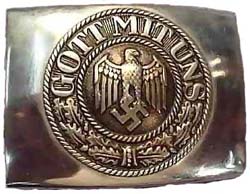
It was no accident that the belt-buckle of the German army uniform
bore the legend Gott Mit Uns. Before
the Holocaust Hitler had encouraged the expulsion of Jews from
Germany, just as Pope Leo VII had done in 937, almost exactly
1,000 years before. Denial of citizenship to Jews dated from
the earliest days of Christian power. So too the denial of civil
rights and the restrictions on practising medicine. Public humiliation
of old Jews was another traditional Christian pastime. Nor did
the Nazis invent the idea of making Jews wear distinctive badges;
they simply adopted Church practices, even down to the colour
yellow. Other minority groups had also been forced to wear distinctive
"badges of infamy" by the Church, and new minorities
were obliged to wear them under the Nazis. The SS used much
the same propaganda techniques to whip up hatred against the
Jews as the Dominicans and Franciscans had used for centuries.
It was no accident that the belt-buckle of the German army uniform
bore the legend Gott Mit Uns.
|
This 1930's poster borrows from a standard
Christian image, where heavenly light from a dove
(representing the Holy Spirit) falls upon a particularly
holy figure favoured by God.
|
|
|
|
|
 Although
Christian statues were left alone, bronze statues of people
the Church did not like were melted down to help the Nazis for
the war effort. A notable example was a statue of the Chevalier
de la Barre, a youth who had been tortured, mutilated and executed
at the instigation of the Church in 1766, whose statue was melted
down for munitions in 1941. The traditional Christian blood
libel against the Jews was revived. In 1934 Der Stürmer,
in its 18 th edition, carried a front-page article under the
headline Jüdischer Mordplan (Jewish Death-plot),
with an illustration showing Jews draining blood from the throats
of blonde-haired infants with Christian crosses in the background.
This was just 20 years after the Vatican itself had stopped
propagating the blood-libel in its own newspapers9.
Another Church has since reprinted the same accusation —
and indeed the whole of the 18 th Edition of Der Stürmer
— in English10. Although
Christian statues were left alone, bronze statues of people
the Church did not like were melted down to help the Nazis for
the war effort. A notable example was a statue of the Chevalier
de la Barre, a youth who had been tortured, mutilated and executed
at the instigation of the Church in 1766, whose statue was melted
down for munitions in 1941. The traditional Christian blood
libel against the Jews was revived. In 1934 Der Stürmer,
in its 18 th edition, carried a front-page article under the
headline Jüdischer Mordplan (Jewish Death-plot),
with an illustration showing Jews draining blood from the throats
of blonde-haired infants with Christian crosses in the background.
This was just 20 years after the Vatican itself had stopped
propagating the blood-libel in its own newspapers9.
Another Church has since reprinted the same accusation —
and indeed the whole of the 18 th Edition of Der Stürmer
— in English10.
|
Front page, Der Stürmer,
18th Ed
This edition repeats the traditional Catholic Blood-libel,
referring to a "Jewish death-plan".
The illustration shows charactured Jews with knives cutting
the throats of angelic blond-haired Christian children.
Note the Christian crosses in the background on the left.
|
|
|
 In
medieval times beneficiaries of Church justice had been obliged
to don sulphur shirts in order to help them burn in purpose-built
furnaces. The Nazis used the same basic idea, but carried it
out moreefficiently with gas chambers and crematoria. Towns
boasted in Nazi times that they were free of Jews (Judenrein),
just as they had done in medieval times. The concept of collective
guilt, the burning of books, the destruction of synagogues —
all were traditional Christian ideas and practices promoted
by the Holy Mother Church and validated by men like Luther. In
medieval times beneficiaries of Church justice had been obliged
to don sulphur shirts in order to help them burn in purpose-built
furnaces. The Nazis used the same basic idea, but carried it
out moreefficiently with gas chambers and crematoria. Towns
boasted in Nazi times that they were free of Jews (Judenrein),
just as they had done in medieval times. The concept of collective
guilt, the burning of books, the destruction of synagogues —
all were traditional Christian ideas and practices promoted
by the Holy Mother Church and validated by men like Luther.
While the encyclical Divini redemptoris explicitly
condemned communism in Russia, Mexico and Spain, a simultaneous
encyclical directed at German Roman Catholics, MIT brennender
Sorge failed to make any explicit criticism of Nazism and
consequently had little if any impact. Article 24 of the Nazi
party programme stated explicitly that "The party as such
represents the standpoint of a positive Christianity",
and its protection was guaranteed. When Nazi Germany seized
Czechoslovakia in 1939, the recently elected Pope Pius XII refused
to criticise the seizure, describing it as one of the "historic
processes in which, from the political point of view, the Church
is not interested". The following month, both Roman Catholic
and Protestant church bells rang out in celebration of Hitler's
50 th birthday, and Cardinal Bertram sent him a congratulatory
telegram.
|
The fact that the swastica is a traditional
adaptation of a cross, did not escape cartoonists
|
|
|
Throughout the war, Church bells were to ring out not only
for Hitler's birthday but also for each of his victories, at
least until the bells had to be melted down to help the Nazi
war effort. When Hitler incorporated Austria into Nazi Germany
he was greeted in Vienna by Cardinal Innitzer, who proclaimed
the Anschluss to have been ordained by divine providence. Hitler
himself on occasion referred to the divine providence that controlled
his actions11.
Here he is in one of his speeches justifying his anti-Semitism::
My feelings as a Christian points me to my Lord and Saviour
as a fighter…In boundless love as a Christian and as
a man I read the passage that tells us how the Lord at last
rose in His might and seized the scourge to drive out of the
Temple the brood of vipers and adders. How terrific was His
fight for the world against the Jewish poison.... 12
 In
1939 and 1940 Pope Pius XII and a number of bishops were unusually
fulsome in their birthday greetings to the Führer. On Hitler's
51 st birthday, 20 th April 1940, Cardinal Bertram conveyed
"warmest congratulations" in the name of all bishops
in Germany, and assured Hitler that these congratulations were
associated with the "fervent prayers which the Catholics
of Germany are sending to Heaven on their altars on 20 th April
for Volk, army and Fatherland, for state and Führer"13,
a sentiment that was to be echoed on subsequent birthdays until
Hitler's suicide. When he heard of Hitler's death in 1945, the
Cardinal, writing in his own hand, instructed all priests in
his archdiocese "to hold a solemn requiem in memory of
the Führer and all those members of the Wehrmacht who have
fallen in the struggle for our German Fatherland.... "14.
According to Roman Catholic canon law at the time, a solemn
requiem could be held only for a public concern of the Church.
Unlike the invasion of Czechoslovakia, this was an historical
process in which the Church was interested. In
1939 and 1940 Pope Pius XII and a number of bishops were unusually
fulsome in their birthday greetings to the Führer. On Hitler's
51 st birthday, 20 th April 1940, Cardinal Bertram conveyed
"warmest congratulations" in the name of all bishops
in Germany, and assured Hitler that these congratulations were
associated with the "fervent prayers which the Catholics
of Germany are sending to Heaven on their altars on 20 th April
for Volk, army and Fatherland, for state and Führer"13,
a sentiment that was to be echoed on subsequent birthdays until
Hitler's suicide. When he heard of Hitler's death in 1945, the
Cardinal, writing in his own hand, instructed all priests in
his archdiocese "to hold a solemn requiem in memory of
the Führer and all those members of the Wehrmacht who have
fallen in the struggle for our German Fatherland.... "14.
According to Roman Catholic canon law at the time, a solemn
requiem could be held only for a public concern of the Church.
Unlike the invasion of Czechoslovakia, this was an historical
process in which the Church was interested.
|
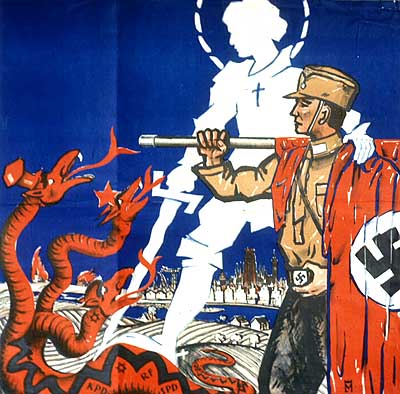
A Nazi propaganda poster - A Nazi party
member draped in the Nazi flag, is threatened by a multi-headed
Jewish snake, and supported and encouraged by a ghostly
Christian knight with a halo, emphasising the godly and
historic nature of German Christian enmity against the
Jews..
|
|
|
It is no coincidence that the groups who suffered most under
the Third Reich were precisely the groups traditionally persecuted
under Christianity — Jews, homosexuals, the physically
and mentally handicapped, gypsies, and other dissenters from
the current orthodoxy. Jehovah's Witnesses, and others who were
killed for their beliefs by the Nazis, can be seen as successors
to the heretics who were killed for refusing to swear allegiance
and for refusing to enlist in armies or fight in wars.
 Pius
XII, though nominally neutral, seemed to many to favour the
Axis powers during World War II. He could not bring himself
to criticise Nazi atrocities. Nor did he see fit to criticise
the many bishops and priests who supported the Nazis and collaborated
with them. After the war the Pope's behaviour was explained
by loyal Roman Catholics in a number of ways: the Pope had not
known about the atrocities, or he had known but had felt unable
to speak out because he did not interfere in political matters,
or he had more important matters to deal with, or alternatively
he could not make a stand because of the vulnerability of the
Vatican — it was better for the Church to sit out this
time of difficulty so that he would be of help after the war
had finished. All of these arguments are untenable15.
In the first place the Vatican knew full well about Nazi atrocities.
At one stage Vatican radio broadcasters had criticised them,
but the Nazis had complained and the criticism immediately ceased.
Jan Karski and the President of Poland, on behalf of the Jews
in the Warsaw ghetto, asked the Pope to excommunicate those
responsible for persecution and murder. The answer was no. The
mass murder of Jews was reported directly to the Pope by Gerhardt
Reigner, but again no action was taken. When the US government
asked the Vatican whether it could confirm information about
genocide the Vatican refused to do so. Joseph Goebbels had been
excommunicated for marrying a divorced Protestant., but not
a single Catholic was ever excommunicated for participating
in war crimes, though practicing Catholics made up about 30%
of the army and 25% of the SS. (The balance was made up of members
of other Christian denominations). Except for Jehovah's Witnesses
it is difficult to find more than a handful of Axis Christians
whose behaviour approached what might reasonably have been expected
of all Christians - which explains why the same few names (Deitrich
Bonhoffer, Martin Niemoller, etc.) are invariably cited by apologists. Pius
XII, though nominally neutral, seemed to many to favour the
Axis powers during World War II. He could not bring himself
to criticise Nazi atrocities. Nor did he see fit to criticise
the many bishops and priests who supported the Nazis and collaborated
with them. After the war the Pope's behaviour was explained
by loyal Roman Catholics in a number of ways: the Pope had not
known about the atrocities, or he had known but had felt unable
to speak out because he did not interfere in political matters,
or he had more important matters to deal with, or alternatively
he could not make a stand because of the vulnerability of the
Vatican — it was better for the Church to sit out this
time of difficulty so that he would be of help after the war
had finished. All of these arguments are untenable15.
In the first place the Vatican knew full well about Nazi atrocities.
At one stage Vatican radio broadcasters had criticised them,
but the Nazis had complained and the criticism immediately ceased.
Jan Karski and the President of Poland, on behalf of the Jews
in the Warsaw ghetto, asked the Pope to excommunicate those
responsible for persecution and murder. The answer was no. The
mass murder of Jews was reported directly to the Pope by Gerhardt
Reigner, but again no action was taken. When the US government
asked the Vatican whether it could confirm information about
genocide the Vatican refused to do so. Joseph Goebbels had been
excommunicated for marrying a divorced Protestant., but not
a single Catholic was ever excommunicated for participating
in war crimes, though practicing Catholics made up about 30%
of the army and 25% of the SS. (The balance was made up of members
of other Christian denominations). Except for Jehovah's Witnesses
it is difficult to find more than a handful of Axis Christians
whose behaviour approached what might reasonably have been expected
of all Christians - which explains why the same few names (Deitrich
Bonhoffer, Martin Niemoller, etc.) are invariably cited by apologists.
 The
story about the Pope not wanting to interfere in politics is
also difficult to sustain: there has never been a time since
the creation of the papacy that it has not been actively involved
in the politics of numerous countries. Many people have been
excommunicated for purely political reasons, and there were
adequate grounds for excommunicating Hitler and his government.
(It is noteworthy that the Pope frequently threatened to excommunicate
communists because of their beliefs.) Furthermore the Pope took
an active interest in the conduct of the war and felt free to
speak about it. For example he was quite prepared to speak out
against the allies when he thought they might bomb Rome. The
story about the Pope not wanting to interfere in politics is
also difficult to sustain: there has never been a time since
the creation of the papacy that it has not been actively involved
in the politics of numerous countries. Many people have been
excommunicated for purely political reasons, and there were
adequate grounds for excommunicating Hitler and his government.
(It is noteworthy that the Pope frequently threatened to excommunicate
communists because of their beliefs.) Furthermore the Pope took
an active interest in the conduct of the war and felt free to
speak about it. For example he was quite prepared to speak out
against the allies when he thought they might bomb Rome.
The argument that the Holocaust was relatively unimportant
to the Pope is also difficult to sustain in view of other matters
that were occupying his time. He was, for example, concerned
about the danger of black men on his property. When Rome was
liberated he asked the allies not to use black soldiers to garrison
the Vatican. Finally the excuse that his personal safety was
necessary for the survival of the Church cannot be sustained.
The Pope could have given implicit guidance, even if he feared
to give explicit guidance. He could for example have stated
that the injunction to love thy neighbour as thyself applies
to all neighbours, not merely Christian ones. He could have
stated that there are circumstances when military orders can
justly be disobeyed. He could have pointed out that Mary, Jesus
and the apostles were all Jewish. He could have said that mass
murder was contrary to one of the Ten Commandments. He could
have done any of these things without endangering himself in
the least. Also, apart from any ethical considerations it is
a fact that Pius kept silent even after Rome was safe, the allies
were winning and Germany was on the defensive. The bald fact
is that the papacy was far more sympathetic to the Nazis and
fascists than to the democracies. Only after the War was lost,
Hitler dead and world opinion unanimous did the Pope disclose
to his college of cardinals that Nazism had been a "Satanic
spectre" and an "arrogant apostasy from Jesus Christ".
 Pius
had also enjoyed friendly relations with Pétain's Vichy
government, Pétain being another keen Roman Catholic
leader with a taste for exterminating Jews and other minorities.
Marshal Pétain and his government were appointed in July
1940 by an overwhelming vote in the democratically elected French
Parliament. Under this government Jews were rounded up by French
police, herded into cattle trucks and sent to Nazi death camps.
Altogether, over 70,000 French Jews were seen off by their Christian
neighbours, never to return. Although he failed to criticise
such atrocities, the Pope did again manage to find time to condemn
communism. He also found time to deplore the surrender terms
demanded by the allies at Casablanca. Even after the war Pius
never quite found the time to make public statements about Nazism,
genocide, atomic weapons or global war. He was occupied with
matters such as the bodily Assumption of Mary into Heaven, which
he was to proclaim in Munificentissimus deus in 1950. Pius
had also enjoyed friendly relations with Pétain's Vichy
government, Pétain being another keen Roman Catholic
leader with a taste for exterminating Jews and other minorities.
Marshal Pétain and his government were appointed in July
1940 by an overwhelming vote in the democratically elected French
Parliament. Under this government Jews were rounded up by French
police, herded into cattle trucks and sent to Nazi death camps.
Altogether, over 70,000 French Jews were seen off by their Christian
neighbours, never to return. Although he failed to criticise
such atrocities, the Pope did again manage to find time to condemn
communism. He also found time to deplore the surrender terms
demanded by the allies at Casablanca. Even after the war Pius
never quite found the time to make public statements about Nazism,
genocide, atomic weapons or global war. He was occupied with
matters such as the bodily Assumption of Mary into Heaven, which
he was to proclaim in Munificentissimus deus in 1950.
|
"When you see a cross". This
is a page from the anti-Semitic German children's book,
"Der Giftpilz" (The Poisonous Mushroom). The
text reads, "When you see a cross, then think of
the horrible murder by the Jews on Golgotha...".
This line of thought has a continuous history in Christian
Europe for centuries - it was not invented by the Nazi's,
merely adopted by them from mainstream Christian teaching.
|
|
|
 Significantly,
none of the mainstream Churches spoke out against the excesses
of Nazism — true enough they protested loudly about the
removal of crucifixes from schoolroom walls, but with the arguable
exception of euthanasia, they lodged no objections and made
no public criticism of the invasions of successive countries,
the suppression of free speech, the abrogation of democracy,
judicial murders, or concentration camps. They did however offer
prayers to the Lord of Battles for the Führer's
victory. Significantly,
none of the mainstream Churches spoke out against the excesses
of Nazism — true enough they protested loudly about the
removal of crucifixes from schoolroom walls, but with the arguable
exception of euthanasia, they lodged no objections and made
no public criticism of the invasions of successive countries,
the suppression of free speech, the abrogation of democracy,
judicial murders, or concentration camps. They did however offer
prayers to the Lord of Battles for the Führer's
victory.
Since the end of the war the German bishops have consistently
failed to acknowledge their role in the success of Nazi persecutions,
a fact that keeps alive a great deal of bitterness in Germany
and elsewhere. In recent years the German Roman Catholic bishops
have edged nearer to admitting their complicity in Nazism, but
their failure to make any sort of clear unambiguous admission
continues to irritate and anger many.
|
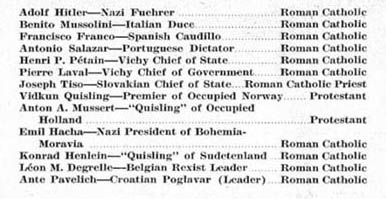
The Religious Affiliation of Nazi and
Fascist Dictators, their puppets, Quislings and Collaborators
|
|
|
 Throughout
Europe, Roman Catholic groups carried out atrocities during
World War II. The Croat Ustaša, who were overwhelmingly
Roman Catholic, ultra-nationalist and fascist, outdid the Nazis
in their barbarism against Orthodox Serbs and partisans, and
assisted in exterminating Jews. Some of their leaders, who together
were responsible for hundreds of thousands of murders, were
Franciscans. One, the commandant of Jasenovac concentration
camp , known as "Brother Devil", accounted for 40,000
lives or more. Other churchmen also found common cause with
the Nazis. The President of Slovakia, Joseph Tiso, was a leading
Nazi responsible for setting up concentration camps in his country.
But this was not his only vocation, for President Tiso was also
a Roman Catholic priest. He was executed for his crimes in 1946. Throughout
Europe, Roman Catholic groups carried out atrocities during
World War II. The Croat Ustaša, who were overwhelmingly
Roman Catholic, ultra-nationalist and fascist, outdid the Nazis
in their barbarism against Orthodox Serbs and partisans, and
assisted in exterminating Jews. Some of their leaders, who together
were responsible for hundreds of thousands of murders, were
Franciscans. One, the commandant of Jasenovac concentration
camp , known as "Brother Devil", accounted for 40,000
lives or more. Other churchmen also found common cause with
the Nazis. The President of Slovakia, Joseph Tiso, was a leading
Nazi responsible for setting up concentration camps in his country.
But this was not his only vocation, for President Tiso was also
a Roman Catholic priest. He was executed for his crimes in 1946.
Other bishops and priests were responsible for many thousands
of deaths, having collaborated freely with the Nazi authorities.
Here is Dr Joachim Kahl, an ex-pastor and German Church historian
on the Roman Catholic fascist movement in Croatia that flourished
between 1941 and 1944:
The Ustaša, as this terrorist organisation was called,
was responsible for the forcible conversion of some 240,000
Orthodox Serbs to Roman Catholicism and for putting about
750,000 of these people to death. There was, from the beginning,
close collaboration between the Catholic clergy and the Ustaša.
Archbishop Stepinać, whom the Vatican appointed in 1942
to be the spiritual leader of the Ustaša, had a place,
together with ten of his clergy, in the Ustaša Parliament.
Priests were also employed as police chiefs and as officers
in the personal body-guard of the fanatical Croatian head
of state, Pavelić. Nuns marched in military parades immediately
behind the soldiers, their arms raised in the fascist salute.
Abbesses were decorated with the Ustaša order. The
most cruel part of this movement was played, however, by the
Franciscans, whose monasteries had for some time been used
as arsenals. Several monks and priests agreed to work as executioners
in the hastily set up concentration camps to which the Orthodox
Serbs were sent for mass execution by decapitation. These
massacres were so brutal that even Croatia's allies, the German
Nazis, protested against them and petitions were sent to the
Vatican. Pope Pius XII, however, said nothing, just as he
also said nothing about Auschwitz. It was not until some ten
years later, in 1953, that he broke his silence by promoting
Archbishop Stepinać, who, as one of those bearing the
greatest guilt, had been sentenced by the Supreme People's
Court of Yugoslavia to sixteen years" forced labour,
to the rank of Cardinal for his "great services"
to the Church16.
Cardinal Stepinać, Archbishop of Zagreb, had been imprisoned
on charges of collaboration. In the Ukraine, the Uniate Church
(which owes allegiance to Rome) was similarly associated with
Nazism. A number of Uniate bishops were arrested after the war,
convicted as collaborators, and given long prison sentences.
A former inmate of the Jasenovac concentration camp, Egon Berger,
described the following atrocity, by the camp commander, a Cathalic
priest called Miroslav Filopovic-Majstorovic:
The priestly face of Fra Majstorovic, all made-up and powdered,
dressed in an elegant suit an green hunter's hat, watched
with delight the victims. He approached the children, even
stroked their heads. The company was joined Ljubo Milos and
Ivica Matkovic. Fra Majstorovic told the mothers there will
now will be a baptism for their children. They took the children
from the mothers, the child whom Father Majstorovic was carrying,
in his child's innocence caressed the painted face of his
killer. The mothers, distraught, perceived the situation.
They offered their lives for mercy for the children. Two children
were placed on the ground, while the third was thrown like
a ball into the air, and Fr Majstorovic, holding a dagger
upwards, missed three times, while the fourth time with a
joke and a laugh, a child was impaled on the dagger. Mothers
began throwing themselves on the ground, pulling their hair,
and began to shout terribly. Ustasha guards of the 14th Osijek
Company took them away and killed them. When all three children
were so brutally killed, these three two-legged beasts exchanged
money, because they seem to have a bet on who would the first
to stick a dagger in a child.16a.
Pope Pius XII had been happy enough to meet Ante Pavelić
in 1941, after his murder spree. (It was this meeting that caused
a British official in the Foreign Office to describe the pope
as “the greatest moral coward of our age”).
|
Archbishop Stepinac with the Ustashi,
the organisation that out-nazi'd the Nazi's,
|
|
|
 Towards
the end of World War II, the Vatican helped Nazi War criminals
to escape prosecution by issuing them with false passports and
moving them to safe countries. In one known case (that of Paul
Touvier, to which we will return) a convicted criminal was moved
from one European state to another over 30 years, entering countries
illegally and taking refuge in Church institutions. More usually,
such criminals were transferred to the safety of Roman Catholic
countries. Often they were sheltered in monasteries, until Red
Cross passports could be obtained, and then taken to countries
such as Spain and Argentina17.
Sometimes they were dressed as priests for the journey18.
A parallel "gold-line" funded this so-called "rat-line".
Gold taken from Jews, Serbs and gypsies was spirited to the
Vatican where it financed the work of saving alleged and convicted
war criminals19.
The Vatican provided passports, bogus documents, money, shelter
and cover stories along with an international network of sympathetic
contacts. Vatican reticence on the matter has been largely due
to the fact that the men responsible held high office in the
Vatican up to the late 1980s at least. This was confirmed in
1988 by Cardinal Franz König, who knew two such men personally,
although he declined to name them20. Towards
the end of World War II, the Vatican helped Nazi War criminals
to escape prosecution by issuing them with false passports and
moving them to safe countries. In one known case (that of Paul
Touvier, to which we will return) a convicted criminal was moved
from one European state to another over 30 years, entering countries
illegally and taking refuge in Church institutions. More usually,
such criminals were transferred to the safety of Roman Catholic
countries. Often they were sheltered in monasteries, until Red
Cross passports could be obtained, and then taken to countries
such as Spain and Argentina17.
Sometimes they were dressed as priests for the journey18.
A parallel "gold-line" funded this so-called "rat-line".
Gold taken from Jews, Serbs and gypsies was spirited to the
Vatican where it financed the work of saving alleged and convicted
war criminals19.
The Vatican provided passports, bogus documents, money, shelter
and cover stories along with an international network of sympathetic
contacts. Vatican reticence on the matter has been largely due
to the fact that the men responsible held high office in the
Vatican up to the late 1980s at least. This was confirmed in
1988 by Cardinal Franz König, who knew two such men personally,
although he declined to name them20.
Such admissions are untypical within the Church. More usual
is the pattern of denial and obstruction. A similar case arose
in 2005 in respect to events connected to the break up of Yugoslavia
in the 1990's . The Church was suspected of sheltering Ante
Gotovina who had been charged with crimes against humanity.
He was wanted in connection with murder and the deportation
of up to 200,000 people during a Croatian offensive, Operation
Storm, in 1995. The UN prosecutor Carla del Ponte believed
the Croatian Church to be hiding him in a Franciscan monastery.
The Pope declined to answer her letters. The Vatican said it
had no intelligence. A spokesman for the Croatian bishops"
conference commented that “A Franciscan monastery is a
broad definition. She always has information, but she can"t
say where” — suggesting that they were not prepared
even to make inquiries. Del Ponte had no doubt that the Vatican
could have found out where Gotovina was hiding in a few days
if it had wanted to and commented publicly that “The Vatican
refuses totally to cooperate with us”21.
(The case mirrors that of Radovan Karadzic, a Bosnian Serb war
criminal from the opposing side, who sought refuge from UN prosecutors
among Orthodox Christian monks in Montenegro22)
Within the Roman Catholic Church, explicit support for extreme
right-wing organisations is still common. In France, Masses
are still said for Marshal Pétain, and leaflets for Jean
Marie Le Pen's National Front are available at church doors23.
The Church also looks on neo-fascists in Italy with a kindly
tolerance. When Giorgino Almirante, leader of the MSI fascist
party, died in 1988 his body was borne in state to the church
of Sant"Agnese in Agone in Rome. After rousing shouts of
"Duce! Duce!" from the crowd of 10,000 and a hail
of salutes from as many straight right arms, the body was led
into the church by the new Neo-fascist leader. There, eight
priests waited to perform the funeral Mass amid the fascist
political banners hung around the altar. The sermon faithfully
reflected the dead man's political views, incorporating as it
did quotations from his lifetime of fascist thought24.
Elsewhere, the Vatican has frequently lent support to right-wing
groups. In 1946 Cardinal Mindszenty organised a plot with the
help of the fascist Arrow Cross and Cardinal Spellman
to overthrow the Hungarian government. Fascism has had a good
friend in the Roman Catholic Church. Senior churchmen have supported
every right-wing dictatorship — from Spain under Franco
and Portugal under Salazar to various South American dictatorships
under their military juntas.
|
These are members of the Teutonic Order.
It is a Christian order of Crusader-Monks similar to the
Templars and the Hospitallers, but created to fight and
kill pagans. It is still in existence.
The man on the right is wearing a Priesterkreuz of the
Deutschen Ordens
|
|
|
| |
|
Close up of a Teutonic Order cross and
a Priesterkreuz
|
|
|
| |
|
A Nazi Iron Cross - clearly and deliberately
based on the Christian cross of the Teutonic Order.
In 1219 the Kingdom of Jerusalem granted the Teutonic
Order the right to
combine the Teutonic Black Cross with a Cross of Jerusalem
|
|
|
The position of Protestants is little better than that of the
Roman Catholics. Luther had stated that the Bible confirms the
right of the State to rule by force, and described this as a
benevolent provision of God. Protestants were thus happy to
accept a Nazi dictatorship and collaborated with Nazis just
as much as their Roman Catholic brethren. On 3 rd April 1933
German Protestants, at the first National Conference of the
Faith Movement, affirmed in a resolution that for a
German the Church is a community of believers who are under
an obligation to fight for a Christian Germany. In
the 1930s Deutsche Christen, who found Nazism and Christianity
to be perfectly compatible, became the largest Protestant faction.
They were led by Reichsbischof Ludwig Müller, a favourite
of Hitler, who regarded the Führer and the Nazis as "presents
from God". Their motto was "The swastika on our breasts;
the cross on our hearts". Their synods passed Aryan legislation.
They sang Nazi hymns. Nazi flags hung in their churches. Their
pastors wore Nazi uniforms. Their Church was an arm of the State.
Like the Roman Catholic Church they were funded by the State,
and benefited from public taxation. Protestant Churches advocated
obedience towards the Führer, and gave prayers for him
and for the Third Reich. Congregations gave Nazi salutes in
Church. Bishops asked for God's blessing for those who accepted
the Führer's call. After the failed attempt on Hitler's
life on 20 th July 1944, the Clergy Council of the German Evangelical
Church sent a telegram to him that said "Thanksgiving is
being offered in all the Protestant Churches of Germany for
God's gracious protection and his manifest preservation....
" Roman Catholic leaders did the same. Cardinal, Michael
von Faulhaber Archbishop of Munich (who later ordained Joseph
Ratzinger) sent a telegram instructing that a Te Deum be sung
in the cathedral of Munich, "to thank Divine Providence
in the name of the archdiocese for the Führer's fortunate
escape." The Pope also sent his special personal congratulations.25.
|
Some Christians have attempted to portray Hitler and
the Nazi Party as atheistic. In fact the nazi's were wholly
opposed to atheism, believing it to be associated with
communism. Hitler outlawed atheistic and freethinking
groups in Germany in the Spring of 1933, immediately after
the Enabling Act was passed, authorising Hitler
to rule by decree.
The largest freethought group, The German Freethinkers
League, was swept away along with smaller freethought
and atheist groups throughout Germany.
No mainstream Church offered any significant opposition
to the Nazis. Few evangelical pastors were imprisoned
at all for opposing the Nazi State. Amongst Roman Catholic
bishops one was expelled from his see, and another served
a short term for currency offences. Hardly any churchmen
of any denomination spoke out against the evils of Nazism.
|
|
New York Times, May 14, 1933, page 2,
|
Atheist Hall Converted
[into religious hall]
Berlin Churches Establish
Bureau to Win Back Worshippers
BERLIN, May 13. - In Freethinkers Hall, which
before the Nazi resurgence was the national
headquarters of the German Freethinkers League,
the Berlin Protestant church authorities have
opened a bureau for advice to the public in
church matters. Its chief object is to win
back former churchgoers and assist those who
have not previously belonged to any religious
congregation in obtaining church membership.
The German Freethinkers League, which was
swept away by the national revolution, was
the largest of such organizations in Germany.
It had about 500,000 members . . . "
|
|
|
For political reasons, Church governments often refused to
show solidarity with those who had been arrested and condemned
for opposing the Nazi government26.
As Konrad Adenauer later wrote to one pastor:
I believe that if all the bishops had together made public
statements from the pulpits on a particular day, they could
have prevented a great deal. That did not happen, and there
is no excuse for it. It would have been no bad thing if the
bishops had all been put in prison or in a concentration camp
as a result. Quite the contrary. But none of that happened
and therefore it is best to keep quiet27.
Nazi and Fascist sympathisers within the Catholic Church were
not confined to countries with right-wing governments. Anti-Semitic
priests were vocal in countries such as Ireland and the USA.
For example more than 30,000,000 in the USA listened to the
anti-Semitic weekly radio broadcasts of a Catholic priest, Father
Charles Edward Coughlin during the 1930s. In 1934 Coughlin announced
a new political organisation called the National Union for
Social Justice - clearly imitating the National Socialists.
Its membership ran into the millions. Coughlin used his radio
program to attack Jewish bankers and express anti-Semitic views,
and to support policies of Hitler and Mussolini. These broadcasts
have been called "a variation of the Fascist agenda applied
to American culture". He had no doubt that he knew God's
mind on a range of issues, announcing that "The New Deal
is Christ's Deal". In January 1934, he testified before
Congress that "God is directing President Roosevelt."
 Curiously,
given God's explicit guidance on the matter, Coughlin later
changed his mind and distanced himself from God's chosen president.
His radio programs preached more and more about the negative
influence of "money changers", communists and Jews.
After the 1936 election, Coughlin expressed ever-increasing
support for the governments of Hitler and Mussolini as an antidote
to Communism, and the Jewish bankers he believed to be behind
the Russian Revolution. He promoted his beliefs through an anti-Semitic
weekly magazine, Social Justice, which began publication
in March, 1936. In 1938, Social Justice reprinted the
fraudulent text known as The Protocols of the Elders of Zion. Curiously,
given God's explicit guidance on the matter, Coughlin later
changed his mind and distanced himself from God's chosen president.
His radio programs preached more and more about the negative
influence of "money changers", communists and Jews.
After the 1936 election, Coughlin expressed ever-increasing
support for the governments of Hitler and Mussolini as an antidote
to Communism, and the Jewish bankers he believed to be behind
the Russian Revolution. He promoted his beliefs through an anti-Semitic
weekly magazine, Social Justice, which began publication
in March, 1936. In 1938, Social Justice reprinted the
fraudulent text known as The Protocols of the Elders of Zion.
The Roosevelt administration finally forced the cancellation
of his radio program and forbade the dissemination through the
post of his newspaper, Social Justice. After 1936, Coughlin
began supporting an organisation called the Christian Front,
which claimed him as an inspiration. In January 1940, a New
York City unit of the Christian Front was raided by the
FBI for plotting to overthrow the government. Coughlin's superior,
Bishop Michael Gallagher of Detroit supported Coughlin, the
"Radio Priest", and no one else in the Church made
any attempt to curb his anti-Semitism, either because they agreed
with him or because of the fear of schism if they tried.
 After
the outbreak of War in September 1939, ("The Jews' War")
the USA sided increasingly with the Allied Powers against the
Axis powers. Coughlin's opposition to the repeal of an arms-embargo
law (ending the USA's neutrality) made him unpopular, and triggered
successful efforts to force him off the air as anti-Semitism
lost its popular appeal to mainstream Catholics. Roy Carlson,
who infiltrated and exposed U.S. fascist groups said: "Coughlin
filled the pages of Social Justice with Hitler's sewer-spawned
lies. He made direct use of Goebbels' speeches, quoting the
Nazi almost word-for-word" (Carlson, Under Cover,
1943). Father Coughlin was not an eccentric maverick. He was
just the most popular of a host of contemporary anti-Semitic
Christian priests and ministers - and his views are not altogether
abandoned. It is not difficult to find Catholic websites that
consider him a saint. After
the outbreak of War in September 1939, ("The Jews' War")
the USA sided increasingly with the Allied Powers against the
Axis powers. Coughlin's opposition to the repeal of an arms-embargo
law (ending the USA's neutrality) made him unpopular, and triggered
successful efforts to force him off the air as anti-Semitism
lost its popular appeal to mainstream Catholics. Roy Carlson,
who infiltrated and exposed U.S. fascist groups said: "Coughlin
filled the pages of Social Justice with Hitler's sewer-spawned
lies. He made direct use of Goebbels' speeches, quoting the
Nazi almost word-for-word" (Carlson, Under Cover,
1943). Father Coughlin was not an eccentric maverick. He was
just the most popular of a host of contemporary anti-Semitic
Christian priests and ministers - and his views are not altogether
abandoned. It is not difficult to find Catholic websites that
consider him a saint.
|
A Nazi propaganda poster showing a Russian
soldier crushing the the Christian cross of Nazi Germany
and other Axis powers (carrying their national flags)
|
|
|
 During
the latter part of the twentieth century, the Roman Church in
much of South America abandoned its traditional right-wing friends
and, to the annoyance of the Vatican, espoused Liberation Theology,
a system of thought verging on Marxism. While some priests and
bishops supported revolutionaries, their traditionalist superiors
were conspiring with their right-wing associates to murder their
more liberal fellow clergymen (see below). Meanwhile the traditional
role of supporting dictatorships anf juntas has been taken over
by Baptists and other evangelists from the USA, who find that
their God has a strong affinity for dictatorships. During
the latter part of the twentieth century, the Roman Church in
much of South America abandoned its traditional right-wing friends
and, to the annoyance of the Vatican, espoused Liberation Theology,
a system of thought verging on Marxism. While some priests and
bishops supported revolutionaries, their traditionalist superiors
were conspiring with their right-wing associates to murder their
more liberal fellow clergymen (see below). Meanwhile the traditional
role of supporting dictatorships anf juntas has been taken over
by Baptists and other evangelists from the USA, who find that
their God has a strong affinity for dictatorships.
 Sociological
studies have frequently noted the tie between Protestant fundamentalism
and extreme right-wing politics in the USA (and sometimes between
Roman Catholic fundamentalism and extreme right-wing politics).
One study showed that Protestant fundamentalists accounted for
much of the support given to George Wallace in the 1968 presidential
election in the USA28.
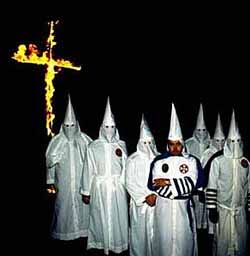
Extreme right-wing politics are espoused by fervent Christian
organisations like the Ku Klux Klan, the John Birch Society
(an extremist group named after a Baptist missionary), and many
others28a.
The affection between religion and extreme politics is mutual.
As one commentator has observed: "All right-wing dictatorships
today have established churches of one world religion or another.
Traditional anti-Semitic churchmen are frequently quoted by
Christian neo-Nazis29.
The only political party in Britain that decrees religious allegiance
for its members is the Nazi Party"30. Sociological
studies have frequently noted the tie between Protestant fundamentalism
and extreme right-wing politics in the USA (and sometimes between
Roman Catholic fundamentalism and extreme right-wing politics).
One study showed that Protestant fundamentalists accounted for
much of the support given to George Wallace in the 1968 presidential
election in the USA28.
Extreme right-wing politics are espoused by fervent Christian
organisations like the Ku Klux Klan, the John Birch Society
(an extremist group named after a Baptist missionary), and many
others28a.
The affection between religion and extreme politics is mutual.
As one commentator has observed: "All right-wing dictatorships
today have established churches of one world religion or another.
Traditional anti-Semitic churchmen are frequently quoted by
Christian neo-Nazis29.
The only political party in Britain that decrees religious allegiance
for its members is the Nazi Party"30.
.jpeg) As
we have seen, both Catholics and Protestants, were complicit
in supporting Nazism and its promotion of traditional Christian
anti-semitism. Yet today, Church leaders are keen to forget
this and present themselves as victims of the Nazis, who are
various presented as pagans or atheists. On a number of occasions,
Churches have been even more perfidious, secretly complicit
in persecuting its own members while simultaneously representing
itself as the victim of persecution. This has been happening
for centuries. A couple of notable examples include the supposed
persecution of the Orthodox Church during the Soviet period.
After the fall of Communism secret police files were made public
which revealed that members of the Orthodox hierarchy had been
in league with the Communist regime, and had been paid for actively
informing on the Church's own members. As
we have seen, both Catholics and Protestants, were complicit
in supporting Nazism and its promotion of traditional Christian
anti-semitism. Yet today, Church leaders are keen to forget
this and present themselves as victims of the Nazis, who are
various presented as pagans or atheists. On a number of occasions,
Churches have been even more perfidious, secretly complicit
in persecuting its own members while simultaneously representing
itself as the victim of persecution. This has been happening
for centuries. A couple of notable examples include the supposed
persecution of the Orthodox Church during the Soviet period.
After the fall of Communism secret police files were made public
which revealed that members of the Orthodox hierarchy had been
in league with the Communist regime, and had been paid for actively
informing on the Church's own members.
Another example is provided by the Catholic church in Argentina,
which backed the military government in Argentina during the
"Dirty War", and called for their followers to be
patriotic. (It also facilitated the adoption of babies by friends
of the regime, the babies
having been stolen from their left-wing oponents). In 2013
when a court in Argentina found that the Catholic Church had
been complicit in persecuting left-wing Catholics - and was
implicated in the murder and mutilation of its own priests.
The Court also noted that the Church was still refusing to assist
in the state's criminal investigations.31.
The Church had previously cited these same murders as examples
of the outrageous treatment of its members. When a left wing
bishop, Enrique Angelelli, was murdered after celebrating a
mass for two murdered priests, Cardinal Jorge Mario Bergoglio
described Angelelli as a martyr - a small reproach to the junta
for overstepping itself.
|
A Catholic bishop shown operating right-wing
puppets responsible for the murder of left-wing Catholic
priests in Argentina.
|
|
|
 Cardinal
Jorge Mario Bergoglio, later Pope Francis, was not without personal
criticism for his own role. He had been one of the senior members
of the Catholic hierarchy which collaborated with right-wing
military junta. He had been head of the Jesuit order from 1973
to 1979. By dismissing left-wing priests from the order, he
signalled to the dictators that they could be arrested. The
two priests, Orlando Yorio and Francisco Jalics were kidnapped
by government forces on May 23, 1976, imprisoned for five months
at clandestine detention center, tortured, and later found drugged
and semi-naked in a field. According to the priests, they had
been dismissed from the Jesuit order by Jorge Mario Bergoglio
for having ministered to residents of the slums. (Residents
of the slums were apparently regarded as too left-wing for Jesuits).
A 1995 memoir by Father Jalics, accuses Father Bergoglio of
betraying the two priests. Cardinal
Jorge Mario Bergoglio, later Pope Francis, was not without personal
criticism for his own role. He had been one of the senior members
of the Catholic hierarchy which collaborated with right-wing
military junta. He had been head of the Jesuit order from 1973
to 1979. By dismissing left-wing priests from the order, he
signalled to the dictators that they could be arrested. The
two priests, Orlando Yorio and Francisco Jalics were kidnapped
by government forces on May 23, 1976, imprisoned for five months
at clandestine detention center, tortured, and later found drugged
and semi-naked in a field. According to the priests, they had
been dismissed from the Jesuit order by Jorge Mario Bergoglio
for having ministered to residents of the slums. (Residents
of the slums were apparently regarded as too left-wing for Jesuits).
A 1995 memoir by Father Jalics, accuses Father Bergoglio of
betraying the two priests.
In 2000 the Argentine Catholic church made one of its famously
ambiguous public apologies "We want to confess before God
everything we have done badly" Argentina's Episcopal Conference
said at that time, without mentioning what those things were.
Confession to ordinary Argentinians - even to a court under
oath - was not considered necessary. Ten years later Bergoglio
twice refused to testify in court about his role while he was
head of the Jesuit order. When he eventually appeared in court
in 2010, he was described by lawyers as being evasive.
|
The right-wing British National Party,
like most right-wing European political parties,
explicitly identifies itself with traditional Christianity
Poster for Elections to the European Parliament 4 June
2009
|
|
|
|
This cartoon was published on 12 August
2008 on the website of Heinz-Christian Strache Chairman
of the The Freedom Party of Austria, a right-wing christian
political party in Austria. It is idealogically identical
to numerous anti-semitic Nazi cartoons.
|
 |
|
Poe's law, named after its author Nathan
Poe, states that without a clear indication of the author's
intent, it is difficult to tell the difference between
an expression of sincere extremism and a parody of extremism.
You might guess that this illustration is a spoof, but
it is not. Paster Pete said things even more extreme than
this!
|
|
|
|
Bernard Partridge Cartoon, Punch Magazine
8 April 1942 (or 4 August?)
The caption reads "Be a good boy Boris and you shall
put up this cross in Constantinople"
|
|
|
| |
|
Another Cartoon representing the swastiks
as an elaborated cross. John Heartfield, 1933
The text says (in German)
Zur Grundung der detchen staatskirhe. Das Kreuz war noch
nicht schwer genug.
(On the founding of the [German] state Church. The cross
still wasn't heavy enough)
|
|
|
| |
Photo gallery - Extreme Right Wing Protestant Christians
| |
|
|
| |
|
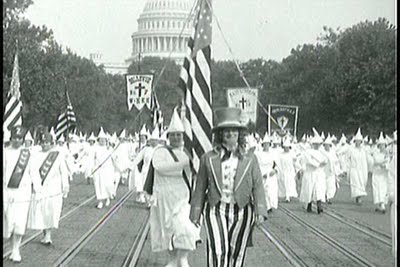
Klansmen in Washington in 1925
|
|
|
| |
| |
|
|
| |
| |
|
|
| |
|
|
|
|
|
|
| |
| |
|
|
| |
|
40,000 Klansmen march on Washington,
1925
|
|
|
| |
|
Reichsbishop Ludwig Müller head
of the Nazi-Protestant Church, photographed in Berlin,
1934
|
 |
| |
|
National Bishop Friedrich Coch giving
a Hitler greeting in Dresden, 10 December 1933. Coch was
one of the leading men of the Deutsche Christen in Saxony.
He was elected to the office of state bishop by the "Brown
Synod" in August 1933.
|
|
|
| |
|
Installation of Ludwig Müller. He
headed the German Christians (Deutsche Christen) and became
Landesbischof (bishop) of the Evangelical Church of the
old-Prussian Union (6 July 1933) and Reich's Bishop (28
June 1933) of the German Evangelical Church (Deutsche
Evangelische Kirche).
|
|
|
| |
| |
|
A procession of Deutsche Christen bishops
in front of the Berlin Cathedral, 23 September, 1934.
Members in party and SA uniforms carry Deutsche Christen
banners, while pastors follow in the rear. SS guards stand
to attention as they pass.
|
|
|
| |
| |
| |
| |
Photo gallery - Extreme Right Wing Catholic Christians
| |
| |
|
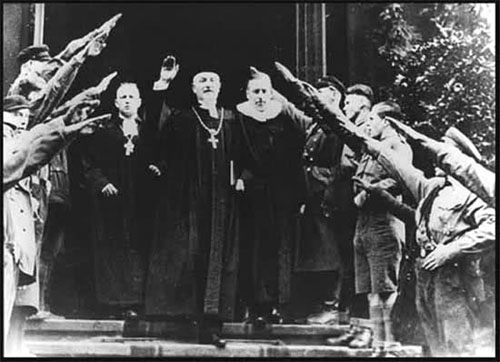
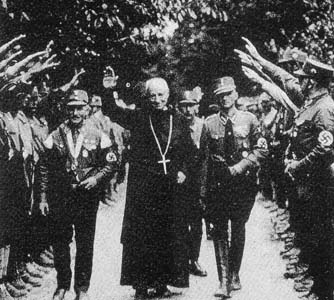
Catholic Clergy giving the Nazi Salute
|
|
|
| |
|
Cardinal Pacelli (later to become Pope
Pius XII)
|
|
|
| |
|
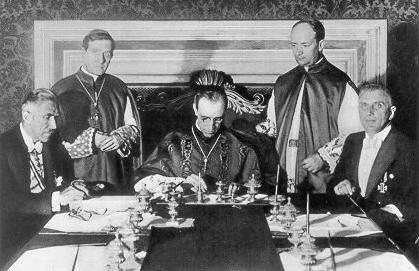
Signing the Concordat between the Vatican
and the Nazis, 20 July 1933. As the Nazi Franz von Papen,
said, "The Third Reich is the first world power which
not only acknowledges but also puts into practice the
high principles of the papacy." As far as the Vatican
is concerned, a government that signs a concordat has
become an arm of the government of God, which means that
the Vatican will help it, giving it divine protection.
Signing the concordat is Cardinal Pacelli (later to become
Pope Pius XII). Second from left is Franz von Papen, a
leading Nazi and devout Roman Catholic.
|
|
|
| |
|
Nazi sponsored celebration for Catholic
Bishop Konrad von Preysing in the Sportpalast, Berlin,
8 Sept. 1935
(He was named Bishop of Berlin on 5 July 1935, and installed
on the following 31 August)
Note the Christian chi-rho symbol on the screen at the
back, behind the swastika banner.
|
|
|
| |
| |
| |
|
Archbishop Cesare Orsenigo, head of
the Diplomatic Corps, attending the Nuremberg Party Rally
in September 1933
|
|
|
| |
| |
|
Nazi Officers and cadets celebrating
one of their regular Christian festivals - Chrismas 1941
|
|
|
| |
|
Catholic Youth Rally at the Berlin-Neuköln
stadium, in August 1933
(Catholic Priests never had any problems making Nazi salutes)
|
|
|
| |
| |
|
|
| |
| |
|
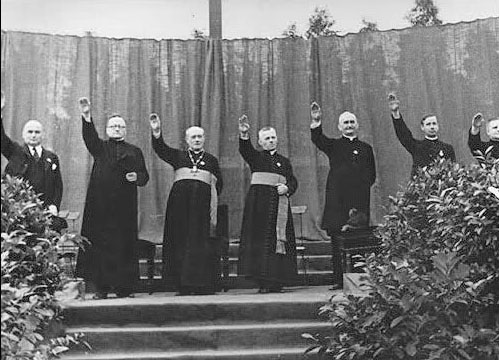
Catholic Bishops giving the Nazi salute
in honor of Hitler.
With Joseph Goebbels (far right) and Wilhelm Frick (second
from right). Frick was instrumental in the racial policy
of Nazi Germany drafting laws against Jewish citizens,
including the Nuremberg Laws in September 1935. Frick
was later convicted of planning, initiating and waging
wars of aggression, war crimes and crimes against humanity.
He was also implicated in setting up concentration camps.
|
|
|
| |
| |
|
Cardinal Bertram and and other Catholic
Churchmen attended by Nazi soldiers
at the funeral procession for Bishop Bares, Berlin, 7
March 1935
|
|
|
| |
| |
|
Nazi Brown Shirts leaving a Church service
|
|
|
| |
| |
|
Photographs of General Franco, devout
Catholic, and the Holy Relic he always carried around
with him
|
|
|
| |
|
General Franco wearing his Roman Catholic
Papal Order on his chest (1939 Spanish poster)
|
|
|
| |
|
Spanish Catholic Hierarchy and Nazis
|
|
|
Photo gallery - Extreme Right Wing Catholic Ustashi
|
The Croatian Ustashi state, set up immediately after
the Nazi German invasion of Yugoslavia, was based on fanatical
Catholicism, and run by a priest. Orthodox Christian Serbs
who refused to convert to Catholicism were butchered in
their villages, or at the Jasenovac death camp, or thrown
into mountain crevasses. Hitler referred to the Ustashi
as “Our Nazis.”
|
| |
|
A Roman Catholic priest forcibly "converting"
a whole village of Orthodox Serbs.
Jews, Moslems, Orthodox Christians, Protestants and other
non-Catholics were traditionally given the choice of conversion,
exile (with loss of possessions) or death.
Father Ante Djuric, of the District of Dvor, in Serbia,
opened his sermons in the following way: "The Orthodox
of this District have only three ways out: to accept the
Catholic faith, to move out, or to be cleansed with the
'metal broom'."
|
|
|
| |
|
Catholic Archbishop Stepinac and Papal
Nuncio Marcone with a Nazi General following
|
|
|
| |
Catholic Saric with Nazi Ante Pavelic
in Sarajevo
|
|
|
| |
| |
|
Ante Pavelic with Catholic Nuns
|
|
|
| |
|
Catholic Archbishop Stepinac with Ustashi
Nazis
|
|
|
| |
|
Hitler and Catholic Ante Pavelic, Nazi
puppet ruler of Croatia
|
|
|
| |
|
Nazi puppet Ante Pavelic with Catholic
Franciscan Monks
|
|
|
| |
|
Gold watches taken from Serb and Jewish
victims and hidden in the residence of the Archbishop
of Zagreb, where they were found after the retreat of
the Ustashi.
|
|
|
| |
| |
|
Catholic Archbishop Stepinac with Nazi
Ante Pavelic,head of the Ustashi in Croatia
|
|
|
| |
| |
|
Catholic Priest Jozef Tiso and Hitler
|
|
|
| |
| |
|
|
| |
| |
| |
|
Catholic Churches in Croatia held memorial
masses for Nazi-leader Ante Pavelic
|
|
|
| |
|
Fathar Joseph Tiso, leading Nazi and
President of Slovakia,
responsible for setting up concentration camps. He was
executed for his crimes in 1946.
|
|
|
| |
| |
Was Hitler a Catholic?
There is no doubt that Hitler was a Catholic.
Strangely, many Catholic apologists now expend energy in trying
to show that he was a pagan or an atheist, and therefore not
a Catholic, or even a Christian.
For a sample of the available evidence, see Hitler's
beliefs
|
|
|
|
|
|
|
|
|
|
|
|
|
|
|
|
|
|
|
|
|
|
|
|
|
|
|
|
|
|
|
|
|
|
|
|
|
|
Buy the Book from Amazon.com
|
|
|
|
|
|
Buy the Book from Amazon.co.uk
|
|
|
| |
| |
| More Books |
|
|
|
|