| |
|
|
There is no greater hatred in the
world than hatred of ignorance for knowledge.
|
|
Galileo Galilei (1564-1642)
|
  The
ancient Greeks were outstanding mathematicians, philosophers
and scientists. One of them, Empedocles, showed that air is
a material substance and not just a void, experimented with
centrifugal force, knew about sex in plants, proposed a theory
of evolution, speculated that light travels at a finite speed,
and was aware that solar eclipses are caused by alignments of
the Sun, Moon and Earth. Knowledge of astronomy was advanced.
Hipparchus accurately determined the distance between Earth
and the Moon1
, estimated the length of the lunar month to within a second,
and discovered the precession of the equinoxes. Some of the
achievements of the ancient Greeks are astonishing. Heron of
Alexandria invented an internal combustion engine. Thales of
Miletus, who lived around six centuries before the birth of
Jesus, was familiar with static electricity. By Roman times
elementary batteries had been invented, although no uses for
them appear to have been exploited. Foundations of many modern
sciences were laid by the Greeks from astronomy to botany, and
even specialised fields of physics such as optics, hydrostatics,
pneumatics, and mechanics. Modern mathematics is full of references
to pioneering Greek mathematicians: Euclidean planes, Diophantine
equations, the theory of Pappus, and so on. The
ancient Greeks were outstanding mathematicians, philosophers
and scientists. One of them, Empedocles, showed that air is
a material substance and not just a void, experimented with
centrifugal force, knew about sex in plants, proposed a theory
of evolution, speculated that light travels at a finite speed,
and was aware that solar eclipses are caused by alignments of
the Sun, Moon and Earth. Knowledge of astronomy was advanced.
Hipparchus accurately determined the distance between Earth
and the Moon1
, estimated the length of the lunar month to within a second,
and discovered the precession of the equinoxes. Some of the
achievements of the ancient Greeks are astonishing. Heron of
Alexandria invented an internal combustion engine. Thales of
Miletus, who lived around six centuries before the birth of
Jesus, was familiar with static electricity. By Roman times
elementary batteries had been invented, although no uses for
them appear to have been exploited. Foundations of many modern
sciences were laid by the Greeks from astronomy to botany, and
even specialised fields of physics such as optics, hydrostatics,
pneumatics, and mechanics. Modern mathematics is full of references
to pioneering Greek mathematicians: Euclidean planes, Diophantine
equations, the theory of Pappus, and so on.
The outlook of Christians was fundamentally different from
that of the ancient Greeks. According to Christians, God revealed
himself through the Bible and the Church. As Tertullian
explained, scientific research [inquisitio] became superfluous
once the gospel of Jesus Christ was available:
We have no need of curiosity after Jesus Christ, nor of research
after the gospel. When we believe, we desire to believe nothing
more. For we believe that there is nothing else that we need
to believe.
De praescnptione haereticorum (On the Rule of the Heretic)
 The
Church taught that it knew all there was to be known. Christian
knowledge was comprehensive and unquestionable. Rational investigation
was therefore unnecessary. Existing learning was not merely
superfluous, but positively harmful. Theologians were convinced
that God had defined strict limits on the knowledge that human
beings might acquire, and anything else was "sorcery".
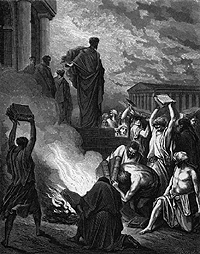
When Saint Paul visited the great city of Ephesus many Christians
burned their books (or scrolls) because they were considered
to contain sorcery. This set the tone for Christian thought
for centuries. In the fourth century Eusebius attacked scientific
enquiry, dismissing it as "useless labour". St.
Augustine of Hippo who regarded scientific enquiry as a
worse sin than lust, also said that "Hell was made for
the inquisitive". To seek to discover more was a sin and
therefore also a crime, the crime of curiositas2
. For him, scientific curiosity ("knowledge and learning")
was as a more serious sin than lust: The
Church taught that it knew all there was to be known. Christian
knowledge was comprehensive and unquestionable. Rational investigation
was therefore unnecessary. Existing learning was not merely
superfluous, but positively harmful. Theologians were convinced
that God had defined strict limits on the knowledge that human
beings might acquire, and anything else was "sorcery".
When Saint Paul visited the great city of Ephesus many Christians
burned their books (or scrolls) because they were considered
to contain sorcery. This set the tone for Christian thought
for centuries. In the fourth century Eusebius attacked scientific
enquiry, dismissing it as "useless labour". St.
Augustine of Hippo who regarded scientific enquiry as a
worse sin than lust, also said that "Hell was made for
the inquisitive". To seek to discover more was a sin and
therefore also a crime, the crime of curiositas2
. For him, scientific curiosity ("knowledge and learning")
was as a more serious sin than lust:
To this the sin [of lust] is added another form of temptation
more manifoldly dangerous. For besides that concupiscence
of the flesh which consisteth in the delight of all senses
and pleasures, wherein its slaves, who go far from Thee, waste
and perish, the soul hath, through the same senses of the
body, a certain vain and curious desire, veiled under the
title of knowledge and learning, not of delighting in the
flesh, but of making experiments through the flesh.2a
The Christian comitment to obedience rather than knowledge
meant that what you saw as white was black if the Church said
it was. Church dogma thus over-rode all empiricle evidence into
modern times.
To be right in everything, we ought always to hold that the
white which I see, is black, if the Hierarchical Church so
decides it
(St. Ignatius Loyola, 1491 - 1556, Spiritual Exercises, Thirteenth
Rule.)
Christianity brought the Dark Ages to Europe, a period when
scientific endeavour was abandoned and learning of all kinds
was rooted out and destroyed. With the exception of military
technology, the Church was to oppose advances in virtually every
scientific discipline for many hundreds of years. Philosophers
were persecuted and their books burned. Such was the persecution
that men of learning were driven to destroy their own libraries
rather than risk a volume being seen by a Christian informer.
Efforts were made to destroy evidence of Greek successes. We
can never know how much was lost forever. Some Greek learning
was preserved because Christian heretics, notably Nestorians,
took it east with them when they fled the wrath of the orthodox
Church. These refugees flourished under Zoroastrian and Muslim
rulers in centres like Damascus, Cairo, Baghdad and Gondeshapur
in Persia. There they translated surviving works into Syriac,
Hebrew and Arabic.
It was later re-translations of these works, mainly from Arabic
into Latin, that fuelled humanism and the development of the
scientific method in western Europe almost a millennium after
Christian orthodoxy had begun its intellectual holocaust. Conquests
of Constantinople by crusaders in 1204 and then by the Turks
in 1453 both resulted in the flight of Greek scholars to western
Europe. They brought remnants of more ancient works that had
been preserved in the East. These influxes encouraged the revival
of Greek learning, leading to an intellectual rebirth that we
know as the European Renaissance.
Having produced no distinctive philosophy of its own, the
early Church had adopted the philosophical ideas of Plato. For
centuries Plato was honoured as a sort of quasi-Christian. Among
the works brought back from the East were the writings of his
pupil Aristotle. Aristotle appealed to medieval Christians even
more than Plato, but some of his ideas seemed incompatible with
theirs. Thomas Aquinas attempted to reconcile Aristotelian thought
with Christianity, and for a while it was accepted that he had
succeeded. Aristotle was now credited with almost divine authority,
and it became as difficult to overturn his ideas as it was biblical
ones. Time after time the Church would seek to suppress scientific
discoveries by reference either to the Bible or to Aristotle.
Ignatius Loyola summed up the traditional Christian view when
he said “We sacrifice the intellect to God” and
Martin Luther was even more direct in expressing the view that
“Reason is the Devil's harlot”. At the end of the
seventeenth century churchmen — even Anglican churchmen
— were still claiming that the Christian religion was the
only real source of knowledge 3
, and the Bible was still regarded an infallible and comprehensive
encyclopædia. It provided information on the origins,
history and nature of the Universe, Earth, animals and mankind.
How such ideas came to be abandoned by most Christians is the
history of Western science.
We will now look at examples of what happened when new scientific
truths contradicted old religious ones, beginning with the most
famous case of all.
I know that I am mortal by nature, and ephemeral; but when
I trace at my pleasure the windings to and fro of the heavenly
bodies I no longer touch the earth with my feet: I stand in
the presence of Zeus himself and take my fill of ambrosia.
Ptolemy, Almagest
For religious reasons it was necessary
for Christian scholars to place Earth at the centre of all creation.
God had created the Universe for humans, so it was natural that
he should build it around them. Accepted Church doctrine in
early times was that our world was flat and circular, and sat
immobile at the centre of the cosmos4.
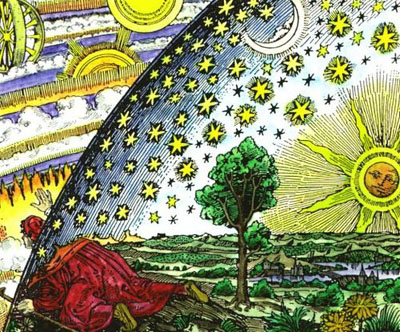
The vault of the sky was a solid structure, a huge dome rather
like a gigantic planetarium. Stars were physically moved around
its inner surface by angels. Anyone adventurous and blasphemous
enough could conceivably break through the firmament at the
edge of the world into the hidden heavenly realms beyond.
| |
|
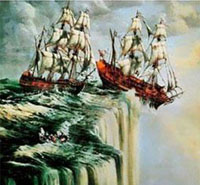
In later medieval thought the earth was
a disk - flat and round - so it was theoretically possible
to find the edge of the world and break through to the
first heaven.
|
|
|
 Within
the dome theologians imagined a number of concentric hemispheres
separating a series of holy regions — the seven heavens
that appear in Jewish, Christian and Muslim literature 5.
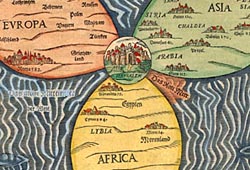
Churchmen knew exactly where the centre of their circumscribed
world was. It was Jerusalem, as medieval maps confirm. Indeed
the precise spot within Jerusalem could be identified, for it
was where Jesus had been crucified. It is supposedly located
in the Church of the Holy Sepulchre. The site of the crucifixion
thus marked the radial centre of of a disc, below the hemispherical
firmament — the exact centre of the Universe. Within
the dome theologians imagined a number of concentric hemispheres
separating a series of holy regions — the seven heavens
that appear in Jewish, Christian and Muslim literature 5.
Churchmen knew exactly where the centre of their circumscribed
world was. It was Jerusalem, as medieval maps confirm. Indeed
the precise spot within Jerusalem could be identified, for it
was where Jesus had been crucified. It is supposedly located
in the Church of the Holy Sepulchre. The site of the crucifixion
thus marked the radial centre of of a disc, below the hemispherical
firmament — the exact centre of the Universe.
 Anyone
who queried church teachings, or even carried out proto-scientific
investigations was liable to severe penalties, especially once
the Inquisition had been created to root out heresy. Often we
do not know the supposed nature of the heresy - in at least
some cases it might have been revealing that the earth is not
flat. All we know for certain is that proto-scientists were
tried and convicted for the crime of heresy - ie the crime of
disagreeing with the Church. Anyone
who queried church teachings, or even carried out proto-scientific
investigations was liable to severe penalties, especially once
the Inquisition had been created to root out heresy. Often we
do not know the supposed nature of the heresy - in at least
some cases it might have been revealing that the earth is not
flat. All we know for certain is that proto-scientists were
tried and convicted for the crime of heresy - ie the crime of
disagreeing with the Church.
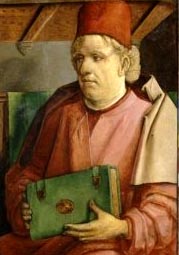
Pietro d'Abano (aka Petrus De Apono or Aponensis) was an Italian
astronomer, philosopher, and professor of medicine in Padua.
He was called before the inquisition but died in their prison
in 1315 before the end of his trial. He was nevertheless convicted
of heresy and his body ordered to be burned. When his body was
found to have been removed and hidden, the Inquisition had to
be content with burning his effigy.
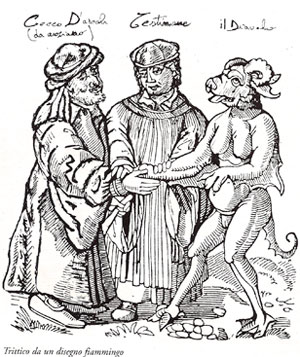
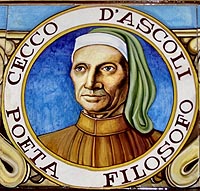 Cecco
d'Ascoli (AKA Francesco degli Stabili), was another famous Italian
polymath – an astronomer, geologist, meteorologist, mineralogist,
encyclopaedist, physician and poet, and victim of the Inquisition.
Since Pietro d'Abano had died in prison, Cecco holds the distinction
of being the first university scholar to be killed by the Inquisition
for heresy. Cecco
d'Ascoli (AKA Francesco degli Stabili), was another famous Italian
polymath – an astronomer, geologist, meteorologist, mineralogist,
encyclopaedist, physician and poet, and victim of the Inquisition.
Since Pietro d'Abano had died in prison, Cecco holds the distinction
of being the first university scholar to be killed by the Inquisition
for heresy.
Inquisitors supposedly accused him of casting Jesus' horoscope,
though his real crime might have been to say that the earth
was spherical. He was burned at Florence on 26 September 1327,
the day after he was sentences, in his seventieth year.
|
Cecco d'Ascoli, Professor of astrology
at the University of Bologna (left),
was represented as having made a pact with the Devil
|
|
|
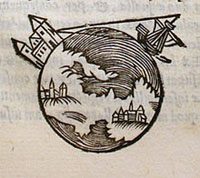
 Respectable
churchmen continued to endorse flat earth theories, arguing
against a spherical earth. Zacharia Lilio, a canon of the Basilica
of St. John Lateran in Rome wrote Contra Antipodes in
1496 (after Columbus) stating explicitly that "That the
earth is not round". Respectable
churchmen continued to endorse flat earth theories, arguing
against a spherical earth. Zacharia Lilio, a canon of the Basilica
of St. John Lateran in Rome wrote Contra Antipodes in
1496 (after Columbus) stating explicitly that "That the
earth is not round".
Later theologians accepted that the heavens were fully spherical
and rotated about a stationary spherical Earth suspended in
space. These heavens were made of transparent crystal, which
explained why they could not be seen. The Earth lay at divine
rest at the centre of all creation, just as God lay at divine
rest in his heaven
 This
second spherical theory was certainly an advance on what had
been believed before, but it was still well behind the ancient
Greeks, who had known that Earth is spherical almost 2,000 years
earlier. Parmenides of Elea recognised it to be so in the fifth
century BC. Pythagoreans found proof that Earth was round: they
noted that our planet cast a curved shadow on the surface of
the Moon during lunar eclipses. Other Greeks spoke of the opposite
side of the world where the Sun shone while it was their night.
Eratosthenes of Alexandria (275-194 BC) calculated Earth's size
and arrived at a circumference of 252,000 stades, which is thought
to correspond to 39,690 km (24,663 miles) — only a little
short of the correct figure for the polar circumference, which
is 40,008 km (24,860 miles). Eratosthenes also developed the
system of latitude and longitude. That Earth was spherical was
so well established by Roman times that emperors carried an
orb to signify their sovereignty over the whole world. This
second spherical theory was certainly an advance on what had
been believed before, but it was still well behind the ancient
Greeks, who had known that Earth is spherical almost 2,000 years
earlier. Parmenides of Elea recognised it to be so in the fifth
century BC. Pythagoreans found proof that Earth was round: they
noted that our planet cast a curved shadow on the surface of
the Moon during lunar eclipses. Other Greeks spoke of the opposite
side of the world where the Sun shone while it was their night.
Eratosthenes of Alexandria (275-194 BC) calculated Earth's size
and arrived at a circumference of 252,000 stades, which is thought
to correspond to 39,690 km (24,663 miles) — only a little
short of the correct figure for the polar circumference, which
is 40,008 km (24,860 miles). Eratosthenes also developed the
system of latitude and longitude. That Earth was spherical was
so well established by Roman times that emperors carried an
orb to signify their sovereignty over the whole world.
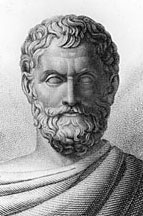 In
the sixth century BC, Thales of Miletus learned from the Babylonians
how to predict the motion of heavenly bodies. He was able to
anticipate a solar eclipse in 585 BC. Anaxagoras of Clazomenœ,
who was born around 500 BC, held the Sun to be an incandescent
mass of hot stone — as near to the truth as he could have
got. He also said that the Moon shone merely because of the
Sun's reflected light, as indeed it does. Pythagoras seems to
have speculated in the sixth century BC that Earth went round
the Sun, not the Sun round Earth. Aristotle mentions Pythagoreans
who regarded Earth as a planet — a heavenly body circling
around the Sun, the central fire that created night and day.
Towards the middle of the third century BC, Aristarchus of Samos
further developed the Pythagorean theory that Earth was in motion
about the Sun. Other philosophers wondered why, if the Pythagorean
theory were right, the fixed stars did not appear to change
position as Earth moved. But Aristarchus had an explanation
for this absence of parallax. He pointed out that it could be
accounted for by the vast distances to the fixed stars, a theory
that was to be vindicated in the nineteenth century. In
the sixth century BC, Thales of Miletus learned from the Babylonians
how to predict the motion of heavenly bodies. He was able to
anticipate a solar eclipse in 585 BC. Anaxagoras of Clazomenœ,
who was born around 500 BC, held the Sun to be an incandescent
mass of hot stone — as near to the truth as he could have
got. He also said that the Moon shone merely because of the
Sun's reflected light, as indeed it does. Pythagoras seems to
have speculated in the sixth century BC that Earth went round
the Sun, not the Sun round Earth. Aristotle mentions Pythagoreans
who regarded Earth as a planet — a heavenly body circling
around the Sun, the central fire that created night and day.
Towards the middle of the third century BC, Aristarchus of Samos
further developed the Pythagorean theory that Earth was in motion
about the Sun. Other philosophers wondered why, if the Pythagorean
theory were right, the fixed stars did not appear to change
position as Earth moved. But Aristarchus had an explanation
for this absence of parallax. He pointed out that it could be
accounted for by the vast distances to the fixed stars, a theory
that was to be vindicated in the nineteenth century.
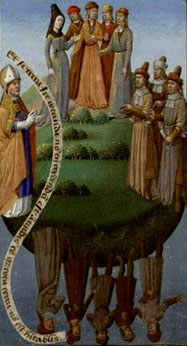
Ancient Greeks had written about people living on the other
side of the world, in an unknown land, the antipodes. In the
eighth century, Vergilius of Salzburg revived the idea that
the earth was spherical and on the other side of the earth people
might be found living in the Antipodes. Saint Boniface condemned
the idea as "iniquitous and perverse" and "contrary
to the scriptures". The then Pope, Zozimus, regarded the
idea as heretical6
but as this heresy occurred before the founding of the Inquisition,
Vergilius suffered no long term problems for voicing his opinion
because of lack of evidence - if evidence had been available
the Pope would have authorised a council to try and punish him.
 The
ancient Pythagorean view was revived by Nicolaus Copernicus
early in the sixteenth century, over 2,000 years after it had
first been put forward. Copernicus did not dare to publish his
ideas on the matter, because the Church was certain that Earth
lay at the centre of everything. He kept his book, De Revolutionibus
Orbium Cœlestium, secret for 36 years. It was published
only after his death. The Inquisition would later condemn his
cosmology as "that false Pythagorean doctrine utterly contrary
to the Holy Scriptures". Their scriptural prooftext included
Ecclesiastes 1:5, which talks about the Sun rising and setting,
and Psalm 104:5 which says that Earth can never be moved. The
Church knew beyond all doubt that the Sun rotated about Earth
because on one occasion God had made it stand still in the sky
(Joshua 10:12-13). According to the greatest Church authorities
it was not possible to believe in the Pythagorean/Copernican
system and still remain a Christian. Even Martin Luther agreed
that this cosmology was incompatible with Christian faith. Here
he is ("Works," Volume 22, c. 1543) referring to Copernicus
and his theory: The
ancient Pythagorean view was revived by Nicolaus Copernicus
early in the sixteenth century, over 2,000 years after it had
first been put forward. Copernicus did not dare to publish his
ideas on the matter, because the Church was certain that Earth
lay at the centre of everything. He kept his book, De Revolutionibus
Orbium Cœlestium, secret for 36 years. It was published
only after his death. The Inquisition would later condemn his
cosmology as "that false Pythagorean doctrine utterly contrary
to the Holy Scriptures". Their scriptural prooftext included
Ecclesiastes 1:5, which talks about the Sun rising and setting,
and Psalm 104:5 which says that Earth can never be moved. The
Church knew beyond all doubt that the Sun rotated about Earth
because on one occasion God had made it stand still in the sky
(Joshua 10:12-13). According to the greatest Church authorities
it was not possible to believe in the Pythagorean/Copernican
system and still remain a Christian. Even Martin Luther agreed
that this cosmology was incompatible with Christian faith. Here
he is ("Works," Volume 22, c. 1543) referring to Copernicus
and his theory:
People give ear to an upstart astrologer who strove to show
that the earth revolves, not the heavens or the firmament,
the sun and the moon. Whoever wishes to appear clever must
devise some new system, which of all systems is of course
the very best. This fool wishes to reverse the entire science
of astronomy; but sacred Scripture tells us that Joshua commanded
the sun to stand still, and not the earth.
 The
Catholic Church taught that sin and imperfection existed only
at the centre of the Universe — on Earth and as far above
its surface as the Moon. God's abode, the heavens, beyond the
lunar orbit, were perfect. On Earth were imperfection and decay,
and natural motion was in a straight line; in Heaven was perfection
and constancy, and natural motion was perfectly circular. All
celestial orbits were thus circular, and in particular the Sun
moved around Earth in a circle. Apart from being wrong about
which body revolves around which, the Church was also mistaken
about the shape of celestial orbits. If heavenly bodies revolved
around Earth in circular orbits then they would have constant
apparent brightnesses. But the apparent brightnesses of planets
vary, an observation that had led ancient Greeks to deduce,
correctly, that the distances between Earth and various other
planets were not constant. In fact, Earth and the other planets
all orbit the Sun, and their orbits do not have the shapes of
circles but rather ellipses, albeit ellipses that (for Earth
and most of the other planets) closely resemble circles. In
an impressive piece of mathematics, the German astronomer Johannes
Kepler calculated the laws of motion for the elliptical orbits
of the planets around the Sun. His book The New Astronomy
effectively proved Copernicus' heliocentric theory. It was placed
on the Index in 1609. The
Catholic Church taught that sin and imperfection existed only
at the centre of the Universe — on Earth and as far above
its surface as the Moon. God's abode, the heavens, beyond the
lunar orbit, were perfect. On Earth were imperfection and decay,
and natural motion was in a straight line; in Heaven was perfection
and constancy, and natural motion was perfectly circular. All
celestial orbits were thus circular, and in particular the Sun
moved around Earth in a circle. Apart from being wrong about
which body revolves around which, the Church was also mistaken
about the shape of celestial orbits. If heavenly bodies revolved
around Earth in circular orbits then they would have constant
apparent brightnesses. But the apparent brightnesses of planets
vary, an observation that had led ancient Greeks to deduce,
correctly, that the distances between Earth and various other
planets were not constant. In fact, Earth and the other planets
all orbit the Sun, and their orbits do not have the shapes of
circles but rather ellipses, albeit ellipses that (for Earth
and most of the other planets) closely resemble circles. In
an impressive piece of mathematics, the German astronomer Johannes
Kepler calculated the laws of motion for the elliptical orbits
of the planets around the Sun. His book The New Astronomy
effectively proved Copernicus' heliocentric theory. It was placed
on the Index in 1609.
|
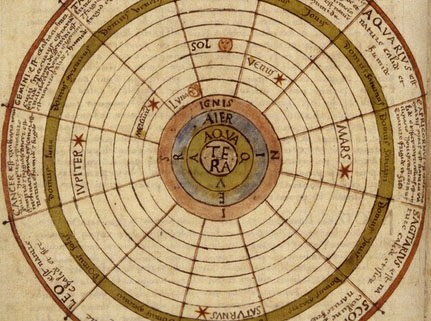
Detail from MS. Canon. Ital. 258 folio
006v.
Concentric rings Earth, Water, Air, and Fire, followed
by
the orbits of the Moon, Mercury, Venus, the Sun, Mars,
Jupiter and Saturn.
|
|
|
Another error of the Church was its denial that Earth spins
on its own axis. Heraclides of Pontus had realised in the fourth
century BC that Earth rotates once every 24 hours. A little
later Aristarchus of Samos (c.310-230) had advanced a complete
Copernican hypothesis. He said that all planets including Earth
orbit the Sun, and that Earth itself rotates on its axis. By
the early 1600s, Copernicus and Kepler had vindicated Aristarchus,
but the Roman Church could not accept that he had been right,
much less that it had been wrong.
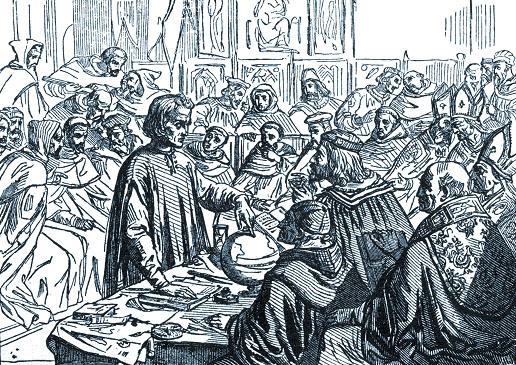
 The
greatest scientist of his day, Galileo Galilei, was fascinated
by the evidence, and saw that the model proposed by Aristarchus
and Copernicus was better than the one taught by the Church.
Galileo was censured for teaching Copernican cosmology in 1616.
Suddenly, the full implications of this cosmology were appreciated.
Copernicus was posthumously declared a heretic and his cosmological
treatise placed on the Index. The
greatest scientist of his day, Galileo Galilei, was fascinated
by the evidence, and saw that the model proposed by Aristarchus
and Copernicus was better than the one taught by the Church.
Galileo was censured for teaching Copernican cosmology in 1616.
Suddenly, the full implications of this cosmology were appreciated.
Copernicus was posthumously declared a heretic and his cosmological
treatise placed on the Index.
Galileo could no longer teach the theory, but with papal approval
he continued to discuss it. His discussions did not favour the
Church's theory, so he found himself in trouble again. In 1633
Pope Urban VIII had him arraigned on a charge of heresy. He
was found guilty, a predicable verdict since, in line with established
Inquisition practice, he was not allowed to mount a defence.
…I humbly begged His Holiness to agree to give him
the opportunity to justify himself. Then His Holiness answered
that in these matters of the Holy Office the procedure was
simply to arrive at a censure and then call the defendant
to recant.
Letter from Francesco Niccolini to Andrea Cioli, about Galileo,
dated 5th September 1632
His sentence contained the following statements:
…by order of His Holiness and Most Eminent and Most
Reverend Lord Cardinals of this Supreme and Universal Inquisition,
the Assessor Theologians assessed the two propositions of
the Sun's stability and the earth's motion as follows:
That the Sun is the centre of the universe and motionless
is a proposition which is philosophically absurd and false,
and formally heretical, for being explicitly contrary to Holy
Scripture;
That the earth is neither the centre of the universe nor
motionless but moves even with diurnal rotation is philosophically
equally absurd and false, and theologically at least erroneous
in the Faith 7.
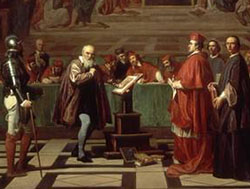 Galileo
recanted under threats of torture by the Inquisition. He was
obliged to say that it was the Sun and not Earth that moved,
and to abjure his heretical depravity in claiming otherwise.
He may have been tortured — we would not know because victims
of the Inquisition were obliged to take an oath not to divulge
what had happened to them. In any case he would have before
his mind the image of Giordano Bruno, another great thinker
of the age. Bruno had also considered possibilities denied by
the Church. He said that stars were really distant suns, and
that there could be inhabited planets orbiting them. He rejected
the idea of a solid firmament. He thought the Universe infinite
and denied that Earth was at its centre 8.
In 1600 he had been publicly burned at the stake in Rome for
his heresies. Galileo
recanted under threats of torture by the Inquisition. He was
obliged to say that it was the Sun and not Earth that moved,
and to abjure his heretical depravity in claiming otherwise.
He may have been tortured — we would not know because victims
of the Inquisition were obliged to take an oath not to divulge
what had happened to them. In any case he would have before
his mind the image of Giordano Bruno, another great thinker
of the age. Bruno had also considered possibilities denied by
the Church. He said that stars were really distant suns, and
that there could be inhabited planets orbiting them. He rejected
the idea of a solid firmament. He thought the Universe infinite
and denied that Earth was at its centre 8.
In 1600 he had been publicly burned at the stake in Rome for
his heresies.
Old and sick, and well aware of Bruno's fate, Galileo now knelt
in penitence before the inquisitors. His writing on the subject,
the Dialogue Concerning the Two Chief World Systems,
was placed on the Index. He was sentenced to life imprisonment.
In fact he spent the rest of his life under house arrest, a
mercy almost certainly attributable to the fact that he was
a personal friend of the reigning Pope.
 Galileo's
Copernican ideas had not been the first to create difficulties.
He had made many scientific discoveries, a number of which had
contradicted Church teachings. He had looked through his early
telescope at the Moon and realised that it was not at all like
the theologians said. It had mountains, just as the Greek philosopher
Anaxagoras had said 2,000 years earlier (anyone with normal
eyesight and an open mind can see their shadows), and these
mountains were interspersed with plains. Few theologians would
look through his telescope to confirm his findings, for they
already knew for a fact that the Moon had a smooth polished
surface. Those who did look said that the shadows they saw must
be blemishes in the telescope lenses. They did not test this
hypothesis by rotating the telescope, or by using another telescope.
There was no point — again because they knew for a fact
that the surface was smooth. Galileo's
Copernican ideas had not been the first to create difficulties.
He had made many scientific discoveries, a number of which had
contradicted Church teachings. He had looked through his early
telescope at the Moon and realised that it was not at all like
the theologians said. It had mountains, just as the Greek philosopher
Anaxagoras had said 2,000 years earlier (anyone with normal
eyesight and an open mind can see their shadows), and these
mountains were interspersed with plains. Few theologians would
look through his telescope to confirm his findings, for they
already knew for a fact that the Moon had a smooth polished
surface. Those who did look said that the shadows they saw must
be blemishes in the telescope lenses. They did not test this
hypothesis by rotating the telescope, or by using another telescope.
There was no point — again because they knew for a fact
that the surface was smooth.
Galileo found other difficulties with Church orthodoxy. Following
Aristotle, the Church taught that natural motion on Earth was
always in a straight line, but Galileo showed that projectiles
describe parabolic curves. Aristotle said that a heavy object
will naturally fall to the ground faster than a light one. Galileo
showed that all objects fall at identical rates under gravity
(unless some other force, like air resistance, acts on them).
Since the Church had adopted Aristotle's teaching as its own,
it was wrong every time he was.
 The
Church also disputed the existence of the moons of Jupiter.
With his telescope Galileo had seen four moons in 1610, but
churchmen said they did not exist. They could not exist because
all heavenly bodies rotated around Earth. The existence of sunspots
was another inconvenience. These were first studied seriously
from around 1610 by Galileo and a German Jesuit priest, Christoph
Scheiner (among others). Scheiner had to publish his findings
under a pseudonym, because of Church opposition. The familiar
argument was that the Sun, being a heavenly creation of God,
must be perfect. Therefore its face could not suffer any form
of blemish. The existence of sunspots thus continued to be disputed
by theologians long after their discovery, even though they
could (and can) sometimes be clearly seen with the naked eye
around sunset. Comets provided yet another difficulty. On the
one hand they were recognised as destructible, which meant that
they must exist within the imperfect region bounded by the Moon;
on the other hand it was realised in the seventeenth century
that they orbit the Sun — which meant that they must lie
beyond the Moon's orbit. Once again theological cosmology contradicted
scientific cosmology. Whether they existed within or without
the lunar orbit, the Church deemed that comets must have a purpose,
and that purpose could only be to act as divine portents. Theologians
explained how angels created them as the need arose and dismantled
them when they were no longer needed 9. The
Church also disputed the existence of the moons of Jupiter.
With his telescope Galileo had seen four moons in 1610, but
churchmen said they did not exist. They could not exist because
all heavenly bodies rotated around Earth. The existence of sunspots
was another inconvenience. These were first studied seriously
from around 1610 by Galileo and a German Jesuit priest, Christoph
Scheiner (among others). Scheiner had to publish his findings
under a pseudonym, because of Church opposition. The familiar
argument was that the Sun, being a heavenly creation of God,
must be perfect. Therefore its face could not suffer any form
of blemish. The existence of sunspots thus continued to be disputed
by theologians long after their discovery, even though they
could (and can) sometimes be clearly seen with the naked eye
around sunset. Comets provided yet another difficulty. On the
one hand they were recognised as destructible, which meant that
they must exist within the imperfect region bounded by the Moon;
on the other hand it was realised in the seventeenth century
that they orbit the Sun — which meant that they must lie
beyond the Moon's orbit. Once again theological cosmology contradicted
scientific cosmology. Whether they existed within or without
the lunar orbit, the Church deemed that comets must have a purpose,
and that purpose could only be to act as divine portents. Theologians
explained how angels created them as the need arose and dismantled
them when they were no longer needed 9.
There was more. When Galileo turned his telescope on Venus
he noticed that it had phases like the Moon. These phases had
been predicted by the heliocentric theory, and provided another
problem for the Church. Yet another difficulty was that through
his telescope Galileo could see thousands of stars that were
too dim to be seen with the naked eye. The problem here was
that the Church taught that the stars, like everything else,
existed only for the benefit of mankind. To devout churchmen
it did not make sense for God to place anything in the firmament
unless it visibly shed light, or was of some other practical
use to people on Earth.
For similar reasons the Church stayed in the age of astrology
while people were pioneering modern astronomy. Theologians knew
for certain that devils were given to molesting people at certain
phases of the Moon 10.
Even popes used the services of astrologers. For example, Julius
II chose the date of his coronation on astrological calculations,
and Paul III chose the time of each consistory (meeting of the
college of cardinals) on a similar basis 11.
Leo X founded a chair of astrology. Astrology might be useful,
but astronomy was not, because the Church already knew everything
to be known about the mechanics of the Universe from God's infallible
handbook. Even the men who pioneered astronomy spent their time
trying to reconcile Church teachings to the real world. The
consequence was that great minds were held back by fruitless
attempts to match theology and observation. Scholars tried to
explain planetary orbits as epicycles (i.e. compound circular
motions) for a long time, because circles would be less offensive
to orthodox religious ideas.
|
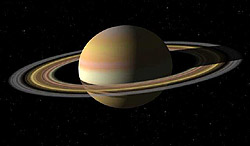
The rings of Saturn presented yet another
problem when they were first seen through a telescope
as they could not be easily explained by theologians.
As it was held that all parts of Jesus Christ were in
heaven, including his prepuce, theologians put two and
two together. Leo Allatius (1586 – 1669, a theologian
and keeper of the Vatican library contended that the heavenly
foreskin formed the rings of Saturn in his work Die
Praeputio Domine Nosri Jesu Christi Diatriba, (A
Discussion of the Foreskin of Our Lord Jesus Christ)
|
|
|
Galileo himself spent time trying to accommodate the biblical
account of the Sun standing still. Kepler might have made further
important discoveries if he had not been constrained by the
belief that planets are guided by angels. So might later cosmologists
if they had not required God to wind up their mechanical universe
like a giant clockwork toy. Such ideas affected even Isaac Newton.
By the 1680s, Newton had deduced the same results concerning
planetary motion as Kepler had arrived at, using his new theory
of gravitation. He still imagined God nudging the planets back
into line from time to time, which invited a degree of teasing
from Leibnitz who wondered why God failed to get it right first
time. Despite this, Newton's theory marked a turning point.
Even if it was conceded that supernatural forces were needed
for occasional fine-tuning, theologians were horrified by the
idea of forces that acted without physical contact. If gravity
could explain basic planetary motions, then supernatural explanations
might soon become superfluous altogether — those guiding
angels would become redundant. Newton was criticised for presuming
to intrude into forbidden territory. As Edmund Halley put it,
Newton had penetrated the secret mansions of the gods. Churchmen
had imagined that they held all the keys to God's heavenly mansions
and did not like trespassers, especially trespassers like Newton
who could open doors that remained closed to them.
Edmund Halley is best remembered for giving his surname to
a famous comet. He realised that various comets recorded in
history were in fact the same comet reappearing every 76 years.
This undermined the idea that comets were divine portents. It
also suggested that theologians had been wrong about angels
constructing and dismantling them as the need arose. The Anglican
Church did not like trespassers any more than the Roman Catholic
Church did, especially if their religious views were less than
orthodox. Halley's views were less than orthodox. He believed
that the world would continue forever, an idea that contradicted
the doctrine of the Second Coming of Christ. Halley was suspected
of atheism, and because of this he failed to win the Savilian
Chair of Astronomy at Oxford in 1691-2. Its gift lay with the
Anglican Church. Halley's was a petty affair in comparison to
Galileo's , but the principle was the same. Churches did not
want to hear theories that contradicted their own, and they
did not want other people to hear them either.
Galileo's Dialogue Concerning the Two Chief World Systems
stayed on the Index until 1835, an annually increasing embarrassment
for educated Roman Catholic believers. By that time the divine
role had been reduced to nothing. The French mathematician Pierre-Simon
Laplace had established that those oddities that Newton had
identified in the planetary orbits did not after all require
gods or angels to correct them. They were, he showed, self-correcting.
When Napoleon asked him where God came into celestial mechanics,
Laplace replied "I have no need for that hypothesis".
Laplace also noted that of all cosmologists Aristarchus had
had the most accurate ideas of the grandeur of the universe.
The reason we see no parallax in the distant stars is their
great distance - which meant that the Earth is but a tiny speck
in a vast universe. Aristarchus and Bruno were both vindicated.
The cosy little universe which consisted of the earth and the
crystal spheres around it was gone for ever. In Medieval times
the words for "universe" and "world" had
been interchangeable - now the Church-approved Medieval model
would be no more than a quaint memory. It was now clear to many
that the theologians and their infallible truths had been comprehensively
wrong. There is no solid firmament. Earth is not at the centre
of the Universe, and nor is it stationary. Neither the Sun nor
the planets revolve around it. Celestial orbits are not circular,
and neither in general is motion in Earth's gravitational field
a straight line. The Moon is not a perfect silver disk, nor
is the Sun a perfect gold one. We live on one insignificant
planet in a vast universe.
|
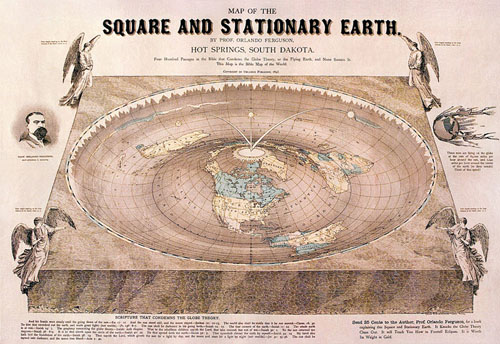
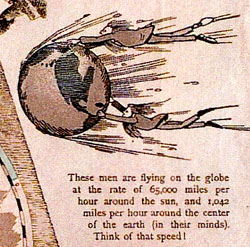
Flat Earth map drawn by Orlando Ferguson
in 1893. The map features "Four Angels standing on
the Four Corners of the Earth" —Rev. 7: 1, a
note that there are "Four Hundred Passages in the
Bible that Condemn the Globe Theory, or the Flying Earth,
and None Sustain It." and also pokes fun at people
who accept the scientific rather than the biblical theory.
|
|
|
Even so in the nineteenth century there were still plenty of
Christians to who refused to accept the truth, and still adhered
to the flat earth theory. Some, like the Christian minister
Wilbur Glenn Voliva who lived well into the twentieth century,
became multi-millionaires from vast numbers of like-minded followers.
I believe this Earth is a stationary plane; that it rests
upon water; and that there is no such thing as the Earth moving,
no such thing as the Earth's axis or the Earth's orbit. It
is a lot of silly rot, born in the egotistical brains of infidels.
(Wilbur Glenn Voliva (1870 – 1942))
There are still a few Christian flat earthers today, along
with millions of Moslem flat-earthers. The Moslems quote the
infallible Koran, and the Christians the infallible bible. At
the same time, many modern Christian apologists have tried to
deny that the Church ever taught that the world was flat. 12.
|
Traditional Christian prooftexts from
the bible, proving the earth to be flat,
cited by Orlando Ferguson:
|
- And his hands were steady until the going down of
the sun—Ex. 17: 12.
- And the sun stood still, and the moon stayed.—Joshua
10: 12–13.
- The world also shall be stable that it not be moved.—Chron.
16: 30.
- To him that stretched out the earth, and made great
lights (not worlds).—Ps. 136: 6–7.
- The sun shall be darkened in his going forth.—Isaiah
12: 10.
- The four corners of the Earth.—Isaiah 11: 12.
- The whole earth is at rest.—Isaiah 14: 7.
- A prophecy concerning the globe theory.—Isaiah:
29th chapter.
- So the sun returned ten degrees.—Isaiah 38: 8–9.
- It is he that sitteth upon the circle of the earth.—Isaiah
40: 22.
- He that spreads forth the earth.—Isaiah 52: 5.
- That spreadeth abroad the earth by myself.—Isaiah
54: 24.
- My hand also hath laid the foundation of the earth.—Isaiah
58: 13.
- Thus sayeth the Lord, which giveth the sun for a light
by day, and the moon and stars for a light by night
(not worlds).—Jer. 31: 35–36.
- The sun shall be turned into darkness, and the moon
into blood.—Acts 2: 20
|
 In
educated circles people would soon be noting that all significant
advances in astronomy had been made since the Church lost its
grip on cosmology in the seventeenth century. Churchmen who
tried to hold the traditional line would find themselves distanced
ever further from educated opinion. Nevertheless, senior clergymen
continued to believe that angels were responsible for planetary
movement and other phenomena well into the nineteenth century
13. Some Christians
still do, but they are now a small minority. Mainstream Churches
have generally accommodated themselves to scientific discoveries,
although without ever admitting earlier errors explicitly. The
Vatican reviewed Galileo's case during the 1980s. After a ten-year
enquiry the Roman Church exonerated itself and justified its
earlier actions, an outcome that met with a degree of surprise
in the wider world14.
Cardinal Ratzinger speaking at La Sapienza University in Rome
(and quoting Paul Feyerabend) described the Church's position
as “reasonable and just”. This explains why, after
he became Pope Benedict XVI, professors and students alike complained
about his planned visit to the University in 2008, causing him
to call it off15. In
educated circles people would soon be noting that all significant
advances in astronomy had been made since the Church lost its
grip on cosmology in the seventeenth century. Churchmen who
tried to hold the traditional line would find themselves distanced
ever further from educated opinion. Nevertheless, senior clergymen
continued to believe that angels were responsible for planetary
movement and other phenomena well into the nineteenth century
13. Some Christians
still do, but they are now a small minority. Mainstream Churches
have generally accommodated themselves to scientific discoveries,
although without ever admitting earlier errors explicitly. The
Vatican reviewed Galileo's case during the 1980s. After a ten-year
enquiry the Roman Church exonerated itself and justified its
earlier actions, an outcome that met with a degree of surprise
in the wider world14.
Cardinal Ratzinger speaking at La Sapienza University in Rome
(and quoting Paul Feyerabend) described the Church's position
as “reasonable and just”. This explains why, after
he became Pope Benedict XVI, professors and students alike complained
about his planned visit to the University in 2008, causing him
to call it off15.
 Bruno's
case has not yet been reconsidered, and most of the evidence
has apparently now mysteriously disappeared while in the custody
of the Vatican. There are, even today Christians who believe
that stars are really angels. Aparently they look like this
figure on the right, though it is not obvious why they might
need wings in a near vacuum. Bruno's
case has not yet been reconsidered, and most of the evidence
has apparently now mysteriously disappeared while in the custody
of the Vatican. There are, even today Christians who believe
that stars are really angels. Aparently they look like this
figure on the right, though it is not obvious why they might
need wings in a near vacuum.
Hypatia was devoted to her magic, astrolabes, and instruments
of music .... She beguiled many people through her satanic
wiles.
Bishop John of Nikiu, 4 th century
One might imagine that pure mathematics could not pose too
much of a threat to Christianity. Not so. Mathematics was tantamount
to enquiring into God's mind, and such presumption could not
be permitted. Churchmen declared geometry to be the work of
the Devil, and accused mathematicians of being the authors of
all heresies. Ancient thinkers like Pythagoras were regarded
as having been dangerous magicians. In the third century the
Church Father wrote in his Refutation of All Heresies,
bracketed together "magical arts and Pythagorean numbers"
(Book VI) and includes mathematicians as one category among
"Diviners and Magicians" (Book IV).
Since Saint Paul himself, Christians had been burning books
on mathematics and science, regarding them as works of sorcery.
As Acts 19:19 puts it "Many of them also which used curious
arts brought their books together, and burned them before all
men: and they counted the price of them, and found it fifty
thousand pieces of silver." Any Christians who practiced
mathematics was likely to be accused of practicing sorcery.
Eusebius Bishop of Emesa ( ca. 300 - ca. 360), a mathematician
and astronomer, had to flee for his life because his flock imagined
him to be a servant of the Devil.
 Pagan
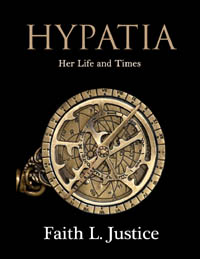
professor were in even greater dangery. Hypatia,
a professor of mathematics and philosophy became head of the
Platonic School in Alexandria around the year 400. Her lectures
were seen as a major threat by Christians. She is thought to
have invented a new type of astrolabe, an astronomical instrument,
but Christians made no distinction between science and magic. Pagan
professor were in even greater dangery. Hypatia,
a professor of mathematics and philosophy became head of the
Platonic School in Alexandria around the year 400. Her lectures
were seen as a major threat by Christians. She is thought to
have invented a new type of astrolabe, an astronomical instrument,
but Christians made no distinction between science and magic.
In those days there appeared in Alexandria a female philosopher,
a pagan named Hypatia, and she was devoted at all times to
magic, astrolabes and instruments of music, and she beguiled
many people through Satanic wiles.16
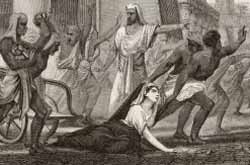 She
revised her father's learned commentary on Ptolemy's Almagest
and wrote her own commentaries on the works of Apollonius and
Diophantus. In 415 she was seized by monks and other followers
of Cyril, the local bishop. They stripped her and dragged her
naked through the streets to a church. They cut off chunks of
her flesh with sharp sea-shells until she was dead, and then
burned what was left of her body. (read
John's account here >). Pagans were horrified, Christians
delighted. For them Cyril was a hero. They dubbed him Theophilus
or “Lover of God”. He is now Saint Cyril. Hypatia's
works are "lost" - almost certainly destroyed as books
of sorcery by zealous Christians. She
revised her father's learned commentary on Ptolemy's Almagest
and wrote her own commentaries on the works of Apollonius and
Diophantus. In 415 she was seized by monks and other followers
of Cyril, the local bishop. They stripped her and dragged her
naked through the streets to a church. They cut off chunks of
her flesh with sharp sea-shells until she was dead, and then
burned what was left of her body. (read
John's account here >). Pagans were horrified, Christians
delighted. For them Cyril was a hero. They dubbed him Theophilus
or “Lover of God”. He is now Saint Cyril. Hypatia's
works are "lost" - almost certainly destroyed as books
of sorcery by zealous Christians.
 Another
great saint, St Augustine
of Hippo, often referred to as the Father of the Inquisition,
shared the opinion of his fellow saint and all right thinking
Christians: Another
great saint, St Augustine
of Hippo, often referred to as the Father of the Inquisition,
shared the opinion of his fellow saint and all right thinking
Christians:
The good Christian should beware of mathematicians and all
those who make empty prophecies. The danger already exists
that mathematicians have made a covenant with the Devil to
darken the spirit and confine man in the bonds of Hell17.
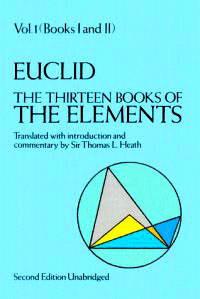
Because of such hostility, mathematics progressed only a little
beyond that of Euclid for many centuries. Indeed, the end of
the flowering of mathematics in the ancient world is usually
dated from the murder of Hypatia. How little progress was made
after her time is demonstrated by the continued use of Greek
textbooks. Euclid's Elements was still in common use
in Christian schools into the twentieth century, as were Hypatia's
astrolabes.
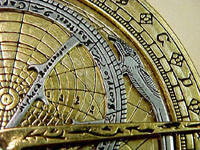 When
the cultivated Abbasid Caliph Haroun al-Rashid (he of the
One Thousand and One Nights) sent Charlemagne an astolabe
water clock in the early ninth century, Christians were horrified.
They did not recognise it as superior technology, merely as
a diabolical contraption designed to work some sort of Islamic
sorcery. When
the cultivated Abbasid Caliph Haroun al-Rashid (he of the
One Thousand and One Nights) sent Charlemagne an astolabe
water clock in the early ninth century, Christians were horrified.
They did not recognise it as superior technology, merely as
a diabolical contraption designed to work some sort of Islamic
sorcery.
The Church had its own use for mathematics. In the Middle Ages
almost all mathematical effort was directed towards calculating
the date of Easter, a matter that the Church believed to be
of the utmost importance. Complicated tables concerning so-called
golden numbers and the movements of imaginary moons, called
ecclesiastical moons, are still included in the Book of Common
Prayer for this purpose. Real mathematics was still a form of
diabolical magic, as was any use of Arabic numerals. In the
statutes of the "Arte del Cambio" in 1299 money changers
in Florence were forbidden the use of Arabic numerals, and were
obliged to use Roman ones'17a.
(It is only in the twenty first century that Christian theologians
have started to provide references to theological works using
arabic rather than roman numerals).
Michael Scot (1175 - c.1232) was a Scottish scholar. He knew
Latin, Greek, Arabic and Hebrew, but was most notable as a mathematician.
(The second version of Leonardo Fibonacci's famous book on Mathematics,
Liber Abaci, was dedicated to him). As a prominent mathematician
and proto-scientist he was believed by Christians to have been
a sorcerer or a magician, aided by demons. He supposedly feasted
on dishes brought fresh and hot brought by spirits from the
royal kitchens of distant countries. Other fanciful stories
were circulated. Scott once turned a coven of witches to stone
(they survive as a stone circle known as Long Meg and Her Daughters
near Penrith in Cumbria). He appears in Dante's Divine Comedy
(Inferno, canto 20.115-117) in the Eighth Circle of Hell reserved
for sorcerers, astrologers, and false prophets. Boccaccio represents
him similarly. He is represented as a magician with power over
demons in many other works, right up to Sir Walter Scott's The
Lay of the Last Minstrel.
When the concept of zero was introduced along with Arabic numerals
from the East, it was seen not as what it is, the most important
advance since ancient times but, in the words of William of
Malmsbury, as "dangerous Mohammedan magic". Zero was
literally satanic. As so often, the problem was that new learning
contradicted Aristotle. Aristotle had avoided ideas of zero
and infinity, and Christians thought they could not exist. To
them, the idea of zero looked to much like "nothing",
the empty void that God had done away with at the creation of
the world. Soon mathematicians and painters would extend their
heresy by discovering the concept of a vanishing point, and
the rules of perspective, advancing art to the level of classical
times. Even so, late medieval popes would lead an extended battle
against heretical zeros. Christian horror of the heretical concept
would resurface periodically as new discoveries were made, even
beyond the Middle ages: for example when a student of Galileo
discovered how to create a vacuum - a practical example of "nothingness"
in the real world - Christendom was riven by righteous horror
all over again.
|
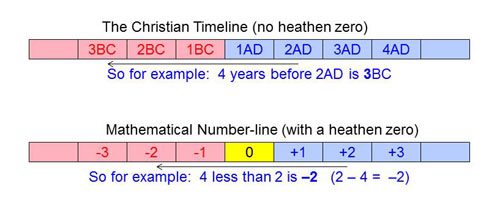
Christians were reluctant to abandon
Roman numerals and adopt Arabic numbers because of the
heathen associations. Along with a terror of the heathen
zero, this ensured that mathematics could not advance
significantly within Christendom.
Even today the Christian calendar does not recognise a
year zero:
|
|
|
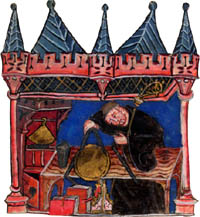 The
"Oxford Calculators" were a group of 14th-century
thinkers, almost all associated with Merton College, Oxford.
They took a logico-mathematical approach to philosophical problems.
When religious reformers cleaned up Oxford University they destroyed
an unknown number of mathematical and astronomical manuscripts
believing them to be conjuring books18.
It was almost certainly at this time that the great collection
of works of the Oxford Calculators disappeared. The
"Oxford Calculators" were a group of 14th-century
thinkers, almost all associated with Merton College, Oxford.
They took a logico-mathematical approach to philosophical problems.
When religious reformers cleaned up Oxford University they destroyed
an unknown number of mathematical and astronomical manuscripts
believing them to be conjuring books18.
It was almost certainly at this time that the great collection
of works of the Oxford Calculators disappeared.
In Tudor times mathematics was still a form of black magic,
and the terms conjure and calculate were used
as synonyms. Astrologers, conjurers and mathematicians were
regarded as being the same19.
In 1614 a Dominican preacher, Tommaso Caccini, could lampoon
Galileo and all mathematicians as magicians and enemies of the
faith.
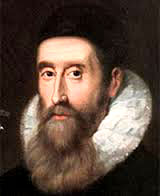 John
Dee (1527 – 1609) was a consultant to Queen Elizabeth I.
One of the most learned men of his age, he had lectured on advanced
algebra at the University of Paris while still in his early
twenties. He was also a respected astronomer, as well as an
expert in navigation (having trained many of those who would
conduct England's voyages of discovery). Doctor Dee straddled
the worlds of science and magic just as they were separating
into distinct magisteria - he was for example still interested
in the language of angels. In 1555, he was arrested and charged
with "calculating". He supposedly cast horoscopes
of Queen Mary and Princess Elizabeth. The charges were expanded
to treason against Mary. Dee exonerated himself in the Star
Chamber, but was turned over to the (Catholic) Bishop Bonner
for religious examination. A series of similar accusations and
slanders would dog him throughout his life, though he was relatively
safe after the death of Bloody Mary in 1558. He is remembered
in Christian mythology as a necromancer rather than a mathematician. John
Dee (1527 – 1609) was a consultant to Queen Elizabeth I.
One of the most learned men of his age, he had lectured on advanced
algebra at the University of Paris while still in his early
twenties. He was also a respected astronomer, as well as an
expert in navigation (having trained many of those who would
conduct England's voyages of discovery). Doctor Dee straddled
the worlds of science and magic just as they were separating
into distinct magisteria - he was for example still interested
in the language of angels. In 1555, he was arrested and charged
with "calculating". He supposedly cast horoscopes
of Queen Mary and Princess Elizabeth. The charges were expanded
to treason against Mary. Dee exonerated himself in the Star
Chamber, but was turned over to the (Catholic) Bishop Bonner
for religious examination. A series of similar accusations and
slanders would dog him throughout his life, though he was relatively
safe after the death of Bloody Mary in 1558. He is remembered
in Christian mythology as a necromancer rather than a mathematician.
John Napier (1550 – 1617), the inventor of logarithms,
also attracted criticism. He was regarded as a magician, and
was imagined to have dabbled in alchemy and necromancy. Ironically,
he invented logarithms for the most Christian of reasons, to
help him calculate the End of the World from the information
in the Book of Revelation.
 Even
in the eighteenth century scientists had to be wary of offending
churchmen. Newton's theory of fluxions, now generally called
differential calculus, the gateway to modern higher mathematics,
was perceived as a threat by leading churchmen. Bishop Berkeley
tried to refute Newton's ideas, seeing them as incompatible
with Christianity. Even then, in the eighteenth century, Berkeley
was complaining about Christians using "heathen zeros".
In 1734 he published a work entitled "The
Analyst; or, A Discourse Addressed to an Infidel Mathematician
..." directed against scientists like Edmund Halley.
In it he derides non-believing mathematicians with questions
such as "Whether the modern Analytics do not furnish a
strong argumentum ad hominem against the Philomathematical
Infidels of these Times". It is classic religious polemic,
similar to that produced by earlier bishops arguing against
Galileo, and to that of later bishops who would try to refute
Darwin. Even
in the eighteenth century scientists had to be wary of offending
churchmen. Newton's theory of fluxions, now generally called
differential calculus, the gateway to modern higher mathematics,
was perceived as a threat by leading churchmen. Bishop Berkeley
tried to refute Newton's ideas, seeing them as incompatible
with Christianity. Even then, in the eighteenth century, Berkeley
was complaining about Christians using "heathen zeros".
In 1734 he published a work entitled "The
Analyst; or, A Discourse Addressed to an Infidel Mathematician
..." directed against scientists like Edmund Halley.
In it he derides non-believing mathematicians with questions
such as "Whether the modern Analytics do not furnish a
strong argumentum ad hominem against the Philomathematical
Infidels of these Times". It is classic religious polemic,
similar to that produced by earlier bishops arguing against
Galileo, and to that of later bishops who would try to refute
Darwin.
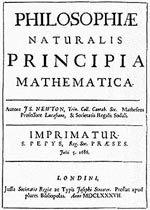
The only reason Newton himself did not come under greater attack
was that he concealed his true beliefs about Christianity (he
did not accept that Christ was divine) and made a point of stating
that he hoped his work would be useful to Christian apologists.
His greatest work, the Principia, was deliberately
written in an abstract style so that only mathematicians would
understand the implications of it.
 Christians
were also opposed to atomic theory, largely because the Greek
philosophers who had first proposed it had been atheists. These
philosophers had held that the world came into existence through
the natural interaction of atoms, and that life had developed
out of a primeval slime. Leucippus had first developed an atomic
theory, and it had been espoused by Democritus, Epicurus of
Samos and the Roman philosopher Lucretius. They held that there
is no purpose to the Universe and that everything is composed
of physically indivisible atoms, with empty space between them.
How else, they asked, could a knife cut an apple? If the apple
were solid matter such a thing would be impossible. Christians
were also opposed to atomic theory, largely because the Greek
philosophers who had first proposed it had been atheists. These
philosophers had held that the world came into existence through
the natural interaction of atoms, and that life had developed
out of a primeval slime. Leucippus had first developed an atomic
theory, and it had been espoused by Democritus, Epicurus of
Samos and the Roman philosopher Lucretius. They held that there
is no purpose to the Universe and that everything is composed
of physically indivisible atoms, with empty space between them.
How else, they asked, could a knife cut an apple? If the apple
were solid matter such a thing would be impossible.
Atoms were indestructible and were in perpetual motion, cannoning
off each other when they collided, or sometimes combining if
they interlocked. There were an enormous number of them, differing
in size, shape and heat, and governed by mechanical laws. When
men like Thomas Hobbes started to resurrect atomic theories
in the seventeenth century, Christians were alarmed by the revival
of this ancient horror. They were convinced that godlessness
was a necessary corollary of atomism20.
Perhaps they were right. The overwhelming majority of physicists
today are both atomists and atheists.
The religion that is afraid of science dishonours God and
commits suicide.
Ralph Waldo Emerson, Journals
 Animals
were an ever-increasing source of embarrassment to Christians.
For one thing it became difficult to believe that they had all
fitted into Noah's ark. As more and more species were discovered
it became more and more difficult to reconcile the facts. Where
was all the fodder stored, and what had the carnivores eaten
during the voyage? How were the tropical animals kept warm,
and the Arctic ones cold? How did Noah collect them all, and
how did they all get back home afterwards? Finally, why were
so many animals not mentioned in the Bible, God's infallible
and comprehensive encyclopaedia? Animals
were an ever-increasing source of embarrassment to Christians.
For one thing it became difficult to believe that they had all
fitted into Noah's ark. As more and more species were discovered
it became more and more difficult to reconcile the facts. Where
was all the fodder stored, and what had the carnivores eaten
during the voyage? How were the tropical animals kept warm,
and the Arctic ones cold? How did Noah collect them all, and
how did they all get back home afterwards? Finally, why were
so many animals not mentioned in the Bible, God's infallible
and comprehensive encyclopaedia?
Another problem was the question of why animals suffered, since
they had never sinned like Adam and Eve and incurred God's wrath.
One answer to this was that, despite appearances, they did not
suffer. They were mere soulless automatons, so it did not matter
what was done to them. This view has survived in the Roman Church
to this day. But if animals did not have souls, how could they
live at all? The answer to this was that they had a sort of
lesser soul, or spirit, or "vital force" much inferior
to a man's and even to a woman's , but indivisible just like
theirs21.
It was this spirit that animated them, just as souls animated
human beings. In the eighteenth century this theory came under
suspicion when it was discovered that movement persisted in
the hearts of animals after death. How was this movement possible
without an animating spirit? Again, muscle tissue, even when
removed from the body, would contract if pricked. But how could
tissue move without an animating spirit? Thinking people started
to suspect that life was not spiritual at all, but merely mechanical.
Such people were called materialists and were branded by the
Church as atheists.
Before Christians needed to counter evolutionary arguments
by claiming the need for divine creation of all animals, they
had been happy enough to adopt Aristotle's line that at least
some animals could be created spontaneously - without the agency
of gods or other animals. So for example rotting meat generated
maggots. Dirty laundry and wheat generated mice. These Aristotelian
ideas, once so central to Christian doctrine, had to be abandoned
in the nineteenth century. They had never been easy to reconcile
with the idea of animating spirits, and was now impossible to
reconcile to scientific discoveries, for example that maggots
do not appear in meat if flies are kept away.
The questions remained and indeed multiplied. If the human
personality was the outward manifestation of the human soul,
why was it affected by disease, or drugs, or food and drink?
For that matter why was it affected by age, or temperature,
or climate? Then in the 1740s Abraham Trembley discovered that
a freshwater polyp, or hydra, could regenerate itself when cut
into pieces. Did each piece have a spirit? If animal spirits
were divisible after all, why not human souls? For the time
being the question had to be left open, for inquisitive Christians
had still not yet succeeded in identifying the seat of the soul.
As soon as its physical location could be established, Christian
truth could be proved once and for all and the materialists
confounded. So far the search has been unsuccessful. The Churches
seem to have given up hope of identifying a biological soul,
and now deny that there is such a thing. Biologists long ago
switched to more productive areas of research.
Had I been present at the Creation, I would have given some
useful hints for the better ordering of the Universe. Attributed
to Alfonso "the Wise", king of Castile (1221-1284)
Leonardo da Vinci had suggested that Earth's past could be
explained by natural forces, but this suggestion was at odds
with the Christian view. God had made the world, and neither
it nor its inhabitants were mutable. Any theory that contradicted
this view was not to be countenanced. In the seventeenth century
the Bible was still the infallible source of all knowledge:
No one seeking to enquire into rocks or minerals, into Earth
history or the formation of Earth's configuration could afford
to ignore or deny the value of his primary source, the Bible22.
The immutability of Earth and its biology was to remain the
established view up to the nineteenth century. One factor that
constrained many pathways of thought was the chronology of Earth
and the Universe. The Jews had held that the world had been
created around 4000 BC (a belief that is still repeated at every
Rosh Hashanah and every Jewish wedding ceremony). Because of
an arithmetical error by a monk, it became accepted Church doctrine
that it had actually been created in 4004 BC. In the sixteenth
century Dr John Lightfoot, Vice-chancellor of Cambridge University
had even worked out the date and time: God started his creation
at 9 am on 23 rd October 4004 BC. Bishop Ussher's estimate in
the mid-seventeenth century differed by 3 hours. He placed the
time of creation at noon on the same day23.
A detailed chronology was worked out for the whole of the Bible,
with dates attributed to every event. Such chronologies were
accorded respect comparable to the biblical text itself. When
Thomas Paine pointed out the absurdities and contradictions
in the Bible in The Age of Reason, he laid considerable
stress on the absurdities of the received chronology. Both he
and his readers believed that an attack on these chronologies
was an attack on Christianity itself. Their common view was
that if the biblical chronologies were wrong, then Christianity
itself was discredited.
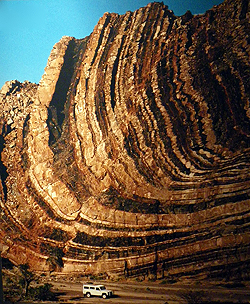 The
position that accepted biblical chronology could not be wrong
precluded any understanding of Earth sciences, or indeed any
possibility of initiating such sciences. That geological processes
took millions of years to shape Earth was unthinkable, as it
was unthinkable that evolution had been responsible for the
diversity of life on Earth. God did not make mistakes or change
his mind about his creation. Animal life was immutable. Mankind
had existed from the formation of Earth in 4004 BC, and so had
the various animal species. The rose red city of Petra was not
merely poetically half as old as time, but literally half as
old as time. Climate and geography were the same as they had
always been. God had created perfect animals, and allowed imperfect
ones like snakes, frogs and mice, to be made by demons or to
arise spontaneously from the process of putrefaction24. The
position that accepted biblical chronology could not be wrong
precluded any understanding of Earth sciences, or indeed any
possibility of initiating such sciences. That geological processes
took millions of years to shape Earth was unthinkable, as it
was unthinkable that evolution had been responsible for the
diversity of life on Earth. God did not make mistakes or change
his mind about his creation. Animal life was immutable. Mankind
had existed from the formation of Earth in 4004 BC, and so had
the various animal species. The rose red city of Petra was not
merely poetically half as old as time, but literally half as
old as time. Climate and geography were the same as they had
always been. God had created perfect animals, and allowed imperfect
ones like snakes, frogs and mice, to be made by demons or to
arise spontaneously from the process of putrefaction24.
Once again the Church was entirely mistaken, and ancient Greek
thinkers had been on the right track. Anaximander, a Greek born
over 600 years before Jesus, had had an inkling about evolution.
He said that land animals had developed from aquatic ones and
that mankind was descended from a different species. He reasoned
that human beings have such long infancies that they could not
always have survived as they do now. To Christians such ideas
were blasphemous. God's creation was immutable. There was no
possibility of change. Species could not evolve any more than
they could die out. God had ordained their existence, and God
did not make mistakes.
All manner of explanations were found for the existence of
fossils. The ones still popularly known as devil's toenails
were believed to be demonic nail parings (they are actually
the remains of bivalve molluscs of the genus Gryphaea).
Belemnites were the remnants of God's thunderbolts.
|
One of the Devil's millions
of discarded toe nails
|
Vestiges of
God's thunderbolts (Belemnites)
|
|
|
|
 Fossils
of ancient marine life found inland were explained by Noah's
flood which had supposedly washed them there. In medieval Europe,
fossilised ammonites were thought to be petrified coiled snakes.
They were called "snakestones" or "serpentstones".
They were considered to be evidence for the miraculous powers
of saints, such as Hilda of Whitby (this myth is mentioned in
Sir Walter Scott's Marmion). Serpentstones possessed
healing and oracular powers. To make the imposture more convincing,
traders would carve the head of a snake onto the wide end of
the ammonite fossil, and then sell them to credulous Christians.
In some cases, the snake's head would be simply painted on. Fossils
of ancient marine life found inland were explained by Noah's
flood which had supposedly washed them there. In medieval Europe,
fossilised ammonites were thought to be petrified coiled snakes.
They were called "snakestones" or "serpentstones".
They were considered to be evidence for the miraculous powers
of saints, such as Hilda of Whitby (this myth is mentioned in
Sir Walter Scott's Marmion). Serpentstones possessed
healing and oracular powers. To make the imposture more convincing,
traders would carve the head of a snake onto the wide end of
the ammonite fossil, and then sell them to credulous Christians.
In some cases, the snake's head would be simply painted on.
|
An Ammonite
|
An Ammonite carved to look like a snake
miraculously turned to stone by the supernatural power
of a saint
|
|
|
|
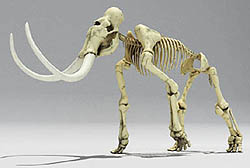 In
the seventeenth century skeletal remains of mammoths were discovered
in England. These remains were also attributed to the flood,
but not everyone saw the explanation as wholly satisfactory.
Another possibility was that they were the remains of elephants
that had been brought over by the Romans, but this was not viable
either, and neither was the theory that they were the bones
of giants ("There were giants in the earth in those days....
" (Genesis 6:4)). Other discoveries contributed to the
confusion. Fossils found in Germany in 1696 had to be dismissed
as a "sport of nature", which was hardly a satisfactory
explanation. In
the seventeenth century skeletal remains of mammoths were discovered
in England. These remains were also attributed to the flood,
but not everyone saw the explanation as wholly satisfactory.
Another possibility was that they were the remains of elephants
that had been brought over by the Romans, but this was not viable
either, and neither was the theory that they were the bones
of giants ("There were giants in the earth in those days....
" (Genesis 6:4)). Other discoveries contributed to the
confusion. Fossils found in Germany in 1696 had to be dismissed
as a "sport of nature", which was hardly a satisfactory
explanation.
|
Fossilised Sea urchins like this
were believed to be fairy loaves,
and hence to be avoided as Satanic.
|
Fossilised remains of trilobites were
thought to be butterflies turned to stone by Merlin. Around
Delabole in Cornwall they are known as Delabole Butterflies.
|
|
|
|
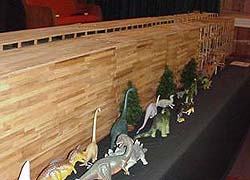 As
early as the 1740s the Swedish taxonomist Linnaeus had realised
that the 5,600 species he had named could not possibly have
been accommodated by Noah's ark. In the second half of the century
Robert Hooke theorised that species were mutable and liable
to extinction25.
He and others who took an interest in geology incurred the antagonism
of churchmen for such ideas. The systematic cataloguing of fossils
gave support to Hooke's views, for it became increasingly obvious
that species had indeed become extinct. Christian teaching was
also undermined by animal remains found in places with currently
unsuitable climates. As
early as the 1740s the Swedish taxonomist Linnaeus had realised
that the 5,600 species he had named could not possibly have
been accommodated by Noah's ark. In the second half of the century
Robert Hooke theorised that species were mutable and liable
to extinction25.
He and others who took an interest in geology incurred the antagonism
of churchmen for such ideas. The systematic cataloguing of fossils
gave support to Hooke's views, for it became increasingly obvious
that species had indeed become extinct. Christian teaching was
also undermined by animal remains found in places with currently
unsuitable climates.
In 1785 James Hutton "the father of modern geology"
published his theory that the earth must be millions of years
old. All of the Christian Churches were outraged and opposed
him as they opposed all scientific theories that contradicted
the bible. As Hutton's biographer put it 26:
The extraordinary hold of the Bible prevented genuine freethinking
about the history and working of the planet, and the few open-minded
scientists who did emerge were quickly censured by the church.
Theologians had always claimed that their divine encyclopædia
was not only infallible but also comprehensive. It contained
all world knowledge. This belief was sustained for centuries
in the face of unforeseen discoveries. It even survived the
unexpected discovery of the Americas but was dealt a fatal blow
by the discovery of Australasia. In the eighteenth century,
Christians were at a loss to explain how the existence of a
whole continent could have been omitted from their comprehensive
encyclopædia*. Particularly
embarrassing was the fact that earlier Christians had executed
men for affirming that there existed undiscovered habitable
lands on the other side of the world. Persecutors had justified
themselves by reference to the Bible's infallibility and comprehensiveness.
Now it was clear that they had been wrong, and the heretics
had been right. For a while, the devout searched for explanations,
loopholes, anything to reconcile the contradictions. None was
convincing, and ever more geological discoveries were being
made. By the nineteenth century the Church's traditional teachings
had become untenable, but geologists and other academics were
still being deprived of their careers for mentioning it.
Architecture and Engineering
Stone buildings that had been built extensively for private
and public purposes were now abandoned. Existing public buildings
(forums, libraries, odeons, theatres, museums, stadia, hippodromes,
circuses, schools, gymnasia, temples, baths, Roman amphitheatres
etc.) were often vandalised or destroyed. Many building techniques
were forgotten once Christianity dominated society. Technological
innovations were now limitted to military and ecclesiastical
structures. The best roads, viaducts, aquaducts in medieval
times were all survivors from Roman times - rarely maintained
or replaced, never superceded.
Impressive old structures, if not taken over or destroyed,
were now considered to be inhabitted by demons, and their construction
was attributed to demons, or to the Devil himself. Any impressive
bridge was likely to be called "The Devil's Bridge",
even if had only recently been built. There are still some 50
ponts du Diable in France alone. The same story is almost
always associated with these bridges: Someone made a contract
with the Devil. The contract stipulated that the Devil would
build the bridge in return for the soul of the first living
thing to cross the bridge. The Devil built the bridge but was
tricked by the other party sending a dog over it. Engineering,
like mathematics, or any form of cleverness, was necessarily
demonic.
|
The Devil’s Bridge, spanning the
River Lune, Kirkby Lonsdale, Cumbria, England,
built in the 12th or 13th Century. One of hundreds of
"devil's bridges" in Europe.
|
 |
Do you really believe that the sciences would ever have originated
and grown if the way had not been prepared by magicians, alchemists,
astrologers and witches ...
Friedrich Wilhelm Nietzsche (1844-1900), The Gay Science
Once Aristotle had found favour with the Christian Church,
his theory that earthly matter was composed of four elements
— earth, air, water and fire — was adapted and clung
to despite its flaws. Any real investigation into the chemical
properties of matter was suppressed. Those who tried were branded
as alchemists and risked the censure of the Church authorities,
although the possibility of transmuting lead into gold seems
to have been too much of an attraction for many churchmen. Some
employed professional alchemists: others practised alchemy themselves.
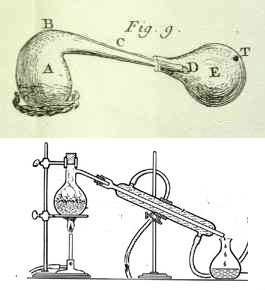 Alchemists
are sometimes dismissed as little more than conjurers, but the
fact is that, until chemistry emerged as a science in the wake
of the Enlightenment, it was alchemists who made whatever progress
was made in the field of chemistry. Alchemists were familiar
with elements such as sulphur, arsenic, antimony, mercury, gold,
silver and other metals. They knew that arsenic was poisonous,
despite the fact that it promotes growth and increases appetite.
If conventional Christian physicians had known as much, quite
a few people over the centuries might have enjoyed longer lives.
Alchemists created compounds from elements, for example cinnabar
(mercuric sulphide). They knew about acids such as vitriol (sulphuric
acid), aqua fortis (nitric acid) and aqua regia (a mixture of
nitric and hydrochloric acids). They used these acids, and other
methods, to refine metals. They employed techniques such as
distillation to produce aqua vitæ, alcohol distilled to
a high proof. They used saltpetre (potassium nitrate) to make
gunpowder. One of them, Böttger (c.1682-1719) discovered
how to make porcelain. They developed scientific theories about
chemical reactions. The specialist equipment they developed
can still be identified in modern laboratories. Alchemists
are sometimes dismissed as little more than conjurers, but the
fact is that, until chemistry emerged as a science in the wake
of the Enlightenment, it was alchemists who made whatever progress
was made in the field of chemistry. Alchemists were familiar
with elements such as sulphur, arsenic, antimony, mercury, gold,
silver and other metals. They knew that arsenic was poisonous,
despite the fact that it promotes growth and increases appetite.
If conventional Christian physicians had known as much, quite
a few people over the centuries might have enjoyed longer lives.
Alchemists created compounds from elements, for example cinnabar
(mercuric sulphide). They knew about acids such as vitriol (sulphuric
acid), aqua fortis (nitric acid) and aqua regia (a mixture of
nitric and hydrochloric acids). They used these acids, and other
methods, to refine metals. They employed techniques such as
distillation to produce aqua vitæ, alcohol distilled to
a high proof. They used saltpetre (potassium nitrate) to make
gunpowder. One of them, Böttger (c.1682-1719) discovered
how to make porcelain. They developed scientific theories about
chemical reactions. The specialist equipment they developed
can still be identified in modern laboratories.
It was alchemists who originated the theory that combustion
involved phlogiston. In this case they were wrong, but they
had formulated a scientifically testable theory, and in testing
it the element oxygen was discovered. The alchemist Theophrastus
Bombastus von Hohenheim (1493-1541) alone arguably did more
for medicine than all approved Church physicians put together
over one and a half millennia. Aware of his own abilities he
called himself Paracelsus because he believed himself to have
surpassed Celsus, the early anti-Christian polymath. Paracelsus
started the battle between scientific medicine and the atrophied
Church version of Galenic medicine. The Church regarded him
as an enemy, and the feeling was reciprocated (Paracelsus likened
Luther and the Pope to two whores discussing chastity ). Iron
and other elements , copper sulphate and potassium sulphate
were added to pharmacopœia through Paracelsus , and he
was the first to realise a connection between goitre and cretinism.
He made advances on many fronts, learning from herbalists and
wise-women. He rejected the idea of panaceas in favour of specific
medical treatments.
|
Most, if not all, scientific advances
were attributable to the Devil and his demons, even those
by churchmen. This illustration depicts the Devil showing
a Franciscan friar (Berthold Schwarz) how to make gunpowder.
Science Museum, Science & Society Picture Library,
Image No. 10267853
|
|
|
|
. This illustration depicts demons showing
a Franciscan friar (Berthold Schwarz) how to make gunpowder
and his assistant how to use it..
Johann Stumpf, Zürich, Christoffel Forschouer M.D.XLVII.
Band II, 419 recto.
|
|
|
Alchemy was proto-chemistry, and as such attracted the attention
of distinguished scientists. Although Robert Boyle publicly
discredited alchemy he believed in its fundamental objective,
transmutation, and wrote at least two treatises on the subject.
Newton suspected that Boyle's role in repealing a statute against
alchemy had been inspired by his own transmutation experiments27.
Newton was himself an advocate of alchemy, and was widely criticised
for it. At every step alchemists and proto-chemists faced opposition
from the Church and its physicians. Chemistry emerged as a separate
scientific discipline only in the nineteenth century, just after
the Church had lost its power to prohibit independent research.
And the prayer of faith shall save the sick.... James 5:14-15
Herbalists had existed since ancient times, and herbalism was
known everywhere. The Mesopotamians, for example, knew about
hellebore, hyoscyamus, mandrake and opium. The founder of pharmacology
is generally regarded as an ancient Greek, Dioscorides, whose
work was known in Latin as De Materia Medica. It detailed
some six hundred plants and almost a thousand drugs. Such knowledge
was scorned by the Church, as were contemporary herbalists.
Like alchemists, they were often accused of practising witchcraft.
Had churchmen taken a more positive interest they might have
learned that witches' sabbats owed their existence more to hallucinogens
such as hyoscine than to Satan. They might also have learned
that naturally occurring compounds can be used as antibiotics
and anaesthetics. Mandrake, hemp and poppy were all alkaloids
traditionally used as anaesthetics. As well as hyoscine (scopolamine),
modern drugs such as picrotoxin, serpasil and cocaine were all
documented in ancient pharmacopœias.
 Frazier's
famous Golden Bough, mistletoe, also known as all-heal,
was used for remedies throughout Europe. The Church shunned
it because of its pagan connotations. Ivy too was used for medicinal
purposes, being a diaphoretic and cathartic. Willow bark provided
an early version of aspirin for fevers and headaches28.
Again, herbalists had known for centuries that dried foxglove
leaves could be used to treat heart conditions, but it was not
until 1775 that a botanist, William Withering, having learned
the use of foxgloves (Digitalis purpurea) for treating
dropsy from an old woman, introduced digitalis into orthodox
medicine. Frazier's
famous Golden Bough, mistletoe, also known as all-heal,
was used for remedies throughout Europe. The Church shunned
it because of its pagan connotations. Ivy too was used for medicinal
purposes, being a diaphoretic and cathartic. Willow bark provided
an early version of aspirin for fevers and headaches28.
Again, herbalists had known for centuries that dried foxglove
leaves could be used to treat heart conditions, but it was not
until 1775 that a botanist, William Withering, having learned
the use of foxgloves (Digitalis purpurea) for treating
dropsy from an old woman, introduced digitalis into orthodox
medicine.
For many centuries the Church clung to the theory of signatures.
Theologians taught that God had created certain plants with
magical medicinal properties and that he had left clues to these
properties. Thus a yellow blossom would cure jaundice, and a
red one could improve the blood. A root shaped like a foot would
relieve gout. Like so many other beliefs of the Church, this
one was utterly mistaken and served only to hold up progress.
Objective research was pointless because the Church already
knew the answers. Pharmacy therefore remained static, confined
in a straitjacket of error.
 The
Church retarded and even regressed other areas of medicine,
rejecting sophisticated rational ideas of ancient times. Ancient
peoples had practised surgery, including cataract operations,
brain surgery and plastic surgery. They used ligatures. They
were aware of the importance of public health and personal hygiene.
Followers of Hippocrates held that every illness has a natural
cause. Christianity rejected all of this. In their view illness
was indisputably caused by sin, diabolical possession, witchcraft
and other satanic forces. To deny it was to invite the attentions
of the Inquisition. Those who carried out medical research were
therefore constantly at risk. Men such as Leonardo DA Vinci
were obliged to carry out research in secret. Any publicity
was dangerous. The man who recognised mental illness as the
explanation for diabolical possession was persecuted and obliged
to flee for his life. Anyone who adopted Hippocratic techniques
was regarded as a heretic. Medical assistance was an attempt
to confound the will of God. A professor of medicine at Bologna
who used skin grafts for plastic surgery was charged with impiety.
Powerful churchmen forbade vaccination during smallpox epidemics
because it was "against the natural law". Anaesthesia
was prohibited on the grounds that if God meant us to suffer,
then we ought to accept the suffering and not seek to ameliorate
it. It was better that a woman with an ectopic pregnancy should
die, in accordance with God's will, than that an operation should
be performed. Christian morality informed official medicine.
So it was that Christian physicians adopted the view that sexual
activity was responsible for all manner of physical ills, a
view that even minimal scientific research could have discredited
centuries ago. The
Church retarded and even regressed other areas of medicine,
rejecting sophisticated rational ideas of ancient times. Ancient
peoples had practised surgery, including cataract operations,
brain surgery and plastic surgery. They used ligatures. They
were aware of the importance of public health and personal hygiene.
Followers of Hippocrates held that every illness has a natural
cause. Christianity rejected all of this. In their view illness
was indisputably caused by sin, diabolical possession, witchcraft
and other satanic forces. To deny it was to invite the attentions
of the Inquisition. Those who carried out medical research were
therefore constantly at risk. Men such as Leonardo DA Vinci
were obliged to carry out research in secret. Any publicity
was dangerous. The man who recognised mental illness as the
explanation for diabolical possession was persecuted and obliged
to flee for his life. Anyone who adopted Hippocratic techniques
was regarded as a heretic. Medical assistance was an attempt
to confound the will of God. A professor of medicine at Bologna
who used skin grafts for plastic surgery was charged with impiety.
Powerful churchmen forbade vaccination during smallpox epidemics
because it was "against the natural law". Anaesthesia
was prohibited on the grounds that if God meant us to suffer,
then we ought to accept the suffering and not seek to ameliorate
it. It was better that a woman with an ectopic pregnancy should
die, in accordance with God's will, than that an operation should
be performed. Christian morality informed official medicine.
So it was that Christian physicians adopted the view that sexual
activity was responsible for all manner of physical ills, a
view that even minimal scientific research could have discredited
centuries ago.
And Noah was five hundred years old: and Noah begat Shem,
Ham, and Japheth. Genesis 5:32
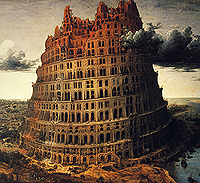 The
Church taught that human language was a gift from God, and the
fact that there were many languages was explained by reference
to the Bible — that infallible encyclopædia of all
world knowledge. The story was that for a while after the flood
all people spoke the same language (Genesis 11:1). When people
attempted to build a tower reaching up to Heaven, God confounded
their plan by making them speak different languages. The story
of this tower, the so-called Tower of Babel, thus accounted
for the world's different languages. No better explanation was
possible until the Church lost its absolute control on the subject. The
Church taught that human language was a gift from God, and the
fact that there were many languages was explained by reference
to the Bible — that infallible encyclopædia of all
world knowledge. The story was that for a while after the flood
all people spoke the same language (Genesis 11:1). When people
attempted to build a tower reaching up to Heaven, God confounded
their plan by making them speak different languages. The story
of this tower, the so-called Tower of Babel, thus accounted
for the world's different languages. No better explanation was
possible until the Church lost its absolute control on the subject.
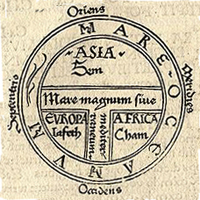 The
first important steps in philology were taken by Johann Herder,
a student of Immanuel Kant, in an essay published in 1772. For
the first time the topic was approached rationally, and the
origin and development of languages investigated. Still, it
was always politic to mantle advances in biblical lore. A convenient
and enduring story was that three important language groups
were derived from Noah's three sons: Ham, Shem and Japheth.
It had long been held that they had given rise to the populations
of Africa, Asia and Europe respectively. With a little development
this idea could be adopted to label the known family groups.
Ham's descendants spoke Hamitic, an African family of languages
including Egyptian and Berber. Shem's descendants spoke Semitic,
a Middle Eastern family including Hebrew and Arabic, and Japheth's
spoke Japhetic, a group that broadly corresponds to the Indo-European
family of languages. This whole theory is now totally discarded
- there are many more than three main language groups. We have
two reminders of the biblical theory. The first is that we still
refer to a genuine language group as Semitic. The second is
that there are still a few traditionalist Christians who regard
black Africans as descendants of Ham, cursed by God with a black
skin, and suitable only for lives as slaves.
This biblical ancestry from Ham is cited as a Christian
justification for other racist
views. The
first important steps in philology were taken by Johann Herder,
a student of Immanuel Kant, in an essay published in 1772. For
the first time the topic was approached rationally, and the
origin and development of languages investigated. Still, it
was always politic to mantle advances in biblical lore. A convenient
and enduring story was that three important language groups
were derived from Noah's three sons: Ham, Shem and Japheth.
It had long been held that they had given rise to the populations
of Africa, Asia and Europe respectively. With a little development
this idea could be adopted to label the known family groups.
Ham's descendants spoke Hamitic, an African family of languages
including Egyptian and Berber. Shem's descendants spoke Semitic,
a Middle Eastern family including Hebrew and Arabic, and Japheth's
spoke Japhetic, a group that broadly corresponds to the Indo-European
family of languages. This whole theory is now totally discarded
- there are many more than three main language groups. We have
two reminders of the biblical theory. The first is that we still
refer to a genuine language group as Semitic. The second is
that there are still a few traditionalist Christians who regard
black Africans as descendants of Ham, cursed by God with a black
skin, and suitable only for lives as slaves.
This biblical ancestry from Ham is cited as a Christian
justification for other racist
views.
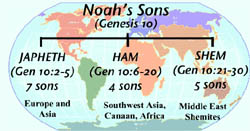 The
first genuine steps in comparative philology came in the Eighteenth
century. Relationships within the Indo-European family were
first identified and explained by William Jones (1746 –
1794). Greeks and Romans had been aware of similarities between
various languages. Stoics and Alexandrian philosophers had theorised
about the origins of language and developed the study of comparative
linguistics. Without the coming of Christianity they might well
have carried out important comparative studies, for example
identifying the principal language groups, and perhaps making
discoveries that are now impossible. Knowledge of languages
such as Hittite, Etruscan, Gothic and Pictish is now lost, probably
forever. As in so many areas of science, it is quite possible
that the Greeks or Romans did carry out important work, and
that it was destroyed by later Christians because it contradicted
their own biblical explanation. The
first genuine steps in comparative philology came in the Eighteenth
century. Relationships within the Indo-European family were
first identified and explained by William Jones (1746 –
1794). Greeks and Romans had been aware of similarities between
various languages. Stoics and Alexandrian philosophers had theorised
about the origins of language and developed the study of comparative
linguistics. Without the coming of Christianity they might well
have carried out important comparative studies, for example
identifying the principal language groups, and perhaps making
discoveries that are now impossible. Knowledge of languages
such as Hittite, Etruscan, Gothic and Pictish is now lost, probably
forever. As in so many areas of science, it is quite possible
that the Greeks or Romans did carry out important work, and
that it was destroyed by later Christians because it contradicted
their own biblical explanation.
Philosophy for Philosophers, Religion for the rest Averroës
(1126-1198)
 Philosophy
is another discipline that flourished in the ancient world.
Christians did not like it, mainly because philosophers often
arrived at conclusions inimical to the Christian faith. Some
Greek and Roman philosophers saw the gods as human inventions
and religion as an unnecessary evil. Diagoras of Melos, Lucian,
Socrates, Anaxagoras and Seneca were all religious doubters.
Leucippus held the belief (anathema to later Christians) that
there were natural laws in the Universe. Democritus, anticipating
the modern anthropologist's discovery of sky gods, suggested
that religion was just a primitive personification of natural
phenomena like thunder and lightning. Others noted that important
beneficial things tended to be deified — things like fire
and water, or the Sun and Moon. One surviving fragment of text
suggests that the gods were a deliberate human intervention
introduced to encourage good behaviour29.
Epicurus of Samos (c.341-270 BC) saw good and evil as human
conceptions and regarded religion as an unnecessary cause of
fear. His primary motivation for studying nature was to rid
the world of its superstition. Lucretius, a Roman philosopher,
advocated morality without religion in his great poetic work
De Rerum Natura. All of these ideas find echoes in
modern thought. Philosophy
is another discipline that flourished in the ancient world.
Christians did not like it, mainly because philosophers often
arrived at conclusions inimical to the Christian faith. Some
Greek and Roman philosophers saw the gods as human inventions
and religion as an unnecessary evil. Diagoras of Melos, Lucian,
Socrates, Anaxagoras and Seneca were all religious doubters.
Leucippus held the belief (anathema to later Christians) that
there were natural laws in the Universe. Democritus, anticipating
the modern anthropologist's discovery of sky gods, suggested
that religion was just a primitive personification of natural
phenomena like thunder and lightning. Others noted that important
beneficial things tended to be deified — things like fire
and water, or the Sun and Moon. One surviving fragment of text
suggests that the gods were a deliberate human intervention
introduced to encourage good behaviour29.
Epicurus of Samos (c.341-270 BC) saw good and evil as human
conceptions and regarded religion as an unnecessary cause of
fear. His primary motivation for studying nature was to rid
the world of its superstition. Lucretius, a Roman philosopher,
advocated morality without religion in his great poetic work
De Rerum Natura. All of these ideas find echoes in
modern thought.
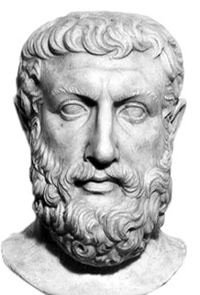 Greek
philosophers such as Xenophanes and Parmenides took the view
that there was only one god. It was also clear to them that
to be true, a religion must be equally available to all people.
It was a commonplace in the fourth century BC that the gods
were all one. Like modern Christian theologians, educated people
in the Hellenic world interpreted their religion in terms of
sophisticated myths and timeless psychological truths. Platonic
philosophers thought about the nature of God and speculated
that it might be the cosmos, masquerading under another name.
The similarity with modern pantheistic ideas of God is striking.
As Lucan wrote when Christianity was still an obscure Jewish
sect: Greek
philosophers such as Xenophanes and Parmenides took the view
that there was only one god. It was also clear to them that
to be true, a religion must be equally available to all people.
It was a commonplace in the fourth century BC that the gods
were all one. Like modern Christian theologians, educated people
in the Hellenic world interpreted their religion in terms of
sophisticated myths and timeless psychological truths. Platonic
philosophers thought about the nature of God and speculated
that it might be the cosmos, masquerading under another name.
The similarity with modern pantheistic ideas of God is striking.
As Lucan wrote when Christianity was still an obscure Jewish
sect:
Is the abode of God anywhere but in the earth, and sea, and
sky, and air, and virtue? Why do we seek heavenly ones beyond?
Whatever you see, and whatever you touch, that is Jupiter30.
Early Christians, lacking any philosopher of note, initially
attached themselves to the Neo-Platonic school but contributed
little - arguably nothing. Christians knew that there was only
one path to truth, and that it was theirs. Philosophy was therefore
at best mistaken and at worst positively evil. According to
one Christian theory, philosophy was not even a human enterprise.
It was the product of fallen angels, wickedly sharing the secrets
of Heaven with the ungodly. So it was that philosophers were
persecuted, and philosophy abandoned.
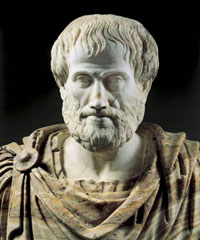 In
the twelfth century Western Christendom rediscovered Aristotle.
The problem was that he seemed to be right about so many things,
yet some of them appeared to contradict known biblical truths.
Plato was abandoned and attempts were made to reconcile Christianity
with Aristotelian thought. These attempts appeared to have succeeded
for a while in the thirteenth century when Thomas Aquinas synthesised
Aristotelian reason and Christian faith. Philosophical investigations
were now reduced to the sort of speculation popularly characterised
by questions such as how many angels could dance on the point
of a needle, and whether the damned shed real tears in Hell.
This sort of speculation characterised a type of philosophy
called scholasticism. It was as near as theologians ever came
to anything like ancient or modern philosophy. Even at the time,
it was recognised as absurd. Thomas More described scholastic
theology as milking a billygoat into a sieve. It is no mere
chance that a leading medieval Christian philosopher, Duns Scotus,
a genuinely intelligent man, has had his name turned into the
word dunce. In
the twelfth century Western Christendom rediscovered Aristotle.
The problem was that he seemed to be right about so many things,
yet some of them appeared to contradict known biblical truths.
Plato was abandoned and attempts were made to reconcile Christianity
with Aristotelian thought. These attempts appeared to have succeeded
for a while in the thirteenth century when Thomas Aquinas synthesised
Aristotelian reason and Christian faith. Philosophical investigations
were now reduced to the sort of speculation popularly characterised
by questions such as how many angels could dance on the point
of a needle, and whether the damned shed real tears in Hell.
This sort of speculation characterised a type of philosophy
called scholasticism. It was as near as theologians ever came
to anything like ancient or modern philosophy. Even at the time,
it was recognised as absurd. Thomas More described scholastic
theology as milking a billygoat into a sieve. It is no mere
chance that a leading medieval Christian philosopher, Duns Scotus,
a genuinely intelligent man, has had his name turned into the
word dunce.
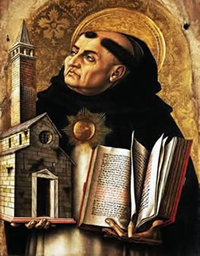 Aquinas's
carefully constructed synthesis was soon being weakened by the
facts, an inconvenient phenomenon since it was recognised that
"truth cannot contradict truth". Within a generation
his synthesis was fatally undermined by William of Occam, but
a façade was propped up until its Aristotelian foundations
were demolished by Galileo and Kepler and the whole edifice
was consigned to history's rubble tip. Aquinas's
carefully constructed synthesis was soon being weakened by the
facts, an inconvenient phenomenon since it was recognised that
"truth cannot contradict truth". Within a generation
his synthesis was fatally undermined by William of Occam, but
a façade was propped up until its Aristotelian foundations
were demolished by Galileo and Kepler and the whole edifice
was consigned to history's rubble tip.
The philosophical theories of the Roman Church thus became
untenable, yet have never been formally abandoned31.
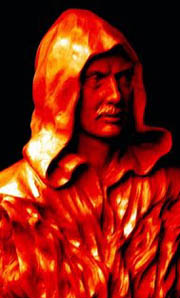 Apart
from the work of William of Occam, it is fair to say that virtually
no significant advances were made during the many centuries
that scholastic theology dominated philosophy under the Christian
Church. In fact many philosophers would say that no substantial
advance was made between the time of Aristotle and the eighteenth
century. Any churchman who looked as though he might make a
useful contribution was silenced. We have already seen what
happened to William of Occam himself and to men like him: Pierre
Abélard, Roger Bacon, Nicolaus Copernicus, Giordano Bruno
and Michael Servetus32. Apart
from the work of William of Occam, it is fair to say that virtually
no significant advances were made during the many centuries
that scholastic theology dominated philosophy under the Christian
Church. In fact many philosophers would say that no substantial
advance was made between the time of Aristotle and the eighteenth
century. Any churchman who looked as though he might make a
useful contribution was silenced. We have already seen what
happened to William of Occam himself and to men like him: Pierre
Abélard, Roger Bacon, Nicolaus Copernicus, Giordano Bruno
and Michael Servetus32.
Sir Francis Bacon (1561-1626) pioneered the scientific inductive
method of inferring general laws from the observation of phenomena.
Soon, men like Hobbes and Spinoza revived genuine philosophy
outside the Church. In the coming centuries sceptics like Voltaire,
Locke, Hume and J. S. Mill would turn it back into a genuine
academic discipline. The Enlightenment would end the period
of domination of philosophy by the Church's scholasticism. Once
again, competing schools would flourish, as they had done 2,000
years earlier under the ancient Greeks.
As the following table shows, the Catholic Church tried to
suppress almost all original philosophers through its Index
Librorum Prohibitorum maintained by the Sacred Congregation
of the Index (censorship police), created in 1559 and abandoned
in 1995.
|
Greatest Philosophers33.
(Western, medieval - 1965 AD)
|
Philosophers on the Index
Librorum Prohibitorum ("Index" or List of
Prohibited Books)
(Western, medieval - 1965 AD)
|
|
Peter Abelard
Roger Bacon
Thomas Aquinas
Erasmus
Montaigne
Giordano Bruno
Thomas Hobbes
René Descartes
Blaise Pascal
Baruch Spinoza
Locke
Leibniz
Berkeley
Montesquieu
Voltaire
Hume
Rousseau
Diderot
Helvétius
Condillac
d'Alembert
d'Holbach
Kant
Condorcet
Bentham
Hegel
Schopenhauer
John Stuart Mill
Kierkegaard
Nietzsche
Russell
Wittgenstein
Jean-Paul Sartre
|
Peter Abelard
-
-
Erasmus
Montaigne
Giordano Bruno
Thomas Hobbes
René Descartes
Blaise Pascal
Baruch Spinoza
Locke
-
Berkeley
Montesquieu
Voltaire
Hume
Rousseau
Diderot
Helvétius
Condillac
d'Alembert
d'Holbach
Kant
Condorcet
-
-
-
John Stuart Mill
-
-
-
-
Jean-Paul Sartre
|
 The
Church dominated philosophy for centuries and produced almost
nothing that modern philosophers recognise as useful or even
meaningful. By contrast, the works of the ancient Greeks are
still studied intensively and feature in university courses.
So are the works of Spinoza, Locke and Hume. Their intellectual
successors, Bertrand Russell and G. E. Moore, developed an analytical
philosophy that encompassed contemporary work at Oxford, Cambridge
and Vienna and is now the world's largest philosophical movement.
The works of Voltaire and Hobbes are long-term best sellers. The
Church dominated philosophy for centuries and produced almost
nothing that modern philosophers recognise as useful or even
meaningful. By contrast, the works of the ancient Greeks are
still studied intensively and feature in university courses.
So are the works of Spinoza, Locke and Hume. Their intellectual
successors, Bertrand Russell and G. E. Moore, developed an analytical
philosophy that encompassed contemporary work at Oxford, Cambridge
and Vienna and is now the world's largest philosophical movement.
The works of Voltaire and Hobbes are long-term best sellers.
Scholasticism on the other hand is now barely recognised as
philosophy at all, except by some conservative theologians.
Otherwise it is of interest only to historians.
|
|
|
|
|
|
|
|
|
|
|
|
|
|
|
|
|
|
|
|
|
|
|
|
|
|
|
|
|
|
|
|
|
|
|
|
|
|
Buy the Book from Amazon.com
|
|
|
|
|
|
Buy the Book from Amazon.co.uk
|
|
|
| |
| |
| More Books |
|
|
|