| |
|
|
The principle of the Inquisition was
murderous ... The popes were not only murderers in the
great style, but they also made murder a legal basis
of the Christian Church and a condition for salvation.
|
|
Lord Acton (1834-1902)
|
The term Inquisition is somewhat misleading in that over the
centuries there have been a number of inquisitions. They have
been directed against all of the groups we have looked at —
Pagans and supposed
Witches, dissenting
sects, Cathars,
Jews, Heretics,
Philosophers,
Freethinkers, Blasphemers,
Apostates,
Humanists,
Pantheists,
Unitarians,
Deists and
Atheists
as well as Muslims, Hindus and members of other religions.
In 1184 Pope Lucius III and the Emperor Frederick formulated
a programme for the repression of heretics. This document, Ad
abolendum, is sometimes known as the charter of the Inquisition,
because it set the tone for future developments. The Fourth
Lateran Council in 1215 ordered all bishops to hold an annual
inquisition, if there was a suspicion of heresy in their See.
But these Episcopal inquisitions were found to be inadequate
for the task.
The Medieval Inquisition
A roving papal Inquisition was set up in 1231 by Pope Gregory
IX. He extended existing legislation against heretics and introduced
the death penalty for them — indeed for anyone who dissented
from his views. Initially intended to be temporary, this Inquisition
was used to extirpate surviving Cathars in the Languedoc. Anyone
accused or "defamed" was treated as guilty, and no
one once defamed got off without some punishment. After 1227
inquisitorial commissions were granted only to the friars, usually
to the Dominicans. The Inquisition was now the "Dominican
Inquisition". Dominic Guzmán's threats of slavery
and death for the citizens of the Languedoc were fulfilled for
a second time. First the massacres, now the Inquisition. The
Bishop of Toulouse marked the canonisation of St Dominic on
his first Saint's Day (4 th August 1234) by burning a woman
for her Cathar beliefs. She had confessed to him as she lay
sick in bed with a fever. She was carried to a field, still
on her sickbed, and consigned to the flames, without any trial.
The churchmen then repaired for their celebratory mbanquet,
at which they thanked Saint Dominic for his miraculous assistance.1.
|
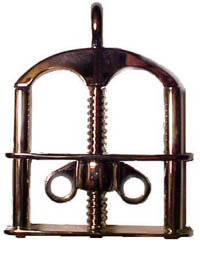
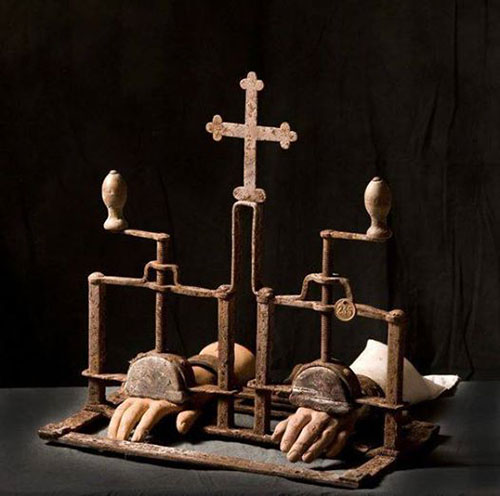
A hand crusher, fitted with a Christian
cross
to emphasise that the torture is being carried out on
behalf of the Christian God.
|
|
|
| All of the legal apparatus of the Inquisition
was developed during this period. Elsewhere, courts followed
at least the basic rules of justice: the accused knew their
accusers, they were allowed legal representation, in some
places judgement was delivered by a jury composed of peers
of the accused. The old bishops" inquisitions had been
public hearings, but these papal inquisitions were different:
now secret hearings took place before clerical judges and
prosecutors. Guilt was assumed from the start. There were
no juries, and no legal representation for the accused.
There was no habeas corpus; no disclosure of any
evidence against the accused, and no appeal. Inquisitors
were allowed to excuse each other for breaches of the rules
— which meant that in effect there were no rules*.
There were secret depositions and anonymous accusations,
torture and unlimited detention in appalling conditions
for those who failed to confess. Dead people were tried
along with the living. When found guilty their children
were disinherited. At least half the estate generally went
to the Church — so that the Church had a direct material
interest in a guilty verdict. Children and grandchildren
of those found guilty were all debarred from any secular
office.
Gregory IX's immediate successor died before assuming
the reins of office, but the next pope, Innocent IV, made
the Inquisition into a permanent institution. In
1252 he issued a bull Ad extirpanda, which explicitly
authorised the use of torture, seizure of goods and execution,
all on minimal evidence. Torture was to be administered
by the secular authority, but when this proved impractical
the inquisitors were allowed to administer it themselves
(and to absolve each other for doing so). Thereafter it
was an exceptional man, woman or child who could not quickly
be convinced of his or her heresy.
|
|
|
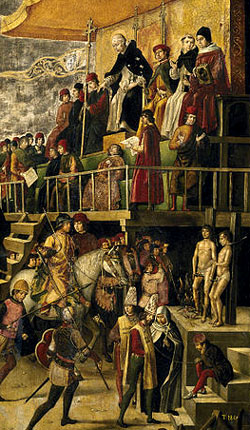
Saint Dominic Presiding over an
Auto de fe
detail, (1475) by Pedro Berruguete
For centuries Saint Dominic was hailed by Dominicans
as the Father of the Inquisition.
They commissioned this painting in his honour, showing
him presiding over an Auto de fe.
The painting reflects practices of the fifteenth
century (not the thirteenth century when Dominic
lived).
Dominicans have recently made efforts to distance
Dominic from the Inquisition.
|
 |
|
|
A "Spanish Gaiter" - for crushing
victims' legs. Here a piece of wood is standing in for
a leg.
|
|
|
In theory torture could be applied only once, and could not
be such as to draw blood, to cause permanent mutilation or to
kill. Boys under the age of 14 and girls under 12 were excused.
In practice there was no one to enforce any of these safeguards,
and they were all ignored. The accused were imprisoned, often
for many months, before being examined. They were often kept
in solitary confinement, in unsanitary conditions, in a dark
dungeon, and without adequate heating, food or water. This was
deliberate, and designed to ensure that most of the accused
would already have broken by the time of the first examination.
Only the strongest characters were able to face a tribunal of
hooded figures who claimed to have heard witnesses and seen
incriminating evidence. Most were prepared to admit anything,
even though they did not know what the accusations were. Those
who failed to admit their crimes were taken to the torture chamber
and shown the instruments of torture. This too was designed
to terrify and break them — the dark chamber, the horrifying
instruments, the torturer-executioner dressed and hooded in
black. If they still failed to admit their guilt they were then
subjected to torture: men, women and children alike. Some people
were tortured for years before confessing. Only the most exceptional
could resist. Every day they risked being tortured to death*.
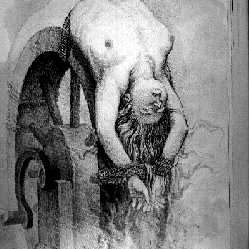
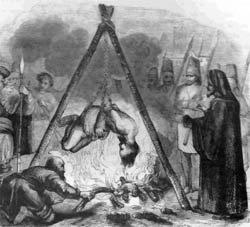
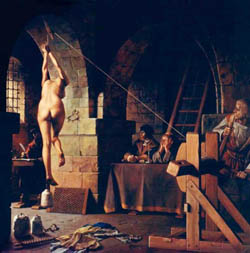  Tortures
varied from time to time and place to place, but the following
represent the more popular options. Victims were stripped and
bound. The cords were tied around the body and limbs in such
a way that they could be tightened, by a windlass if necessary,
until they acted like multiple tourniquets. By attaching the
cords to a pulley the victim could be hoisted off the ground
for hours, then dropped. Whether the victim was pulled up short
before the weight touched the floor, or allowed to fall to the
floor, the pain was acute. This was the torture of the pulley,
also known as squassation }. It was also called the
strappado, (by which name we have already encountered it being
used at Bamberg). John Howard, the prison reformer, found this
still in use in Rome in the second half of the eighteenth century*. Tortures
varied from time to time and place to place, but the following
represent the more popular options. Victims were stripped and
bound. The cords were tied around the body and limbs in such
a way that they could be tightened, by a windlass if necessary,
until they acted like multiple tourniquets. By attaching the
cords to a pulley the victim could be hoisted off the ground
for hours, then dropped. Whether the victim was pulled up short
before the weight touched the floor, or allowed to fall to the
floor, the pain was acute. This was the torture of the pulley,
also known as squassation }. It was also called the
strappado, (by which name we have already encountered it being
used at Bamberg). John Howard, the prison reformer, found this
still in use in Rome in the second half of the eighteenth century*.
 The
rack was a favourite for dislocating limbs. Again, the victim
could be flogged, bathed in scalding water with lime, and have
their eyes removed with purpose designed eye-gougers. Fingernails
were pulled out. Grésillons (thumbscrews) were applied
to thumbs and big toes until the bones were crushed. The victim
was forced to sit on a spiked iron chair that could be heated
by a fire underneath until it glowed red-hot. Branding irons
and red-hot pincers were also used. The victim's feet could
be placed in a wooden frame called a boot. Wedges were then
hammered in until the bones shattered, and the "blood and
marrow spouted forth in great abundance". Alternatively
the feet could be held over an open fire, and literally roasted
until the bones fell out; or they could be placed in huge leather
boots into which boiling water was poured, or in metal boots
into which molten lead was poured. Since the holy proceedings
were conducted for the greater glory of God the instruments
of torture were sprinkled with holy water. The
rack was a favourite for dislocating limbs. Again, the victim
could be flogged, bathed in scalding water with lime, and have
their eyes removed with purpose designed eye-gougers. Fingernails
were pulled out. Grésillons (thumbscrews) were applied
to thumbs and big toes until the bones were crushed. The victim
was forced to sit on a spiked iron chair that could be heated
by a fire underneath until it glowed red-hot. Branding irons
and red-hot pincers were also used. The victim's feet could
be placed in a wooden frame called a boot. Wedges were then
hammered in until the bones shattered, and the "blood and
marrow spouted forth in great abundance". Alternatively
the feet could be held over an open fire, and literally roasted
until the bones fell out; or they could be placed in huge leather
boots into which boiling water was poured, or in metal boots
into which molten lead was poured. Since the holy proceedings
were conducted for the greater glory of God the instruments
of torture were sprinkled with holy water.
 Whole
families were accused. Family members would often be induced
to incriminate each other in order to minimise the suffering
of their loved ones. Minor heretics who confessed might escape
with light sentences, whereas denial invited trouble. The inquisitor
Conrad of Marburg (or Konrad von Marburg) burned every victim
who claimed to be innocent. Whole
families were accused. Family members would often be induced
to incriminate each other in order to minimise the suffering
of their loved ones. Minor heretics who confessed might escape
with light sentences, whereas denial invited trouble. The inquisitor
Conrad of Marburg (or Konrad von Marburg) burned every victim
who claimed to be innocent.
Hearings of the Inquisition denied every aspect of natural
justice, and became ever more prejudiced as time went on. They
were held in secret, generally conducted by men whose identities
were concealed. In the Papal States and elsewhere, Dominicans
acted as both judges and prosecutors. By papal command they
were forbidden to show mercy. There was no appeal. The evidence
of embittered husbands and wives, children, servants and persons
heretical, excommunicated, perjured and criminal could be used,
secretly and without their having to face the accused, their
charges being communicated to the victim only in summary form.
 No
genuine defence could be sustained. For example, if a husband
provided an alibi, saying that his wife had been asleep in his
arms when she was alleged to have been attending a witches"
sabbat, it would be explained to him that a demon had adopted
the form of his wife while she was away. The husband had been
duped. There was no way for him to prove otherwise. Spies were
employed with the incentive of payment by results. Perjury was
pardoned if it was the outcome of "zeal for the faith"
— i.e. supporting the prosecution. Loyalties were over-ridden
so that obedience to a superior was forbidden if it hindered
the inquiry, and those who helped the inquisitors were granted
the same indulgences as pilgrims to the Holy Land. Any advocates
acting for and any witnesses giving evidence on behalf of a
suspect laid themselves open to charges of abetting heresy.
No one was ever acquitted, a released person always being liable
to re-arrest and a condemned person liable to a revised sentence
with no retrial, at the discretion of the inquisitor. In theory
torture could be inflicted only once, but in practice it was
repeated as often as necessary on the pretext that it was a
single occurrence, with intervals between the sessions. Confessions
were virtually guaranteed unless the victim died under torture.
Then came the sentence, and execution of the sentence: No
genuine defence could be sustained. For example, if a husband
provided an alibi, saying that his wife had been asleep in his
arms when she was alleged to have been attending a witches"
sabbat, it would be explained to him that a demon had adopted
the form of his wife while she was away. The husband had been
duped. There was no way for him to prove otherwise. Spies were
employed with the incentive of payment by results. Perjury was
pardoned if it was the outcome of "zeal for the faith"
— i.e. supporting the prosecution. Loyalties were over-ridden
so that obedience to a superior was forbidden if it hindered
the inquiry, and those who helped the inquisitors were granted
the same indulgences as pilgrims to the Holy Land. Any advocates
acting for and any witnesses giving evidence on behalf of a
suspect laid themselves open to charges of abetting heresy.
No one was ever acquitted, a released person always being liable
to re-arrest and a condemned person liable to a revised sentence
with no retrial, at the discretion of the inquisitor. In theory
torture could be inflicted only once, but in practice it was
repeated as often as necessary on the pretext that it was a
single occurrence, with intervals between the sessions. Confessions
were virtually guaranteed unless the victim died under torture.
Then came the sentence, and execution of the sentence:
...The obdurate and relapsed were taken outside the church
and handed to the magistrates with a recommendation to mercy
and instruction that no blood be shed. The supreme hypocrisy
of this was that if the magistrate did not burn the victims
on the following day, he was himself liable to be charged
with abetting heresy*.
 Almost
everyone fell within their jurisdiction. People were executed
for failing to fast during Lent, for homosexuality, fornication,
explaining scientific discoveries, and even for professional
acting. Almost
everyone fell within their jurisdiction. People were executed
for failing to fast during Lent, for homosexuality, fornication,
explaining scientific discoveries, and even for professional
acting.
In order that no blood be shed, the favoured methods of execution
did not involve the cutting of flesh. So it was that burning
and roasting were popular, the stake having been inherited from
Roman law. Estates of those found guilty were forfeit, after
the deduction of expenses. Expenses included the costs of the
investigation, torture, trial, imprisonment and execution. The
accused bore it all, including wine for the guards, meals for
the judges, and travel expenses for the torturer. Victims were
even charged for the ropes to bind them and the tar and wood
to burn them. Generally, after paying these expenses, half of
the balance of the estate went to the inquisitors and half to
the Pope, or a temporal lord. This proved such an efficient
way of raising money that it became popular to try the dead
as well as the living. Bones were dug up and burned, even after
many years in the grave. As in trials of the living, there were
no acquittals, and the heretic's property was forfeit. In practice
this meant that the heirs of the deceased were dispossessed
of their inheritances.
The Knights Templar
|
Knights Templars being burned alive
Illustration, anonymous Chronicle, From the Creation
of the World until 1384.
Bibliothèque Municipale, Besançon, France.
|
|
|
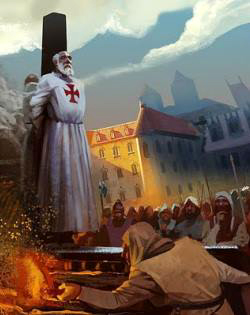
The trial of the Knights Templar demonstrates how unjust the
Inquisition could be. The charges of heresy against them were
almost certainly fabricated. No real evidence was ever produced
to support the accusations. The best that could be managed was
hearsay evidence such as that of a priest (William de la Forde)
who had heard from another priest (Patrick de Ripon) that a
Templar had once told him, under the inviolable seal of confession,
about some rather improbable goings on*.
Inquisitors obtained the most damning evidence through the use
of torture. In countries where torture was not permitted, the
Templars denied the charges, however badly they were otherwise
treated and however long they were imprisoned. As soon as torture
was applied the required confessions materialised*.
Inquisitors refused to attach their seals to depositions unless
they included confessions*,
so that only one side of the case appeared in official records.
In France, where torture was applied freely, there were many
confessions, and also many deaths under torture. Accused templars
who retracted their confessions faced death at the stake as
relapsed heretics.
Wherever the charges were investigated without applying torture,
no confessions were made and no other evidence found. When no
English Templars could be induced to confess, the
Pope insisted that torture be applied When the Archbishop
of Mainz delivered a verdict favourable to the Templars at a
provincial council, the Pope simply annulled it*.
When it looked as though the Templars in Cyprus might be acquitted,
the Pope ordered a new trial backed by torture*.
When the fate of the Templars was considered at the Council
of Vienne late in 1311 the cardinals had "a long dispute"
as to whether a defence should be heard at all*.
In the event no defence was heard and the Pope enforced the
King of France's demand that the Order be suppressed.
|
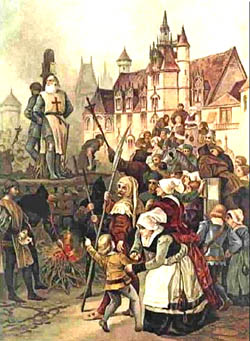
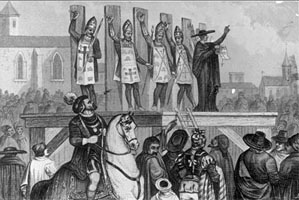
In 1310, 54 templars were burned outside
Paris.
Manuscript Image from J. Riley-Smith (ed.), The Oxford
Illustrated History of The Crusades
(Oxford University Press: Oxford, 2001), p.244
|
|
|
 Under
torture, the Templar Grand Master himself, Jacques de Molay,
confessed — though it is likely that his confession was
fabricated or at least added to, since he was dumbfounded when
it was read out to him. When he tried to mount a defence on
behalf of the Templar Order, he was told that "in cases
of heresy and the faith it was necessary to proceed simply,
summarily, and without the noise of advocates and the form of
judges"*. Since all
of the Order's assets had been seized there was in any case
no way for him to mount an effective defence. By asking to do
so he invited death at the stake, as a number of churchmen pointed
out at the time. Under
torture, the Templar Grand Master himself, Jacques de Molay,
confessed — though it is likely that his confession was
fabricated or at least added to, since he was dumbfounded when
it was read out to him. When he tried to mount a defence on
behalf of the Templar Order, he was told that "in cases
of heresy and the faith it was necessary to proceed simply,
summarily, and without the noise of advocates and the form of
judges"*. Since all
of the Order's assets had been seized there was in any case
no way for him to mount an effective defence. By asking to do
so he invited death at the stake, as a number of churchmen pointed
out at the time.
After years in prison and unknown amounts of torture he confessed
in exchange for the promise of a sentence of perpetual imprisonment.
The sentence was to be delivered in public, but did not go as
planned. As an expert on the Inquisition, put it:
 "The
cardinals dallied with their duty until 18 March 1314, when,
on a scaffold in front of Notre Dame, Jacques de Molay, Templar
Grand Master, Geoffroi de Charney, Master of Normandy, Hugues
de Peraud, Visitor of France, and Godefroi de Gonneville,
Master of Aquitaine, were brought forth from the jail in which
for nearly seven years they had lain, to receive the sentence
agreed upon by the cardinals, in conjunction with the Archbishop
of Sens and some other prelates whom they had called in. Considering
the offences which the culprits had confessed and confirmed,
the penance imposed was in accordance with rule—that
of perpetual imprisonment. The affair was supposed to be concluded
when, to the dismay of the prelates and wonderment of the
assembled crowd, de Molay and Geoffroi de Charney arose. They
had been guilty, they said, not of the crimes imputed to them,
but of basely betraying their Order to save their own lives.
It was pure and holy; the charges were fictitious and the
confessions false. Hastily the cardinals delivered them to
the Prevot of Paris, and retired to deliberate on this unexpected
contingency, but they were saved all trouble. When the news
was carried to Philippe he was furious. A short consultation
with his council only was required. The canons pronounced
that a relapsed heretic was to be burned without a hearing;
the facts were notorious and no formal judgment by the papal
commission need be waited for. That same day, by sunset, a
pile was erected on a small island in the Seine, the Isle
des Juifs, near the palace garden. There de Molay and de Charney
were slowly burned to death, refusing all offers of pardon
for retraction, and bearing their torment with a composure
which won for them the reputation of martyrs among the people,
who reverently collected their ashes as relics." "The
cardinals dallied with their duty until 18 March 1314, when,
on a scaffold in front of Notre Dame, Jacques de Molay, Templar
Grand Master, Geoffroi de Charney, Master of Normandy, Hugues
de Peraud, Visitor of France, and Godefroi de Gonneville,
Master of Aquitaine, were brought forth from the jail in which
for nearly seven years they had lain, to receive the sentence
agreed upon by the cardinals, in conjunction with the Archbishop
of Sens and some other prelates whom they had called in. Considering
the offences which the culprits had confessed and confirmed,
the penance imposed was in accordance with rule—that
of perpetual imprisonment. The affair was supposed to be concluded
when, to the dismay of the prelates and wonderment of the
assembled crowd, de Molay and Geoffroi de Charney arose. They
had been guilty, they said, not of the crimes imputed to them,
but of basely betraying their Order to save their own lives.
It was pure and holy; the charges were fictitious and the
confessions false. Hastily the cardinals delivered them to
the Prevot of Paris, and retired to deliberate on this unexpected
contingency, but they were saved all trouble. When the news
was carried to Philippe he was furious. A short consultation
with his council only was required. The canons pronounced
that a relapsed heretic was to be burned without a hearing;
the facts were notorious and no formal judgment by the papal
commission need be waited for. That same day, by sunset, a
pile was erected on a small island in the Seine, the Isle
des Juifs, near the palace garden. There de Molay and de Charney
were slowly burned to death, refusing all offers of pardon
for retraction, and bearing their torment with a composure
which won for them the reputation of martyrs among the people,
who reverently collected their ashes as relics."
(Henry Charles Lea, A History of the Inquisition of the
Middle Ages Vol. III, NY: Hamper & Bros, Franklin
Sq. 1888, p. 325)
Jacques de Molay and Geoffroi de Charney were roasted alive,
slowly, over a smokeless fire. (A document known as the Chinon
Parchment, discovered in September 2001 by Barbara Frale
in the Vatican Secret Archives, confirms that Pope Clement V
knew Jacques de Molay and other leaders of the Order to be innocent
as early as 1208).
Templar assets were divided up between Church and State, and
interest in the fates of individual Templars immediately subsided.
|
Detail of a miniature of the burning
of Jacques de Molay (the Grand Master of the Templars)
and Geoffroi de Charney.
From the Chroniques de France ou de St Denis, BL Royal
MS 20 C vii f. 48r
(In fact they were roasted slowly, rather than burned
like this)
|
|
|
The activities of the Medieval Inquisition were so terrible
that the memory of them has survived throughout Europe to the
present day. Some Christians acknowledge that the Inquisition
was one of the most sinister that the world has ever known,
and now attribute its work to satanic forces. On the other hand
there are many others prepared to defend its record.
The Spanish Inquisition
 The
Medieval Inquisition was established in Barcelona in 1233. Five
years later its authority was extended to Castile, Leon and
Navarre. This was essentially an extension of the Inquisition
established to extirpate the remnants of Catharism. Over 200
years later another inquisition was to appear : the Spanish
Inquisition. Their Roman Catholic Majesties, Ferdinand
and Isabella, established it in 1479, with the explicit sanction
of Pope Sixtus IV, who in 1483 also confirmed the Dominican
friar Thomas de Torquemada as Grand Inquisitor for Aragon and
Castile. The Inquisition was initially directed against Jewish
and Muslim converts who were suspected of returning to their
own religion, and thus being guilty of apostasy. (Many had converted
to Christianity only under threat of death.) The
Medieval Inquisition was established in Barcelona in 1233. Five
years later its authority was extended to Castile, Leon and
Navarre. This was essentially an extension of the Inquisition
established to extirpate the remnants of Catharism. Over 200
years later another inquisition was to appear : the Spanish
Inquisition. Their Roman Catholic Majesties, Ferdinand
and Isabella, established it in 1479, with the explicit sanction
of Pope Sixtus IV, who in 1483 also confirmed the Dominican
friar Thomas de Torquemada as Grand Inquisitor for Aragon and
Castile. The Inquisition was initially directed against Jewish
and Muslim converts who were suspected of returning to their
own religion, and thus being guilty of apostasy. (Many had converted
to Christianity only under threat of death.)
The first European who regularly smoked
tobacco, Rodrigo de Jerez, a crewman on the Santa Maria
was imprisoned by the Spanish Inquisition for his "sinful
and infernal" habits, because "only Devil
could give a man the power to exhale smoke from his
mouth." He was released seven years later, after
smoking tobacco had become popular.
|
|
|
The process was much the same as that of the Medieval Inquisition,
and indeed was deliberately modelled on it. It too was manned
mainly by Dominicans. They copied the methods of arrest, trial,
punishment, staffing, and procedure, even down to the blessing
of the instruments of torture. Llorente, vicar-general to the
bishop of Calahorra and historian of the Inquisition, computed
that Torquemada and his collaborators, in the course of eighteen
years, burnt at the stake 10,220 persons, 6,860 in effigy, and
otherwise punished 97,321.
 There
were a few differences from the Medieval Inquisition, for example
there were cases where people were able to mount a defence and
were acquitted. Better records were kept. Some inquisitors seem
to have been relatively enlightened and were suspicious of accusations
motivated by the self-interest of accusers. Prisons seem to
have been better than most ecclesiastical prisons — there
are cases of people committing minor heresies in order to get
themselves transferred from ecclesiastical prisons to those
of the Inquisition. On the other hand, this may say more about
ecclesiastical prisons than Inquisition prisons, for even in
the latter many died before their cases were heard. In the early
days the accused were able to appoint their own defence counsel,
but by the mid-sixteenth century this had changed. If advocates
were permitted they had to be abogados de los presos,
officials of the Inquisition, dependent upon the inquisitors
for their jobs. It is fair to assume, as their clients did,
that these court officials were aware of their employers"
expectations and of the dangers of doing their jobs too well. There
were a few differences from the Medieval Inquisition, for example
there were cases where people were able to mount a defence and
were acquitted. Better records were kept. Some inquisitors seem
to have been relatively enlightened and were suspicious of accusations
motivated by the self-interest of accusers. Prisons seem to
have been better than most ecclesiastical prisons — there
are cases of people committing minor heresies in order to get
themselves transferred from ecclesiastical prisons to those
of the Inquisition. On the other hand, this may say more about
ecclesiastical prisons than Inquisition prisons, for even in
the latter many died before their cases were heard. In the early
days the accused were able to appoint their own defence counsel,
but by the mid-sixteenth century this had changed. If advocates
were permitted they had to be abogados de los presos,
officials of the Inquisition, dependent upon the inquisitors
for their jobs. It is fair to assume, as their clients did,
that these court officials were aware of their employers"
expectations and of the dangers of doing their jobs too well.
It was widely accepted that the Inquisition existed only to
rob people, as people openly affirmed*.
Both rich and poor knew that it was the rich who were most at
risk. The fact that the Inquisition funded itself from the property
it confiscated meant that in effect it burned people on commission.
Individual inquisitors also funded themselves, acquiring great
wealth during their careers. Some inquisitors were known to
have fabricated evidence in order to extort money from their
victims, but even when discovered they received no punishment*.
Similarly their staff of helpers, called familiars,
were free to commit crimes without fear of punishment by the
secular courts*. After
1518 this was formalised. Familiars enjoyed immunity from prosecution
similar to benefit of clergy or modern diplomatic immunity.
This provided another cause of popular scandal, along with their
exemption from taxation.
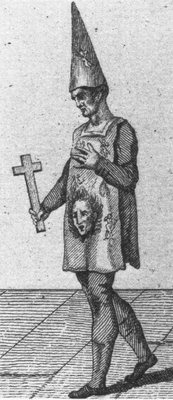
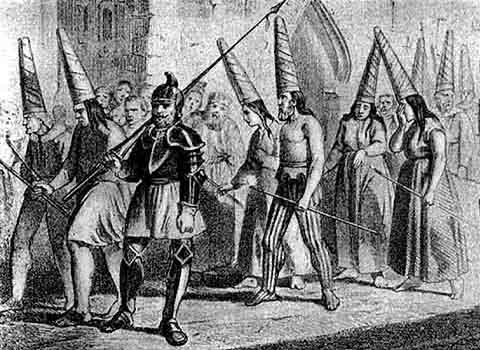
|
Inquisition victims wearing their distinctive
hats and carrying penitential candles
|
|
|
The activities of the inquisitors were resented by all sections
of society, and the papacy was obliged to interfere from time
to time, although the inquisitors were powerful enough to ignore
it on many occasions. Pope Sixtus IV issued a bull on 18 th
April 1482 protesting that
in Aragon, Valencia, Mallorca and Catalonia the Inquisition
has for some time been moved not by zeal for the faith and
the salvation of souls, but by lust for wealth, and that many
true and faithful Christians, on the testimony of enemies,
rivals, slaves and other lower and even less proper persons,
have without any legitimate proof been thrust into secular
prisons, tortured and condemned as relapsed heretics, deprived
of their goods and property and handed over to the secular
arm to be executed, to the peril of souls, setting a pernicious
example, and causing disgust to many*
When someone was arrested all of his or her property was seized.
This was then sold off as required to pay for the upkeep of
the person arrested. This might go on for years until the property
was all sold off. The families of the accused were not supported,
so they also suffered hardships. In some cases the children
of rich parents starved in the streets*.
Others survived by begging. The King, Ferdinand, intervened
from time to time, and later, in 1561, provision was made to
support dependents — although the effect was to use up
the sequestered assets that much faster.
The accused were invited to confess their crimes but not told
what these crimes were. Sometimes it was difficult to guess,
as any of the following were considered serious crimes: changing
bedding on a Friday, not eating pork, dressing in certain ways,
wearing earrings, speaking in foreign languages, owning foreign
books, casual swearing, criticising a priest, or failing to
show due reverence to the Inquisition. Three methods of torture
were popular, the garrucha, the toca and the
potro. The garrucha was the strappado (see
page 378) under another name. The toca was a water
torture. A linen strip was forced down the throat of the accused
and water poured down it until the stomach was distended. The
potro was a form of rack combined with tourniquets.
Detail from The Inquisition Tribunal
(Auto de fe de la Inquisición)
by Francisco Goya, painted between 1812 and 1819.
It shows an Auto de fe, or accusation of heretics,
by the tribunal of the Spanish Inquisition, inside a
church.
|
|
|
Surviving records of these torture sessions make harrowing
reading*. As the torture
progressed the victims were soon ready to admit to anything.
They would admit to having done whatever they were accused of.
But since they did not know the specifics of the accusation
they could not admit to them item by item. More torture was
applied. They admitted to whatever their accusers had said,
but again they could not be specific because they did not know
what their accusers had said. More torture was applied. They
begged for clues. They begged for mercy. They were told to confess.
They confessed to crimes, real or invented, apparently whatever
they could think of. They asked what it was the inquisitors
wanted and offered to confess to it whatever it was — still
not good enough. More torture was applied. And so it went on,
sometimes until they went mad. Sometimes they died under tortured.
Many died in prison. Others committed suicide. Of the survivors
some were disabled for life.
The lucky ones got off with penance, whipping or banishment.
Others were condemned to slow deaths in prison or in the galleys.
As the writer George Ryley Scott noted in his book A History
of Torture:
Of all the punishments which the Inquisition inflicted in
the name of God, for sheer long-continued cruelty, nothing
ever rivalled the treatment of the galley-slaves, who were
flogged very nearly every day during the period they laboured
at the oars…It was a fate worse than death. For, as
everyone knew, it meant a life of the most terrible hardship
man could possibly endure and yet continue to live; it almost
inevitably entailed death long before the sentence was completed.
It meant, in the majority of instances, that the victim was
gradually whipped to death*.
Others were condemned to public execution, but this was rarely
a simple matter of dispatching the victim. Even those who confessed
immediately were tortured. Execution was not the sentence
— it was an additional sentence. At the end of
the trial a public ceremony was held called an Auto-da-fé
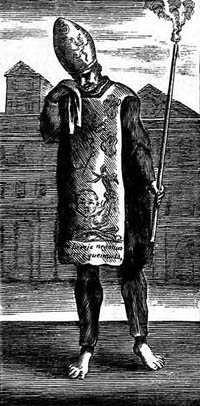
(Portuguese for Act of Faith). The victim was dressed
in a penitential tunic ( san benito) painted with a
design. Impenitents wore tunics painted with pictures of their
wearers burning in Hell with devils fanning the flames. On their
heads they wore 3-foot-long pointed pasteboard caps (corozas),
also painted. Around their necks they wore nooses, and in their
hands they carried candles. Anyone judged likely to speak out
against the Inquisition was gagged. After a procession came
a Mass and sermon, in which the Inquisition was praised and
heresy condemned. The sentences were read aloud and then carried
out. As usual the secular authorities were obliged to burn victims
on the Church's behalf on the grounds that ecclesia non
novit sanguinem — the Church does not shed blood.
Burning generally took place on Sundays or festivals in order
to attract the largest possible audience. Participation was
a meritorious act — so for example any persons who helped
collect firewood would earn a remission of their sins.
|
Auto de Fe (1683) by Francisco
Ricci Auto de Fe. The scence is the Plaza Mayor, Madrid,
30 June, 1680, during the Spanish Inquisition. Inquisition
victims are shown at different stages of the process.
Although it is difficult to see what is happening, the
painting gives a good idea of the scale and theatricality
of the event.
|
|
|
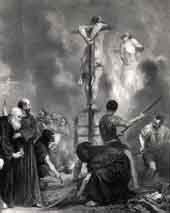 A
slow roasting was considered preferable to quick incineration.
Victims were tied high up on their stakes, partly to give the
crowds of faithful a good view, partly to prolong the agony.
Sometimes there was further torture before the fire was lit.
For example Protestants who refused to recant might have burning
sprigs of gorse thrust into their faces until they were burned
black. A
slow roasting was considered preferable to quick incineration.
Victims were tied high up on their stakes, partly to give the
crowds of faithful a good view, partly to prolong the agony.
Sometimes there was further torture before the fire was lit.
For example Protestants who refused to recant might have burning
sprigs of gorse thrust into their faces until they were burned
black.
The whole event was a popular festival for the devout, who
enjoyed the spectacle and ridiculed the victims in their death
agonies. The events were closely linked to royal spectacles.
The king was obliged by his coronation oath to attend these
mass burnings. Such burnings were even held to help celebrate
royal marriages.
|
Children and grandchildren of the condemned were prohibited
from becoming priests, judges or magistrates, lawyers,
notaries, accountants, physicians, surgeons, or even shopkeepers.
They could not become mayors or hold other public offices.
Some penalties passed from generation to generation without
limit. Under statutes of limpieza de sangre,
the descendants of heretics, like those of Jews and Moors,
suffered civil disabilities because of their "tainted
blood". San benitos worn by heretics were
hung up in local churches as an eternal badge of shame
so that no one should forget their heretical ancestors.
The Spanish Inquisition continued its work for centuries,
and exported its practices to the New World. The Portuguese
exported similar practices to their colonies, not only
to the New World but also east to countries like Goa.
The fact that few of the indigenous people of the New
World could be induced to convert should have meant that
there was little recidivism, and therefore little heresy.
In fact many hundreds of heresy trials were conducted
in South America.
|
|
|
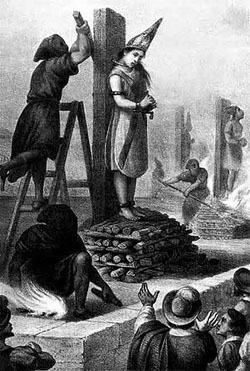
Execution of Mariana de Carabajal
at Mexico. Illustration from El Libro Rojo,
1870.
Ten members of Mariana de Carabajal's family were
tried for practicing Judaism, and burned at the
stake. Mariana (who lost her reason) was tried and
put to death at an auto-da-fé held in Mexico
City on March 25, 1601
|
 |
|
|
Palace of the Inquisition - Cartagena,
Colombia
|
|
|
The Spanish Inquisition continued to execute its victims into
the nineteenth century. When the French army invaded Spain in
1808 the Dominicans in Madrid denied that they had torture chambers
in their building. The soldiers searched and found that they
did. The chambers were full of naked prisoners, many of them
insane. Similar discoveries were made throughout the country.
|
detail, Auto de fe at San Bartolome,
Otzolotepec, Mexico, by an unknown artist,
Museo Nacional de Arte, Mexico
|
|
|
The Inquisition kept some records,
but we cannot know how many trials went unrecorded. Where records
were kept they were often destroyed later. Few records survive
from the victims for a number of reasons. Some were killed.
Some died in custody. Some died under torture. Some were driven
mad. Some were deprived of their tongues. Those who survived
and were still able to communicate were sworn to secrecy. So
it is that often the only evidence we have is circumstantial.
According to European folk memory the "Pear of anguish"
or "Pope's Pear" was was a favorite instrument of
the Inquisition. It was a pear shaped metal object that could
be inserted into a bodily orifice. By turning an external screw
it expanded until it tore the surrounding tissue. Pointed ends
of the 'leaves' were specifically designed to rip the throat,
intestines or cervix. It was allegedly used used on women, judged
to have 'had sex with the Devil or his familiars.' Inserted
into the vagina of the victim.
|
A Pear of Anguish, or "Pope's Pear"
- Closed
|
A Pear of Anguish, or "Pope's Pear"
- open
|
|
|
|
While it existed, the Spanish Inquisition was regarded with
horror, even by Roman Catholics from other countries who witnessed
its activities. It was abolished by Joseph Bonaparte in 1808,
but it was reintroduced by Ferdinand VII in 1814, and finally
ended by government decree on 15 th July 1834.
|
The Inquisition Tribunal or The
Inquisition Auto de fe (Auto de fe de la Inquisición)
by Francisco Goya painted between 1812 and 1819. It shows
the accusation of heretics, by the tribunal of the Spanish
Inquisition, inside a church. The accused sit in chains
wearing sanbenitos and pointed hats.. The work is now
in the collection of the Real Academia de Bellas Artes
de San Fernando in Madrid.
|
|
|
The Portuguese and Goan Inquisitions
 The
Spanish Inquisition was exported not only to the Spanish colonies,
but also to Portugal and its colonies. In 1497, King Manuel
I of Portugal married, Isabella of Aragon and when she died
he married her younger sister Maria. The Spanish monarchs insisted
that a clause be included in the marriage contract requiring
the introduction of the Inquisition to Portugal, and the expulsion
or conversion of all Jews. The
Spanish Inquisition was exported not only to the Spanish colonies,
but also to Portugal and its colonies. In 1497, King Manuel
I of Portugal married, Isabella of Aragon and when she died
he married her younger sister Maria. The Spanish monarchs insisted
that a clause be included in the marriage contract requiring
the introduction of the Inquisition to Portugal, and the expulsion
or conversion of all Jews.
A large Jewish community had been well-integrated into Portuguese
society until the massacre of several hundred 'Conversos' or
'Marranos' in Lisbon in 1506, instigated by two Spanish Dominicans,
but no formal Inquisition was installed in Portugal until the
reign of the next king.
The Portuguese Inquisition (Inquisição Portuguesa)
was established in 1536 by the King of Portugal, John (João)
III. The main target of the Portuguese Inquisition were Marranos
or New Christians, those who had converted to Catholicism, both
Jews (Conversos), and Moslems (Moriscos). They
had been pressured into converting to Christianity, and were
suspected of secretly practising their old religion. Many of
the New Christians had come to Portugal to escape persecution
by the Spanish Inquisition.
As in Spain, the Inquisition was subject to the King. It was
headed by a Grand Inquisitor, selected by the king, but appointed
by the Pope. In practice the Grand Inquisitor was always a member
of the royal family. He would nominate other inquisitors. The
Portuguese Inquisition held its first auto-da-fé ("Act
of Faith") in Portugal in 1540. Courts of the Inquisition
were established in Lisbon, Coimbra, and Évora, and for
a short time in Porto, Tomar and Lamego. In Portugal's colonial
possessions, courts were established in Brazil, Cape Verde,
and Goa. The activity of the courts extended beyond New Christians
suspected of backsliding, to any form of religious non-compliance,
including cases of divination, witchcraft and even to bigamy.
The Portuguese Inquisition also censored books. Like other Inquisitions
it was renowned for its injustice, rapaciousness and cruelty.
 An
auto-da-fé was the ritual of public penance of condemned
heretics and apostates that took place when the Portuguese Inquisition
had decided their punishment, followed by execution of the sentence
by the civil authorities. Auto da fé in Portuguese mean
"act of faith". The most extreme punishment imposed
was execution by burning. As the execution was more spectacular
than the penance, the term auto-da-fé came to mean the
punishment rather than the penance. An
auto-da-fé was the ritual of public penance of condemned
heretics and apostates that took place when the Portuguese Inquisition
had decided their punishment, followed by execution of the sentence
by the civil authorities. Auto da fé in Portuguese mean
"act of faith". The most extreme punishment imposed
was execution by burning. As the execution was more spectacular
than the penance, the term auto-da-fé came to mean the
punishment rather than the penance.
The auto-da-fé was a the final step in the Inquisition
process. It involved a Catholic Mass, prayer, a public procession
of those found guilty, and a public reading of their sentences.
Preparations began a month in advance and occurred only when
the inquisition authorities had enough prisoners to put on a
good show. The ritual took place in public squares or esplanades
and lasted several hours with ecclesiastical and civil authorities
in attendance. An all-night vigil would be held with prayers,
ending in Mass at daybreak and a breakfast feast. The ceremony
of public penitence then began with a procession of prisoners,
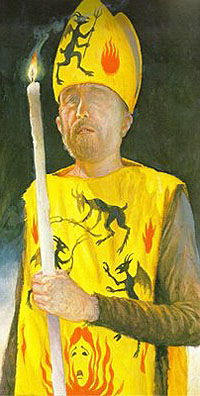
who bore elaborate symbols on their clothes. They wore a kind
of tabard called a sanbenito, made of yellow sackcloth. Designs
painted on the san benito identified the supposed crimes of
the accused. Figures of monks, dragons and demons in the act
fanning flames signified that the heretic was impenitent and
had been condemned to burn at the stake. If a victim repented
before the procession, then the sanbenito was painted with the
flames downward (fuego repolto), signifying that the victim
was not to be burnt alive, but would be strangled before being
burned. On their head victims were made to wear a tall conical
hat, also decorated to indicate the nature of their supposed
crimes. Around their neck they wore a noose. They carried a
large yellow wax candle. Prisoners' identities were kept secret
until the very last moment. They usually had no idea what their
sentence was to be, or even what the outcome of their trial
had been. Prisoners were generally taken outside the city walls
to a place called the quemadero or burning place. There the
sentences were read. Punishments included whipping and torture,
as well as burning at the stake.
|
sanbenitos worn by auto-da-fe penitents.
The man on the left wears a sanbenito that announces that
he has confessed his crime and has been given a penance
less than death. The one in the middle has confessed too
late, so will be garroted before being burned. The one
on the right will burn alive.
|
|
|
Afterwards, sanbenitos were hung up in the churches as mementos
of disgrace to their wearers and their families, and as the
trophies of the Inquisition. Sanbenitos often remained on display
for centuries, a constant embarrassment to families of those
convicted by the Inquisition.
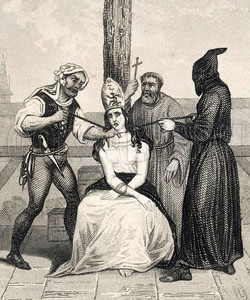 In
the second half of the seventeenth century, António Vieira
exposed the abuses of the Portuguese Inquisition in Brazil.
His writings were condemned as rash, scandalous, erroneous,
savoring of heresy and designed to pervert the ignorant. He
was himself brought before the Inquisition. After three years
imprisonment, he was penanced in Coimbra, in 1667. Now he had
personal experience of the routine abuses and cruelty. Back
in Rome, he was free to expose the abuses. He characterized
the Holy Office of Portugal as a tribunal that served to deprive
men of their fortunes, their honor and their lives, while failing
to discriminate between guilt and innocence. He said it was
known to be holy only in name, while its works were cruelty
and injustice, unworthy of rational men, though it was always
proclaiming its superior piety. He drew up a report of two hundred
pages on the Inquisition in Portugal, with the result that after
a judicial inquiry Pope Innocent XI suspended it in Portugal
and its Empire. Autos-da-fé were stopped. Inquisitors
were instructed not to inflict sentences of relaxation (ie execution),
confiscation, or perpetual slavery in the galleys. But the Inquisition
had friends in high places. It started up again in1681, and
was soon perpetrating the same abuses as before. After the Lisbon
Earthquake of 1755 Inquisitors proposed increasing the number
of executions of heretics by way of propitiating God, an idea
which amounted to human sacrifice, as Voltaire noted at the
time. In
the second half of the seventeenth century, António Vieira
exposed the abuses of the Portuguese Inquisition in Brazil.
His writings were condemned as rash, scandalous, erroneous,
savoring of heresy and designed to pervert the ignorant. He
was himself brought before the Inquisition. After three years
imprisonment, he was penanced in Coimbra, in 1667. Now he had
personal experience of the routine abuses and cruelty. Back
in Rome, he was free to expose the abuses. He characterized
the Holy Office of Portugal as a tribunal that served to deprive
men of their fortunes, their honor and their lives, while failing
to discriminate between guilt and innocence. He said it was
known to be holy only in name, while its works were cruelty
and injustice, unworthy of rational men, though it was always
proclaiming its superior piety. He drew up a report of two hundred
pages on the Inquisition in Portugal, with the result that after
a judicial inquiry Pope Innocent XI suspended it in Portugal
and its Empire. Autos-da-fé were stopped. Inquisitors
were instructed not to inflict sentences of relaxation (ie execution),
confiscation, or perpetual slavery in the galleys. But the Inquisition
had friends in high places. It started up again in1681, and
was soon perpetrating the same abuses as before. After the Lisbon
Earthquake of 1755 Inquisitors proposed increasing the number
of executions of heretics by way of propitiating God, an idea
which amounted to human sacrifice, as Voltaire noted at the
time.
In 1773 and 1774 autos-da-fé were ended along with discrimination
on the grounds of purity of blood (Limpeza de Sangue). The Portuguese
inquisition was finally abolished in 1821 by the "General
Extraordinary and Constituent assembly of the Portuguese Nation".
Goan Inquisition
In the 15th century, the Portuguese had explored the sea route
to India and Pope Nicholas V enacted the Papal bull Romanus
pontifex. This granted the patronage of the propagation
of the Christian faith in Asia to the Portuguese and rewarded
them with a trade monopoly in newly discovered areas. Missionaries
of the Society of Jesus were sent to Portuguese colonies, where
the government provided incentives for baptised Christians.
They offered rice donations for the poor, good positions in
the Portuguese colonies for the middle class and military support
for local rulers. We know from St. Francis Xavier's own letters
that even before the Inquisition, missionaries were encouraging
the destruction of Hindu temples and religious artefacts.
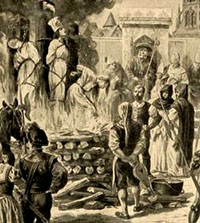 In
a letter dated 1545 the Catholic missionary, St. Francis Xavier
asked King John III of Portugal for an Catholic Inquisition
to be established in Goa, in Portuguese India. The Goa Inquisition
was established in 1560 with jurisdiction over Goa and the rest
of the Portuguese empire in Asia. In
a letter dated 1545 the Catholic missionary, St. Francis Xavier
asked King John III of Portugal for an Catholic Inquisition
to be established in Goa, in Portuguese India. The Goa Inquisition
was established in 1560 with jurisdiction over Goa and the rest
of the Portuguese empire in Asia.
Some, perhaps most, Hindus and Moslems who had converted to
Christianity had done so for non-religious reasons. The starving
might accept conversion in exchange for food. Others were attracted
by social standing in Portuguese society, others by "protection"
offered by the Church. Those attracted by food were known as
"rice Christians". Orphans were indoctrinated. Others
were discriminated against if they failed to convert. The Catholic
Church was disturbed by the fact that many converts decided
on reflection to continue practising their original faith, just
as many Jewish and Moslem converts did in Spain and Portugal.
The Church considered such people apostates, Christians guilty
of the serious crime of abandoning their faith. The Inquisition
was established to punish exactly such apostate Christians.
Naturally the Goa Inquisition followed the same practices as
its parent organisation.
The inquisition was headed by a judge from Portugal. He was
answerable to (and only to) the General Counsel of the Lisbon
Inquisition. He handed downunishments in line with the Rules
that governed that Inquisition. As in the Iberian peninsula,
the Inquisition was used an instrument of social control, a
vehicle for appropriating property and a mechanism for enriching
Inquisitors. Inquisition proceedings were conducted in secret.
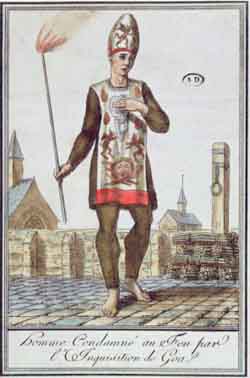 The
Inquisition proceeded against not only apostate converts, but
apostate descendants of converts, and indeed Christians who
retained non-Christian practices, who broke prohibitions against
the observance of Hindu or Muslim rites, or who interfered with
Portuguese attempts to convert non-Christians. Sephardic Jews
living in Goa, who had fled the Iberian Peninsula to escape
the Spanish Inquisition, were also persecuted. The
Inquisition proceeded against not only apostate converts, but
apostate descendants of converts, and indeed Christians who
retained non-Christian practices, who broke prohibitions against
the observance of Hindu or Muslim rites, or who interfered with
Portuguese attempts to convert non-Christians. Sephardic Jews
living in Goa, who had fled the Iberian Peninsula to escape
the Spanish Inquisition, were also persecuted.
The first inquisitors in Goa, Aleixo Dias Falcão and
Francisco Marques, established themselves in the palace previously
occupied by Goa's Sultan, obliging the Portuguese viceroy to
relocate to a more humble residence. The inquisitor's first
act was to forbid the open practice of the Hindu faith on pain
of death. The narrative of Da Fonseca describes the violence
and brutality of the inquisition. He records the need for hundreds
of prison cells to accommodate the accused.
Autos De fé started almost immediately, for second and
steadfast apostates and heretics. Again, as in Spain and Portugal,
the Inquisition burnt living people at the stake where it could,
and in effigy if it could not. We do not know how many people
were burned alive, because (as elsewhere) Inquisition records
have been lost. Those convicted of lesser crimes were forced
to work in galleys and gunpowder factories.
The Portuguese colonial administration enacted anti-Hindu laws
designed to encourage conversions to Christianity. The public
worship of Hindu gods was made unlawful. Hindus were forced
to assemble in churches to listen to Christian preaching and
supposed refutations of their satanic religion. Laws banned
Christians from keeping Hindus in their employ.
Christian agricultural labourers were forbidden from working
on land owned by Hindus and Hindus forbidden to employ Christian
labourers. Christian palanquin-bearers were forbidden from carrying
Hindus as passengers. Hindus were not allowed to enter the capital
city on horseback or palanquins. Successive violations resulted
in imprisonment.
Portuguese regulation had been oppressive from the beginning,
but they got progressively worse. Fr. Diogo De Borba and his
advisor Vicar General, Miguel Vaz had planned the conversion
of Hindus. Under this plan, in 1566, Viceroy António
de Noronha issued an order which applied to the entire area
under Portuguese rule:
I hereby order that in any area owned by my master, the king,
nobody should construct a Hindu temple and such temples already
constructed should not be repaired without my permission.
If this order is transgressed, such temples shall be, destroyed
and the goods in them shall be used to meet expenses of holy
deeds, as punishment of such transgression.
In 1567, a campaign of destroying temples in Bardez resulted
in some 300 Hindu temples being destroyed. From 1567 on Hindu
rituals were banned including marriages and cremation. Everyone
above 15 years of age was compelled to listen to Christian preaching,
on pain of punishment. In 1583 the army was co-opted to destroy
Hindu temples. Non-Christian holy books were destroyed. Filippo
Sassetti, who visited India from 1578 to 1588 wrote
The fathers of the Church forbade the Hindus under terrible
penalties the use of their own sacred books, and prevented
them from all exercise of their religion. They destroyed their
temples, and so harassed and interfered with the people that
they abandoned the city in large numbers, refusing to remain
any longer in a place where they had no liberty, and were
liable to imprisonment, torture and death if they worshipped
after their own fashion the gods of their fathers.
In 1620, further legislation was passed to prohibit the Hindus
from performing weddings. At the urging of Franciscans, the
Portuguese viceroy forbade the use of Konkani in 1684. He decreed
that within three years, the local people should speak the Portuguese
tongue and use it in all their dealings in Portuguese territories.
The penalties for violation was be imprisonment. . The same
decree provided that all the non-Christian symbols along with
books written in local languages should be destroyed. This decree
was confirmed by the King of Portugal three years later.
|
A procession by the inquisition in Goa
- Dominicans in the lead, victims in sanbenitos behind.
From Picart's 'The Ceremonies and Religious Customs
of the Idolatrous Nations' (English version, London,
1733-38)
|
|
|
In the laws and prohibitions of the inquisition in 1736, over
42 Hindu practices were prohibited, including the wearing of
ponytails, greeting people with Namaste, wearing sandals, and
even removing one's slippers on entering a church. Many restrictions
were purely cultural, not religious. Traditional musical instruments
and singing were prohibited, and were replaced by Western music.
Hindus were renamed when they converted and were not permitted
to use their original names. Converts were expected to adopt
western diets including pork and beef, and to drink alcohol.
These measures were intended partially to prove the converts'
commitment, and partly to help isolate converts from non-Christian
friends and family members. Those who persistently refused to
give up their ancient Hindu practices were declared apostates
or heretics and condemned to death. Restrictions on the local
language were also tightened. In 1812, the Archbishop of Goa
decreed that Konkani should be restricted in schools. In 1847,
this prohibition was extended to seminaries. In 1869, Konkani
was completely banned in schools. Konkani became the lingua
de criados ("language of servants").
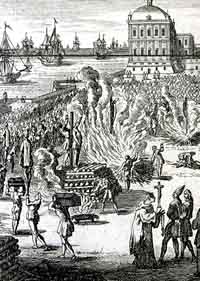 The
Inquisition also persecuted local Jews and Syrian Christians
in Kerala, representatives of an early Christian tradition older
than Roman Catholicism, that survives today as the Jacobite
Christianity. In 1599 the Synod of Diamper authorised the forceable
conversion of the "Syriac Saint Thomas Christians"
on the grounds that they were Nestorian heretics. Assassination
attempts were made against Syriac Church leaders. Every known
item of Syriac literature was burnt. Syriac altars were pulled
down to make way for Catholic altars. Syriac Christians later
swore the Coonan Cross Oath, severing relations with the Catholic
Church. The
Inquisition also persecuted local Jews and Syrian Christians
in Kerala, representatives of an early Christian tradition older
than Roman Catholicism, that survives today as the Jacobite
Christianity. In 1599 the Synod of Diamper authorised the forceable
conversion of the "Syriac Saint Thomas Christians"
on the grounds that they were Nestorian heretics. Assassination
attempts were made against Syriac Church leaders. Every known
item of Syriac literature was burnt. Syriac altars were pulled
down to make way for Catholic altars. Syriac Christians later
swore the Coonan Cross Oath, severing relations with the Catholic
Church.
Voltaire said of the Goa Inquisition, that "The Portuguese
monks made us believe that the people worshiped the devil, and
it is they who have served him".*.Historian
Alfredo de Mello describes the Christian orders of Goan inquisition
as nefarious, fiendish, lustful, and corrupt, a view in line
with the views of a number of European visitors to Goa between
1560 and 1812 who recorded their experience in books and letters.
Most of the Goa Inquisition's records were destroyed after
its abolition in 1812, so it is impossible to establish the
number of Hindus, Moslems, Jews, non-Catholic Christians and
others put on trial, nor the numbers burned alive or otherwise
punished. A legacy of bitterness about Catholic attrocities
continues to the present day, witnessed by a number of books
on the topic published in India.
The Konkani language received official recognition in 1987
when the Indian government recognised it as the official language
of Goa.
The Roman Inquisition
The Roman Inquisition, more correctly the Congregation
of the Inquisition, was set up in 1542 by Pope Paul III
to help eradicate Protestantism from Italy. It was composed
of cardinals, one of whom had proposed its establishment in
the first place. He later became Pope himself, taking the name
Paul IV. A keen opponent of the free exchange of ideas, he enjoys
the distinction of having put even his own writings on the Index.
 Procedures
of the Roman Inquisition were no more just than those of earlier
inquisitions, and executions became more common than in Spain.
Freethinkers and scientists were added to the existing categories
of victim for torture and execution. It was this inquisition
that was responsible for burning the foremost philosopher of
the Italian Renaissance, Giordano Bruno, in 1600; and for inducing
the foremost scientist, Galileo, to recant under the threat
of torture. Procedures
of the Roman Inquisition were no more just than those of earlier
inquisitions, and executions became more common than in Spain.
Freethinkers and scientists were added to the existing categories
of victim for torture and execution. It was this inquisition
that was responsible for burning the foremost philosopher of
the Italian Renaissance, Giordano Bruno, in 1600; and for inducing
the foremost scientist, Galileo, to recant under the threat
of torture.
Book burning was as popular as elsewhere, but political repression
added a new dimension. This persecution too continued for centuries,
until the papacy became too far out of step with the rest of
Western Christendom. Eventually the Church decided to change
its ways, or at least give the appearance of changing them.
Pope Pius VII purported to forbid the use of torture in 1816,
although in practice it continued to be used for decades to
come. Public burnings became something of an embarrassment too.
The answer was not to abandon executions but to carry them out
more discreetly. Pius IX, in an edict of 1856, sanctioned "secret
execution". In the Papal States things had changed little
since the Middle Ages — it was for example still a crime
to eat meat on a feast day. Political trials were conducted
by priests, whose power was absolute. Again, the accused were
not permitted legal representation, nor were they allowed to
face their accusers. All this came to an end only in 1870, when
the Papal States were seized. The last prisoners of the Inquisition
were released , and the Pope became a self-confined prisoner
in his own palace.
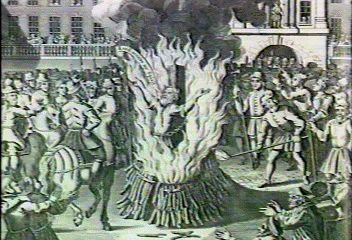 In
1908 the Holy, Catholic and Apostolic Inquisition changed
its name to the Holy Office. In 1967 it changed it
again, this time to the Congregation for the Doctrine of
the Faith. It still functions from a large building near
the sacristy of St Peter's in Rome. Since 1870 its dungeons
have been converted into offices. Despite the name change, there
is no apparent embarrassment about its history. On the contrary
it still conducts heresy trials according to rules that breach
what are elsewhere regarded as elementary rules of natural justice. In
1908 the Holy, Catholic and Apostolic Inquisition changed
its name to the Holy Office. In 1967 it changed it
again, this time to the Congregation for the Doctrine of
the Faith. It still functions from a large building near
the sacristy of St Peter's in Rome. Since 1870 its dungeons
have been converted into offices. Despite the name change, there
is no apparent embarrassment about its history. On the contrary
it still conducts heresy trials according to rules that breach
what are elsewhere regarded as elementary rules of natural justice.
Despite the methodical destruction of Church torture chambers
in modern times there is still evidence of their existence —
not only medieval records but the testimony of early penal reformers
like John Howard (1726—1790 ). Other reliable witnesses
also recorded the horrors they encountered. The Victorian architect
who saved the Cité of Carcassonne found not only chains
in the bishop's prison, but human bones still attached to them*.
Museums throughout Europe display instruments of torture carefully
designed to inflict the maximum of pain over prolonged periods
without shedding blood (a Papal requirement).
Because so many records have been lost, no one knows how many
men, women and children were tortured or burned to death over
the centuries by the various inquisitions. Similarly undetermined
is the number of families dispossessed, children orphaned, communities
destroyed. All we can say with certainty is that the pain and
suffering that was caused is incalculable. Even sources sympathetic
to the Roman Church accept estimates in excess of nine million.
One irony is that the Medieval, Spanish and Roman Inquisitions
would all have burned Jesus as a persistent heretic if he had
appeared before them. They might each have done so on different
grounds: for example for advocating absolute poverty, for practising
Judaism, and for criticising St Peter.
|
|
|
|
|
|
|
|
|
|
|
|
|
|
|
|
|
|
|
|
|
|
|
|
|
|
|
|
|
|
|
|
|
|
|
|
|
|
Buy the Book from Amazon.com
|
|
|
|
|
|
Buy the Book from Amazon.co.uk
|
|
|
| |
| |
| More Books |
|
|
|




.jpeg)